
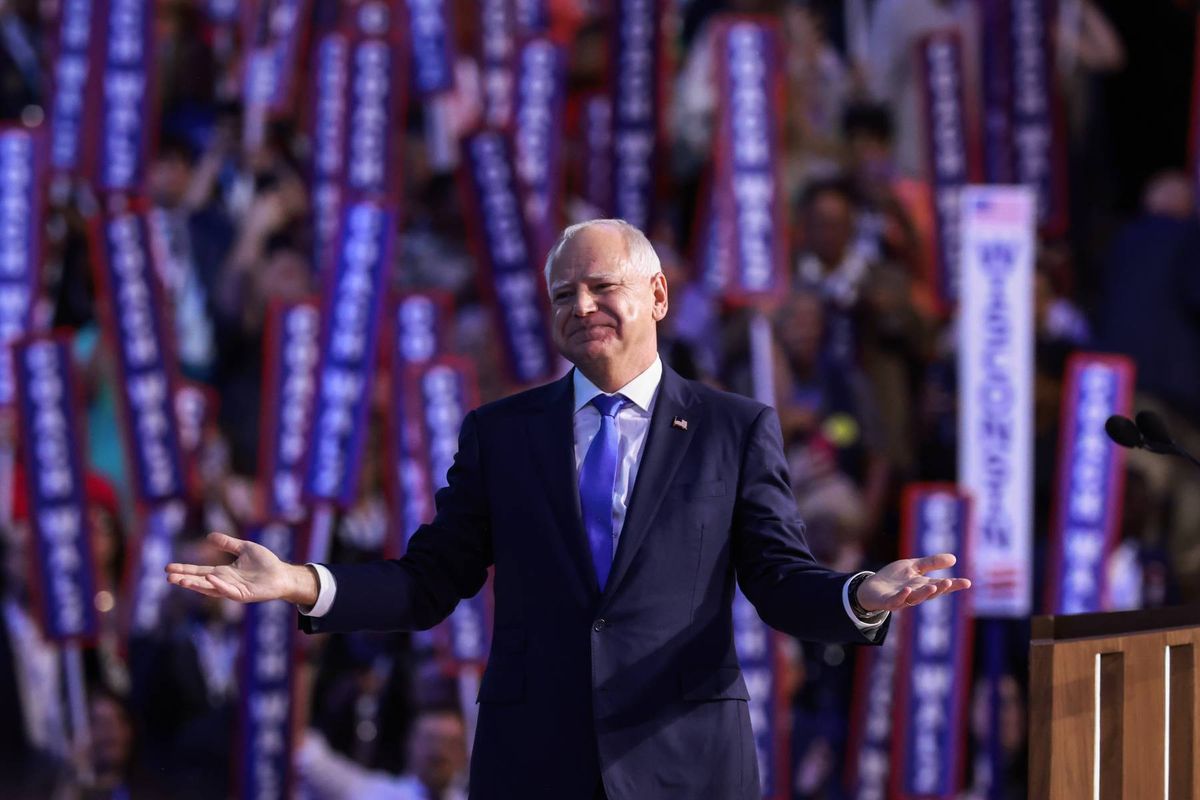
Minnesota Governor Tim Walz took the stage at the Democratic National Convention on Wednesday, where he officially accepted the vice presidential nomination in front of a raucous audience in Chicago’s United Center.
“It is the honor of my life to accept your nomination as vice president of the United States,” Walz declared to deafening cheers within the arena. Walz spoke in front of a sea of “Coach Walz” signs, and used several football metaphors throughout his speech, which came shortly after a member of the high school team he coached spoke at the convention, backed by several other players from the team.
As has become a common occurrence in Walz’s campaign speeches, he framed his address to the convention around the concept of neighborliness.
“Growing up in a small town like that, you learn how to take care of each other,” he said. “That family down the road, they may not think like you do, and they may not pray like you do. They may not love like you do. But they are your neighbors. And you look out for them. They look out for you.”
“Everybody belongs,’ Walz said. “Everybody has a responsibility to contribute.”
The speech was joyous, rousing, and emotional. Walz spoke about how it took him and his wife Gwen years to conceive. They were ultimately able to with the help of fertility treatments. “Hope, Gus, and Gwen: you are my entire world and I love you,” Walz said, fighting back tears and gesturing to his family in the audience, who were in tears themselves.
But while Walz brought emotion into the arena, he pulled no punches in discussing the 2024 Republican platform.
“Some folks just don’t understand what it takes to be a good neighbor,” Walz said. “Their Project 2025 will make things much much harder for people who are just trying to live their lives.”
“They spend a lot of time pretending they know nothing about this but I have taught high school football long enough to know — and trust me on this — that when somebody takes the time to draw up a playbook, they are going to use it,” he added. “It is an agenda that serves nobody except the richest and most extreme amongst us. It is an agenda that does nothing for our neighbors in need, and is it weird? Absolutely. Absolutely. But it is also wrong and dangerous.”
Walz contrasted his criticism of Republicans with his and Harris’ vision for the nation. “If you are a middle-class family or a family trying to get into the middle class, Kamala Harris will cut your taxes,” he said. “If you are getting squeezed by prescription drug prices, Kamala Harris will take on big pharma. If you are hoping to buy a home, and she will help it to be more affordable. No matter who you are, Kamala Harris will stand up and fight for your freedom to live the life that you want to lead.”
Walz, just weeks ago a relatively unknown governor, has skyrocketed into the public consciousness as the dark horse contender to become Harris’ running mate. Walz — a former high school teacher and 24-year veteran of the National Guard — entered politics much later in life than your stand issue politico. His working-class credentials, down-to-earth attitude, and Midwestern dad charm made him a viral sensation among Democrats.
“You know, I haven’t given a lot of big speeches like this one in my life,” Walz said on Wednesday. “But I’ve given a lot of pep talks. So let me finish with this: Team, it’s the fourth quarter. We’re down a field goal. But we’re on offense. We’re driving down the field. And, boy, do we have the right team to win this. Kamala Harris is tough. She’s experienced. And she’s ready.”
Neil Young’s “Rockin’ in the Free World” kicked in as soon as Walz finished speaking, after which he was greeted by his family onstage. CNN reported that Young personally gave the DNC permission to use the song. He has previously sued the Trump campaign for using it.
Walz is an inspirational force, but he’s also an incredibly effective and ruthless messenger against the GOP’s political agenda, and he knows how to communicate progressive policies to centrist voters. He first entered politics by defeating a six-temp Republican incumbent to nab a seat in the House of Representatives, and would hold that seat for six terms himself even as his district voted for Trump in the general election. Walz is credited with slapping the incredibly sticky label of “weird” on Trump, his running-mate Sen. J.D. Vance (R-Ohio), and the GOP at large. The dig is driving conservatives up the wall.
As previously reported by Rolling Stone, the Harris campaign plans to deploy Walz as a “sledgehammer against Vance and Trump” between now and election day.
“We are running against a weird dangerous agenda of taking away people’s rights, monitoring women’s pregnancies, and other insane hurtful bullshit like making Trump a dictator,” one source close to the campaign previously told Rolling Stone. “The antidote to that is a regular guy in Tim Walz — a veteran, football coach, friendly neighbor who helps fix your car, and a really successful governor.”




 commonplace.org






Jack White Responds After Uproar Over Taylor Swift Songwriting Comment