
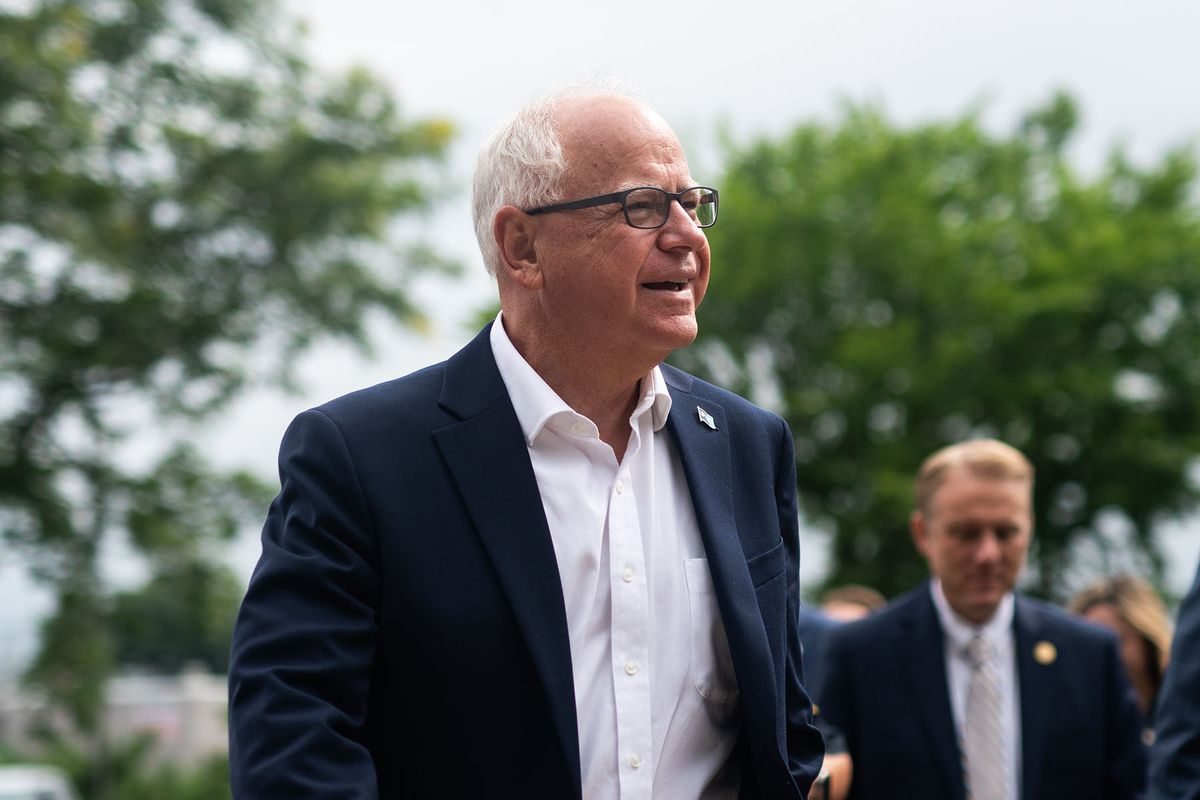
After Vice President Kamala Harris ascended to the top of the Democratic ticket last month, the new nominee was forced to speed-run the usually months-long process of vetting potential running mates. It turned out to be a race between affable white men, and Minnesota Governor Tim Walz came out on top.
“One of the things that stood out to me about Tim is how his convictions on fighting for middle-class families run deep. It’s personal,” Harris wrote in a statement announcing her decision on Tuesday. “We are going to build a great partnership. We are going to build a great team. We are going to win this election.”
Walz is incredibly popular within his own state, one he has successfully governed on a message of economic advancement and progressive policies aimed at helping working families. His salt-of-the-earth charm makes him incredibly hard to hate, as well as an incredibly effective communicator. Walz has been called a “joyful warrior,” and images of him smiling while cuddling a piglet and giggling on carnival rides with his daughter have gone viral amid rumors that he was in the running for a spot on the ticket. But while Walz is the quintessential image of a nice midwestern dad, he’s also an expert in taking Republicans to task, and can be ruthless in his criticism when necessary.
Here’s a small sampling of times when Harris’ new running mate has stuck it to Donald Trump, J.D. Vance, and the Republican Party:
When he started calling Trump and Vance “weird”
Walz has been widely credited with the Democratic shift in messaging to start calling Trump and Vance what they are: weird as hell. He did so in a series of TV hits beginning last month. “These guys are just weird,” he said on MSNBC after tearing apart J.D. Vance’s claims of understanding small-town America apart. “They’re running for he-man women-haters club or something.”
He later explained the line of attack to CNN’s Jake Tapper: “My point on this was that people kept talking about how Trump is going to put women’s lives at risk — that’s 100-percent true. Trump is potentially going to end constitutional liberties that we have and end voting — I do believe all those things are a real possibility. But it gives him way too much power. Listen to the guy. He’s talking about Hannibal Lecter and shocking sharks and whatever pops into his mind. I just think we give him way too much credit.”
When he defeated a six-term Republican incumbent to win his seat in the House
Before he was an elected lawmaker, Tim Walz was an enlisted servicemember, and a high school teacher and football coach. According to Walz, he decided to run for the House in 2004, after several of his students were denied entry to a speech given by former President George W. Bush in his hometown of Mankato, Minnesota, because they had previously volunteered for Democrats.
“While I had a passion for politics, I had never been overly involved in political campaigns, and many people thought that a high school teacher and football coach didn’t stand a chance,” Walz wrote on X in 2020.
In 2006, Walz ran, and he won, defeating six-term Republican incumbent Gil Gutknecht. He would serve six terms himself before running for governor in 2018.
When he dismantled Republican accusations that his policies are “socialism”
“They scream socialism, but we just build roads and schools and prosperity into this,” he told MSNBC before railing against how Trump and Republicans want to go “backwards” and “give tax cuts to the wealthy.”
“I’m all for pulling yourself up by your boot straps, but we didn’t have any boots,” he added. “Social security was the boots and we pulled ourselves up and we paid that back.”
When he exposed the GOP ticket as phonies
“These are weird people on the other side,” Walz told MSNBC. “They want to take books away, they want to be in your exam room. Listen to them speak, listen to how they talk about things. … [Republican leadership] has told [Republicans] that they shouldn’t take about race, but they can’t help it. It’s built into their DNA because they have no plan.”
Walz continued to attack Republican policies before going directly after Trump and Vance. “A robber baron real estate guy and a venture capitalist trying to tell us they understand who we are?” he said. “They don’t know who we are.”
When he and the state legislature passed a bonanza of progressive reforms in Minnesota
Walz won the governorship of Minnesota in 2018 in a blowout election against Republican Jeff Johnson. Initially, it would be an uphill struggle, with Republicans controlling the State Senate during the first years of his term.
In 2023, Minnesota’s Democratic–Farmer–Labor Party secured control of both chambers for the first time in a decade. The result was a progressive legislative tour de force that saw Walz sign into law universal free school meals, protections on reproductive freedoms, child tax credits, paid leave, massive infrastructure packages, universal gun background checks, and much much more.
Walz called the 93rd Minnesota Legislature the “most productive session in Minnesota history,” and “the most supportive of middle class and working people that we’ve ever seen.”
As Harris embarked on her search for a running mate, there’s no doubt that Walz’s accomplishments in his state heavily tipped the scales in his favor.
When he spoke very candidly about his feelings on Trump
“How often in 100 days do you get to change the trajectory of the world,” Walz said of the renewed effort to take down Trump. “How often do you get to do something that’s going to impact generations to come. How often do you make that bastard wake up and know that a Black woman kicked his ass and sent him on the road.”
When he was a Midwestern dad — in the best way possible
Walz is more relatable than everyone in the GOP combined.
When he defended Harris taking over the ticket and made clear the GOP is stuck with Trump
“Democrats are ready to move when the situation warrants it,” he said on Fox News. “It doesn’t matter conviction, it doesn’t matter the failed policies, the Republican Party is stuck with Donald Trump. He’s yours, you’ve got him, welcome to it. The Democratic Party can make our decisions and pick our nominee. If you don’t like it, don’t vote for it in November.”
When he explained that the American dream is for everyone
“When someone else has rights, it’s not like a damn pie,” Walz said. “Rights aren’t that way. There’s enough for everybody. Same thing with jobs. Same thing with housing. Same thing with health care.”
“Yes, they’re a threat,” he continued, speaking about Trump and Republicans, “but we’re not going to stay in their frame, we’re not going to stay where they’re at, we’re not going to play their game. We called them out for the weird nonsense they believe and we presented a different argument to the American public, one where everybody matters, one where we can achieve, one where we solve problems.”




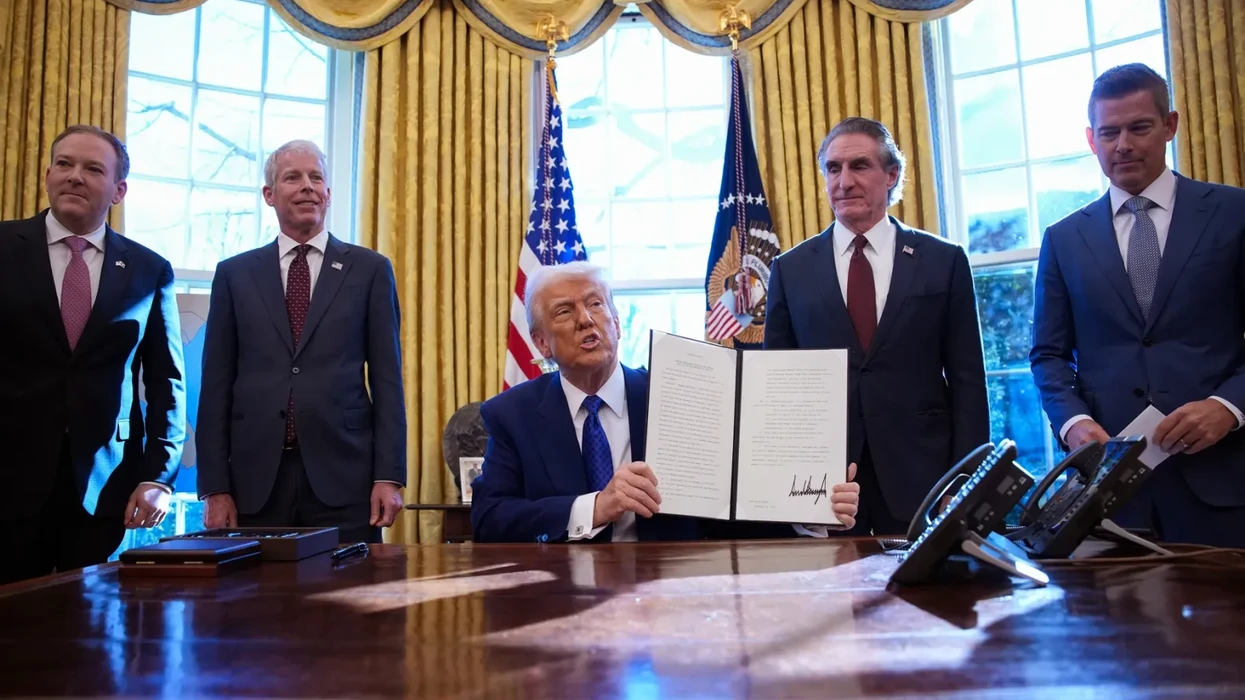

President Donald Trump discussing Venezuela at a press conference at Mar-a-Lago.
Why Venezuela Could Be a Turning Point in Gen Z’s Support for Trump
When Donald Trump called himself “the peace president” during his 2024 campaign, it was not just a slogan that my fellow Gen Z men and I took seriously, but also a promise we took personally. For a generation raised in the shadow of endless wars in Iraq and Afghanistan, it felt reassuring. It told us there was a new Republican Party that had learned from its failures and wouldn’t ask our generation to fight another war for regime change. That belief stood strong until the U.S. overthrew Venezuelan President Nicolás Maduro.
Growing up in the long wake of the wars in Iraq in Afghanistan shaped how my generation learned to see Republicans. For us, “traditional” Republican foreign policy became synonymous with unnecessary conflicts that caused young people to bear the consequences. We heard how Iraq was sold to the public as a necessary war to destroy weapons of mass destruction, only to become a long conflict that defined the early adulthood of many millennials. Many of us grew up watching older siblings come home from deployments changed, and hearing teachers and coaches talk about friends who never fully came back. By the time we were old enough to pay attention, distrust of Bush-era Republicans wasn’t ideological, it was inherited from what we had heard.
As the 2024 election was rolling around, that dynamic had flipped. After watching wars in Ukraine and Gaza dominate headlines while Joe Biden was president, the Democrats were now the warmongers. My friends constantly told me how a vote for Kamala Harris was a vote to go to war. On the other hand, Donald Trump and the Republicans were the ones my friends thought could keep us safe. “I’m not voting for Trump because I love him,” one friend told me. “I’m voting for him because he cares about us and I don’t want to go fight in a stupid war.” For many of my friends, much of their vote came down to one question: Who was less likely to send us to fight? The answer to them was pretty clear.
Fast forward to now, and Venezuela has begun to complicate that belief. Even without talk of a draft or a formal declaration of war, the renewed focus on U.S. involvement and troops on the ground has brought back the same language of escalation my generation was taught to distrust. Young men online have been voicing the same worries, concerned that the ousting of Maduro mirrors the early stages of wars they were raised to fear. When I asked a friend what he thought about Venezuela, he shared that same sentiment. “This is how all these wars always start,” he told me. “They might try to make it sound like it’s not actually a war, but people our age always end up being the ones that pay the price for it.” For young men who supported Trump because they believed he represented a break from interventionist politics, Venezuela blurs the line between the “new” Republican Party they thought they were backing and the old one they were raised to reject.
For many young men, Venezuela has become a major part of a broader shift of how they view Trump. A recent poll from Speaking with American Men (SAM) found that Trump’s approval rating has fallen 10 percent among young men, with only 27 percent agreeing with the statement that Trump is “delivering for you”.
Gen Z men’s support of Trump was never about ideology or party loyalty, it was about the idea that he had their back and would fight for them. But that’s no longer the case. Recently, Trump proposed adding $500 billion to the military budget. Ideas like that will only hurt the president with young men. My friends don’t want more military spending that could get us entangled in foreign wars; they want a president who keeps them home and fights for their economic and social needs. As Trump pushes for a bigger military and more intervention abroad, the promise that once made him feel like a protector of young men now feels out of reach.
For my generation, Venezuela isn’t just another foreign policy dispute, it’s a conflict many young men worry they could be the ones sent to fight. Gen Z men didn’t support Trump because he was a Republican, but because they believed he was different from the old Republicans. He would be a president who would have their back, fight for their interests and keep them from fighting unnecessary wars. Now, that promise feels fragile, and the fear of being the ones asked to face the consequences has returned. For a generation raised on the effects of the wars in Iraq and Afghanistan, the idea of another war isn’t abstract, it’s personal.