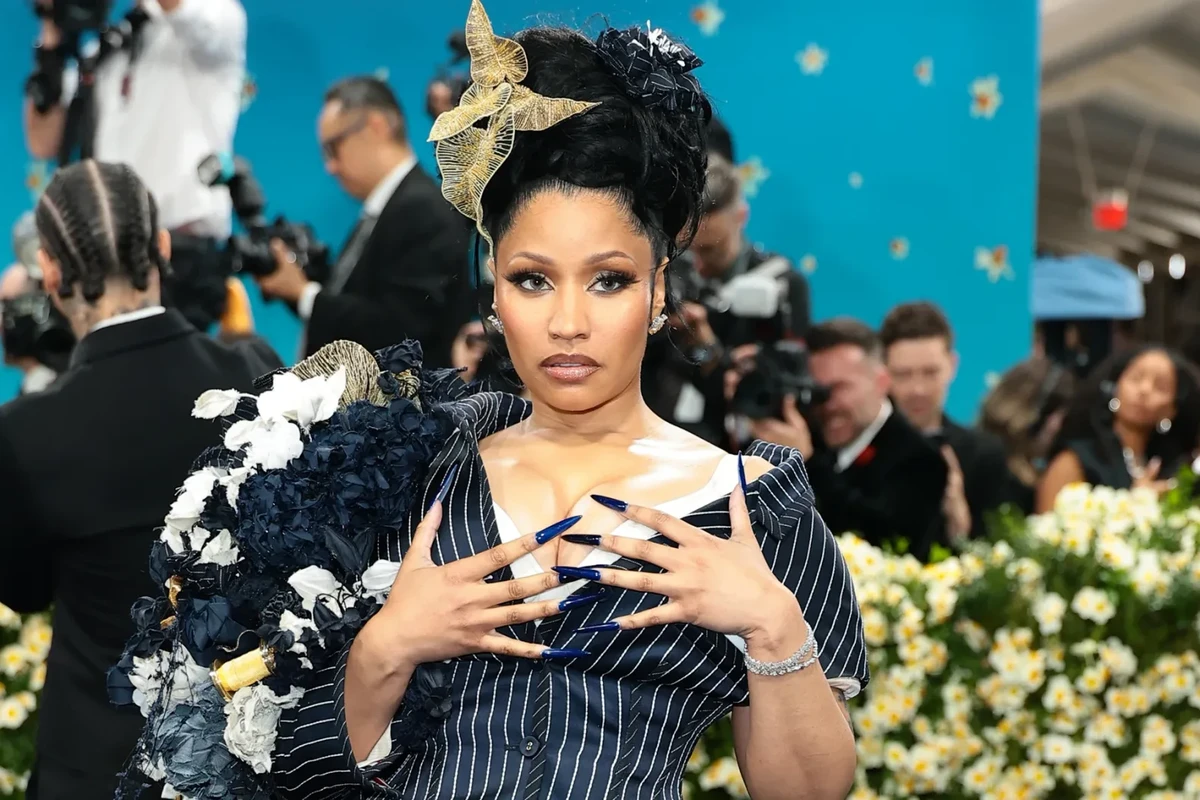

Nicki Minaj has avoided the sale of her $20 million Hidden Hills mansion to pay the $500,000 default judgment that a security guard won after suing the “Starships” rapper and her husband over his alleged assault at a concert in Germany.
“She has satisfied the judgment,” the guard’s lawyer, Paul Saso, tells Rolling Stone. “It required us going to the one-yard line.”
Saso confirmed the agreement just as Los Angeles Superior Court Judge Cindy Pánuco was on the brink of entering a blockbuster decision to sell the home at a hearing on Thursday afternoon. Plaintiff Thomas Weidenmuller nearly won the ruling in November, but he faced a delay because he lacked a bank statement detailing Minaj’s payments on her $13.3 million mortgage and the daily interest accrual. The judge said that if the house didn’t fetch the expected price, she would need to confirm that a lower sale price would still be sufficient to satisfy all liens and levies.
When Saso informed the court of the “eleventh-hour development,” Judge Pánuco seemed relieved. She thanked him for his patience and diligence. “I wanted to make sure we got this right. It was a big thing. I’m glad this was resolved in a way that makes sense for all of the parties,” the judge said.
Outside the courthouse, Saso said his client was relieved as well. “He’s incredibly gratified and happy. It’s been a long time coming to have justice finally done here,” the lawyer said. “He’s very happy for himself. He suffered a very heinous attack, years ago, and not only did it take years to achieve the judgment, but it then took nearly two years in order to enforce that judgment.” The lawyer said he never expected the case to require that he “put a levee on a multimillionaire’s house, and go to the last 24 hours before she decides to satisfy the judgment.”
Saso said he hopes the resolution will be a turning point for the controversial musician who recently drew backlash for calling former CNN anchor Don Lemon a homophobic slur over one of his reports on protests in Minneapolis. She also bashed California Gov. Gavin Newsom in a series of X posts last month after he made a statement supporting trans youth.
“She has been very vocal online recently and demeaning to various types of people, and she’s certainly been very vocal about her thoughts on the gay and trans community,” Saso said. “I’m happy that this case has helped her transition – transition from a person who avoids responsibility to someone who is being forced to take responsibility. And my hope is that it helps her transition from a person of violence to a person of peace.”
Weidenmuller filed his application for the order last October, telling the court he tried to enforce his default judgment through less extreme measures, but Minaj and her husband, Kenneth Petty, hadn’t responded. He said attempts to garnish payments flowing to Minaj proved futile, claiming seven “potential garnishees” either failed to respond or claimed they had no accounts payable to the singer.
Minaj’s eight-bedroom luxury home has a $13,258,000 mortgage lien, and Minaj, as the sole owner, would have been entitled to a $722,151 homestead exemption, the application said. With the home recently appraised at $20 million, a sale was expected to yield approximately $6 million in funds once the lien and exception were paid.
The application described Minaj as a global music superstar with an estimated net worth of at least $150 million. “There is little doubt that she is highly capable of paying the judgment in full, and yet, she has refused to do so despite multiple written requests for payment and levies served upon several of her suspected creditors,” the filing said.
Weidenmuller filed his underlying lawsuit in January 2022. He claimed Petty ambushed him from behind and sucker punched him in the face because he was upset Weidenmuller had stepped in to defend a female security guard during a dispute with Minaj backstage at a 2019 concert in Frankfurt.
According to Weidenmuller, Minaj had blamed the female guard for allowing a fan to breach a barricade and climb onstage with her. Minaj berated the female guard while recording the exchange. Weidenmuller says he intervened to warn Minaj the guard’s career might be “ruined” if Minaj shared the video. In response, Minaj allegedly threw a shoe at Weidenmuller but missed. Petty then accused Weidenmuller of disrespecting Minaj and allegedly punched Weidenmuller in the face, leaving him “stunned and disoriented,” the lawsuit claimed.
“I felt a blinding pain in my head, neck, face, and jaw. I could tell in that instant that something was seriously wrong with my jaw,” he wrote in a court filing. Weidenmuller said medics called an ambulance to take him to a hospital, where he underwent the first of several surgeries and remained for 10 days.
“I now have five plates in my jaw, and my jaw has not yet been fully reconstructed. The doctors must still insert implants into my jaw as a part of the reconstruction process. In the interim, the doctors have inserted donor bones from a deceased person into my mouth in order to preserve space for the future implants,” he wrote in a sworn statement.
Weidenmuller previously asked for around $21,000 to cover medical bills and $700,000 for his ongoing injury along with pain and suffering. The judge trimmed it down to $503,318 when she awarded the money under a default judgment because Minaj and Petty never responded to the lawsuit.
The German security guard and his lawyers told the court they made repeated attempts to serve Minaj and Petty with the lawsuit but were never successful. They mailed copies and sent a process server to the couple’s gated community just west of Los Angeles, but never made contact. They eventually published the summons in a newspaper.
A rep for Minaj and Petty did not respond to a request for comment from Rolling Stone. The couple married in 2019 and welcomed a son a year later. Petty, 47, remains a defendant in a sexual assault lawsuit filed in Brooklyn federal court by Jennifer Hough, the woman at the center of Petty’s 1994 attempted rape conviction.
Minaj has sparked controversy for other reasons beyond her social media posts. The “Barbie World” singer made a surprise appearance at Turning Point USA’s AmericaFest as Erika Kirk, the conservative activist and widow of TPUSA founder Charlie Kirk, gushed over Minaj’s anti-Newsom tweets. Minaj then professed her “love” for President Donald Trump and Vice President J.D. Vance. She later called for Lemon’s arrest over his coverage of an anti-ICE protest at a Minnesota church, leading the now-independent journalist to label her “ignorant.”
“She doesn’t understand politics. She doesn’t understand journalism,” Lemon said. “And I’m not surprised that she is weighing in on something that is beyond her capacity.”









‘Karma’s a Bitch’: Boy George on Why Culture Club Recreated Their Biggest Hit With AI
More than 40 years after its original release, Boy George and Culture Club have rerecorded their chart-topping hit, “Karma Chameleon,” using AI to recreate the vocal characteristics of the original 1983 recording. Alongside digital formats, the release will be available on vinyl in red, gold and green, the colors referenced in the song, featuring reimagined cover art. The rerecord marks the launch of Artist Included, a music technology company co-founded by Boy George’s manager, Paul Kemsley, and entertainment attorney and film producer Jeremy Rosen. Boy George serves as creative director.
Asked why he decided to recreate the song, Boy George has a simple answer: “Control!,” he tells Rolling Stone. “Having some say over where it goes. ‘Karma Chameleon’ is a secret weapon. It’s a song you starve the audience for because they want to hear it, and live, it’s always been a real pleasure to sing it. But in terms of what it does commercially, it’s like having something really powerful with your name on it, and you have no say about where it goes.”
The idea for the rerecord was prompted by a commercial sync license for “Karma Chameleon” involving Richard Branson for Virgin Voyages. Culture Club signed to Branson’s Virgin Records in 1982, and Boy George has maintained a close relationship with the entrepreneur ever since. According to Kemsley, Branson paid approximately $4 million for the deal ($2 million of which went to the master recording rights holders), while Boy George received only an appearance fee because he has never owned the masters for his biggest song.
“Karma’s a bitch,” Boy George states. “When we wrote that song, we weren’t looking 40 years ahead. We weren’t thinking of longevity. That song, because of the context of when it was recorded, the social feeling has stayed with people. It’s become part of people’s lives. Having control over it again, to a certain extent, is very exciting.”
The rerecord has a warmer vocal tone and sits slightly lower in the mix than the original, but is faithful enough to it that it plays like a remaster. The rerecording was produced by JJ Blair and Culture Club’s guitarist Roy Hay with additional production by song’s original producer, Steve Levine. Prior to the session, the AI was trained using archival demos licensed from Levine who had preserved them for decades. The instrumentation was newly recorded by Hay, Culture Club bassist Mikey Craig and session musicians. Only the vocal performance is AI-assisted.
“When I went into the studio to record it, I was like a pub singer imitating myself,” says Boy George. “You listen to where you pace things [sings the first line of ‘Karma Chameleon’]. You listen to where you put the voice: in your nose or your throat or chest. What you do instinctively as a 22-year-old, you don’t do as a 40-year-old or a 65-year-old. There’s a clipped way of singing it, which you forget through playing it live so many times. It was very European-sounding and youthful. I’ve taken it somewhere much more blues-y over the years, dragging out the notes. It’s about the nuance. When you sing something live over 40 years, it changes shape. It’s interesting to take it back to the original recording and recapture that feeling.”
Getting close to the original vocal is a hurdle for most musicians whose voices change over time. It took 18 months for Artist Included’s AI to work out the kinks. In the first iteration, Boy George sounded like “Pinky and Perky, two pigs on helium in a cartoon,” says Kemsley, referring to a children’s television series where the titular characters sing in high-pitched, fast-paced voices. The technology is now refined, and the plan is to rerecord Culture Club’s and Boy George’s entire back catalogs. Kemsley claims this will take two weeks, or as long as it takes Boy George to sing every song.
“I was a naysayer,” admits Boy George. “I was like, ‘This will never work.’ But I actually prefer this version [of ‘Karma Chameleon’]. For me, as the person that sang it originally, and re-sang it, what I love about this version, it has the sound of that time, but the warmth and experience and integrity of everything I’ve learned in my life.”
Kemsley, who has managed Boy George since 2014, frames the project as an attempt to rebalance longstanding industry economics. “This record has been making millions of dollars for [almost] 45 years, and George hasn’t,” says Kemsley. “The whole thing seems terribly unjust. You sign your life away at the age of 22, then have to wait 35 years to get the reversions, but you still don’t get any master recording income. Over the years, bands try to get their masters back and they never get them, with the major labels claiming they are work-for-hire.”
To put this in context, a record company often owns or controls master recording rights, a term stipulated when it signs an artist. That covers the music; the lyrics and composition are an entirely separate right known as publishing, which, by contrast, follows the composition, and therefore the song through every new recording. As a result, rerecords create a new master recording, and can benefit publishing by re-engaging the artist and generating renewed interest in the underlying work.
When it comes to rerecords, many artists are restricted to a certain length of time during which they are forbidden from releasing a new, faithful version to the original. Longstanding artists sometimes use Section 203 of the U.S. Copyright Act to reclaim rights to their masters after 35 years. They are rarely successful, as record companies often argue the masters were created as work made for hire.
The way Artist Included is structured, the artist receives the lion’s share of revenue. “The industry I was in no longer exists,” Boy George points out. “Artists like me are expected to carry on following that model. I haven’t done that for years. I used to say I’m the only person who realizes the ‘80s are over. You want to keep the spirit of that moment to some extent, but you move on. AI is not going anywhere, so having that conversation is exciting. And being ahead of the game in terms of how people use it, is also quite exciting for me.”
Considering Culture Club’s acrimonious split with their former drummer, Jon Moss, which resulted in a hefty settlement, rerecords of their songs also have the benefit of bypassing the need for his approval to use the original master recordings, which have four-way songwriting credit between its members.
“He still gets something from it,” clarifies Boy George. “Jon is a part of what we did [originally as a band].” But Kemsley is quick to point out that Moss is not a part of what they’re doing now with the rerecords, and is not entitled to any percentage of it. The band will see an increase in publishing, and as a credited songwriter, Moss will continue to receive publishing income, while the new master revenues do not involve him.
The next song queued up for rerecord is another signature Culture Club hit, “Do You Really Want to Hurt Me,” and Artist Included’s AI is primed, having retained Boy George’s voice for training purposes. The company has also been in conversations with publishing companies and other artists, mainly from the Eighties and Nineties, though no names are being disclosed yet. Kemsley says the conversations have not been a hard sell.
“People will react to what they see and hear,” says Boy George. “It’s much more powerful when people see it released and see what can happen.”
Kemsley notes Boy George turns 65 the day before the release of the new “Karma Chameleon,” which is the retirement age in the UK. “We’re not retiring,” Kemsley clarifies. “Far from it. We’re going back to the beginning, and we’re going to do it all again. We’re going to change the way revenue flows through to the artist. And we’re going to have some real fun with it.”