
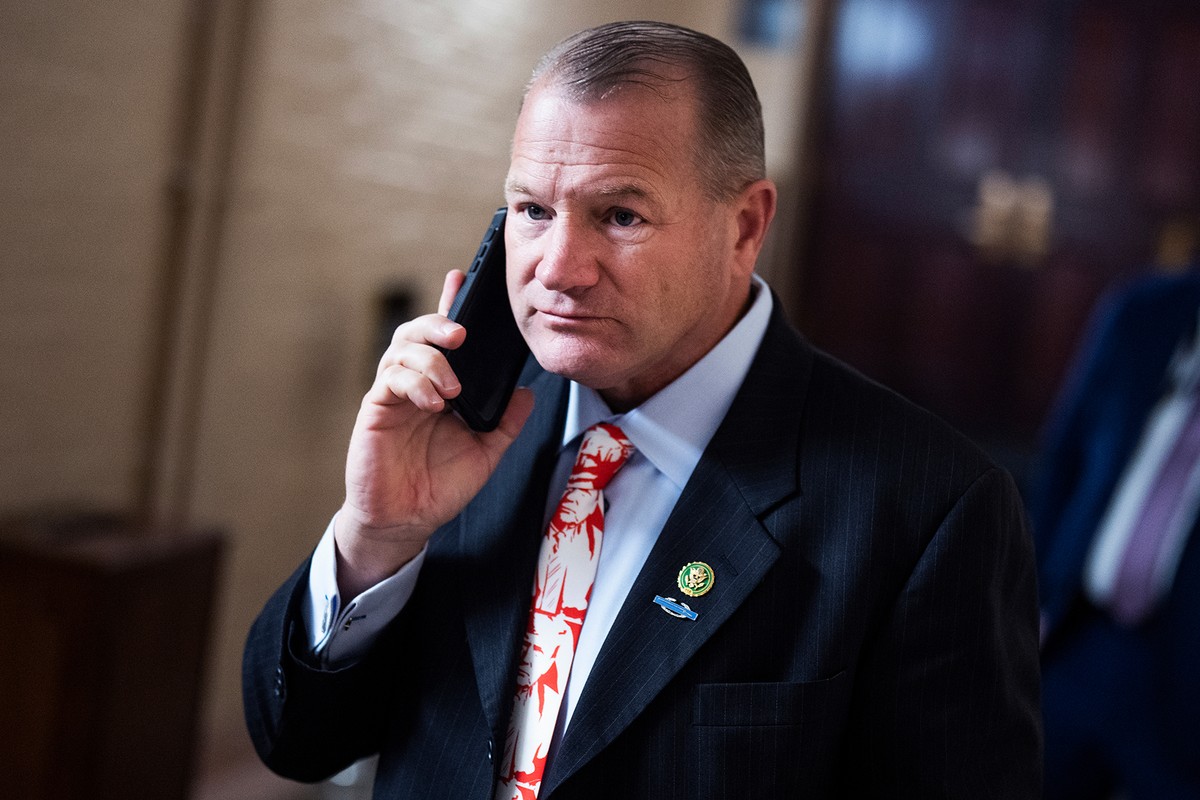

Republican lawmakers are not happy with a Texas representative who continues to wear a military pin he didn’t earn — and over a year after the Army revoked it.
Rep. Troy Nehls (R-Texas), an ardent supporter of former President Donald Trump, is facing allegations of “stolen valor” as he continues to wear a Combat Infantryman Badge pin on his suit jacket, despite the Army revoking the pin in March 2023.
“It’s really shameful,” a military veteran Republican lawmaker told NOTUS. “It speaks to deep insecurities. Combat Infantry Badges are given out for combat. He didn’t earn it.”
“If you’re wearing something that’s specifically been addressed as something you can’t wear, that is stolen valor,” another Republican lawmaker told the outlet. “It’s specifically addressed in U.S. Code, that particular badge.” Wearing the pin is “illegal and stolen,” the lawmaker said.
Retired Navy SEAL and current Montana Rep. Ryan Zinke added that “as a former commander, it matters what you wear on your uniform,” noting that “if you didn’t earn it, you shouldn’t wear it.”
“That’s ridiculous, that’s stolen valor,” said Rep. Wesley Hunt (R-Texas), who wears the Combat Action Badge himself.
The badge in question is only awarded to Infantry or Special Forces personnel who are engaged in combat. Nehls never saw combat when he served as a Civil Affairs officer in Afghanistan and Iraq, thus making him ineligible for the pin. Still, he continues to wear the pin on his suit lapel on the daily, just under his pin for the 118th Congress.
Nehls’ military feats first came under scrutiny after a CBS News investigation in May revealed that the Pentagon rescinded his Combat Infantryman Badge because of his deployment as a Civil Affairs Officer. In 2006, he was retroactively awarded the Combat Action Badge, which is for Army soldiers who are neither Infantry or Special Forces but are “actively engaging or being engaged by the enemy.”
Whether he was awarded more than one Bronze Star has also come into question. His military record and the Department of Defense say Nehl’s received only one Bronze Star — yet Nehls took to social media to denounce the DOD, writing last month that the department was wrong. “I have two,” he wrote.
“For the doubters,” Nehls continued, posting photos of military documents showing the Bronze Star — the Army’s eight-highest award — was bestowed to him twice, once in 2004 and another in 2008.
Nehls’ press secretary, Emily Matthews, told CBS News that “Congressman Nehls doesn’t wear medals he wasn’t awarded.” His office claims he was not aware of the Pentagon rescinding his Combat Infantryman Badge, despite the Pentagon saying he was made aware in March 2023 when it occurred.
Nehls is one of the House of Representatives’ most vocal Trump supporters. He’s been spotted wearing a shirt emblazoned with Trump’s mugshot, and Rolling Stone reported in December that when Nehls was asked what House Republicans’ hoped to gain from a Joe Biden impeachment inquiry, he yelled: “All I can say is Donald J. Trump 2024 baby!”




Stephen Miller in Washington, D.C., on Oct.21
Stephen Miller Wants to Win Back Young Men. It Might Not Be So Easy
Stephen Miller is not much of a man, at least by the right wing’s increasingly Herculean standards. Gawky, bald, and pasty, Miller has nevertheless ascended during Donald Trump’s second administration, most recently climbing from an advisory role to the lame-duck leader’s chief of staff.
In that role, Axios reports, Miller has one priority: win back America’s young men to the MAGA cause.
The right sees young men as one of its most important demographics, as they have been less susceptible to the overall leftward shift of young people over the past 20 years. But after making massive gains with the group in the 2024 cycle, Trump’s MAGA Man project stumbled, its support drying up faster than the lawn in front of a Texas frat house. In the 2026 midterms, young men swung 38 points in favor of the Democrats compared with how they voted in 2024. Why this happened is a complex puzzle, but the biggest piece in it is clear: American men are sick of war. In Iran, they faced the existential threat that America would revert to the warlike nation that sucked their older brothers’ and parents’ generation into 20 years of futile bloodshed in the Middle East.
Miller appears to have identified this early. The New York Times reported last week that Miller’s pitch to Trump when he was angling for the chief of staff job involved direct advice to wind down the Iran war, which Miller thought — correctly — had alienated supporters he couldn’t afford to lose.
But Iran is only part of the picture. I’ve reported on masculinity in America for years, and the anxieties that young voters face are more holistic than just a fear of being sent to die in a foreign land. That’s part of it, of course — while Generation Z was mostly too young to fight in the peak of the Global War on Terror, plenty of them remember older siblings or parents who spent years away in Iraq or Afghanistan. But what they remember even more were the economic effects of 20 years of American war. For many young men I’ve spoken to over the past few years, their childhood political memories aren’t Clinton getting a blowjob or the all-encompassing trauma of 9/11. Those on the older side remember their parents losing jobs in the 2008 crash; those on the younger side left high school or college and walked right into the Covid pandemic.
Now, with missiles flying over the Persian Gulf, young men see it happening all over again: gas prices going up, food costs rising, and the promise of owning a home and one day retiring slipping even further down the drain, even if they aren’t drafted to fight for a cause they don’t support.
In 2016, and to a much greater extent in 2024, Donald Trump effectively harnessed young men’s anxiety about their place in the world. In both those campaigns, he met men where they were: in 2016 on social media and in 2024 in a new-media world of podcasters and influencers. Both of these places gave a generation of adrift young men a culture they felt at home in — and in Trump, they had a leader there with them.
This had a profound effect. Some young conservatives, at least, still see their futures as directly linked with Trump, likely because the MAGA movement was the first time they’d ever felt a sense of political agency or control. But for those less ideologically linked with Trump, the relationship is more transactional. Sure, young men may get a kick out of Trump shimmying around on TV and talking trash. But what his successful campaigns have done is promise those men something concrete: their prices coming down, their fortunes going up, a leader who will fight for their place in the world. A few years back, at a UFC fight just after Trump was elected for the second time, a pair of twentysomethings told me that they loved that Trump “comes out like a fighter,” which they said “resonates with a lot of people that are hurting.” “When they see a strong figure like that, it gives a sense of hope,” one said.
The difference, now, is that Trump doesn’t represent that hope anymore. And that means Miller has a very, very tall hill to climb. He can’t, as he did in 2024, just tell men to “show that you are not a beta” and vote for Trump. Axios reports that Miller is expected to focus on more of this culture-war chum, cracking down on “woke” policies at schools and offices.
But all of that is window dressing. In the midterms, young men swung toward Democrats in record numbers because that party offered them something: an end to foreign wars, a better shot at the future. Even if Miller is successful and gets Trump to roll back the Iran war, young men aren’t stupid: you barely get credit for “ending” a war that you started in the first place.
Axios reports that Miller also plans to push other economic reforms the Trump administration has mentioned but not delivered on in the past, like prescription-drug prices, but also that they will continue to focus on fraud and eliminating the federal bureaucracy. The latter points sound like a rehash of DOGE, an idea that may have initially sounded good on paper but yielded unclear, if not disastrous, actual results. Still, it’s a sign that Miller has identified some of the core issues he believes lost Trump votes with every demographic, not just young men. Democrats have their own ideas of what Americans voted on this month, though, and heavy majorities in both houses of Congress they can use to push them.
The next two years, then, will determine which party is able to persuade young men that it’s fighting for them. Miller has taken this task upon himself, which Democrats should see as an opportunity. After all, he doesn’t look like that hard of a guy to beat.