
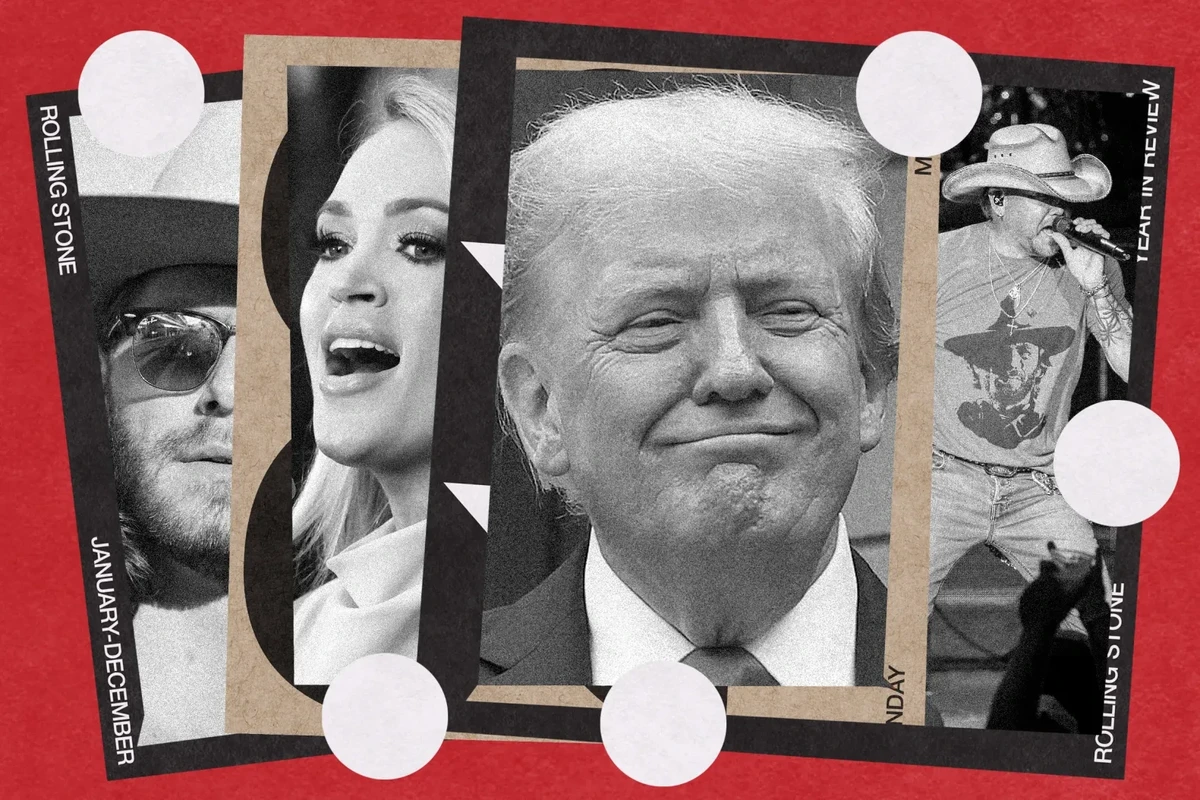

In 2017, the narrator in country hitmaker Chris Janson’s song “Fix a Drink” seemed exhausted by party politics.
“I turn on Fox News and then CNN/But it’s the same dang thing all over again,” Janson sings in the bouncy pop-country tune, looking for a way out of the cultural fray. “The world’s in the toilet and the market’s in the tank/Well, I can’t fix that, but I can fix a drink.”
Janson’s hit single was emblematic of the type of feel-good country music that Nashville churned out during the first few years of the first Trump administration, as the industry grappled with how to address the polarization that the 2016 election had supercharged. The answer was songs primarily about bipartisan, boozy escapism that also preached civility and offered, per one Kenny Chesney single, a breezy roadmap for healing division: “Buy a boat/Drink a beer/Sing a song/Make a friend/Can’t we all get along?” Chesney asked in “Get Along,” a chart-topper.
Eight years later, however, the message being peddled by Nashville’s country music industry shows signs of marked change, just like that of many corporations, universities, op-ed pages, and American institutions from CBS to the CDC. The MAGA movement, emboldened by winning the presidency and both houses of Congress, has gone mainstream in this distinctly reactionary period in American culture. In many cases, embracing MAGA has proven to be good for business too, and Music Row has rushed to get onboard.
Case in point: When Janson was readying a new album to be released during Trump’s second term, he previewed it with “I Don’t Give a Damn,” a song that struck a different tone than that of “Fix a Drink.” “I’m done apologizing/I’m standing for the flag,” the proud Trump supporter sang, before staking an overtly political claim: “The left ain’t right/And the right ain’t wrong.”
“This is exactly the way I feel right now,” he said in a TikTok video.
Janson’s pivot is only one example of the overt MAGA-fication of Music Row, which began to reveal itself immediately following Trump’s second presidential win in 2024: Trump was no longer a figure to shy away from, but one to embrace. In December of that year, right after the election, Jelly Roll chatted with the president-elect and hammed it up with Speaker Mike Johnson at a UFC fight. At Trump’s inauguration the next month, Carrie Underwood sang “America the Beautiful” and Parker McCollum performed Toby Keith’s “Courtesy of the Red, White, and Blue (The Angry American)” at the Commander-in-Chief Ball — and they were two much more mainstream names than that of Keith himself, who was years past his commercial peak when he performed at Trump’s first inaugural alongside Lee Greenwood.
Since then, the floodgates have only opened. Zach Bryan posed for a photo op with Trump at last February’s Super Bowl, Cody Johnson railed against the “No Kings” movement during a June concert (“Protest the protests!” he implored his audience), and the typically apolitical Keith Urban performed at a private Mar-a-Lago function for a Trump donor in November, at which President Trump stopped by.
Meanwhile, upstarts like Warren Zeiders, Gavin Adcock, and Nate Smith have been openly championing Trump. After Zeiders appeared on Fox News’ One Nation show, Trump posted, “Warren Zeiders is FANTASTIC. Go to his concerts, and ENJOY!” Adcock posted Instagram videos of himself driving his truck over Biden campaign signs in the run-up to Election Day and went on an expletive-laden rant about the former president onstage at a concert. During a September concert in Chicago, Smith broke down in tears after he donned a red MAGA hat. “Being able to live fully authentic to who I am in front of everybody just felt right,” he said afterward. “And it felt good and it felt free.”
“It’s a different climate than it was, let’s say, the first time he ran,” conservative country singer Justin Moore recently told Fox News. “Trump being back in office, I think it has emboldened more people to speak out.”
WHEN SOME CRITICS USE THE PHRASE “Music Row” as shorthand for Nashville’s country music industry, it can suggest a shadowy cabal making sinister decisions to pair homogenized music with white identity politics. But the reality is that Music Row is simply a business: a string of corporations and mid-level managers with bosses who have bosses, all in the service of making money by turning music into commerce. If there is any unifying principle underlying Music Row, it’s a keen understanding of where the marketplace has landed, what it will tolerate and what it will not.
During Trump’s first administration, that meant avoiding him as best as possible and treating politics as just another problem that a beer or a boat can help listeners forget. That calculation has shifted: Just as corporations have retreated from the DEI initiatives they installed over the past few years, the major record labels and multinational corporations that make up the commercial country music industry have largely backtracked from both the late-2010s era of songs about national unity and the early-2020s era of gestures toward social change. Artists on Capitol Nashville, the label that released Mickey Guyton’s “Black Like Me” in 2020, now perform at Mar-a-Lago. As for Guyton, the genre’s voice for open-mindedness and tolerance, who just a few years ago became the first Black woman to co-host the ACM Awards? She spent the past year far away from Nashville, competing on a singing competition series in China.
The path to how Music Row arrived here can be traced to two pivotal moments. The first was the 2020 election of Joe Biden, which radicalized many of country music’s conservative-leaning artists, resulting in election denialism, spats between stars over trans rights, and one member of the most popular country duo of the 2010s unfollowing the other in what was speculated to be over political differences. (In a recent interview, Florida Georgia Line’s Tyler Hubbard refuted that theory, claiming the split had everything to do with career decisions and nothing to do with partisan politics.)
The other was in August of 2023, when in the span of a few weeks, two songs fueled by the right-wing-media echo chamber hit Number One on Billboard’s all-genre Hot 100 chart: Jason Aldean’s “Try That in a Small Town,” a product of Music Row, and Oliver Anthony’s insurgent “Rich Men North of Richmond.”
Seeing that conservative grievance politics could generate a profit, other artists leaned into MAGA music. Florida Georgia Line’s Brian Kelley released a song in 2024 called “Make America Great Again,” and a who’s who of country singers who’d aged out of the charts — Thompson Square, Gretchen Wilson, Jerrod Niemann, and perennial shit-stirrer John Rich — teamed up to take a stab at their own song of that title. Last month, Drew Baldridge, another country upstart, released “Rebel,” a song in which he pledges to “stand my ground, ain’t gonna back down.” Earlier this fall, he promoted the track with a direct-to-camera post that used footage he filmed of men allegedly restraining a belligerent customer at an Australian McDonald’s. “In that moment, it just hit me, this is what my song ‘Rebel’ is about,” he said. “It’s about standing up for what is right.”
Country music websites also seem to be making the MAGA shift. In a May post about Morgan Wallen, the country lifestyle publication Whiskey Riff called out the “virtue-signaling media who has spent the past 10 years pushing cancel culture.” A recent post about Kid Rock labeling the media “Public Enemy #1” after Charlie Kirk’s assassination echoed Rock’s statement: “So who is to blame for stoking this fire of lies… well, the liberal media of course.”
Opry Entertainment Group, the parent company of the Grand Ole Opry, owns a minority, non-controlling interest in Whiskey Riff. And the Opry, too, has found its own ways to meet the MAGA faction where they are. When the 100-year-old institution invited Jelly Roll to become its latest member, it did so not within the sacred confines of the Opry House but in a segment during Jelly’s appearance on Joe Rogan’s podcast, which, despite having guests that range from Bernie Sanders to Trump, has become closely associated with the cultural ascendance of MAGA.
“I bet I’m the first person to ever get invited to the Grand Ole Opry on a podcast!” Jelly Roll said.
It’s not a coincidence that Christian music has been surging in popularity on Music Row at the same time MAGA has captured the culture. Artists like Anne Wilson, Gabby Barrett, and Jelly Roll, all with label homes in Nashville, have actively courted and won over both country and Contemporary Christian Music audiences. Meanwhile, American Idol — whose judges panel is now primarily made up of country artists, including Underwood and Luke Bryan — is experiencing a rebirth as a praise-music launching pad. The mainstream country and Christian music industries have never been closer.
Onstage at this month’s AmericaFest, the annual conference hosted by Kirk’s organization Turning Point, Aldean and his wife, Brittany, spoke openly about their role as country-music flag-wavers for the MAGA movement.
“I think we live in a country now where if you’re a Christian, you’re made to feel like that’s a bad thing,” Jason Aldean said. “When you’re in the situation we’re in, you have an obligation to speak out when you hear and see things that don’t seem right.”
The year in country music ended much like it started: With a major star standing just feet from the president. At this month’s newly Trump-ified Kennedy Center Honors, George Strait was among the recipients, watching as artists like Miranda Lambert, Brooks & Dunn, and Vince Gill sang his praises. As Gill ended his heartfelt performance of Strait’s “Troubadour,” he pointed up to the box where the King of Country Music was sitting. Directly next to Strait was Donald Trump.Photographs in Illustration
Images used in illustration: Rudy Carezzevoli/Getty Images; Kevin Lamarque – Pool/Getty Images; Clive Brunskill/Getty Images; Scott Legato/Getty Images


 Sunsara Taylor (right, with Michelle Xai) is a leader and co-founder of Refuse Fascism.Juliana Yamada/Los Angeles Times/Getty Images
 Bob Avakian (pictured in 2014), who founded the Revolutionary Communist Party, has ties to Refuse Racism.Courtesy of The Bob Avakian Institute
 Members of the Revolutionary Communist Party march from the South End to Boston Common during May Day in Boston, May 1, 1980.Tom Landers/The Boston Globe/Getty Images
 Activists with RevComs held the protest near MacArthur Park in December 2024 ahead of President-elect Trump’s planned wave of migrant deportations.Mario Tama/Getty Images
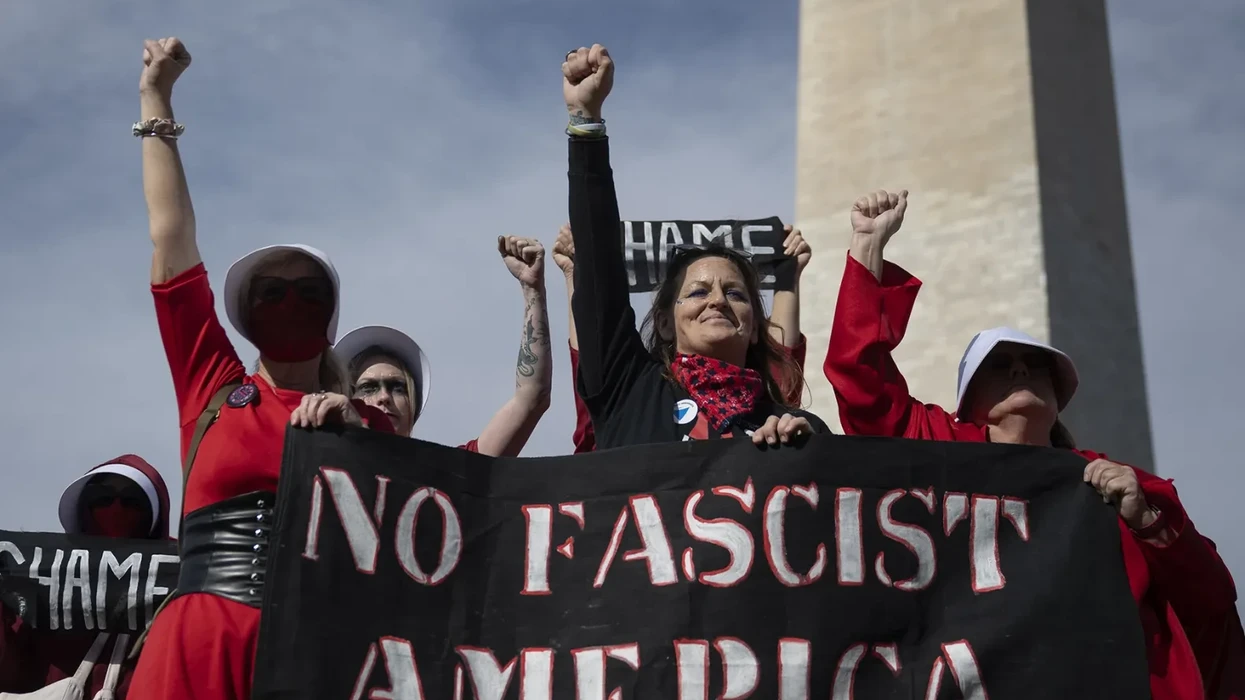
 Refuse Fascism protestors hold a rally around the Washington Monument on November 5, 2025.Celal Gunes/Anadolu/Getty Images
The Rise of the Digital Oligarchy