
This story was originally published on Feb. 9th, 2026
Bad Bunny is no stranger to making history, and last night, he conquered another first when he became the first artist to perform only in Spanish at the Super Bowl halftime show. Up until the big day, the only hint we had about potential themes for the show came from the Apple Music trailer that showed Bad Bunny dancing to his hit song “Baile Inolvidable” with a diverse cast of dancers. The vibe was unity and fun. But Bad Bunny always finds a way to get many complex messages into his performances, just as he does with his songs.
The performance had been even more anticipated because of the conservative backlash he received (to the point of Turning Point USA organizing an alternative halftime show). Additionally, because of Bad Bunny’s highly political Grammy acceptance speeches (he started one by declaring, “ICE out”), many people couldn’t wait to see what Bad Bunny might say or do during his 13-minute halftime set.
But in true Bad Bunny fashion, everything was a surprise. The show featured many symbols of Puerto Rican history and culture, as well as gestures to the broader Latino community, and a strong reframing of U.S. notions of what it means to be American. Here are some of the significant symbols and history lessons that were wrapped up in the show that you just might have missed.
Sugar Cane
The halftime show began with a wide shot of people working in sugar-cane fields before the camera panned down to Bad Bunny singing “Tití Me Preguntó” as he walked past people cutting cane with machetes. Sugar cane was the economic engine for many Caribbean countries in the 19th and early-20th centuries, including Puerto Rico. Sugar plantations have also long been symbols of the legacy of colonialism and slavery in the region. Enslaved Africans worked the sugar plantations until 1873, when Puerto Rico under Spanish colonial rule ended slavery. After the U.S. took over in 1898, U.S. sugar companies gobbled up Puerto Rican lands while reaping enormous profits off Puerto Rican labor and land. The laborers in the halftime show wore all-white clothes and straw “pava” hats, referencing the figure of the iconic Puerto Rican countryman, or jíbaro. Beginning the halftime show with sugar-cane fields and the agricultural laborers who harvested them both references a common image associated with rural Puerto Rican life, and nods to the history of colonialism that continues to impact life in the Caribbean.
Piragua Stand
As Bad Bunny walked through the sugar-cane fields during “Tití Me Preguntó,” he passed various scenes: friends at a coco frío stand, a group of older men playing dominoes, young women getting their nails done, and then a piragua (Puerto Rican shaved ice) stand where Benito is served the treat before he keeps walking. The piragua stand is an icon of Puerto Rican culture that signals community and nostalgia. Piragua stands can be found all over Puerto Rico and the diaspora. In piraguas, the shaved ice is usually topped with tropical flavored syrups that are displayed in glass bottles on the piragua cart. During Bad Bunny’s halftime performance, each glass bottle of piragua syrup on the cart featured a different flag, including Colombia, Spain, Puerto Rico, and Mexico. Besides the fact that the lyrics to “Tití Me Preguntó” reference women from each of those countries, the flags were yet another representation of Latino unity during the show.
Sapo Concho
On a screen above the halftime stage, viewers saw the animated character “Concho,” who is a key figure in Bad Bunny’s DeBÍ TiRAR MáS FOToS short film and album. Concho is a sapo concho, a crested toad endemic to Puerto Rico that is now critically endangered due to invasive species and the rapid development that is destroying its habitat. Just days before DeBÍ TiRAR MáS FOToS came out, Bad Bunny released a short film of the same name. That film featured Puerto Rican actor Jacobo Morales playing an elderly Bad Bunny who reminisces with his friend Concho as they looked through photos. At one point, Morales’ character heads to the center of town to purchase quesitos (a Puerto Rican puff-pastry roll filled with sweet cream cheese). He wanders down the street and encounters an American cashier trying to sell him cheese-less vegan quesitos. The short film, and the album as a whole, is a meditation on the dangers of gentrification that is rapidly transforming Puerto Rico. The endangered sapo concho is the perfect embodiment of the potential destruction of Puerto Rican life via U.S. colonialism and gentrification.
Casita
Bad Bunny performed several songs, including “Yo Perreo Sola,” “Safaera,” “Party,” and “Voy a Llevarte Pa’ PR” from the rooftop of the famed “Casita” (Spanish for “little house”). Bad Bunny fans were first introduced to the casita in the short film Debí Tirar Más Fotos. In the film, actor Jacobo Morales lives in a traditional cement house in the countryside of Puerto Rico. The house is very typical of the Puerto Rican midcentury homes that were built to better withstand hurricanes, in comparison with the much-older-style wooden homes. This home was pink, in the Puerto Rican tradition of painting homes a bright color, with shuttered windows and a carved wood door. These are the kinds of homes that are becoming less common with new development in Puerto Rico. Bad Bunny turned the casita into one of his stages during his 2025 “No Me Quiero Ir de Aquí” residency in San Juan. At the residency concerts, Bad Bunny performed on the porch and on the rooftop, bringing a different group of celebrity guests to the casita to party with him. On Super Bowl Sunday, the casita welcomed a host of important Latino celebrity guests such as Cardi B, Pedro Pascal, Young Miko, Karol G, and Jessica Alba.
El Morro
The portion of the halftime show that featured a wedding, plus Lady Gaga and Bad Bunny singing “Baile Inolvidable,” was a partial replica of Castillo San Felipe del Morro, more commonly known as El Morro. This 16th-century Spanish-built stone fort borders part of the coast of the historic areas of Puerto Rico’s capital city, San Juan. El Morro is now a national symbol of Puerto Rico so much so that it often appears on license plates, in addition to being a U.S. National Park and a UNESCO World Heritage Site. One of the most iconic elements of El Morro are the small stone turrets, or garitas, that were used as shelter for soldiers who were on the lookout for enemy ships. A small garita was featured on the back right corner of the El Morro-inspired set.
Toñita
During Bad Bunny’s performance of Nuevayol, he took a shot given to him by Maria Antonia “Toñita” Cay, or Toñita, a pillar of the Puerto Rican community in New York City and a link between the island and its diaspora. In the lyrics for “Nuevayol,” Bad Bunny shouts her out, saying, “Un shot de cañita en casa de Toñita/PR se siente cerquita” (A shot of rum in Toñita’s house/Puerto Rico feels close). Toñita has run the Caribbean Social Club in the Brooklyn neighborhood of Williamsburg for more than 50 years. She has famously refused to sell her property, despite mass gentrification in the area. Given the issues Bad Bunny focuses on in DeBÍ TiRAR MáS FOToS, it makes sense that he shouts out Toñita as an example of how the Puerto Rican community looks out for one another.
Electric Poles
As Bad Bunny performed his political-party track “El Apagón,” viewers saw the same cane workers from the start of the show hanging from electric poles. “El Apagón” literally means “blackout.” The song talks about both Puerto Rican pride and the frustrations of dealing with the frequent blackouts that plague the country. The longest blackout in American history was the nearly yearlong blackout Puerto Rico suffered after Hurricane María. This was a result of Puerto Rico’s poorly maintained power grid, the severity of the storm, and massively inadequate and inhumane response by the U.S. government to the hurricane. The situation was so dire that many citizens taught themselves basic electrical skills and began risking their lives climbing electrical poles in order to begin reconnecting loose or damaged power lines and restoring power, sometimes to entire towns. This poignant moment in the show demonstrated the continuity between colonial exploitation of Puerto Ricans across centuries.
Flags of the Americas
At the end of the show, Bad Bunny shouted “God bless América!” and proceeded to list nearly every country in the Americas from Chile in the south to Canada in the north. Then, hordes of people carrying flags of every country and territory in the Americas surrounded him. This celebration of the Americas follows a long line of Latin musicians — including Panamanian Rubén Blades, Puerto Rican Residente, and Mexican group Los Tigres del Norte, among many others — who have written songs uniting the Americas against U.S. imperial interests. After listing all of the countries, Bad Bunny held out the football he carried off and on throughout the performance to the camera to show the words “Together we are America,” and said, “Seguimos aquí” (“We’re still here.”). The phrase “Seguimos aquí” comes from a poignant moment in his short film about gentrification in Puerto Rico, but in the context of the halftime show, the phrase took on a new meaning. This was a powerful rebuke to the exclusionary rhetoric coming from conservatives that Bad Bunny was not American enough to perform at the halftime show, and that Latinos in general are suspicious foreigners who aim to destroy “real American” ways of life. Instead, Bad Bunny proudly declared that America is much more than the United States, and that the United States would not be what it is without Latino and Caribbean immigrants.
Ricky Martin
For weeks people have wondered who Bad Bunny would bring out for the halftime show, with Cardi B as a clear frontrunner. Ricky Martin was another. Martin is familiar to U.S. mainstream audiences from his crossover in the late-Nineties Latin boom. At the time, Martin, already an established Latin pop star, began singing in English, and embodied a Latin-lover stereotype with songs like “Livin’ la Vida Loca” and “Shake Your Bon-Bon.” But at the Super Bowl, we saw a different Ricky: Not only did he sing in Spanish, but he also sang “Lo Que le Pasó a Hawaii,” arguably the most politicized song on DeBÍ TiRAR MáS FOToS. The song itself is a call to arms that Puerto Ricans should hold onto their culture and their land in the face of rampant gentrification and displacement that stems from centuries of colonial rule. During Bad Bunny’s residency in Puerto Rico, a different guest sang this song every week. This was a full-circle moment: Rather than adapting to the tastes of mainstream U.S. for Latin-lover masculinity, Martin performed a Spanish-language defense of his homeland and a direct rebuke to the U.S.
Azul Clarito (Light Blue)
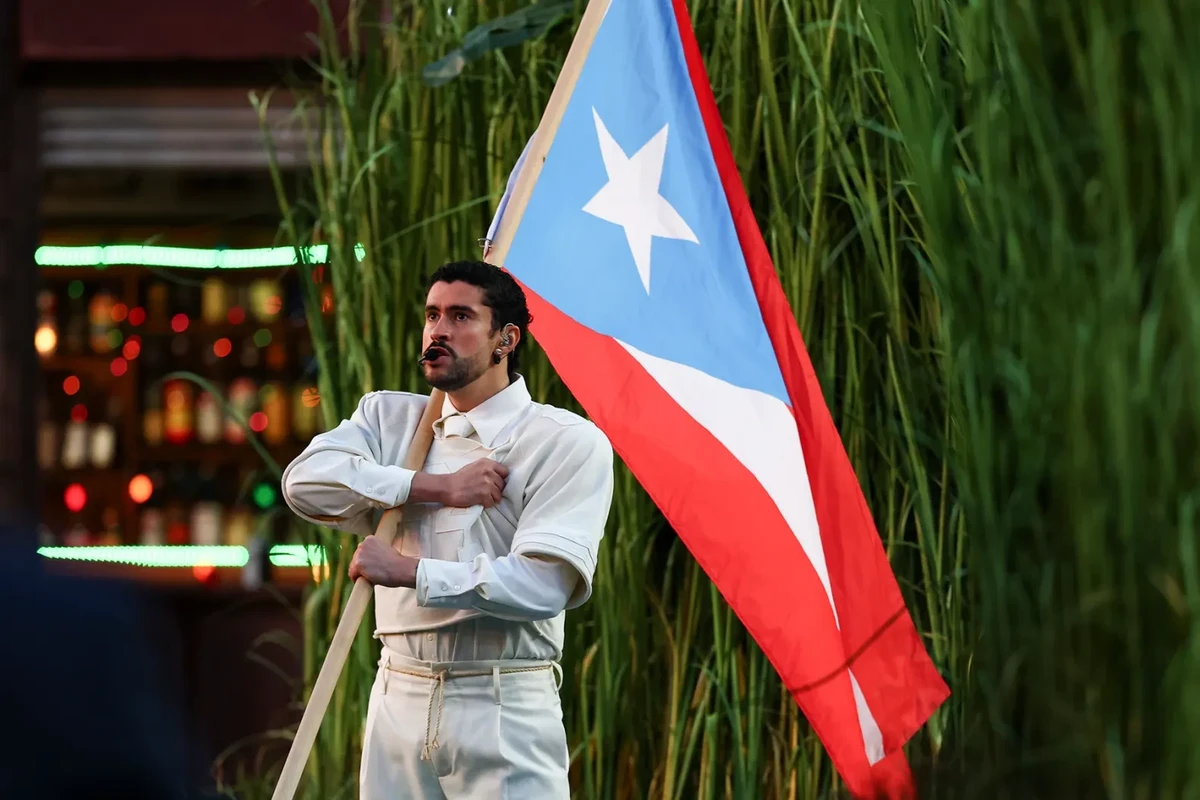
There were various touches of light blue during the halftime show, a color associated with Puerto Rican independence. One notable pop of light blue was Lady Gaga’s dress, which was adorned with the red flor de maga, the national flower of Puerto Rico. As the song “El Apagón” started, Bad Bunny emerged carrying a large Puerto Rican flag. Rather than the dark blue of the officially recognized Puerto Rican flag, Bad Bunny’s flag had a light-blue triangle, referencing the island’s original flag prior to U.S. takeover The U.S. later changed the shade of blue on the Puerto Rican flag to match that of the U.S. flag. As a territory of the United States, Puerto Rico has no sovereignty nor voting representation in the U.S. government. In this context, the azul clarito has become associated with movements advocating for Puerto Rican independence. On his song “La Mudanza,” Bad Bunny raps, “Aquí mataron gente por sacar la bandera/Por eso es que ahora yo la llevo dondequiera” (They killed people here for having the flag/That’s why now I take it with me everywhere). This references the Ley de la Mordaza, or Gag Law, which banned Puerto Ricans from having a Puerto Rican flag, let alone criticize colonialism, from 1948 to 1957. So, Bad Bunny clutching his flag with azul clarito on the halftime show set was a powerful anti-colonial statement.

Pete Hegseth’s ‘Warfighter’ Crusade Isn’t About Killing