
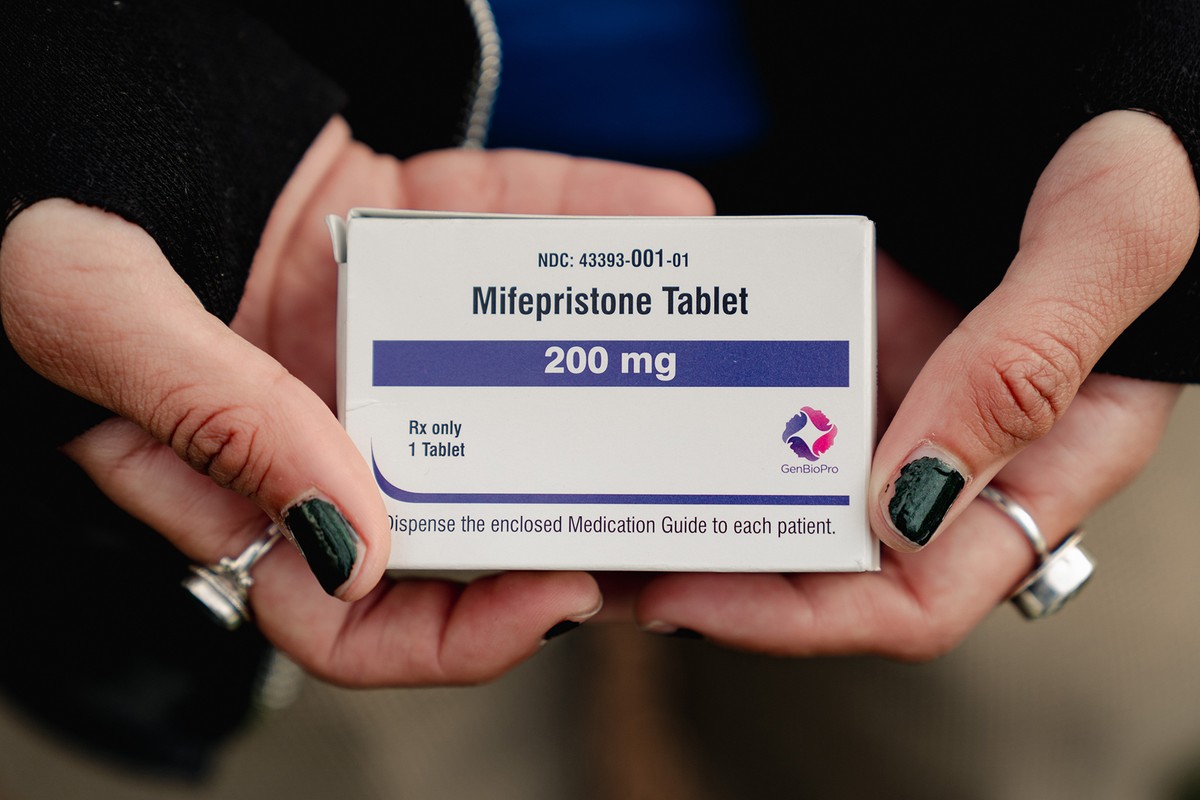

On Tuesday, lawmakers in Louisiana voted 64-29 to reclassify drugs used in abortion as controlled dangerous substances. It’s a move staunchly protested by hundreds of physicians in the state, who fear passing this bill will interfere with patient care given how commonly one of the pills, misoprostol, is used to save lives in pregnancy care.
“Misoprostol is such a literal life-saver,” New Orleans OB-GYN Dr. Nicole Freehill tells Rolling Stone. “It’s disappointing this bill is moving forward, but I am still hopeful the Senate and/or the governor will listen to the hundreds of physicians who are opposed to this change and not pass or sign the bill.”
The floor debate for SB 276 was initially scheduled for Monday, but was deferred to Tuesday. State Rep. Mandie Landry sought to pass an amendment deleting the controversial amendments from the bill or recommit the bill to the health and welfare committee for more discussion, but her motions failed. “Placing mifepristone and misoprostol on the controlled substances list is harmful and malicious,” Landry says. “It is purely the product of Louisiana Right to Life and their politics. Doctors and common sense are all against it.”
Toward the end of a heated debate, state Rep. Aimee Freeman got passionate. “I understand that Right to Life runs some of your worlds, and I’m sorry that you can’t see what the doctors have come to us to tell us. If you believed in the right to life, you would believe in maternal outcomes being the best for the women of this state,” she said.
Landry, who spoke out against the mifepristone and misoprostol amendments multiple times throughout the debate, said of Right to Life: “The amount of power they have in here is so insulting to me. They’ve abused this process so many times; they’ve manipulated it. Everyone in here knows that; no one’s denying it. And they hijacked a bill.”
Vice President Kamala Harris weighed in after the vote, posting on X: “Absolutely unconscionable. The Louisiana House just passed a bill that would criminalize the possession of medication abortion, with penalties of up to several years of jail time. Let’s be clear: Donald Trump did this.”
Now that the state House has voted to move SB 276 forward, it will head back to the state Senate for another vote, but the legislation is expected to become law. Republican Gov. Jeff Landry (no relation to Mandie) is firmly opposed to abortion rights. His spokesperson did not respond to a request for comment.
Misoprostol and mifepristone both have other clinical uses, but they have come under increased scrutiny because the pills may be taken to induce an abortion. Louisiana has a near-total abortion ban which has been in place since August 2022, with no exceptions for rape or incest, and narrow exceptions for life of the pregnant person and “medically futile” pregnancies.
Last-minute amendments added to the state’s bill would reclassify mifepristone and misoprostol as Schedule IV controlled dangerous substances under Louisiana law, an unprecedented move. OB-GYNs in the state argue that since abortion is illegal, they do not use the pills for this purpose and rarely use mifepristone at all. But they emphasize that misoprostol is used daily for miscarriage care, to induce labor, to stop postpartum hemorrhaging, and to prepare the cervix for medical procedures. Health care workers are deeply concerned reclassifying the medications will be harmful to their patients and potentially delay care in life-or-death situations.
While the bill contains an exception for pregnant women who are found in possession of the medications, anyone else without a prescription can be sentenced to felonies, punishable with up to 10 years in jail. Reproductive health advocates and health care professionals are worried about what precedent this will set not only for Louisiana, but for other red states, where maternal health is already in peril, that might follow suit. This move to classify the misoprostol and mifepristone as “dangerous controlled substances” could signal the latest front in Republican-led states’ war on reproductive health.
SB 276 STARTED OUT as a bill filed by state Sen. Thomas Pressly (R) with the intent of making “coerced criminal abortion by means of fraud” a crime. Pressly’s sister, Catherine Herring, was slipped abortion medication without her consent by her husband, who pleaded guilty to drugging her drinks in a plea deal. After the bill passed the state Senate, it went to the state House and while it was being discussed in a criminal justice committee hearing, Pressly surprised doctors, advocates, and legislators alike by adding amendments, co-written by Louisiana Right to Life, which would reclassify mifepristone and misoprostol.
Doctors across the state were stunned and scrambled to put together a response before the revised bill came to a vote. More than 280 physicians, including OB-GYNs and emergency room doctors, signed a letter begging Pressly to reconsider his amendments, which they said create “the false perceptions that these are dangerous drugs.” Neither drug comes with a risk of addiction, which is generally what is meant by at risk of abuse, when determining whether a medication should be on the controlled substances list. Joe Fontenot, the executive director of the Louisiana Board of Pharmacy, confirmed to NPR that under Louisiana law, abuse refers to addiction.
The doctors’ letter to Pressly states, “Mischaracterizing misoprostol, a drug routinely and safely used on labor units throughout the state, as a dangerous drug of abuse creates confusion and misinformation, and harms women seeking high quality maternal care.”
Pressly responded by saying that since filing his bill, he has heard stories from “additional victimized women” who have “experienced trauma due to misoprostol or mifepristone.” He says this led him to believe the drugs were a public health risk, which is why he added the amendments. (Pressly’s office did not respond to a request for comment regarding these claims.)
Pressly, who is not a doctor, said that the doctors he did consult with assured him the re-classification would not harm health care for women. Again, this is in direct opposition to 280 health care professionals who think otherwise. Last week, the state’s powerful anti-abortion organization Louisiana Right to Life defended Pressly’s amendments by releasing what they called an “investigative report” about the supposed “rampant abuse of abortion pills.” The organization does not use the word “abuse” in the same way doctors do; instead, they detail stories of women who posed as pregnant minors in order to show how easy it is to acquire abortion medication online.
The group’s report includes a claim from an anti-abortion pregnancy center about patients who have reached out after experiencing complications while self-medicating. Of course, one way to solve this issue would be to legalize abortion in the state again. Since the Supreme Court issued its Dobbs ruling allowing states to ban abortion, the U.S. has seen an increase in medication abortion as pregnant people attempt to seek care in red states by ordering pills online.
On Monday, the president of the Louisiana Society of Addiction Medicine submitted a letter to the speaker of the state house, referring to SB276 as “legislative overreach” and voicing the organization’s opposition to the legislation: “This bill goes against the spirit of the drug scheduling system.”
The Louisiana bill has spurred an outcry from reproductive health advocates across the country, who worry that consequences could reverberate across states with restrictive abortion access. “These politically motivated and cruel restrictions undermine the safety and autonomy of individuals seeking abortion care, during a time in our nation’s history when reproductive care is being used as a political issue,” says Nourbese Flint, President of abortion justice organization All* Above All. “Now more than ever, it’s crucial to ensure that medication abortion and all forms of reproductive health care are classified as lifesaving and essential medications and remain accessible and affordable for everyone, regardless of their circumstances.”
ALL THE HEALTH CARE professionals that Rolling Stone spoke with in recent weeks have stressed the same point: Misoprostol is much more than an abortion pill.
“Calling it an abortion drug is absurd, it is a very common pregnancy drug,” says one health care professional who asked to remain anonymous. “Misoprostol is used in many, many routine pregnancies; its use in abortion is the rarity and exception. It’d be like calling a speculum an ‘abortion tool.’”
“Literally every single day on labor and delivery, someone, if not multiple people, is receiving misoprostol for induction of labor,” says Freehill, the New Orleans OB-GYN. “It’s a very inexpensive medication and very effective at preventing hemorrhage, for IUD insertions, for endometrial biopsies, to prep a patient’s cervix when they have a miscarriage. It’s utilized for so many things and on a very regular basis.”
She likens adding misoprostol to the controlled dangerous substance list to reclassifying Tylenol as dangerous. “Misoprostol saves tens of thousands of lives every year because of its ability to prevent or stop postpartum hemorrhage,” she says. “It is just so commonly used and such a fantastic medication in all of these non-abortion uses, so for it to come under attack and go under Schedule IV, it was like ‘What do you mean?!’”
Postpartum hemorrhage is the third-leading cause of maternal mortality. Louisiana is already one of the states with the worst maternal mortality rates in the country, with rates even worse for women of color. Even before the abortion ban, four Black mothers were dying for every white mother.
Freehill says that while advocates of the reclassification amendments claim doctors can keep using the medications as they did before, this only works in theory. Since Dobbs, she’s had numerous problems getting misoprostol filled for patients and had multiple instances of pharmacists telling her they would not prescribe it under any circumstances. She worries this will only get worse if the medication becomes classified as a Schedule IV drug.
Any delay in a patient receiving misoprostol could be life-threatening, adds Freehill. She poses a hypothetical of a patient who is heavily bleeding attempting to fill the prescription and getting denied by a pharmacy. “I may or may not get that message right away, and hopefully quickly resolve that problem,” she says.
Depending on how long it takes the patient to get the medication, it could result in life-threatening hemorrhage or require surgery to fix what should have been resolved with prompt, evidence-based care. Any hoops added to the process create risk.
Additionally, Freehill and fellow doctors are worried that patients will be confused about the medication in general. Even if there is an exception for pregnant women who use the drugs without a prescription, Freehill notes most patients don’t read the detailed intricacies of legislation. She says she has already provided care to multiple patients who, in the midst of having a miscarriage, have asked her if they are going to be investigated for their medical emergencies.
Dr. Jennifer Avegno is the director of New Orleans’ health department. She says that mischaracterizing misoprostol and mifepristone as “dangerous” is “bad science,” and none of her colleagues or the 280 health care professionals who signed the letter have identified any case of the drugs being abused like other Schedule IV drugs like Xanax and Valium.
“As an emergency physician, neither I nor my colleagues have encountered cases of overdose, intoxication, or withdrawal symptoms from either drug,” Avegno tells Rolling Stone. “These medications do not meet the medical standard for ‘drugs of abuse,’ nor are they public health hazards — no public health agency has defined or identified them as such. In a state with some of the worst outcomes for maternal health, why would we want to make childbirth and pregnancy care more dangerous through bad science and inappropriate use of the law?”
Avegno worries about what precedent this will set. “What is to stop a legislator from being able to place any medication they might like — or they might have some financial reason to decrease use — on the list?” she says.
Freehill expresses a similar concern, wondering if birth control pills or IUDs could be future targets. She also worries that if pharmacies are scared to stock the medication, it would cause a shortage. In her opinion, Pressly should pass his legislation to criminalize coerced abortions by means of fraud, without his recent additions criminalizing mifepristone and misoprostol.
“I feel like that’s appropriate, and right now that’s enough,” says Freehill. “We need to do a lot more research. I don’t think we have to go to this next step that could affect so many thousands of women across our state in a negative way that is not intended.”









War Is Peace: Trump’s Regime-Change Reversal
As American and Israeli rockets fly into Tehran, with the stated goal of regime change, anyone who bought into the self-evidently absurd idea of “Donald the Dove” ending America’s forever wars ought to be suffering from a bloody form of buyer’s remorse.
It was always bullshit. But that’s what the Trump team was selling hard. Take human ghoul Stephen Miller’s tweet days before the election: “Kamala = WWIII. Trump = Peace.”
The Trump team reads George Orwell’s 1984 like an owner’s manual and so of course “war is peace.” Their undermining of NATO and the dismantling of American alliances in favor of a “might makes right” foreign policy executed by a sycophantic kakistocracy is a guarantee of more war amid autocratic power grabs worldwide, with a side order of corrupt crony capitalism to profit from the chaos.
If you voted for Trump and believed him, this is on you. And that includes self-styled Palestinian peace activists who thought that Biden and Harris were the worst of all possible worlds and stayed home. We will no doubt see protests for the innocent lives lost in these strikes — but I’d have a lot more time for those folks if they were also seen protesting the estimated 20,000 to 30,000 Iranian lives snuffed out by murderous mullahs in the last few months alone.
The Islamic Republic of Iran has been despotic and dangerous from its inception. The Iranian people have been oppressed and denied basic freedoms for decades. But this is an extreme example of a war of choice. The American military strikes against Iran’s nuclear weapons facility last year were justified because Iran cannot be trusted with a nuclear weapon. That is true. But the much trumpeted total obliteration of those facilities is apparently not true — or so goes the justification for this war. And don’t forget that it was Trump who pulled the U.S. out of an Obama-era deal to stop Iran from developing weapons — arguing absurdly that the imperfect anti-nuke deal needed to be blown up to stop Iran from developing a bomb. Iran’s subsequent progress toward a bomb then created the rationale toward these strikes. This is a self-inflicted state of emergency. Peace is war and war is peace.
Pity the willful dupes in Congress who deluded themselves into thinking that Trump deserved the Nobel Peace Prize. They’ll probably rationalize that he would’ve been peaceful if he got the honor. Now it will be read as a cautionary tale for not sucking up. The chairman of the Board of Peace is now bored of peace. While Rand Paul remains admirably consistent, it’s Lindsey Graham who is pirouetting around the Senate floor while the Gimp Speaker Mike Johnson is unable to speak for the basic constitutional principles of separation of powers let alone authorization to go to war.
If you’re feeling shell-shocked trying to keep up with Operation Epstein Distraction, get ready for the inevitable next crisis — regime change without a plan for replacement. This is what the Trump administration did in Venezuela — kidnapping the socialist dictator Maduro but keeping his regime in place in exchange for crude oil access. The opposition is still in exile and its leader María Corina Machado gave her Nobel Peace Prize to Trump in exchange for exactly nothing.
One of the clear lessons of history is that if you don’t win the peace, you don’t win the war. The Saudis and their Sunni allies will back the U.S. and Iran because they hate the Shia Iranians (who, incidentally, are not Arabs), but beyond removing the Iranian regime, the plans for replacement and stabilization seem TBD — and with Trump’s inability to stay focused on anything beyond his immediate self-interest, solid plans are unlikely to emerge. Maybe a leader will come from the underground opposition; maybe it will be the Shah’s son, who has been living in the U.S. waiting for a restoration like many members of the diaspora. The upside is that Iran has a distinguished history and an accomplished Persian culture: The Islamists don’t represent the entirety of the people of Iran and never have.
But the path ahead will be messy at best. It will require concerted effort and civil commitment, not just an open call for private investment from Mar-a-Lago members. If the United States is now kidnapping and killing dictators without direct provocation, it establishes a dangerous precedent which will come back to bite us after demolishing our moral authority in the world.
It is the unexpected effects, the cascades of consequence where we cannot always plan ahead, that cause most responsible statesmen to try to keep the peace. But Trump has the carelessness of a rich-boy bully who can always buy or bluster his way out of trouble. He’s a con man who has found his ultimate mark in his followers, who fool themselves into thinking that a reflexive liar is the one man with the courage to tell the truth.
Perhaps the most prominent example is the vice president himself — a bright guy who not that long ago compared Trump to Hitler and a deadly narcotic but then convinced himself that careerism demanded an abrupt conversion. After all, he endorsed Trump less than two years ago with this very serious column headlined “Trump’s Best Foreign Policy? Not Starting Any Wars,” explaining, “He has my support in 2024 because I know he won’t recklessly send Americans to fight overseas.”