
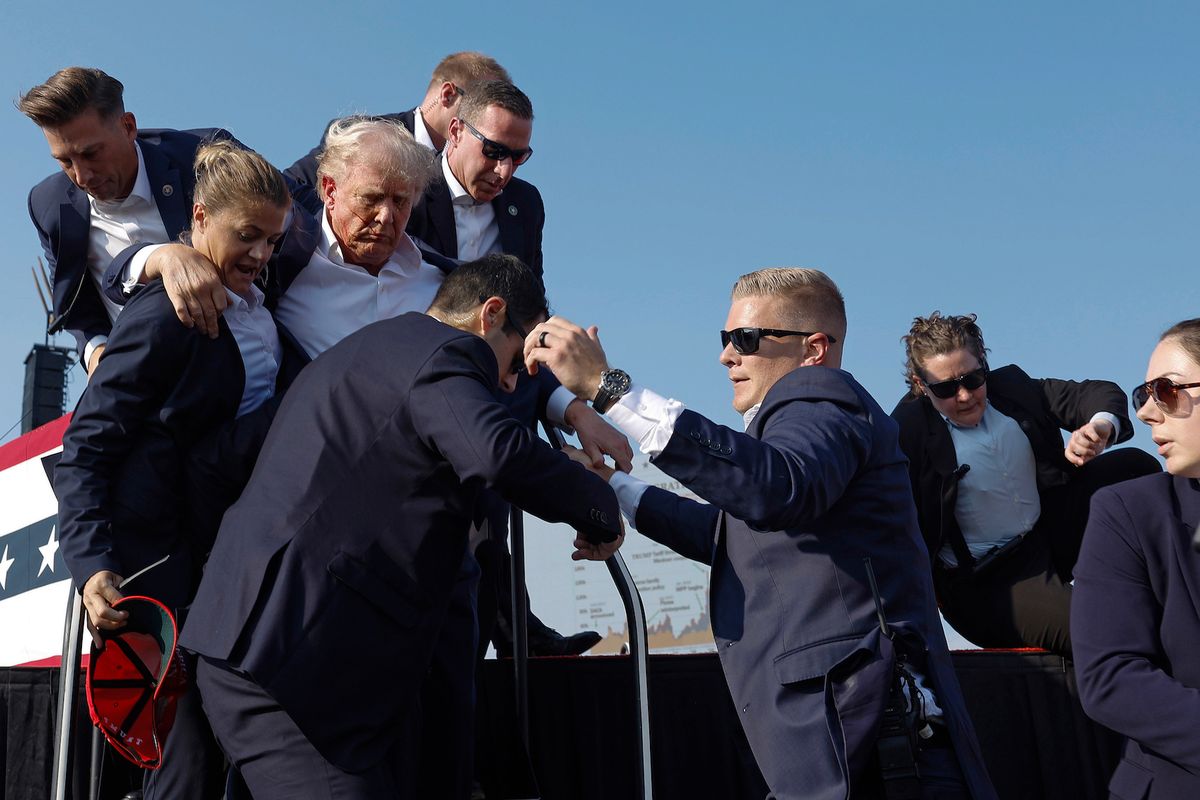

It’s been 11 days since the assassination attempt against Donald Trump at a rally in Butler, Pennsylvania. Investigations by law enforcement and journalists so far have produced few details about the apparent shooter’s motivations — while revealing major security failures.
The Trump rally shooting, from a nearby rooftop, was the first near-assassination attempt on a current or former president in 40 years — and “the most significant operational failure at the Secret Service in decades,” the agency’s director, Kimberly Cheatle, told lawmakers at a House hearing on Monday. One attendee was killed in the attack, and two attendees were seriously injured. Cheatle resigned on Tuesday.
Here’s what we know about the shooter and the assassination attempt at Trump’s rally:
What We Know About The Shooter
The shooter has been identified as Thomas Matthew Crooks, 20, of Bethel Park, Pennsylvania. What information has been gleaned from Crooks’ minimal online footprint and the ensuing drips of information from law enforcement and public records shows either a complex political mindset or a young man who was still forming his political views.
A registered Republican who had given $15 to a liberal anti-Trump group, Crooks’ household appears to have been politically divided: His father was registered as a Libertarian, his mother as a Democrat, and his sister as a Republican. Classmates have given conflicting remembrances of Crooks’ political leanings, ranging from outright conservatism to general apathy. Nothing in the deluge of coverage stemming from a sprawling law enforcement investigation has revealed any evidence of left-wing extremism.
While publicly available records and law enforcement haven’t provided an easy political answer for Crooks’ motive, what is known paints a picture of Crooks and his family as a microcosm of Pennsylvania, a swing state where Trump eked out a victory against Hillary Clinton in 2016 but lost by a slim margin to Joe Biden in 2020.
In an era when politics pervades nearly every aspect of life — and in which many Americans wear their political affiliations on their sleeves — the Crooks family home showed no outside signals of their political beliefs. Neighbors told CNN that no political signs or flags were seen at the home.
Crooks’ classmates have given conflicting accounts of his political beliefs. While one described him as conservative, another former classmate, Vincent Taormina, said Crooks confronted him over Taormina’s support for Trump, something he apparently told the FBI after Crooks’ attempt on Trump’s life. However, the agency also asked about Crooks’ apparent disdain for other politicians, like Bernie Sanders and Hillary Clinton, Taormina told Fox News.
Other classmates and teachers have described Crooks as a loner who kept to himself — and preferred to do so. Crooks’ solitude was apparently in line with that of his father. “I called [my brother], but he didn’t answer the phone, and I know he saw my name on the caller ID,” Mark Crooks, the shooter’s uncle, told NBC News. “I called to see how he was doing, but he didn’t call back, and that’s typical of him.”
A registered Republican, Crooks made a small donation to the Progressive Turnout Project — an anti-Trump group — on the day Biden was inaugurated, when the shooter was 17. It’s unclear when he registered as a Republican.
Still, much work remains to be done. On one of two phones Crooks apparently used were some 14,000 images, including stock images of firearms and “articles related to government officials,” lawmakers briefed by law enforcement told reporters. Other information gleaned from Crooks’ devices suggests he could have been looking to target a wide variety of political figures. In recent months, he had searched for information about President Joe Biden’s events.
Photos of House Speaker Mike Johnson and House Minority Leader Hakeem Jefferies were found on Crooks’ devices, as was a photo of Fulton County District Attorney Fani Willis, who is prosecuting Trump and his allies for their role in efforts to overturn 2020 election results in Georgia.
Among the data discovered by law enforcement were searches for the dates of the Democratic National Convention in Chicago, Trump rally dates, and searches related to explosives and major depressive disorder, a diagnosis given to a school shooter in Michigan whom Crooks also made a subject of his online searches. Further, email accounts associated with Crooks’ father were tied to purchase of gold bars, coins, and firearm equipment on eBay, The New York Times found. Advertisements for gold and precious metals are a staple of right-wing media. Rolling Stone’s emails to those addresses went unanswered, as did calls to Crooks’ neighbors and family.
Unlike other high-profile American shooters, Crooks did not leave a manifesto or other obvious explanation of his motive for trying to kill a former president. In Crooks’ wake — like that of mass killer Stephen Paddock in Las Vegas and others — questions, speculation, unfounded allegations of political motivation, and, of course, conspiracies have abounded about why Crooks tried to kill perhaps the most famous person in the world.
Timeline of the Attack
Ahead of the July 13 rally, Crooks had asked for the day off work at his job at a nearby nursing home. At some point that day, Crooks’ father, Matthew, called 911 to report his son missing, law enforcement told Fox News. Reports vary on whether Matthew called before or after the shooting, and whether he knew the weapon used in the assassination attempt was also missing.
On the morning of the rally, Crooks was able to fly a drone over the Trump rally site, according to law enforcement. He returned around 5 p.m. and raised the suspicions of rally-goers who spotted him carrying a duffel bag and a range-finder. Several Trump supporters said they tried to warn law enforcement, to no avail.
More than an hour passed between the time when Crooks was identified as a “person of interest” by law enforcement at 5:10 p.m., and when he began firing at 6:12 p.m. In that crucial hour, rally goers warned police of a suspicious person on the roof of a building near the rally site. A local police officer briefly tried to confront Crooks and retreated after Crooks trained his gun on him; the officer wasn’t able to unholster his weapon, while being raised up to the roof by another officer. Trump took the stage to begin his remarks. This all happened before Crooks fired his first shots, and was taken down by a Secret Service sniper.
Trump was struck in the ear, an injury that was finally detailed on Saturday by House Rep. Ronny Jackson — a controversial figure who is not Trump’s official doctor. Two rally-goers were injured in Crooks’ attack and a third died.
Trump wore a large white bandage over his ear during the Republican National Convention last week. Over the weekend, Trump wore a smaller flesh-colored bandage while speaking at a rally in Grand Rapids, Michigan.
The Investigation
The massive investigation into Crooks began shortly after the shooting, with agents from the Bureau of Alcohol, Tobacco, and Firearms combing through paper records — a handicap required by laws pushed by the gun lobby to prevent the creation of an easily-searchable database of American firearms and their owners — to identify Crooks, who was not carrying identification.
Sale records for the AR-15-style rifle Crooks used that day led investigators back to the family home. There, law enforcement confiscated 14 firearms, an explosive device, Crooks’ second phone, a hard drive, and three USBs.
The apparent failure of local law enforcement and especially the Secret Service to adequately protect Trump has drawn the ire of Republicans, who grilled director Kimberly Cheatle at a House Oversight Committee hearing on Monday. She resigned on Tuesday.
Republicans are incensed that the Secret Service reportedly rebuked requests from the Trump campaign for increased security for the candidate. Meanwhile, local law enforcement have said they warned the Secret Service ahead of the rally that area police didn’t have the manpower to properly patrol the outer perimeter of the rally site.
“The officer was in a defenseless position and there was no way he could engage the actor while holding onto the roof edge,” Tom Knights, the Butler Township manager, said in a statement, adding that the officer “immediately communicated the individual’s location and that he was in possession of a weapon. Moments later, the individual commenced firing.”
In the ensuing fallout over the assassination attempt, local law enforcement — which numbered about 100 officers from several different agencies — have said the Secret Service did not assign any agency responsibility for the area outside the inner security perimeter that contained the building from which Crooks fired.



War Is Peace: Trump’s Regime-Change Reversal
As American and Israeli rockets fly into Tehran, with the stated goal of regime change, anyone who bought into the self-evidently absurd idea of “Donald the Dove” ending America’s forever wars ought to be suffering from a bloody form of buyer’s remorse.
It was always bullshit. But that’s what the Trump team was selling hard. Take human ghoul Stephen Miller’s tweet days before the election: “Kamala = WWIII. Trump = Peace.”
The Trump team reads George Orwell’s 1984 like an owner’s manual and so of course “war is peace.” Their undermining of NATO and the dismantling of American alliances in favor of a “might makes right” foreign policy executed by a sycophantic kakistocracy is a guarantee of more war amid autocratic power grabs worldwide, with a side order of corrupt crony capitalism to profit from the chaos.
If you voted for Trump and believed him, this is on you. And that includes self-styled Palestinian peace activists who thought that Biden and Harris were the worst of all possible worlds and stayed home. We will no doubt see protests for the innocent lives lost in these strikes — but I’d have a lot more time for those folks if they were also seen protesting the estimated 20,000 to 30,000 Iranian lives snuffed out by murderous mullahs in the last few months alone.
The Islamic Republic of Iran has been despotic and dangerous from its inception. The Iranian people have been oppressed and denied basic freedoms for decades. But this is an extreme example of a war of choice. The American military strikes against Iran’s nuclear weapons facility last year were justified because Iran cannot be trusted with a nuclear weapon. That is true. But the much trumpeted total obliteration of those facilities is apparently not true — or so goes the justification for this war. And don’t forget that it was Trump who pulled the U.S. out of an Obama-era deal to stop Iran from developing weapons — arguing absurdly that the imperfect anti-nuke deal needed to be blown up to stop Iran from developing a bomb. Iran’s subsequent progress toward a bomb then created the rationale toward these strikes. This is a self-inflicted state of emergency. Peace is war and war is peace.
Pity the willful dupes in Congress who deluded themselves into thinking that Trump deserved the Nobel Peace Prize. They’ll probably rationalize that he would’ve been peaceful if he got the honor. Now it will be read as a cautionary tale for not sucking up. The chairman of the Board of Peace is now bored of peace. While Rand Paul remains admirably consistent, it’s Lindsey Graham who is pirouetting around the Senate floor while the Gimp Speaker Mike Johnson is unable to speak for the basic constitutional principles of separation of powers let alone authorization to go to war.
If you’re feeling shell-shocked trying to keep up with Operation Epstein Distraction, get ready for the inevitable next crisis — regime change without a plan for replacement. This is what the Trump administration did in Venezuela — kidnapping the socialist dictator Maduro but keeping his regime in place in exchange for crude oil access. The opposition is still in exile and its leader María Corina Machado gave her Nobel Peace Prize to Trump in exchange for exactly nothing.
One of the clear lessons of history is that if you don’t win the peace, you don’t win the war. The Saudis and their Sunni allies will back the U.S. and Iran because they hate the Shia Iranians (who, incidentally, are not Arabs), but beyond removing the Iranian regime, the plans for replacement and stabilization seem TBD — and with Trump’s inability to stay focused on anything beyond his immediate self-interest, solid plans are unlikely to emerge. Maybe a leader will come from the underground opposition; maybe it will be the Shah’s son, who has been living in the U.S. waiting for a restoration like many members of the diaspora. The upside is that Iran has a distinguished history and an accomplished Persian culture: The Islamists don’t represent the entirety of the people of Iran and never have.
But the path ahead will be messy at best. It will require concerted effort and civil commitment, not just an open call for private investment from Mar-a-Lago members. If the United States is now kidnapping and killing dictators without direct provocation, it establishes a dangerous precedent which will come back to bite us after demolishing our moral authority in the world.
It is the unexpected effects, the cascades of consequence where we cannot always plan ahead, that cause most responsible statesmen to try to keep the peace. But Trump has the carelessness of a rich-boy bully who can always buy or bluster his way out of trouble. He’s a con man who has found his ultimate mark in his followers, who fool themselves into thinking that a reflexive liar is the one man with the courage to tell the truth.
Perhaps the most prominent example is the vice president himself — a bright guy who not that long ago compared Trump to Hitler and a deadly narcotic but then convinced himself that careerism demanded an abrupt conversion. After all, he endorsed Trump less than two years ago with this very serious column headlined “Trump’s Best Foreign Policy? Not Starting Any Wars,” explaining, “He has my support in 2024 because I know he won’t recklessly send Americans to fight overseas.”