
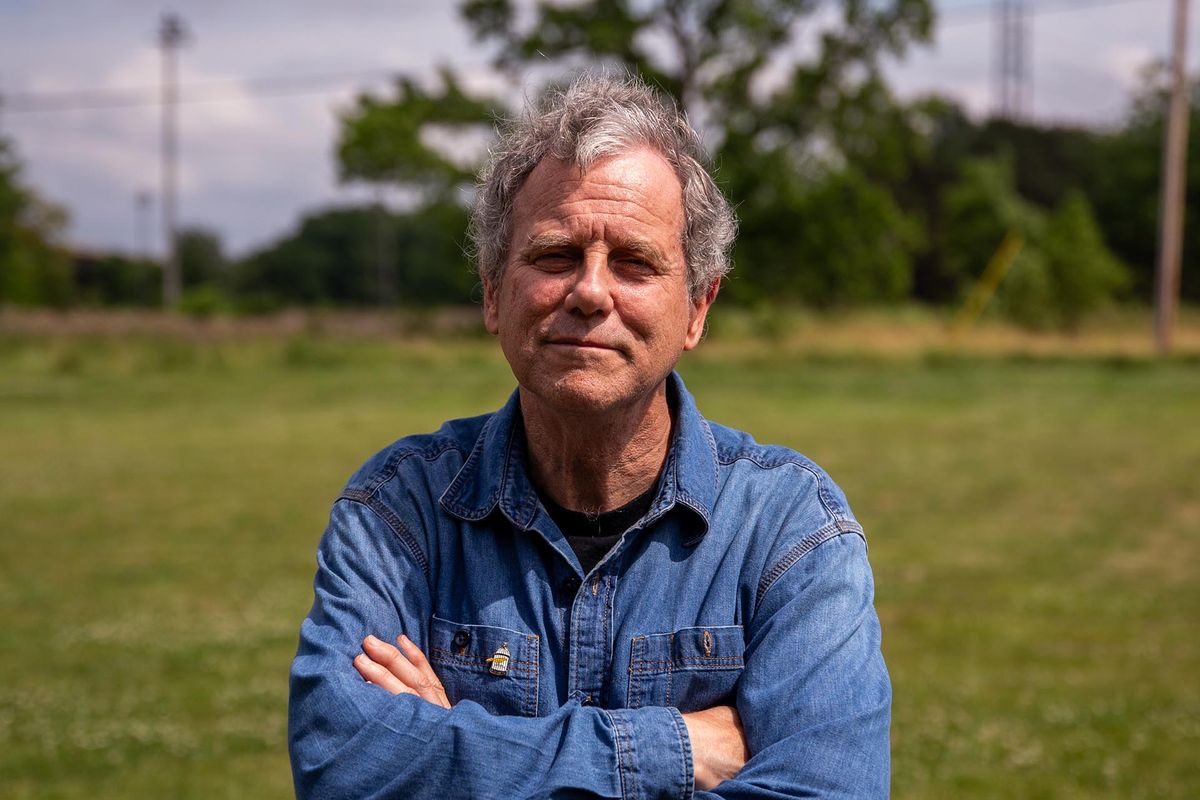

The first time I see Sherrod Brown he’s wearing a bright-orange hard hat and overshirt, slapping the backs of a group of burly union steelworkers. He comes through the side of the cavernous steel facility in a scrum of old-school union bosses — guys straight out of central casting for the next Scorsese movie, all rumpled shirts and cropped goatees, with names like Dave McCall and Donnie Blatt and Dickie Peskar. I don’t actually recognize Brown at first because he — a career politician — blends in so well with these grizzled toughs. He’s clean-shaven, though, and behind safety glasses, his eyes have mischievous wrinkles that make him look younger than his 71 years. Over our heads there’s a massive crane system grabbing drums of galvanized steel sheet — picture a 50,000-pound toilet paper roll — and dropping them off at the other end of the building for distribution so they can become car doors and washing machines and dozens of other things. The plant we’re in, Cleveland-Cliffs’ flagship production facility, pumps out just over a ton of this stuff for every worker-hour the United Steelworkers Local 979 puts in. The 979’s union hall is just up the road, at the top of a hill on Independence Avenue, where you can look down straight past the blast furnace chimneys and see Cleveland’s downtown skyscrapers, towering columns of steel and glass, the whole life cycle of American industrial power in one view. No one’s ever said politics had to be subtle.
Brown is here to fight for these workers — and hope that in turn they’ll fight for him. Ohio’s senior senator was first elected in 2006, in the waning third of the disastrous second Bush dynasty, in a state known to go red or blue depending on the year. But recently, Ohio’s looking pretty red, and Brown’s running in the race of his life to hang on to a seat that, without him in it, the Democratic Party would probably have written off several cycles back. He’s got a shot, though, because he’s been going to bat for guys like the Local 979ers for his entire career.
Take today for example: After the back slapping and a short introduction from Peskar, 979’s president, Brown gets behind a podium in front of some local news cameras and the assembled steelworkers to lay down the law. The problem is that since 2019, the Mexican government has essentially been skirting steel-import rules and flooding the U.S. market with cheaper steel.
“We can’t and we won’t let the lack of trade enforcement hurt any more steelworkers or shutter any more steel plants,” Brown rasps. He has a distinctive voice that sounds like his throat is full of crushed rocks and half a pack of Newports, though he’s never smoked. “We know Ohio workers are the best in the world. They can make steel as long as the rules are fair. Everyone knows Ohio steelworkers — and Cleveland-Cliffs steelworkers — are the best in the world. They can compete — you can compete — with anyone. You just need that fair playing field.”
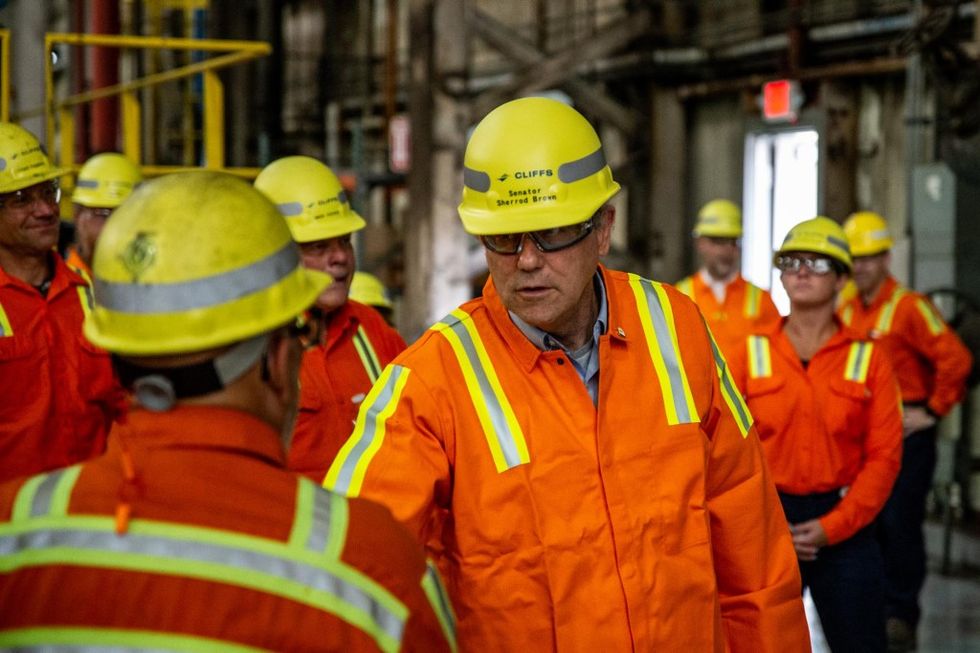
These are his people, this is his state, these are his issues. Brown doesn’t mention Joe Biden’s name once during his speech, referring to “the president” or “the administration.” The underlying message is this: Brown will take on anyone on behalf of Ohio, even the president of his own party. He makes the case that “the administration” — meaning Biden — is not doing enough to stop the Mexican and Chinese steel companies from flouting the law and encroaching on USW Local 979’s turf. This turf is Brown’s chosen ground, and he’ll take on all comers.
The Democratic Party is not, to put it gently, in good shape in Ohio. Before Biden made the remarkable decision to drop his bid for reelection, he was absolutely dying in the state. After passing the reins to Vice President Kamala Harris, things look a little better, but not much. Since 2016, Ohio has belonged to Donald Trump: He beat Hillary Clinton 51 to 43 percent and then trounced Biden 53 to 45 in 2020. But Brown has thus far managed to find a path to victory, preserving a key Senate seat for the shaky Democratic majority.
“I think Sherrod Brown is the smartest politician in Ohio,” says one longtime Republican operative in the state. “If anyone can survive this year and the national Senate map, it would be [him]. Anyone who writes the obituary for Sherrod Brown is dumb.”
Still, 2024 is the first time he’ll have run in an election year with Trump, as well as a fellow Ohioan on the top of the opposing ticket — along with all the chaos in the Democratic Party. While I was in Ohio reporting this story, Biden faltered so badly on the debate stage that it touched off a weekslong succession crisis as Democratic leaders fought tooth and nail over whether or not to eject him from the ticket. Then, someone shot Trump in the ear — an honest-to-God assassination attempt, culminating in an indelible image of a wounded candidate raising his fist in defiance as blood ran down his face. He recovered and announced Ohio’s junior senator, J.D. Vance, as his vice presidential running mate. Then, Biden dropped out. What never changed, though, was Brown’s strategy for winning — and winning big — in a polarized state that’s hostile to the party he represents.
AFTER THE STEEL STOP, Brown hits the union hall. A smattering of steelworkers and USW staff tuck into a spread of cold-cut sandwiches and deli sides. Brown is in and out of the room so quickly I don’t realize it until I’m 20 minutes into a conversation with a group of women who are so complimentary to him that I briefly entertain the possibility that the campaign has hired shockingly down-to-earth actors to butter me up. “He just shows up,” says Christine Dempsey, a member of the USW’s grievance committee. “You get the sincerity from Sherrod,” says steelworker Michelle Miller.
Brown grew up in Mansfield, Ohio, where his father was a doctor. The family was middle class, but lived in an area that, Brown says, was hit hard and early by the decline in American manufacturing jobs. His mutual love affair with organized labor started half a century ago when he was a fresh-faced kid from Yale University hanging out in union halls. It was around then when he started his political career, too. He was a senior at Yale in 1974 when he was recruited by another Ohio politician to run for a vacant seat in the state Legislature. He served there for eight years before running for Ohio secretary of state, which he won, serving until he was ousted in 1990 by the great-grandson of William Howard Taft. Rather than lick his wounds, he ran for Congress in 1992 and won. He served there until he jumped to the Senate in 2006.
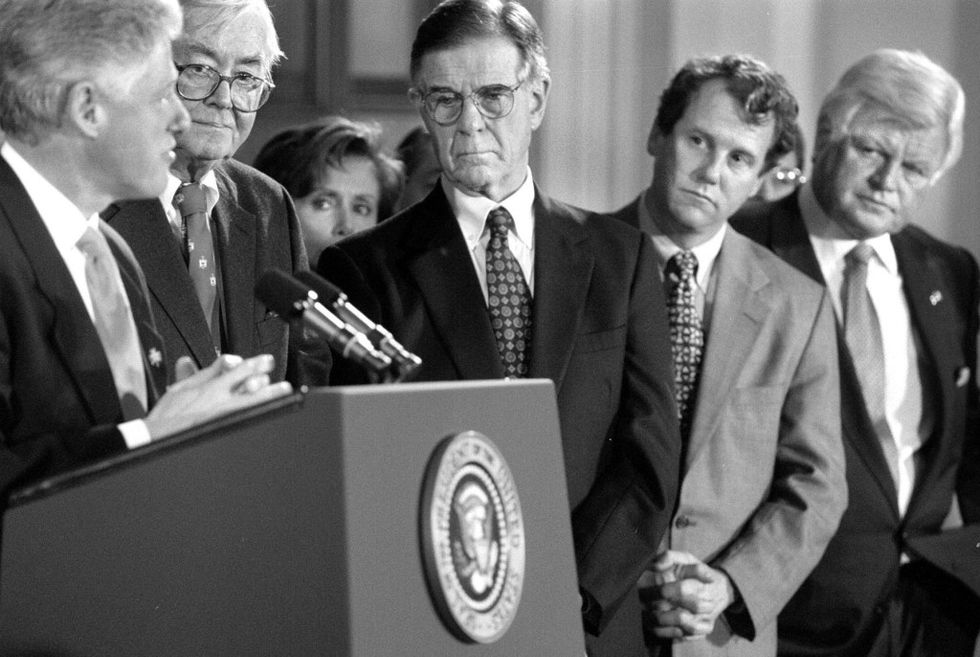
Today, Brown is on the tail end of 50 years of almost-unbroken political service. And yet, he’s never run for president. The closest he’s come was a short “exploratory” trip called the “Dignity of Work Tour” in 2019. It didn’t last long: He told Rolling Stone in 2020 that he quickly realized he “didn’t have the ambition” to make a real run at the office. In an interview in his D.C. office in early July, Brown tells me that the political upheaval of the past five years hasn’t changed that view. “I’ve heard people say, ‘I wish you would run,’ but I have zero interest,” Brown says. “I came to terms — I’m very satisfied with the decision I made back in ’19 not to run.”
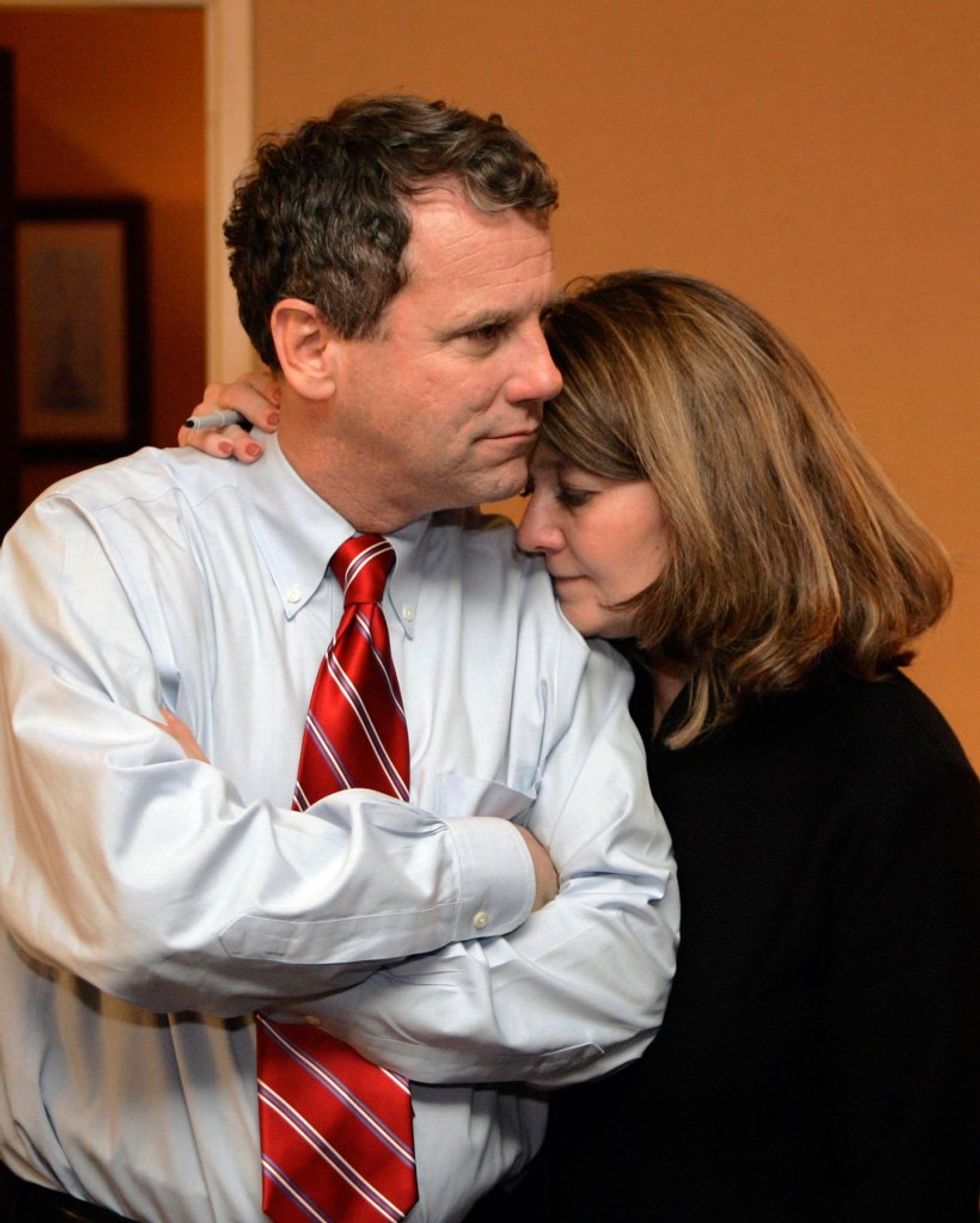
“This [the Senate] is a really big job in his view,” Brown’s wife, Pulitzer Prize-winning columnist Connie Schultz, tells me. Brown and Schultz have been married for 20 years. They each have two children from previous marriages. “He loves what he does. Public service has been his career.” As that career has stretched on, Schultz says, she’s offered him a list of “10 jobs he could have” that would let him work less, relax more. She refuses to tell me what the jobs were, but says he’s certainly got “more books in him.” (So far, he’s written three.) “He doesn’t want them,” she says about the other jobs. “He loves the work, the retail politics.… I used to joke that I thought I was an extrovert until I met Sherrod, then I realized I was just cheerful in a newsroom.”
The extroversion is infectious. He’s perennially 15 or more minutes behind schedule with harried staff trying to shoo him to his next engagement while he gets sucked into a story about dangerous jobs (on one afternoon, Brown gets fixated on the plight of train conductors who deal with trauma after striking pedestrians) or politely inspecting a massive, handlebar-mustachioed pipefitter’s Harley-Davidson. He’s obsessed with high school mascots, often remembering specific people by their school and mascot. There’s always another bike to check out, story to tell, knickknack or picture, or other bit of Ohio-related paraphernalia to see.
Before I spend much time with the man himself, two of his D.C. aides give me some Sherrod tips. Number one: Do not lie about your level of baseball knowledge. It’s better to fess to no knowledge than to try to chop it up with Brown and be exposed as a fraud. This is not a tip to take lightly: In a cute bookstore Schultz recommends in the Cleveland suburbs, I pick up a recent nonfiction book about the 1947 Indians’ post-desegregation World Series run, thinking I’ll glean a fact or two to drop in conversation. On page one: a blurb raving about the book, signed by Brown. Number two: Do not use the term “Rust Belt.” I receive this tip after using the term with one of his staff and getting a look of such disgust I’m embarrassed to even have it here on the page. (Brown thinks the term is demeaning to workers and portrays manufacturing jobs as outdated.) Number three, from Schultz: Never be rude to wait staff or service workers. “If you mistreat an hourly-wage earner, it will permanently affect his opinion of you.”
When he first got to D.C. in the Nineties, Brown swapped out the traditional pin given to new members of Congress for one he’d received from a mine worker in Ohio. The pin, which depicts a small canary in a birdcage, was a reminder of early mine workers’ primitive warning system for toxic gases, long before collective bargaining agreements won them safety standards. On the trail, it becomes a great campaign prop: At a rally at a trade-union building in Toledo, Brown spots a young girl in a pink dress, holding hands with her father. He tells her the canary story and gives her his own pin, pulling it off his denim shirt and pinning it to the front of her dress. She beams and says she’s going to be a carpenter when she grows up, just like her dad.
In the hands of another candidate, this kind of thing could look forced. Brown knows his strengths: the pins, the stories about saving Teamsters pension funds and janitorial workers getting their first paid vacations, the heartfelt tale of Schultz’s teenage asthma attack that sent her to the hospital, where she pulled through thanks to her father’s union health insurance. The janitor story, in particular, always hits. At a labor conference in Las Vegas, one of the venue’s janitors proudly claimed that as a result of collective bargaining, she was about to have her first week of paid vacation, ever, a reminder of just how transformative the smallest gains can be for workers at the bottom of our economy. I hear Brown tell it no fewer than four times.
Brown’s campaign, I find, is an exercise in extreme message discipline. Pick your battles, and fight them with everything you’ve got. Brown knows that he can win with labor: His opponent, conservative businessman Bernie Moreno, was forced to pay more than $400,000 in a series of wage-theft lawsuits last year and has been sued multiple times for discrimination. Brown knows he wins on abortion: He’s been consistent throughout his career in his support for a woman’s right to choose. While introducing Brown at a “Women for Sherrod” event in Cleveland, Schultz says abortion and gay rights were two issues she specifically researched Brown’s positions on before their first date. (He, meanwhile, showed up with several pages of typed-out quotations he wanted to read to her.) Abortion has also been a winning issue in Ohio’s recent electoral history: In 2023, Brown helped lead the charge on Issue 1, a state-ballot measure that enshrined a right to abortion, contraception, miscarriage care, and fertility treatments, which passed by 14 points last November. Moreno is an anti-abortion hardliner. The contrast is clear, and so far, it appears to be working, as Brown holds a five-point lead in most polls.
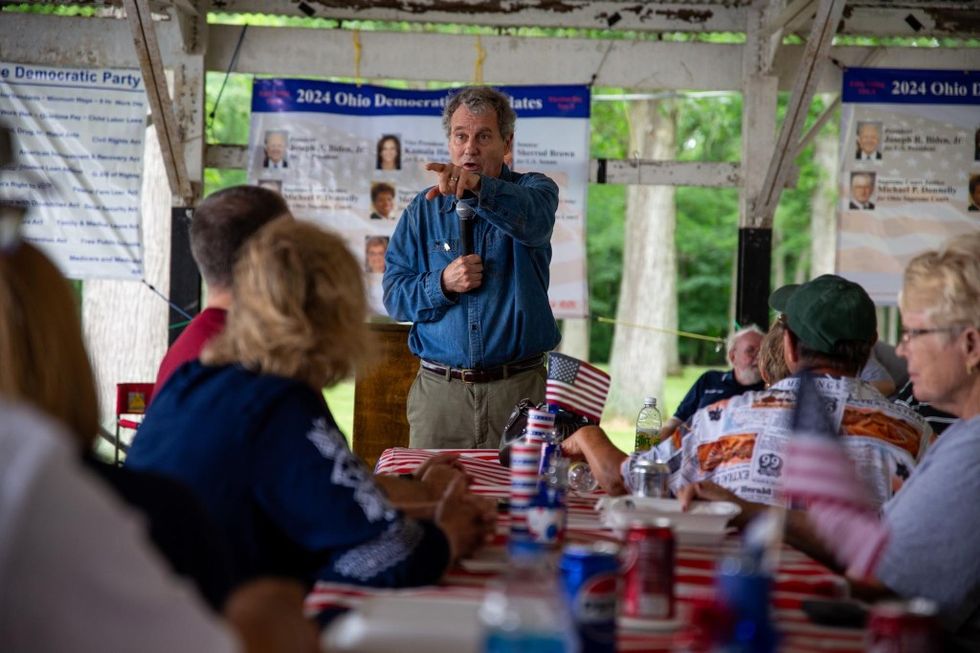
But this message discipline can cut the other way. Take the Six-County Democratic Party Picnic in Defiance, Ohio, this June. Brown shows up on his first public stop in a day of events in western Ohio after spending the morning fundraising. Underneath a gazebo in Defiance’s UAW park, he takes the podium first, launching into the Teamsters’ pension story to a crowd of retirees grazing on pulled-pork sandwiches and canned soda. It’s about as sympathetic a crowd as any I’d seen thus far, until it isn’t: One after another, two women stand up, loudly but politely confronting Brown on his position on the Israel-Hamas war. The first inspires some back and forth with Brown, who insists the booing crowd let her speak. Brown calls for a “negotiated settlement,” and to “get the hostages out.” The second confronts Brown with his record of condemning the 2018 Rohingya genocide, and demands to know why he won’t call the war in Gaza by the same name. Amid boos, Brown responds.
“I don’t think it’s genocide,” he says. “I think it’s terrible what’s happened, I think too many families have lost people in Gaza, too many kids have been killed, I agree with all of that. I think that Netanyahu has not conducted this war right.… I don’t think it’s genocide. Genocide is what happened in Rwanda. Genocide is what the Nazis did. This is not genocide. We’ve gotta do better at getting help to people in Gaza, we’ve got to stop the kind of … killing, but it’s not genocide.”
The woman has her answer, and sits down. The next heckler is less subtle: a young man in a baseball cap.
“Sherrod!” he yells. “You’re a full-time imperialist! You’re a—” and he’s drowned out by the crowd. One goateed man screams, others chant “Boo, boo,” and “Lock him up!”
The campaign decides, shortly after, that it’s time to go. We pull out of the UAW park past a cluster of protesters waving Palestinian flags. Local police, who Brown’s security team coordinated with, are on their way in, and Brown is on his way out — off to another union hall in Toledo, an hour away.
Brown doesn’t appear particularly flustered. He wasn’t dismissive of the protests, but it’s clear there are other topics he’d rather talk about. He tells a story occasionally about his time at Yale, at the height of the Vietnam War, encountering protesters from privileged families screaming in the streets at cops who, he says, were probably the guys whose fathers or brothers or sons were actually fighting in the war. Class is always going to be Brown’s central issue, and if that gets him screamed at sometimes, so be it. “I got called a war criminal earlier today,” he quips wryly to one of the union guys as we walk into the Northeast Ohio Building and Construction Trades Council. “Oh, that’s fun!” the worker replies.
Inside, Brown is back to work and back on message. He has to be: He needs people to bubble in both Trump’s name and his own on their ballots, party allegiance be damned. “How many of your guys went for Trump?” I hear him ask one trade-union boss at a campaign stop. “About 30 to 40 percent,” the man replies, and Brown grimaces. “At least tell them if they’re gonna vote for Trump, that Brown’s the most pro-union guy in Ohio,” Brown says.
The union rank and file “don’t want to be told who to vote for,” Lee Daher, a senior business representative with the Central Midwest Carpenters Union, tells me on the phone a few weeks after the Toledo event. “We make sure they’re educated. [We say,] vote for who you want, do a split ticket, but switch over for this Democrat because like it or not, he’s going to help you get work hours.”
The last time Brown ran, in 2018, he won in six different House districts that elected Republicans to Congress, and flipped a handful of traditionally Republican counties while holding his heavily pro-union bases of power. Coupled with a strong showing from women and minority voters, he kept his seat comfortably, but pollsters have the current battle with Moreno as a toss-up, particularly with Trump on top of the ticket.
This is another thing Brown doesn’t like to talk about. During a car ride between stops in Ohio, I ask what it’s like to see Trump using, in some ways, a bastardized version of Brown’s own promises to the working class. I mention his catchphrase, “the dignity of work,” thinking of Trump’s impassioned 2016 speeches promising to bring jobs back.
“I’ve never heard Donald Trump talk about ‘dignity of work,’ ” Brown grumbles. “It’s not Trump, it’s that corporate America has had its way far too often on trade agreements that have cost us a lot of jobs.”
Trump, of course, also loves to rail on corporate America on the trail. The difference is that while in office, he served its interests. Though he won’t talk about it, Brown has witnessed the GOP’s tectonic shift toward total devotion to Trump in D.C., where Brown was used to at least sometimes being able to reach across the aisle.
“One of the biggest challenges has been the step up in partisanship,” Schultz tells me. “We’ve had a Republican-dominated Statehouse the whole time. I sat through the whole impeachment trial, and it drove home for me what [Brown] was seeing — that internal heartbreak. It didn’t matter what Donald Trump did, nothing was going to change the minds of most of the Republicans. That is a difference now in this country.”
AFTER MY TRIP TO OHIO, I go to D.C. to interview Brown in his Senate offices. It’s early July, and the TVs in the basement cafe of the Dirksen Senate Building are locked on coverage of Democrats wrestling with the choice to dump Biden or not. His offices are covered in photos and memorabilia of famous Ohioans: athletes, musicians, activists, astronauts. Chef Boyardee — of canned spaghetti fame — opened his first restaurant in Cleveland, a fact I now know because there’s a picture of him on Brown’s wall.
When Brown comes out, he’s excited to tell me about all of the Ohio stuff, taking me on a tour around the room. After a brief interlude about baseball – while batting leadoff in the 1994 Congressional Baseball Game, Brown accidentally broke then-Ohio Rep. Mike Oxley’s arm while running through a tag at first base — I see if I can get anything out of Brown about the very non-Ohio, non-baseball question at hand.
“We’re in a relatively unique election cycle,” I say delicately. Brown looks at his staff. “What, don’t go there?” he asks them. One does a nervous kind of groan-laugh, which gets a chuckle from me and Brown.
“I’ll participate in the question, which I shouldn’t do,” Brown says. He has a habit of speaking quickly when taking a question he’s not particularly happy with, as if he can just fast-forward through it. “I care a lot about who the president is, of course. We wouldn’t be able to do what we were able to do in ’21, ’2, ’3, and ’4 — from the child tax credit to prescription drugs, all these things, without the president. But my job, in many ways, it’s different: It’s to represent Ohio. It’s to fight for workers who are ignored and overlooked. It’s about helping my state to be more prosperous. It’s about looking out for seniors and people who get screwed by the system. So fundamentally that doesn’t change. I assume with the right president I’ll have more success with those things.”
Ten days later, on July 19, Brown calls for Biden to drop out of the race. Two days after that, Biden is out. Still, if there’s one thing Brown’s made clear, it’s that he’ll treat whoever sits in the Oval Office next pretty much the same. If they’re working for Ohio’s workers, he’ll help them. If they’re working against Ohio’s workers, he’ll get in the way.
I ask Daher, the carpenters’ union rep, what he thinks other Democrats would have to do to claw back support in the Ohio heartland. “Get in early,” Daher says. With Brown, he says, it’s the whole package: his tenure in office, his look, the rasping voice, the fact that it “always looks like he needs a haircut.” You can’t fake authenticity, in other words, but you can build it.
“He never thinks he’s enough,” Schultz says. “He’s got this idea of what we should do in our lifetimes, and he never feels like he measures up.”
One of the quotes Brown brought to their first date, Schultz tells me, was by George Bernard Shaw. It goes like this: “I want to be thoroughly used up when I die, for the harder I work, the more I live.” She thinks it would be a great inscription on their joint tombstone. Before then, of course, there’s at least one more election to win. Brown, and those around him, seem sure that they can pull it off. Win or lose, Sherrod Brown will keep fighting until he’s all used up.





The Rise of the Digital Oligarchy
On Jan. 11, 1994, I drove to UCLA’s Royce Hall to hear Vice President Al Gore deliver the keynote address at the Information Superhighway Conference. I was in the early stages of building Intertainer, which would become one of the first video-on-demand companies. The 2,000 people crowded into that auditorium did not know it, but they were crossing a threshold. The roster of speakers read like a who’s who of industrial power: TCI’s John Malone, Rupert Murdoch, Sony’s Michael Schulhof, Barry Diller of QVC. These were among the richest and most commanding figures in American communications. Today, their combined force and fortunes are a rounding error beside Elon Musk, Mark Zuckerberg, Peter Thiel, Jensen Huang, Jeff Bezos, and Marc Andreessen. The world the Hollywood moguls walked back out into would not, in any meaningful sense, be the world they had left.
Gore’s UCLA speech now reads like a confident moment in the early‑Clinton fantasia of managed modernization: the assumption that a lightly guided market, properly “incentivized,” could be coaxed into building a new civic commons. He framed the whole project as a public utility constructed with private capital, insisting that “the nation needs private investment to complete the construction of the National Information Infrastructure. And competition is the single most critical means of encouraging that private investment.” What is striking, in retrospect, is not the technophilia but the blithe certainty that “competition” would safeguard pluralism and access, that state‑designed market rules would prevent the emergence of bottlenecks and private tollbooths. The actual trajectory of the internet — toward a stack dominated at each layer by a handful of firms from carriers to platforms to ad brokers — renders the scene almost allegorical: an administration hymning competition as the guarantor of openness while midwifing, in practice, the consolidated, quasi‑monopolistic order that would eventually narrow and privatize the very public sphere it imagined itself to be creating.
For 150 years since the Industrial Revolution, Americans had trusted that science and technology would bind the nation together, just as railroads and the telegraph had once compressed its continental distances. The historian John P. Diggins observed that “whereas the very nature of politics in America implied division and conflict, science was seen as bringing forth cohesion and consensus.” That faith was about to be tested to destruction.
Within two years, Gore and Newt Gingrich collaborated to pass the Telecommunications Act of 1996, and buried inside it was a provision — Section 230 — that would prove more consequential than anything else in the bill. It granted the new platforms a liability shield unavailable to any other business in America: immunity from responsibility for the content their users generated, moderated, or amplified. The effect was to hand the architects of the digital age a license to build without obligation. Welcome to the Wild West; the platforms own the sheriff.
What followed was an era of rapacious accumulation. In 1994, the largest company in America by market capitalization was Exxon, valued at $34 billion. Today, Google is worth $3.7 trillion. And when Donald Trump took the oath of office in January 2025, flanked by the very technocratic elite whose fortunes had grown beyond all precedent, the possibility loomed that the preceding 10 years was crystallizing into a name: techno-fascism — an authoritarian, corporatist order in which a narrow caste of technocratic elites deploys digital infrastructure and artificial intelligence to automate governance, intensify surveillance, and erode democratic accountability, all while presenting their dominion as the neutral application of expertise.
For the past decade I have written about the almost theological divide between two competing creeds. The gospel of nostalgia promises to “make America great again” — its default logic being that the America of the 1950s, when white men’s assumptions went unchallenged by people of color, women, immigrants, or queer individuals, was a more stable and legible world worth recovering. The gospel of progress, as Andreessen has written, holds that “there is no material problem — whether created by nature or by technology — that cannot be solved with more technology.” Its default logic is simpler: stop complaining. Flat wages, rising social media–induced mental illness, falling homeownership, a warming planet — perhaps, but at least we have iPhones. But the philosopher Antonio Gramsci had foreseen this dialectic in 1930: “The old is dying and the new cannot be born. In this interregnum many morbid symptoms appear.”
After the Republican midterm disappointments of 2022, Thiel called for a party that could unite “the priest, the general, and the millionaire”— a formula that reads, with hindsight, as a precise blueprint for Trump’s second administration: Christian nationalism, military force deployed at home and abroad, and a financial oligarchy powerful enough to steer the state. By the election of 2024, the gospel of nostalgia and the gospel of progress had concluded a short-term bargain to elect Trump. The result is the rise of an oligarchy of fewer than 20 American families.
The Copernican Moment
A deep unsettlement runs beneath our society today. Just as Nicolaus Copernicus displaced the Earth from the center of the cosmos, we are now displacing the human from the center of consciousness. New discoveries about cognition in other animals and organisms — octopuses dreaming, bees counting, trees retaining memory of drought — suggest, as Michael Pollan has written, that thought and feeling are not human monopolies but properties of life itself. The first Copernican revolution humbled our astronomy; the second threatens to humble our very being.
Yet the revelation carries its twin anxiety. If mind is no longer our exclusive inheritance, what becomes of that inheritance when machines begin to mimic it? Artificial intelligence poses not merely a technical challenge but a metaphysical one. It asks whether consciousness can exist without vulnerability — without the pulse and jeopardy of a life that can be lost. The Portuguese neuroscientist Antonio Damasio reminds us that the brain evolved to serve the body, that consciousness begins in feeling. Machines, however elaborate, know no hunger, no pain, no desire. To be conscious in the human sense is to participate in necessity — to be held by one’s own fate.
The real danger is not that machines will become like us, but that we will become like them: efficient, unfeeling, exquisitely programmable. A people habituated to passivity and optimized for consumption may eventually forget the work of building a world together. What once belonged to politics — the imaginative labor of collective destiny — has been quietly surrendered to the corporate logic of the algorithm. The result is not enlightenment but enclosure: a society awake to everything except itself.
This interregnum, then, is not a pause but a rupture — a suspended time in which institutions still stand yet no longer persuade, in which the future arrives in forms no one quite intended. What began for my generation as the optimistic dream of a communications revolution has matured into a general condition of American life: a digital oligarchy adrift between orders, armed with enormous power but uncertain whom, or what, it serves. Some of us glimpsed the terrible risk when it was still only a risk — that the principles of kleptocracy would become America’s own. That grim vision is now arriving, in real time, in the person of Trump. As David Frum wrote in The Atlantic, “The brazenness of the self-enrichment now underway resembles nothing from any earlier White House, but rather the corruption of a post-Soviet republic or a postcolonial state.” And the techno-fascist oligarchs are at the trough, waiting to be fed.
The Age of Surveillance and Simulation
The first clear sign that the promise of the digital commons had curdled came with Edward Snowden’s disclosures in 2013, when Americans learned that Google and Facebook had opened their back doors to the security state. What had been marketed as an architecture of connection revealed itself also as an infrastructure of monitoring.
By the mid-2020s, the fear had hardened into habit. A 2025 YouGov survey found that nearly a quarter of Americans admitted to censoring their own posts or messages for fear of being watched or doxxed. Surveillance no longer needed a knock at the door. The mere awareness of a watching eye did the work. What had been a public square had become, almost imperceptibly, a panopticon of self-restraint.
Into this apparatus stepped a new class of private overseers. Palantir, the data-mining firm Thiel co-founded, grew from a counterterrorism instrument into a generalized engine for correlating personal information — tax filings, social media traces, the bureaucratic exhaust of ordinary life. Insiders warned that data citizens had surrendered to the IRS or Social Security for basic governance could be recombined for far more intrusive purposes. The point was not simply that we were being watched, but that we were being rendered legible — sorted, scored, and classified in ways invisible to us. As Anthropic’s CEO Dario Amodei told The New York Times, the Fourth Amendment’s prohibition on unreasonable search and seizure is effectively nullified by AI:
It is not illegal to put cameras around everywhere in public space and record every conversation. It’s a public space — you don’t have a right to privacy in a public space. But today, the government couldn’t record that all and make sense of it. With AI, the ability to transcribe speech, to look through it, correlate it all, you could say: This person is a member of the opposition — and make a map of all 100 million. And so are you going to make a mockery of the Fourth Amendment by the technology finding technical ways around it?
We are witnessing the first serious moral battle of the AI era, and its front lines run straight through the boardrooms of Silicon Valley. Anthropic drew them first. The company refused to allow its systems to be turned on the American public in the name of security and declined to let the Pentagon wire its AI into autonomous weapons capable of identifying and killing without human authorization. To the Defense Department, accustomed to purchasing compliance along with contracts, the idea that a vendor might set moral limits on military use was borderline insubordinate. Secretary of Defense Pete Hegseth designated Anthropic a supply-chain risk to national security. President Trump, on Truth Social, called the company “radical woke” and ordered federal agencies to stop using its technology. Anthropic had been, in effect, blacklisted for conscience.
What happened next revealed something important about the moral landscape of the AI industry. OpenAI, which had publicly positioned itself as sharing Anthropic’s red lines — Sam Altman insisted his company, too, opposed mass domestic surveillance and fully autonomous weapons — moved swiftly to fill the vacuum. While Anthropic was being frozen out of Washington, D.C., OpenAI quietly negotiated and signed a deal of its own with the Pentagon, granting the Defense Department access to its models for deployment in classified environments. OpenAI then published a blog post with a pointed aside: “We don’t know why Anthropic could not reach this deal, and we hope that they and more labs will consider it.” The company that had stood shoulder to shoulder with Anthropic in principle had, in practice, used Anthropic’s exclusion to capture the contract.
The backlash was swift — and came from inside the house. Caitlin Kalinowski, who had led OpenAI’s hardware and robotics teams since late 2024, publicly announced her resignation. Her statement, posted on X and LinkedIn, was brief and precise: “AI has an important role in national security. But surveillance of Americans without judicial oversight and lethal autonomy without human authorization are lines that deserved more deliberation than they got. This was about principle, not people.”
The formulation was careful, almost scrupulously fair to her former colleagues. But the substance was damning. A senior technical executive, one who had spent her career building the physical systems through which AI meets the real world, had concluded that OpenAI had crossed lines it had publicly promised not to cross — and had done so without the internal deliberation those lines deserved. Some users canceled their ChatGPT subscriptions in protest. Claude, Anthropic’s AI assistant, became the number-one free app in the Apple App Store, displacing ChatGPT. The market, in its way, had registered a verdict.
What the episode exposed is the hierarchy of pressures operating on every AI company at this moment. Altman’s public statements and OpenAI’s private negotiations inhabited different moral universes, and the gap between them is a measure of how quickly principle buckles under the combined weight of government contracts, competitive anxiety, and the intoxicating proximity to power. Hegseth and Trump have sent the clearest possible signal: Companies that draw lines will be punished; companies that erase them will be rewarded. The outcome of this first moral battle of the AI era will do much to determine the shape of every battle that follows.
But erasure, in this case, is not incidental — it is the business model. The questions that seem separate — who controls the weapons, who watches the citizens, who owns the culture, whose labor trains the machine — are in fact a single question, asked of us all at once: whether humanity will remain the author of its own story, or be quietly written out of it.
The Technocracy’s Bargain
Artificial intelligence functions in this landscape not only as a tool, but also as an ideology. The systems that now summarize our news, grade our tests, and generate our images are built entirely from accumulated human expression, yet are heralded as replacements for the slow, wayward work of thought. By design they remix rather than originate; they automate style while evacuating risk. The consequence is a flood of synthetic prose and imagery that feels like culture but carries none of the scars of experience. Anyone with a prompt can simulate the surface of artistry, further collapsing the distinction between the crafted and the merely produced.
We need to insist on the human self as something more than a flicker of circuitry or an echo of stimulus — to hold that our consciousness is not reducible to mechanism, that our art, our music, our capacity for beauty and sorrow carry a dignity no machine can counterfeit. We need to imagine a future in which humanity still governs its own creation — not as the object of its inventions, but as their author and their measure. A world that offers consumption in place of purpose courts a different and more corrosive kind of unrest.
The outlines of that unrest were already legible by the middle of the decade. In labor reports and think-tank bulletins one could trace the quiet unmaking of the white-collar world. Young graduates, credentialed and deeply indebted, were discovering that the jobs they had trained for no longer existed in familiar form; whole categories of administrative and creative work were being absorbed by AI or retooled around its efficiencies. Commentators spoke of an “AI job apocalypse” not as metaphor but as demographic fact — an educated stratum slipping downward, its ambitions collapsing into precarity. History offers a warning: When a surplus of the educated meets a scarcity of opportunity, turbulence and unrest follows. The clerks and interns of the knowledge economy can become the dissidents of a new era.
But many of the technocrats already sense what is coming and prefer to prepare their escape. They buy compounds in New Zealand, secure airstrips in remote valleys, fortify estates on distant islands stocked and wired for siege. The gesture betrays everything: They, too, expect the storm. They simply mean to watch it from a safe distance — beyond the reach of the graduates, the strivers, the displaced millions who will inhabit the world their machines made. In that distance — the gap between those who build exits and those who have nowhere to go — the interregnum takes on its most recognizable shape: a society waiting, with gathering impatience and anger, for a new settlement that has yet to arrive.
Sean O’Brien, president of the Teamsters, said something recently about AI and labor that hangs in the air like a change in pressure: For once, those who have never known economic danger are about to feel what it means to be exposed — to live without insulation from the market’s weather. According to The New York Times, “The unemployment rate for college graduates ages 22 to 27 soared to 5.6 percent at the end of last year.”
For 30 years, the country has drifted ever further from the world of things. The old economy of matter — of tools, factories, and physical production — was gradually exchanged for an economy of signs. We learned to believe that the future belonged to those who trafficked in abstractions: the managers of systems, the manipulators of symbols, the custodians of information. That belief became the moral core of the professional class. To think was noble; to make was obsolete.
For decades, the professional class watched the industrial world hollow out and mistook the spectacle for confirmation of its own permanence. It confused exemption with destiny. Now, the correction is arriving — not from the shop floor, but from the circuits.
This is one meaning of the interregnum: a pause in which the old class myths no longer align with material reality, and no new story has yet cohered. In the space between, people who once felt like authors of the future are discovering that they were also characters, written into a script whose logic they did not fully control.
Yet another path exists, if we can summon the imagination to take it. Rather than waging a doomed Luddite resistance, we might seek a grand bargain with the architects of the new order — entering into direct negotiation with Big Tech over the political terms of the transition. The question is not whether AI can be stopped; it cannot. The question is whether its spoils can be shared.
How much of the immense stream of revenue flowing through the platforms and hyperscalers could be redirected toward a sovereign fund, a common dividend for those whose labor has been displaced? Anthropic’s Amodei has suggested a tax of three percent of AI revenues to seed the sovereign fund. It is a moment that calls less for purity than for negotiation — an uneasy but deliberate partnership between humanists and technologists, aimed at keeping a frustrated graduate class from becoming the raw material of a larger revolutionary breakdown.
Marshall McLuhan believed that new media were creating “an overwhelming, destructive maelstrom” into which we were being drawn against our will. But he also believed in a way out. “The absolute indispensability of the artist,” McLuhan wrote, “is that he alone in the encounter with the maelstrom can get the pattern recognition. He alone has the awareness to tell us what the world is made of. The artist is able [to give] … a navigational chart to get out of the maelstrom created by our own ingenuity.”
Our great inquiry now must be: How do we quit the politics of national despair — a maelstrom that our own ingenuity has created? It will be hard, because a vast media industry depends on your engagement with its outrage. Three companies — X, Meta, Google — monopolize the advertising revenue that flows from that outrage. Seventy-eight percent of Americans say these social media companies hold too much power. To break the spell, we need to understand the roots of the phony culture war they have cultivated — and remember that America has had a real promise. Only when we recover that memory can we begin to imagine what the new promise of American life might look like.