
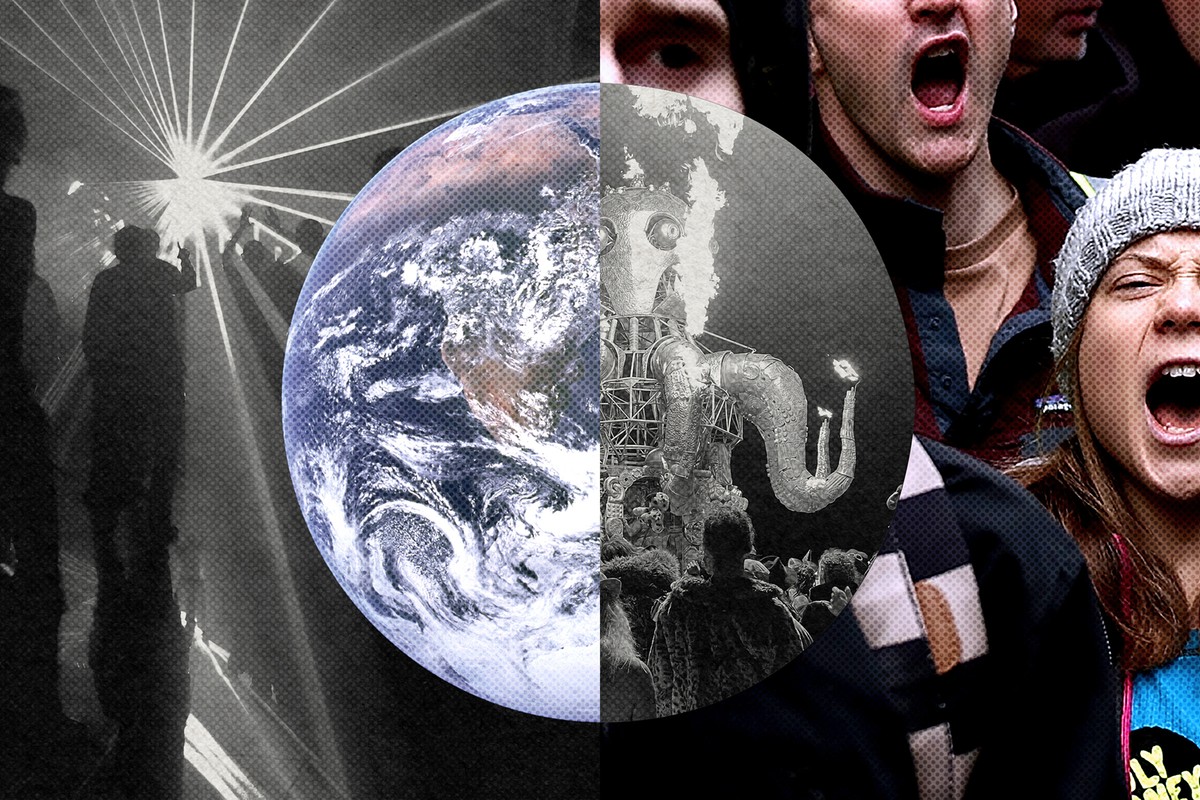

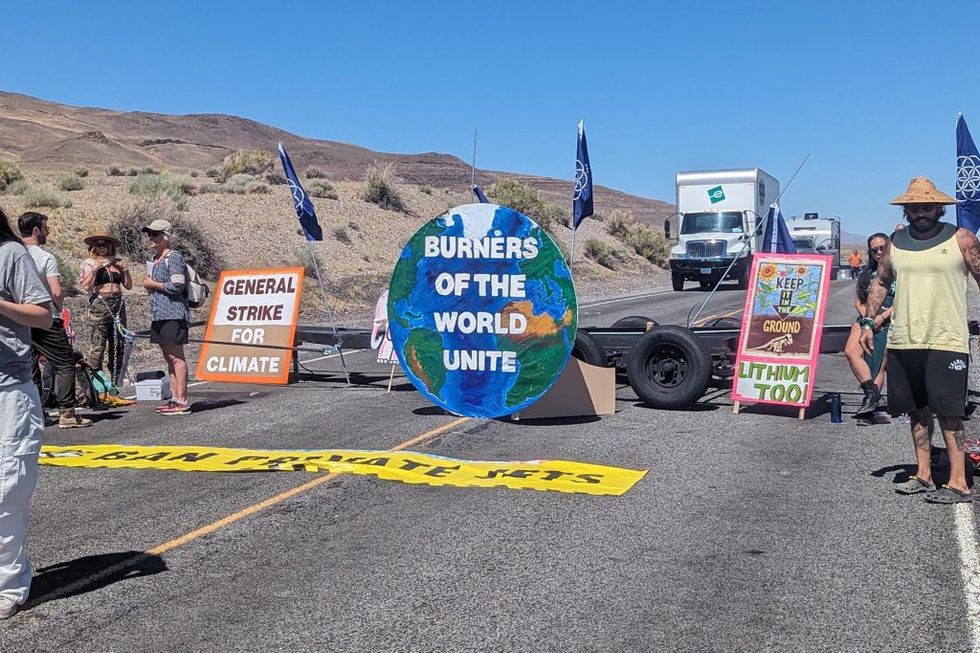
The morning of the blockade, Emily Collins, co-founder of the climate group Rave Revolution, suits up in a pair of camo pants and combat boots, unaware of the conflict that lies ahead. In the garage, her fellow co-founder, Tommy Diacono, puts the finishing touches on his masterpiece — a human-size planet Earth sign made out of wood with the day’s objective emblazoned in white paint: “Burners of the World Unite.”
“Nature loves courage,” Diacono repeats to himself like he does every morning, quoting American ethnobotanist and mystic Terence McKenna. “You make the commitment, and nature will respond to that commitment by removing impossible obstacles.”
That August morning, Diacono and Collins are preparing to be the obstacle. Joined by a handful other activists from Extinction Rebellion and Scientists Rebellion, and operating under the umbrella name Seven Circles, the crew plans to block the road leading to Burning Man with a trailer bed, forcing eager Burners to reckon with one last bit of reality before their week of revelry: The planet is on fire, and they — the elites — are the reason why. “Abolish capitalism!” read the other signs, making Seven Circles’ diagnosis of the climate crisis clear. “De-growth now!”
Collins and Diacono had targeted Burning Man out of the sense that it “controls,” as Collins put it, “a large piece of the cultural zeitgeist.” Formerly loyal Burners themselves, both credit it as a major catalyst in their political awakening; the first time they had glimpsed the possibility that human beings, by nature, are cooperative and generous.
“Burning Man changed my life,” Diacono says.
For the uninitiated, Burning Man is a weeklong arts extravaganza in Nevada’s Black Rock Desert. Once a year, the torchbearers of the counterculture gather with Silicon Valley technocrats on an ancient, alkaline lake bed known as the playa, and, with Amish-like efficiency, erect an 80,000 person metropolis that is half Mad Max, half Mos Eisley cantina.
Crucially, no money, save for ice, is permitted. Instead, imagine dancing at sunrise when, impossibly, a piece of honey toast appears in your hand, a beekeeper who has waited all year for this moment grooving to your delight, or, matted with grime, staggering into a leopard-print lounge and receiving a foot massage from a stranger who observes some detail about your inner being no one else has ever noticed. Burning Man’s commitment to gift giving and radical inclusion really does seem to bring out the best of humanity, but somewhere behind the rumble of private jets and whine of RV generators, an uncomfortable question began to jangle:
How long can you celebrate Burning Man when real people are on fire?
For climate science godfather James Hansen, 2023 and 2024 will be remembered as the “the turning point at which the futility of governments in dealing with climate change was finally exposed.” In California, Allstate and State Farm pulled out of the home-insurance market, citing wildfire risk, while in Hawaii, the deadliest blaze in more than a century killed 100 people in Lahaina. Meanwhile, on Kauai, Mark Zuckerberg, who once arrived at Burning Man via helicopter, is building a vast underground shelter assumed to be a bunker for civilizational collapse — a reminder that while the tech bros may play apocalypse for a week each year in Black Rock City, they are also taking the real one they helped create very seriously.
As we leave the ticky-tacky of suburban Reno behind, Andrea O’Ferrall softly cries. A silver-haired woman from Seattle who quit her job teaching fourth grade to focus on climate activism full time, this is not the retirement she had imagined — handcuffing herself beside strangers in the glaring Nevada sun.
“I think we’re going to have a collapse,” she blurts. It is a conclusion the other activists have already grieved.
Within a few hours, they would be on the ground, a gun in the air, and their blood on the earth.
SOMETHING DESPERATE AND DEFIANT is stirring in the climate movement: As mass climate demonstrations have decreased the past few years, smaller and more confrontational forms of protests are on the rise.
Soup thrown on Van Gogh’s “Sunflowers,” or rather, the protective glass. Feet glued to the floor of the U.S. Open. Rome’s Trevi Fountain dyed black. Traffic snarled. Pipelines blocked. Some of these actions over the past few years are Hail Marys, quixotic attempts to do something — anything — in the face of the unthinkable. Some are performance art designed to prod: Which is more absurd, this, or that we would let the world burn? A few are designed to make extraction more costly. Nearly all are reflective of an online generation’s implicit understanding of the attention economy: Conflict equals clicks.
For Dana Fisher, a sociologist at American University and author of the new book Saving Ourselves: From Climate Shock to Climate Action, the change in tactics became apparent when Greta Thunberg decided to get arrested at a German coal mine in January 2023 — a clear escalation from the Fridays for Future strikes she was previously leading prior to the Covid-19 pandemic.
Fisher argues these acts of civil disobedience are in their earliest, mildest days, and will ideally spur a mass mobilization at a scale unlike anything the U.S. has seen before. “It will start with something that looks like George Floyd, which was the largest sustained protests in U.S. history, and move along from there to the point where we start to see our elected officials in our government start to feel like they’re facing what we call a legitimation crisis,” she tells me while under tornado watch in Washington, D.C. “And that’s when they’ll start to act, when they start to realize that if they don’t act, they’re going to lose control.”
Different scholars have different ideas about how many people it would take to provoke “a legitimation crisis.” Erica Chenoweth, a political scientist at Harvard University, is frequently quoted for her magical tipping point number of 3.5 percent of the population, or about 11 million people in the United States. Chenoweth herself points to the work of Damon Centola, and suggests it would need to be closer to 25 percent — a quantum leap from where the movement is now.
In September 2019, climate demonstrations hit their peak when 6 million protesters skipped school and work to take part in the Fridays for a Future strikes. In the United States, half a million people participated. Mun Chong, an activist with Seven Circles who says she had never thought about the climate before in her life, was riveted. “I was just shocked to see so many kids marching,” she tells me in Reno. Shortly after, she joined the U.S. chapter of Extinction Rebellion.
Then Covid-19 happened, and the George Floyd protests, diverting some of the movement’s momentum. The Sunrise Movement, heralded by some as the climate vanguard after its members occupied then-House Speaker Nancy Pelosi’s office in 2018 to push for a Green New Deal, found itself facing internal criticism from activists of color who said they felt “tokenized.” Then President Joe Biden won, and the progressive coalition that had gotten him over the line seemed to slump — complacent or plain exhausted — into a post-Trump stupor. Now, horrified by concessions to the fossil fuel industry in the Inflation Reduction Act, the failure of COP28 to produce any meaningful fossil-fuel phase-out, and the unprecedented pumping of fossil fuels in the U.S., some activists are waking up again, and they’re done playing nice.
MICHAEL GREENBERG IS the 30 year-old co-founder of the plucky new climate group Climate Defiance. Since forming a year ago, the Columbia grad’s “small, SWAT-like” team has raised bird-dogging to an art, interrupting everyone from Sen. Amy Klobuchar (D-Minn.) for supporting the L 3 pipeline, to Sen. Joe Manchin (D-W.Va.) for championing the Mountain Valley Pipeline. Many of their videos show them cussing out their targets, sometimes provoking physical violence. After one protester called Manchin a “sick fuck” at a recent Harvard Institute of Politics event, he was shoved to the ground by a fossil-fuel lobbyist volunteering as a Manchin aide; real harm, but also prime content.
“Five people shutting down the CEO of Exxon got five million views,” Greenberg boasts, referring to another action this past December when activists unfurled a banner that read “Eat Shit Darren” at an awards banquet for Darren Woods, hosted by Chemical Marketing & Engineering, a “nonprofit focused on sustainable innovation in the chemical industry.”
In one year, such actions have netted Climate Defiance 65 million views on X (formerly Twitter), says Greenberg, and stories in The New York Times and this magazine — impressive stuff for an organization still in its infancy. It also claims its agitating — and the White House meeting that followed its protest of senior clean energy advisor John Podesta — is partially responsible for what environmentalist Bill McKibben is calling a tentative win for the movement: In late January, Biden announced a temporary pause on new liquified natural gas (LNG) export projects.
The political timing was lost on no one.
“The youth are just over this president,” says Roishetta Ozane, founder of the Vessel Project and a frontline activist who guides federal officials on tours of her community in “Cancer Alley,” Louisiana. “They they are calling him ‘Genocide Joe.’ They feel like he doesn’t care about other people…. They’re upset about the Mountain Valley Pipeline and they’re just fed up with it, right? So something bold has to be done.”
Ozane, who says she was helping plan “a large-scale civil disobedience action” at the Department of Energy in Washington if the administration did not go through with the LNG pause, says the disruptive videos Climate Defiance is known for “haven’t been taken lightly.”
“They’re basically ready to burn it down,” she says, citing the comments she sees on their videos.
But for a movement that largely agrees mass mobilization is the goal — tens of millions of citizens participating in protests and strikes, enough to directly threaten the government — converting virtual numbers to physical ones is perhaps the defining challenge for this new generation of digitally-native climate activists.
Marshall Ganz, 80, cut his organizing teeth with the Student Nonviolent Coordinating Committee in Mississippi and United Farm Workers, learning much of the art of organizing from Cesar Chavez himself. He points out that sustained power building — the basis of any real movement — requires extremely strong social bonds, the kind developed IRL. Ganz should know: He once organized the Salinas broccoli industry through a soccer league.
When I reach him by phone, he suggests we switch to FaceTime so we can see each other. “That’s better,” he says, placid posture and walrus mustache coming into view. He proceeds to ask me 10 minutes’ worth of questions about my home and steps through the world, gently schooling me in the value of slower, more human relating.
Ganz thinks many of the disruptive climate protests today are mobilizing rather than organizing, and “just sending symbols.” Doing one attention-grabbing action after another, he explains, is not the same as building an organization that can sustain power for the long haul. Even as he says it, his eyes twinkle kindly; he wants the kids to win, and has devoted the last 20 years to teaching organizing at Harvard University and around the world. “Their energy is precious,” he says. Nevertheless, he is also honest.
“It’s a little bit like in cartoons where Wiley Coyote runs off the cliff and then looks down and there’s nothing there,” he says, describing his experience advising another prominent youth-led climate group transfixed by its own X dashboard and what he calls “the enchantment of numbers.”
“It’s a little bit,” he adds, “like tactics in search of strategy.”
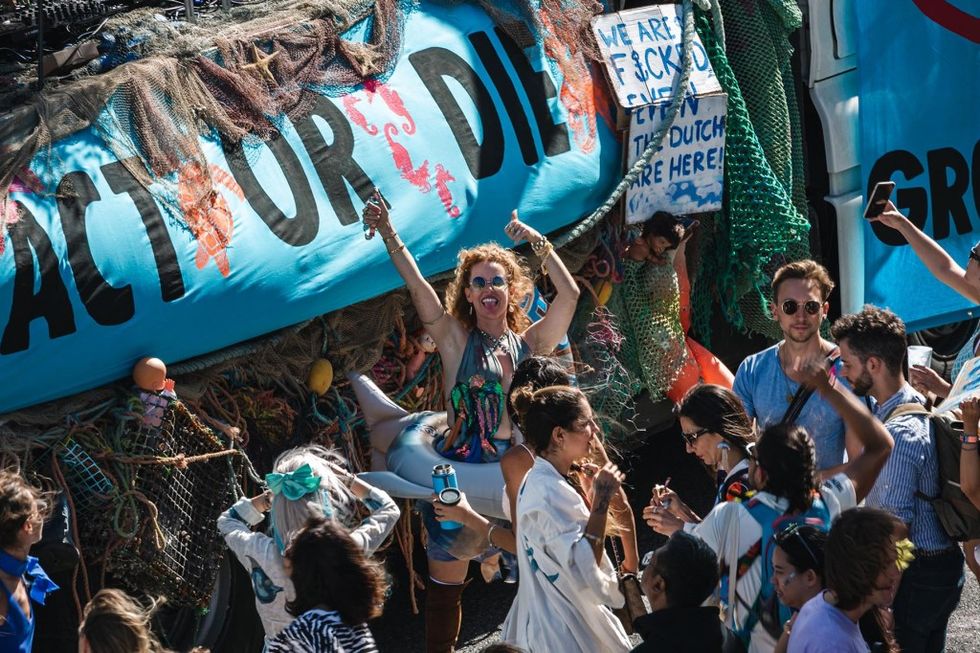
RAVE REVOLUTION’S STRATEGY, in theory, was to make the revolution irresistible. It’s an idea first articulated by filmmaker Toni Cade Bambara, and a thought that many ravers have had on the dance floor: If you want to mobilize the masses, you have to first move them.
Diacono, 40, had been inspired by the “technoprotests” in Tbilisi, sparked in 2018 when police raided Bassiani and Café Gallery, two nightclubs known as havens for the queer community in post-Soviet Georgia. According to the police, the raids were in response to several drug-related deaths, but the club owners maintained they were the victims of a fascist smear campaign. In the hours following the raids, the club kids moved to the steps of Parliament as thousands danced in an epic party that lasted days.
The technoprotests struck Diacono as something he and his Burner friends were well-positioned to replicate. The concept also seemed to inject a certain cool, artistic factor into the grave, nebbishy world of environmentalists. Wasn’t that what the climate movement was missing, what the Civil Rights Movement had? Spirit? Soul?
As Diacono cooked pasta for us one night last March, he held forth on these ideas with the heat of a martyr. Originally from Malta, a small island nation near Italy and Tunisia, Diacono had woken up to the climate crisis, hard. Built like a bull and tattooed like a pirate, he oozed both testosterone and tears. He would text me links about emperor penguins experiencing “total breeding failure” because of the loss of sea ice. Most days he sounded deeply depressed, always tottering, it seemed, on the edge of a nervous breakdown.
It’s like you’re on a ship foundering at sea, he says later of his growing alienation. “And all the people you love, instead of trying to save the ship, or finding a life boat, are all drunk at the buffet, arguing over the last shrimp cocktail.”
Diacono’s problem was this: He understood the truth a little too clearly. Renewable energy is cheaper than fossil fuels, but the cheaper energy is, the more people consume. There simply was no way to stop the destruction of the planet without destroying capitalism, he believed. In 2020, he abandoned his job working as a restaurant consultant in Milan, hopeful, again, from the pandemic relief checks. They proved that different political realities were possible; everything was a choice.
With his newfound freedom, he organized a permaculture workshop in Portugal, increasingly aware that “going back to farming is going to be part of the healing process for all of us to get out of this mess.” There, on a friend’s property, he met Collins, originally from Florida, who had been in the process of building an eco-commune in Mexico. They bonded over their deep love for the planet, a reverence that psychedelics, another major thread of Burner culture, had enhanced. Now, burying mounds of dead wood back into the depleted soil, they sought to live a life of imperfect devotion.
The first rave of theirs I attended was on Earth Day in Union Square, New York City. Instead of a disco ball, the Climate Clock hung overhead. Installed at the request of Greta Thunberg, its digital numbers told the time that April day in 2023: Approximately six years left to avoid 1.5 degrees celsius of warming, the threshold after which all hell — scientifically speaking — breaks loose. (According to former NASA atmospheric physicist James Hansen, the time is really less than one year.)
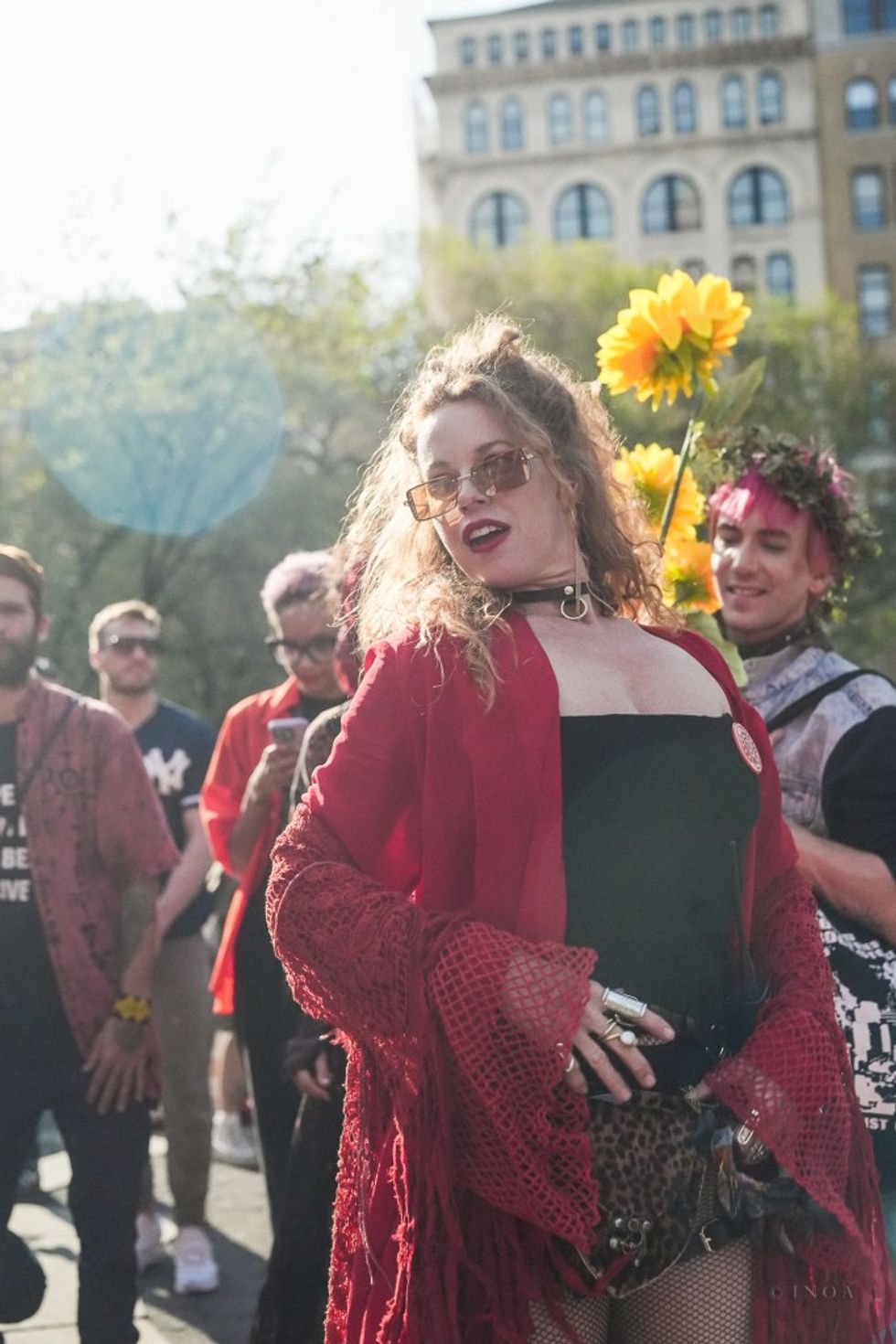
Throughout the afternoon, DJs spun, pretty people danced, and an activist from Ecuador pleaded for his motherland, his feather headband outlined against the Whole Foods behind him. Chris Smalls was supposed to be there but wasn’t; another organizer from the Amazon Labor Union sang original reggae songs instead. Curious onlookers joined. Disgruntled chess players left. Environmental lawyer Steven Donziger, freshly free from house arrest after his battle royale with Chevron over oil drilling in Ecuador, gave an impassioned speech about how Biden won’t save us, then hurried off to a Marianne Williamson fundraiser.
In the crowd, Diacono sulked, unable, it seemed, to get in the mood. Later, I learned that he and Collins had felt betrayed; they had expected hundreds of New York Burners to show up, but few of them had.
THE ROAD TO BURNING MAN is narrow and slow, passing by miles of sagebrush to the east and the Pyramid Lake Paiute Reservation to the west. Once a year, the rural highway becomes the path of a mass migration as tens of thousands of Burners make their way to Black Rock City — a procession Seven Circles intends to bring to a standstill.
I am riding to location with Collins, O’Ferrall, and Will Livernois — a member of Scientists Rebellion from Seattle who believes “scientists are not good at talking about these things,” and is hoping that Seven Circles will recruit some creative types today. Behind us are Chong and Holley White, an Extinction Rebellion activist from New York City, and Guy Danilowitz, a public defender from Sacramento who is supporting the group as a legal observer. In front of us are Diacono and a getaway driver hauling the trailer that the activists are planning to lock down to, ideally prompting their arrest.
Suddenly the walkie-talkie fuzzes to life and Diacono’s voice crackles over. It’s almost time to stop. “Confirmed for Car Two, over.” Collins replies. “Car Three?”
Car three confirms; everything seems to be in place. But every protest operates according to its own turbulent logic, and as soon as the trailer screeches to a halt sideways, time starts moving very fast.
The abruptly stopped Burners start rolling down windows, alarmed and offering assistance. When it becomes clear they are being waylaid by people with planet Earth signs, and not friendlies with a flat tire, they surround the activists, enraged. “These fat fucks are trying to stop us from going to Burning Man!” a man in an American-flag cowboy hat exclaims, trying to move the trailer bed and dragging Collins, who is chained to it, in the process. “This is a democracy!” Diacono intervenes. “We have a right to protest!”
From the other lane headed to Reno, a woman who identified herself as Athena approaches. “You guys don’t have no business on reservation land,” she says authoritatively, referring to the Pyramid Lake Paiute Reservation. “This is federal land. You guys go do your BS over there with Burning Man somewhere else.”
The pissed-off Indigenous people present a problem. Seven Circles know they are on Bureau of Land Management ground; they purposefully picked the spot because there is a hill, preventing the Burners from driving around them in the mostly flat desert. But now, face-to-face, the dynamic is uncomfortable. “We can’t do this!” White blurts, getting cold feet.
“Call the fucking cops and tell them they have guns!” Cowboy Hat huffs to a companion as he stalks back to his vehicle.
Minutes later, two Pyramid Lake Rangers wail to the scene, dust clouds blossoming behind their trucks. Suddenly, one plows through the activists’ barricade, narrowly missing Chong as the other activists scream in terror. Wheeling around, bumper dangling, he comes back for a second pass. “I’m going to take all of you out,” a disembodied voice from within the truck’s cabin drones. “You better move.”
Now a ranger leaps from the mangled truck, brandishing a gun. “Get on the ground, now!” he shouts, kneeling on the back of White, the only activist who hadn’t wanted to get arrested, the one who was supposed to be the police liaison. “We’re nonviolent!” shrieks Collins, still chained to a piece of the trailer bed, now a heap of scattered metal.
“Stop resisting!” the ranger commands White, slamming her head off of State Highway 447. ”He’s hurting me!” White moans, a trickle of blood running down her face.
On the shoulder of the road, Danilowitz, the legal observer, attempts to communicate with White and take down the officer’s information. Seconds later, he too is tackled into the dirt.
Later, the rangers would justify their use of force by saying they had thought they were responding to an armed group. They were also on edge. Just a day before, one of their colleagues had been killed in a shootout nearby.
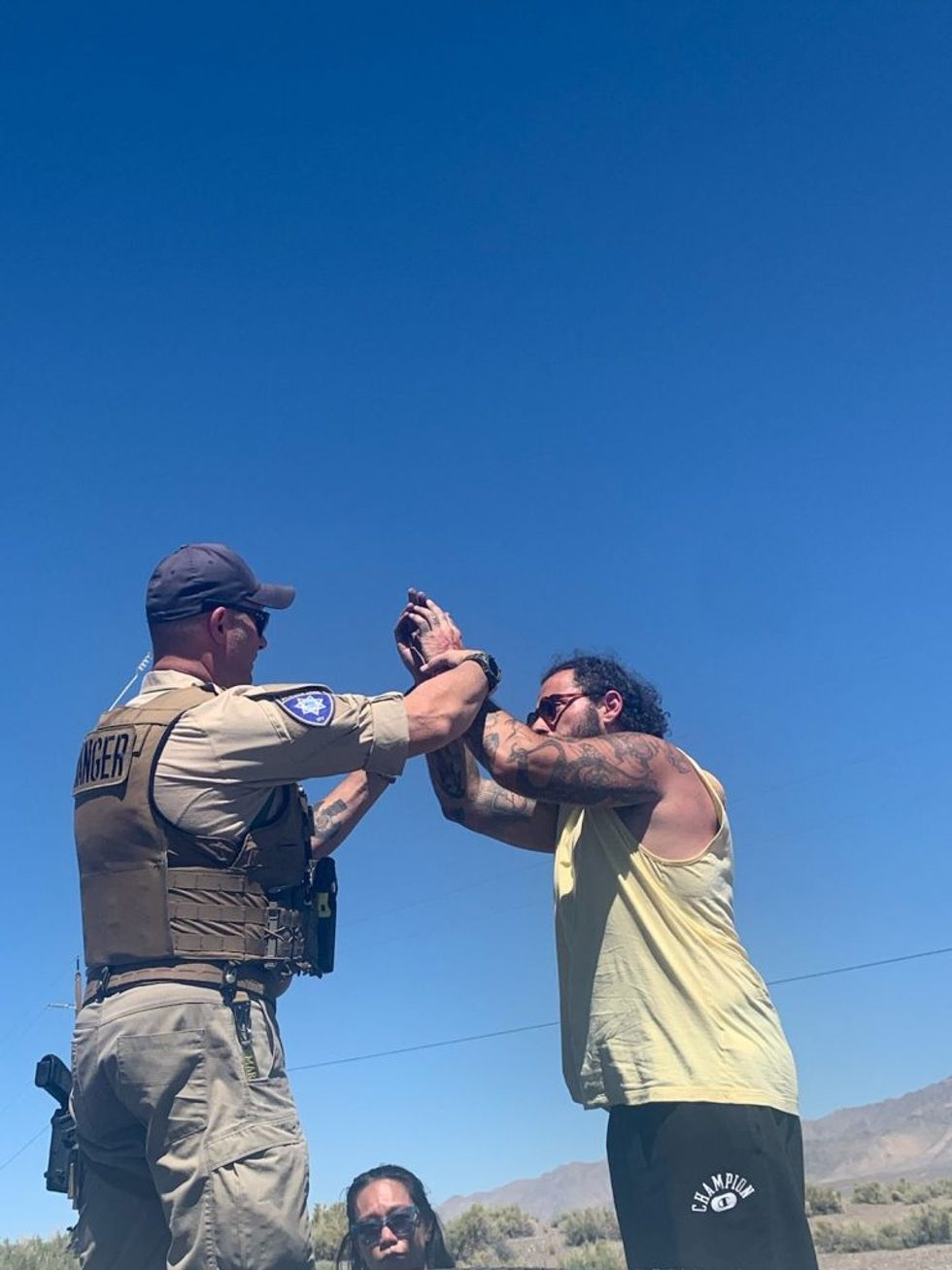
As they handcuff the activists, I hitchhike away from the scene. I want to see for myself what Collins and Diacono had — the promise of Burning Man that had once led them to believe the eco-revolution could spring from its head.
As I set up my tent that night in Black Rock City, I eavesdropped as Burners a few flaps down discussed the action, which had already gone viral on YouTube. Their conversation flowed over the same contours I would hear again and again that week: What was the point? Why pick on us? Don’t they know we already agree?
THIS IS THE CLASSIC ARGUMENT against disruptive protest: People are typically put off by it, especially if it inconveniences the common man. Robb Willer, a sociologist who studies protest tactics at Stanford University, has found that while disruptive actions may trend on X, “extreme protest tactics” tend to turn people off to the groups that use it — and sometimes also the cause itself.
Last year, Extinction Rebellion UK, sensitive to this kind of critique, announced it was abandoning its foundational methods of blocking bridges and roads in London. “WE QUIT!” it posted provocatively on X on New Year’s Day.
Founded in 2018, Extinction Rebellion, or XR for short, is one of the largest climate groups in the world, with chapters in 86 countries. Originally committed to nonviolent disruptive protest, its theory of change also includes making mass protest popular. At times, the two tactics have appeared at odds, like in 2019, when crowds dragged XR activists off of a train they had halted in Canning Town, a predominantly Black and Asian working-class neighborhood, prompting XR to issue an apology.
In April 2023, XR unveiled its rebrand with a peaceful, family-friendly demonstration around Westminster advertised as “The Big One.” Yet although the Big One was the largest climate protest in U.K. history, with more than 60,000 people marching without any arrests, the papers barely covered it, spurring a fresh round of debate about whether media attention outweighs possible alienation.
As Laura Thomas-Walters followed the ping-pong match between those who said disruptive protest was effective and those who said it was a turn-off, it struck her that both sides were missing the point. A Welsh social scientist who serves as a researcher in XR’s Data Analysis Insight Circle, she had found that popular support, while a bonus, doesn’t really make a difference given how today’s democracies serve corporate interests. “As harsh as it sounds, the public has very little influence on creating political change,” she tells me. “I would love to believe it wasn’t so.”
The voices that do matter, from a purely functional perspective, are the voices of the elite, a group she characterizes not necessarily as the one percent, but as people who work in law, finance, and media, or own businesses.
She points to Birmingham, Alabama, in 1963, when activists used a variety of tactics such as sit-ins and boycotts of white merchants during the Easter shopping season to push for desegregation. “It got to the point where they might still have been Ku Klux Klan members themselves and racists, but they started writing and demanding action from the government to address the concerns because it was affecting their business personally,” she explains.
In other words, the real juice is in squeezing the elites, but to do it at any meaningful scale, two elements are needed.
Bodies and time.
WHEN LUCAS WINNIPS, a Dutch civil servant, first began protesting the Netherlands’ fossil-fuel subsidies in a ministry office in October 2020, he was joined by six comrades. Nearly three years later, he stood on a highway in the Hague with 25,000. When telling the story of how he and his fellow activists achieved such a feat, Winnips tends to repeat one phrase: “We just plowed on.”
Winnips is part of the Dutch chapter of Extinction Rebellion, responsible for one of the most successful climate campaigns in recent history. Last year, after protesters occupied the A12 highway for 27 consecutive days starting Sept. 9, parliament caved to their demand, and asked the cabinet to come up with scenarios for how to phase out fossil-fuel subsidies.
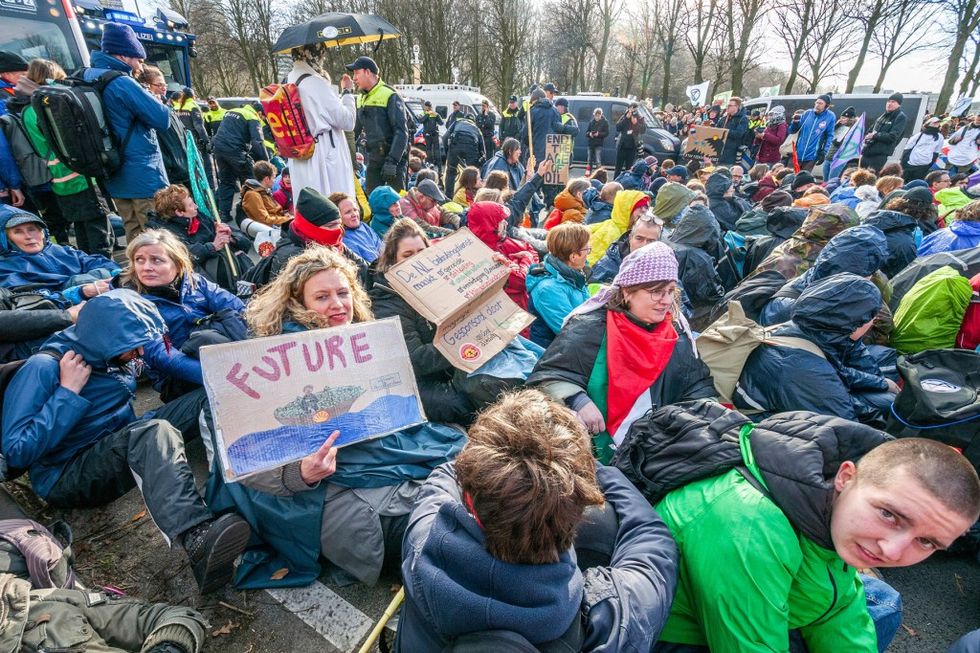
As of yet, nothing has been changed, so the protesters march on. But even getting to this point was a slow, grinding process, involving more than 50 actions, including 37 blockades of the A12, and more than 13,000 total arrests. Protesters faced water cannons and hypothermia; the media, in the beginning, was largely critical. But as more people joined and the official subsidy number kept being upwardly revised — from 4.5 billion euros in 2020 to as much as 46 billion euros in 2023 — the narrative began to shift.
It helped that they did the protests each day at noon, giving drivers a chance to find alternate routes. It also helped that the protesters strived to be model citizens, taking their arrests peacefully and even bringing a complete orchestra onto the A12 to play. In a society once ranked least likely to participate in a climate protest because the population tends to be rather satisfied with the status quo, says Winnips, the A12 protests have become “part of the cultural fabric.”
REVOLUTIONS ARE ALWAYS CULTURAL, says Roger Hallam, co-founder of Extinction Rebellion, because people hate politics. “When people hate politics,” he says, “that in itself is a political revolutionary artifact.”
In 2020, Hallam was ousted from the organization he helped create for being too rigid and too radical, a term that makes him bristle. “In terms of objective morality and certainly in terms of historical sociology, we’re the average guy, and the other guys are psychopaths,” he says.
Average behavior for Hallam included throwing pink paint on NGOs like Greenpeace (the final straw for XR), and using drones to stop planes coming in and out of Heathrow Airport. It also included advocating for regime change. A few days after the paint incident, one of Hallam’s other orgs, Beyond Politics, threw an event in Trafalgar Square titled, “Bring Down the Government.” Speaking to reporters, he explained his thinking. “What we’re doing today is taking the next step, from rebellion to revolution. That’s to say: Regardless of what anyone else thinks, regardless of who follows us, we are enacting a revolution against the British government, not to negotiate with it, but to remove it from power,” he said.
Hallam, who pulls many of his ideas from years of studying civil disobedience at King’s College, believes much of the West is in a “pre-revolutionary period.” That’s not a normative preference for revolution over reform, he clarifies; revolutions can be quite nasty. “I’m just saying as a sociologist, we’re way past the point where carbon regimes, with their carbon parties, are going to reduce carbon emissions by 50 percent in five years. It’s just a ridiculous notion. It’s dreamy and unrealistic.”
Hallam’s prediction for the climate movement is that part will drop the word “climate” altogether. “What we need to have now,” he says, “is a revolution against the global elites in order for the younger generation to survive.”
In the United States, Seven Circles is the only climate group Hallam sees with the right analysis. It’s still “very small” and “not too impressive,” he told me last November, “but it basically has the DNA, you might say, to build a mass movement.”
When I catch up with Diacono and Collins, they are no longer in the U.S. but northeast Italy. It’s been five months since the blockade, which resulted in minimal fines, and although they feel they successfully exposed Burning Man for what it is — a massive cosplay — they are restrategizing. They are also looking to buy, for 100,000 euros, a crumbling stone estate where they hope to ride out collapse by farming rabbits, chickens, and bees. Their experience of the blockade had radicalized them even further; they now no longer consider themselves climate activists, but socialists devoted to system change, a conviction that Israel’s brutal war in Gaza has only amplified tenfold.
“What we saw with Palestine,” Collins tells me over Zoom, “is that if our leaders are not even willing to budge in bombing innocent civilians, native innocent civilians, then they’re not going to budge an inch on carbon, on oil drilling, on wildlife, on extraction.”
“You are asking people that are running a system that cannot even stop itself from bombing children, doing a genocide, to please burn less fossil fuels,” agrees Diacono.
BURNING MAN ENDS EACH YEAR with torching a massive, man-shaped effigy, whose incineration is open to interpretation. As seen in many ancient festivals, this act is both highly cathartic and completely symbolic, a valve to relieve any true revolutionary pressure among the masses, just as Mardi Gras crowns a fake king.
Last year, the ritual was postponed due to rain — a highly aberrant two to three months’ worth that turned the powdery white playa into a squelching soup of burning, alkaline mud, making driving impossible and walking a treacherous adventure. As we sheltered in place for days, shivering in our tents and peeing in bottles (the trucks that normally service the porta potties couldn’t make it through initially), it was impossible not to feel humbled.
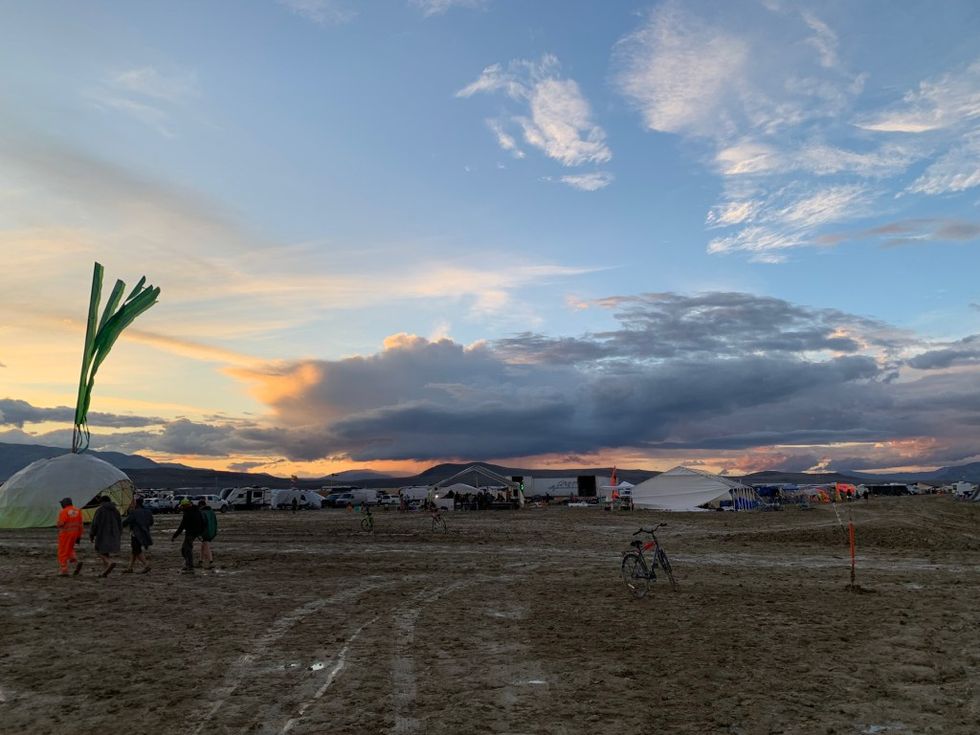
It was as if Mother Nature was laughing at us, or perhaps some old Paiute ghosts, risen from the same earth where we now were hunkered in all our blinking, LED buffoonery. I thought about the old millenarian prophecy — told by Northern Paiute weather doctor Jack Wilson, a.k.a. Wovoka, in 1890 — that God had given him power over the rain, and that if the people would dance a new dance, God would send a storm to purify the evil brought by white men. The ceremony, which spread among other tribes such as the Sioux and the Lakota, eventually became known as the Ghost Dance, known to school children today because it precipitated the U.S. Army’s massacre of hundreds of Lakota men, women, and children at Wounded Knee.
As Lakota medicine man Lame Deer once interpreted the prophecy, “They told the people they could dance a new world into being. There would be landslides, earthquakes, and big winds. Hills would pile up on each other. The earth would roll up like a carpet with all the white man’s ugly things — the stinking new animals, sheep and pigs, the fences, the telegraph poles, the mines and factories. Underneath would be the wonderful old-new world as it had been before the white fat-takers came.… The white men will be rolled up, disappear, go back to their own continent.”
Perhaps Wovoka was off by a century, I thought, as the winds whipped our tarps. Perhaps only now are we beginning to summon the storm upon ourselves.


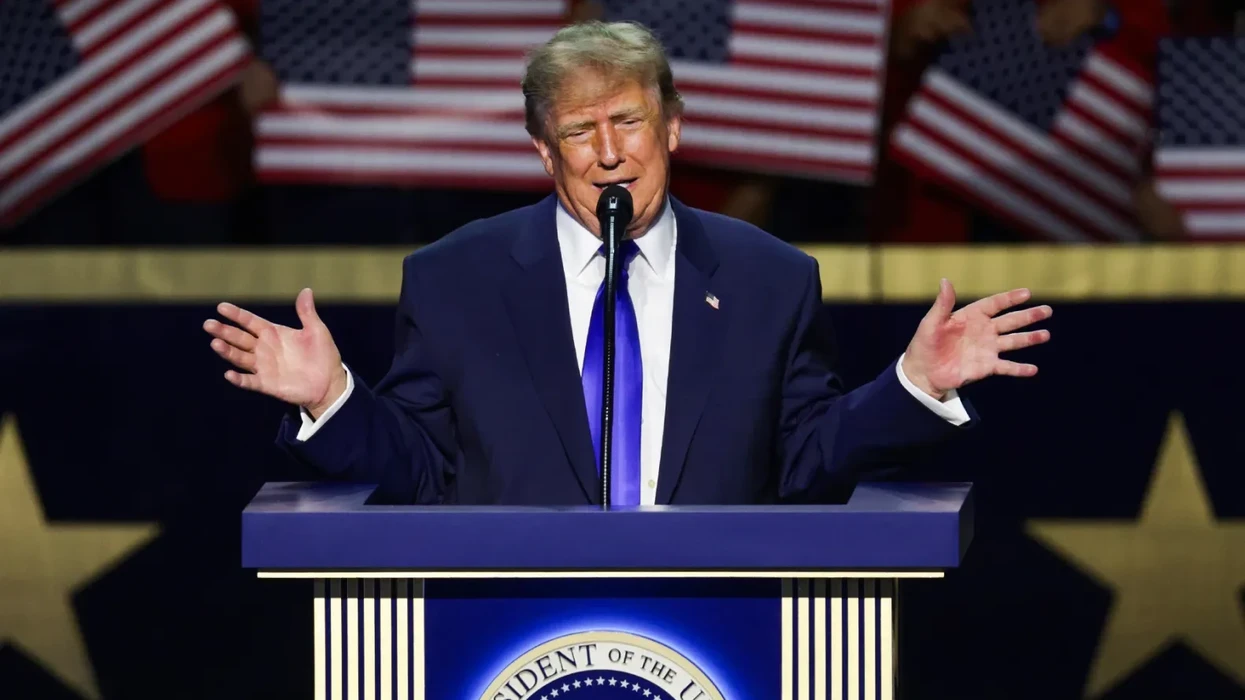





Canadian Prime Minister Mark Carney speaks at a press conference in Ottawa, Ontario, on Aug. 22, 2026.
How Mark Carney Became Leader of the Free World by Standing Up to Trump
In Canadian Prime Minister Mark Carney, Donald Trump has finally met an adversary who truly understands the art of the deal — and it could threaten the entire premise of his presidency.
There have been many self-inflicted catalysts to Donald Trump’s ruination: epic corruption, inflation and the soaring price of gas, the ceaseless angry old man posts and memes, ICE’s assault on the rule of law, the Supreme Court’s mullah-like extremism, his vanity, self-pity, cruelty, and of course the unprovoked, catastrophic failed war on Iran. They are all derived from Trump’s delusional belief in his nonexistent superpowers. But the downfall of Trump will also be forever dated to a small, inexplicable and quixotic folly: his attack on Canada.
Despite the president’s incessant, bizarre claims that he can destroy Canada economically as he wages a trade war against America’s neighbor to the north, in the last few weeks Prime Minister Carney has quietly but effectively ended Trump’s ability to lead the free world in any way other than as an extortion racket and disorganized crime syndicate.
In a potlatch, in the tradition of indigenous peoples of the Pacific Northwest, a head man would display his tribe’s wealth and power by lighting their most precious possessions on fire. The destruction appeared pointless to European eyes, but First Nations peoples understood the significance of the rite: If the chieftain of the tribe could squander incredible riches, what possible hope did a rival have in waging war against such an overwhelmingly powerful enemy? The mindless waste of resources in a potlatch, as every Canadian schoolchild learns, was actually a finely tuned demonstration of dominance, and a way to avoid conflict.
Trump, the self-described big chief of America, has concocted a new and perverse version of the potlatch that better resembles setting himself on fire. By lawlessly declaring an unprovoked trade war on Canada, Trump has set alight the most valuable assets of the United States: international alliances, the Constitution, respect, friendship, trust, goodwill, the rule of law (hell, the whole idea of law). Instead of displaying his power, Trump has demonstrated his fundamental weakness and loosening grip on reality. In Trump’s form of chaotic destruction, with his historical illiteracy and rat-like cunning combined with his desire to humiliate his perceived enemies, he isn’t pursuing trade policy or a geopolitical strategy. For Trump, domination is the point. The absurdity of farmers and fishermen and auto workers on both sides of the Canadian border having their lives set ablaze in service of the president’s ego trip is the end in itself.
Measured in a simpleton’s economic terms, America appears to have the upper hand in a trade war with Canada. The economy of the United States is more than a dozen times as large as Canada’s, so a trade war that represents a national cataclysm north of the border will barely register in Trump’s America. Trump’s pretextual use of an alleged “trade deficit” to justify his trade wars is concocted according to his whims, urged on by fanatical anti-trade sycophants and enablers, the ever-changing metric a means of blackmail, the nonstop stream of insults and half-witted social media posts somehow managing to be simultaneously enraging and mind-numbingly boring to my fellow Canadians.
“Just watch,” Trump trolled last week as he promised to gratuitously punish Canada, like an old drunk sitting in his underwear yelling at his television set — only with the powers of the commander-in-chief. “All we have to do to cut our trade deficit with a country is not trade with them,” he said in the Oval Office over Labor Day weekend, adding that America will also stop trading with Europe, Mexico, and Switzerland, threatening in one unhinged rant to end trillions of dollars in commerce. As if to underscore his madness, he followed it up with a meme showing the American colors covering all of North America, as well as Greenland and Iceland. But for reasons known only to himself, he has focused his true menace on my home and native land: “If we don’t do any trading with Canada, if we just end all trade with Canada, we’d save ourselves $90 billion. Canada would be in a heap of trouble. I don’t think they’d exist. Because, again, they do 95 percent of their business with us.”
If you don’t think this is the unhinged talk of a confused old fool showing signs of dementia, take a look at the bond market.
After Trump illegally breached America’s free trade agreement with Canada last year, imposing tariffs that were based on transparent lies about fentanyl crossing the border, he proceeded to gaslight America’s ally with a steady stream of infantile ALL CAPS derision.
Living inside a constant reality TV show, with fake deadlines and formulaic melodrama, Trump then imposed a 30-day timeline for a new accord, or he would unilaterally impose additional 50-percent tariffs relying on a never-before-used statutory justification — a preposterous gambit under America’s binding trade treaty with Canada. Confronted with the prospect of constantly changing trade terms in an increasingly lawless America, Prime Minister Carney didn’t take the bait, engaging in talks in good faith but with eyes wide open (and elbows up, as they say in Canada). Using one of the oldest tricks from an increasingly pathetic and obvious set of bullying tactics, Trump then prematurely announced that a deal with Canada had been reached when there was no such agreement — an attempt to box Carney in. But again, Carney didn’t cave like so many other world leaders.
Like the many con men I’ve written about over the years, Trump is convinced of his own genius, certain that the world is a ship of fools and that he — and he alone — can see through the tissue of lies and deceptions. The problem, inevitably, is that grifters are never as smart as they think they are, a fatal flaw compounded when they start to believe their own lies — and then encounter someone who can see through their act.
As his second term has illustrated, Trump is certain that everyone will cow in the face of his “Hulk Smash”: the Supreme Court, television networks, Ivy League universities, white shoe law firms, the abject former UK Prime Minister Keir Starmer chasing after the president’s windblown papers like a schoolboy — an image that quickened his downfall. Changing the basic terms of the proposed agreement at the last moment is a classic power play in any negotiation. So it was with Canada this summer. At the last minute before Trump’s invented time limit expired, as the clock ticked towards midnight, Trump’s minions attacked Canada’s profoundly important French culture — ridiculing the notion that there is such a thing as a distinct Canadian nation at all. He slapped tariffs on the automobile industry, lumber, steel, aluminum, and for kicks and giggles, hockey sticks to shove his version of reality directly up the ass of the milquetoast Canadians.
Under the new terms Trump purported to impose, the United States (which is to say Trump) would have control over any other Canadian trade agreements. Trump then reserved the right to change the deal at any time in the future, for any reason, with no notice — meaning the deal wouldn’t be worth the pencil it was written in, as Carney noted.
Lake Ontario, that’s now Lake America, and your prime minister is a governor, and you’re going to wish that you were the 51st state by the time I get through with you.
But then something bizarre happened to Trump’s bonfire of the vanities. In Carney, the president discovered that he had encountered a man who was not looking for a fight — but who equally wasn’t afraid of him. For all the bluster and menace and braggadocio, Trump didn’t realize that he had walked into a trap. By agreeing for negotiations to happen this summer, a year ahead of the larger deal for the renewal of the North American treaty, Carney had picked the time and place for the inevitable looming confrontation; with Trump vulnerable in the coming election, the canny Carney had managed to create real leverage. Carney then cleverly enlarged the dispute and raised the stakes by accurately calling America’s attack a declaration of war, surprising the flat-footed American negotiators who apparently didn’t take Trump’s threats seriously themselves — adding another layer of leverage to Canada’s supposedly weak hand.
In Carney, it turned out, Trump has met a leader of real strength, the understated but steely and confident kind reflecting Canada’s national character. The irony is that Carney was elected last year almost entirely as a result of Trump’s Kafkaesque trade war, defeating a weak-kneed conservative who very likely would have meekly submitted to America’s neocolonialist threats. Another irony is that the politically inexperienced Carney turns out to have genius-level instincts. The whippet-thin banker is an unassuming figure, the opposite of Trump, but every bit as ruthless in his way. He is a self-made man and intellectual with degrees from Harvard and Oxford, who epitomizes the meritocracy. The child of schoolteachers in the far north Alberta, raised in a home that prized education and social responsibility, Carney earned his way to the absolute heights of global finance through his intelligence and diligence. His resume is almost a parody of accomplishment, with stints as the head of the banks of both Canada and England, as well as years with Goldman Sachs and working for the likeminded businessman-turned-politician Michael Bloomberg. Faced with the global financial crisis of 2008 and then Brexit, Carney witnessed the idiocies of economic self-destruction in the 21st century, preparing him with a unique set of experiences to confront Trump’s lawless trade war — to Canada’s great good fortune.
In truth, Carney was elected specifically to deal with such a crisis, and Canada has had decades to prepare for this conflagration. Living next to an elephant requires a certain amount of caution and awareness, so Canadians understand American politics down to the last looney. Knowing your enemy is the greatest asset in war, as the ancient Chinese philosopher Sun Tzu said, and Carney’s deeply intimate awareness of America gives him the ability to exploit Trump’s obvious weaknesses: a thin skin, hubris, impulse control, arrogance
Plan beats no plan is a truism of all crisis management, an acknowledgement that any executive, sports coach, or sentient human being understands. If you want to shape events and succeed, do the work to anticipate and understand what lies ahead so you don’t live in a state of constant surprise, chaos, and disarray. Planning is also the ultimate expression of Carney’s life force, the guiding principle of his meticulously accumulated achievements and triumphs. While Trump, like so many fools throughout time, doesn’t read or listen to contrary opinions or care to prepare, trusting his gut and native intelligence, Carney is a careful student of power dynamics and the deep lessons of history. Control what you can control, Carney explains to Canadians as he describes the need to diversify and de-risk the relationship with a declining United States. Europe might seem distant geographically, but Russia’s attack on Ukraine and self-inflicted withdrawal of its resources from Europe present an opportunity for a resource-rich nation like Canada. Membership of the European Union seems fanciful now, perhaps, but there is no question that Canadian distrust of America is hardening into real anger and dismay. The same logic applies to the countless opportunities in Asia, with Carney traveling the world signing new free trade agreements as Canada pursues a strategy to end its dependence on the undependable Americans. There is also no turning back the clock as Canada duly notes how few friends it really has in the political and media classes of the United States.
Given Trump’s use of Manhattan real estate brute force strong-arm tactics, imagine Carney’s eyes lighting up when he realized that American negotiators were attempting to attack the French-speaking peoples of Canada and the entire notion of a national culture. There was obviously no way the Canadian people were going to accept such humiliation and subjugation at the hands of an amoral gangster. As Trump’s designated thug Howard Lutnick piled on the bad faith, last-minute demands, it became evident that Carney had no choice but to walk away — despite the awful short term pain America could inflict.
Thus Carney’s plan has been put in action, with the backing of a nation unified in outrage at America’s belligerence. Trump can harm Canada, but that street runs two ways. By standing up to Trump, Carney has lured him on to the economic battlefield at the precise moment when his presidency is collapsing, with the calamitous midterm elections looming. Tight races are being run in many states that are heavily dependent on trade with Canada — Ohio, Maine, New Hampshire, Michigan, Wisconsin, Pennsylvania, Alaska — the exact jurisdictions Canada will target with long-planned tariffs aimed at specific economically sensitive economic sectors, in order to increase the pressure on the ill-prepared president.
Apart from cheap shots and idiotic put downs, Trump has no history of seeking compromise and no real plan in response, as usual, apart from lashing out like a cornered animal. Trump also has vanishingly little popular support in America for his personal grudge match with Canada, an obsession that looks weirder with each passing insult. The struggling North American car industry has been jerked around by Trump’s vengeful destruction of the electric vehicle, losing billions in the process. and taxes described as tariffs will make life even more unaffordable for working American consumers. Uncertainty and unpredictability are lethal to any investment strategy, as actual business people and union leaders understand. Across the rust-belt industries Trump proclaims he is protecting, his tariff-taxes are disrupting and distorting markets and driving up costs for no purpose other than his insistence on harming America’s neighbor and ally, an enemy only in the president’s fevered imagination.
But to what end? It’s a question with no sensible answer.
Many Americans like to think foreigners draw a distinction between Donald Trump and themselves. But this self-serving piece of evasion is rapidly disappearing for Canadians, as the United States wages a war of aggression to impoverish a friendly nation, and heedlessly attack its history and sense of place and purpose. When Trump threatens the Canadian dollar, implicitly saying that he will do all he can to make the country economically uncompetitive, the statement is front page news in Canada, while it barely rates a mention in the American press. The American politicians who register tepid defenses of Canada are remarkable not so much for standing up for their neighbor or the rule of law, but for how few and far between they are — and how feckless.
As the trade war escalates this week — or evaporates into another TACO (Trump Always Chickens Out) — the damage done to America’s reputation will be lasting. Once American arrogance is seen in broad daylight, it suddenly is everywhere, in Secretary of Treasury Scott Besant likening Canada to a “yipping dog,” or in former President Barack Obama distractedly turning up to a speaking engagement in Toronto carrying his cardboard coffee cup as if he can’t wait to collect his fee and return to Chicago to gaze admiringly at the shrine he has built to himself.
Damnatio Memoriae is the Latin term for the ancient Roman ritualistic destruction of all memorials to a tyrant, a kind of reverse branding deal with posterity that Trump is furiously trying to counteract with his White House bunker and ballroom and sad sack victory arch that memorializes no victory — structures very likely to be torn down or repurposed when Trump’s presidency expires.
With a mid-term election tsunami gathering force, Trump has already become a lame duck in the eyes of the world, albeit a particularly dangerous one facing richly deserved corruption investigations and possible impeachment. But the damage to the nation’s brand as ugly Americans and wannabe neocolonialist hegemon will be impossible to erase. As the trade conflict intensifies and Canada retaliates in a measured defensive way, taxing golf clubs to counter Trump’s childish hockey stick impost, Trump’s impulsive provocations will only reveal his inability to formulate anything like the concept of a winning strategy. When reality descends and he leaves office or is forced to finally end his mindless war and inevitably declare himself the winner, as his fragile manhood requires, Trump will further diminish himself and his country in the eyes of the world. Under Trump, America risks ending up like the president: alone, lost, friendless.
Despite Trump’s flailing efforts at waging a mutually destructive internecine war, foreign investment is growing in Canada, with a summit taking place this month for investors representing a trillion dollars to extol the virtues in backing a reliable, trustworthy country governed by the rule of law. Holding Canada’s main weapons in reserve, in accordance with Carney’s disciplined plan, if necessary Canadians can fight back with damaging export taxes on oil, gas, electricity, potash for America’s farmers — truly damaging countermeasures that will be employed only as a last resort. But Canada is already showing the world that it is possible to defy Trump, even when the country has so much to lose. Bullies like Trump can’t survive defiance because it reveals their true nature. In that sense, Mark Carney has become the new leader of the free world, fighting on behalf of nations too afraid to confront the American despot. As a result, incredibly, under Carney’s leadership Canada is becoming a kind of law-abiding underdog badass outlaw nation, in its understated but determined way — a reality I could palpably sense when I was in London in recent days and my 15-year-old English cousin expressed awe at my homeland’s willingness to stare down the bully-boy president.
“I would kill to be a Canadian,” he said.