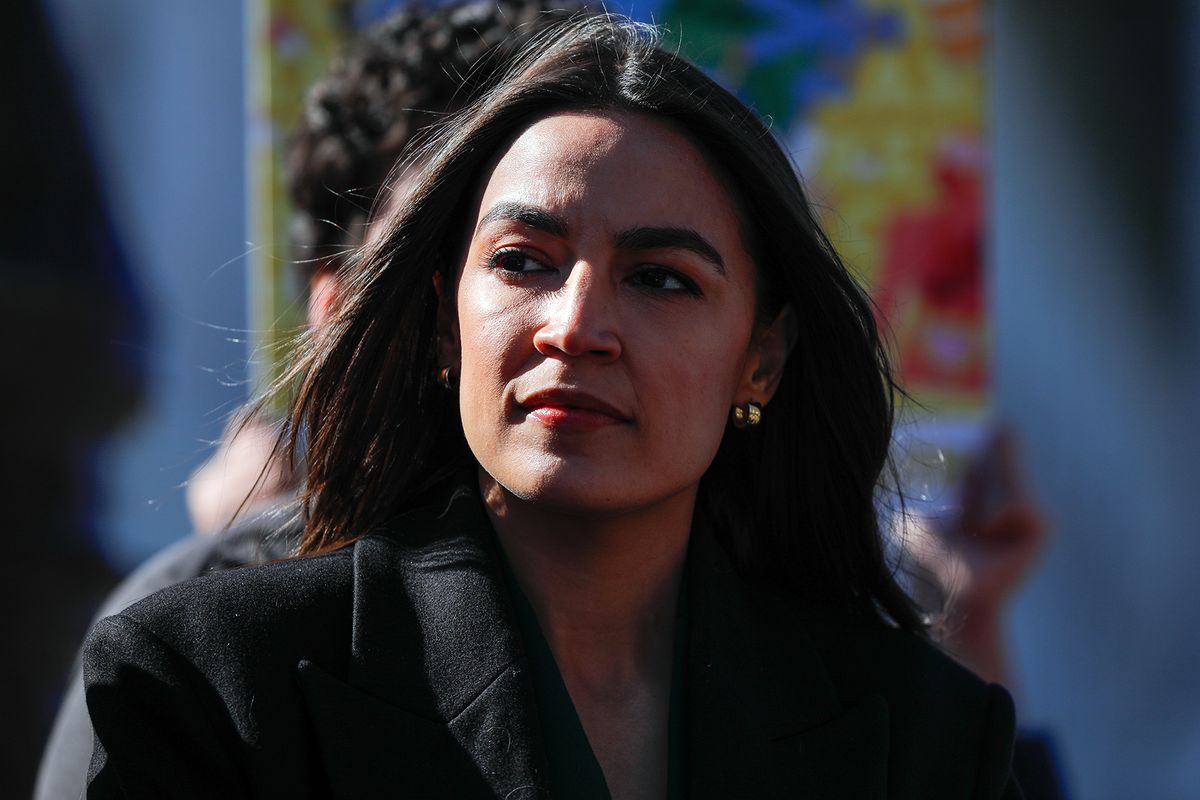

Rep. Alexandria Ocasio-Cortez (D-N.Y.) has been the subject of AI deepfake imagery for years, and she’s ready to fight against non-consensual, sexually-explicit, AI-generated imagery.
Ocasio-Cortez reveals to Rolling Stone that she will be leading the House companion of the Disrupt Explicit Forged Images and Non-Consensual Edits (DEFIANCE) Act of 2024 with a bipartisan group of representatives. The bill is her first move since being named to the House of Representatives’ bipartisan task force on AI, which was announced last month.
The legislation amends the Violence Against Women Act (VAWA) so that people can sue those who produce, distribute, or receive the deepfake pornography, if they “knew or recklessly disregarded” the victim did not consent to those images.
“How we answer these questions is going to shape how all of us live as a society, and individually the things that are going to happen to us or someone that we know, for decades,” Ocasio-Cortez tells Rolling Stone. She says there is an “urgency of the moment because folks have waited too long to set the groundwork for this,” so we need to contend with it and come to answers about how to regulate deepfake technology in a way to protect victims. “But there’s also the necessity to think deeply and take very seriously the conclusions and the actions that we come to.”
“How we answer these questions is going to shape how all of us live as a society.” — Alexandria Ocasio-Cortez
Ocasio-Cortez says when working on the bill, it was crucial to her and her team that they work intimately with abuse survivors. “It’s just a different way of legislating around this where you’re really centering the people that have been most affected by this,” she says.
More than 25 organizations have endorsed the bipartisan legislation, including the National Women’s Law Center, the Sexual Violence Prevention Association, the National Domestic Violence Hotline, and UltraViolet.
Ocasio-Cortez is co-leading the bill with Sens. Dick Durbin (D-Ill.) and Lindsey Graham (R-S.C.). The Senate introduced the DEFIANCE Act on Jan. 30, about a week after several AI-generated sexually-explicit deepfakes of Taylor Swift went viral on X. Today, the House is introducing a companion bill, which is a bill with similar or identical language that makes it so both chambers of Congress can consider the legislation simultaneously.
The bill defines “digital forgeries” as visual depictions “created through the use of software, machine learning, artificial intelligence or any other computer-generated or technological means to falsely appear to be authentic.” Any digital forgeries that depict the victims “in the nude or engaged in sexually-explicit conduct or sexual scenarios” would qualify. Victims would be able to sue “individuals who produced or possessed the forgery with intent to distribute it; or who produced, distributed, or received the forgery” if the individual knew the victim didn’t consent.
The rise of generative AI is making it easier than ever for the public to create realistic images. A 2019 study by cybersecurity company DeepTrace Labs, which builds tools to detect deepfakes, found that 96 percent of deepfake videos are non-consenual pornographic, all of which contained women. As UN Women reports, women who face multiple forms of discrimination, including Black and indigenous women and other women of color, LGBTQ people and women with disabilities are at heightened risk to experience technology-facilitated gender-based violence.
If the bill passes the House and Senate, it would become the first federal law to protect victims of deepfakes, providing a civil recourse for them.
That’s not to say there haven’t been previous efforts to curtail deepfakes, although so far no action has been taken on the past bills targeting them. Rep. Yvette Clarke (D-N.Y.) introduced a DeepFakes Accountability Act in June 2019 and again in September 2023, in an attempt to establish criminal penalties and provide legal recourse to deepfake victims. In May 2023, Rep. Joe Morelle (D-N.Y.) introduced the Preventing Deepfakes of Intimate Images Act, which would have criminalized the sharing of non-consensual and sexually-explicit deepfakes.
Despite these previous efforts, current federal law does not provide any protections for the specific harms victims of deepfakes face.
“We’ve been working on this legislation before I even knew that I was going to be named to the bipartisan AI task force,” says Ocasio-Cortez. “It’s a really, really big deal.”



Donald Trump speaks to members of press aboard Air Force One
Trump’s Year of Media Capture
This was the year when public broadcasting was gutted and hyper-partisans prospered, when the First Amendment was exhaustively praised and opportunistically abandoned. It was the year when media capture came to America.
Before 2025, “media capture” was a term used exclusively overseas, describing the compromise of a free press to curry favor with the regime in power. Sometimes this happened through threats and intimidation, greased by partisan group think. Other times, the cudgel was money: wealthy administration allies would buy independent news organizations and neuter them to fall in line with the state-backed version of facts.
Hungary is often cited as a prime example of media capture — and so it seemed notable that Hungary’s elected autocrat Viktor Orban was repeatedly praised by Donald Trump and Republicans during the 2024 election. It was a clear sign of intent.
One year later, we’ve gotten used to Baghdad Bob-like lies from Trump administration flacks and absurd sycophancy from Cabinet secretaries. We expected spinelessness from the vast majority of congressional Republicans. But the lack of leadership inside news media when faced with an explicitly hostile executive branch has been surprising, largely driven by corporate owners who hid behind a fig leaf of “fiduciary responsibility” to shareholders and genuflected when threatened. They shoveled out millions to Trump for perceived slights (and there is always a perceived slight) that never would have held up in court.
The total is more than $90 million dollars to date. ABC News agreed to pay Trump $15 million for his library after anchor George Stephanopoulos discussed Trump’s conviction for sexual abuse against E. Jean Carroll. Likewise, Paramount paid Trump $16 million for the routine process of an edit to a CBS 60 Minutes interview — in this case, of then-Vice President Kamala Harris — during the 2024 campaign, after Trump refused to participate. Editing a long interview down to time is not evidence of bias; it is a normal part of the news business. But it seemed that parent company Paramount needed to pay the vig in order to sell its company to the Trump-friendly Ellison family — and so it was paid. In a totally coincidental move, CBS announced it would shut down the one of the highest-rated broadcast late-night shows in America, hosted by the beloved comic and frequent Trump critic Stephen Colbert.
Trump has sued the New York Times (subsequently calling them an “a serious threat to the national security of our nation”) and the Wall Street Journal (over their reporting on the Epstein files) — who admirably refused to back down. He sued YouTube, who decided to abandon the protections of Section 230 just this once and pay Trump $24 million dollars for suspending his account after the January 6 attacks. Meta and X forked over millions, as well. Showing that capitulation only encourages more aggression, Trump just announced an absurd $5 billion suit against the BBC for editing the speech he gave before the attack on the Capitol. This would be a bad joke if it didn’t come from the president of the United States.
America’s leadership in the world has always been based on the power of our example as much as the example of our power. And just as the ideals of the “good America” as a beacon of freedom and democracy have been undermined, the voice of America to the wider world has been silenced. Right out of the gate, one of Trump’s first actions was to shut down the Voice of America and public diplomacy stations that offer free information to autocratic nations.
Vladimir Putin has long railed against Radio Free Europe and Radio Liberty — which began broadcasting into the Soviet Union during the Cold War and helped destabilize that totalitarian regime. Trump was quick to give Putin that gift, freezing more than $75 million in funding previously appropriated by Congress. Their struggle to secure new revenue streams led to the legendary R.E.M. to remix and re-lease their first single Radio Free Europe as a promotion. (Full disclosure, my wife Margaret Hoover is the host of Firing Line on PBS and sits on the board of RFE/RFL.)
While Secretary of State Marco Rubio has long believed that the Cuban people should be freed from the Castro-founded communist regime, he presided over the abrupt shutting of Radio Marti. As a New York Times headline succinctly stated, “Trump Did What the Castro’s Couldn’t: Take Radio Marti Off the Air.” Likewise, Team Trump talks tough about standing up to Beijing, but they gave China’s Communist Party a boost by dismantling Radio Free Asia. It’s springtime for autocrats around the world.
Conservatives have been threatening to kill the Corporation for Public Broadcasting since the 1960s, when Mr. Rogers famously saved it with his congressional testimony. The expense is a rounding error and the benefits include offering kids in remote rural areas and inner cities alike access to educational programing — and their parents a dose of culture the algorithms don’t deliver. Trump put it on his hit list and of course congressional Republicans obligingly voted to pull the trigger on Bird Bird. Among the casualties of these cuts is the award-winning documentary series the American Experience. One of the greatest communicators of civic education is silenced in time for America’s 250th birthday. It is darkly ironic and entirely fitting.
The greatest, currently incomplete media acquisition of 2025 had to do with the fate of Warner Brothers Discovery, the parent company of HBO and CNN. During negotiations, the Ellisons were seen as having the upper hand for federal merger approval precisely because of their close relationship to Trump. This was stated as fact in straight news articles — ignoring what a complete rupture such partisan favoritism reflected on the American system. I’m actually sympathetic with David Ellison’s stated aim of creating news for the middle 70 percent of Americans. But reports that the Ellisons offered Trump assurances that their programming would be more friendly to his administration and even offered to fire specific CNN news anchors with whom Trump is apparently displeased showed the contradictions in this position. The latest news that the CBS editor-in-chief Bari Weiss — a heterodox opinion journalist who founded the now Ellison-owned Free Press — apparently spiked a 60 Minutes story on forced deportations to Salvadoran prisons hours before it was set to air, recommending that journalists get Trump senior adviser Stephen Miller’s perspective included in the segment, did little to re-center perceptions. As it stands, Netflix made the successful bid for WBD streaming and studio businesses and CNN’s future remains unclear. But the world needs a strong and independent CNN.One of the great debates of the 2024 election inside legacy newsrooms — including CNN — was whether Trump should be covered like any other candidate. Like many colleagues, I felt that covering Trump fairly required crucial context, including his previous attempt to overturn an American election on the back of a lie that led to an attack on our Capitol. Some executives felt that calling out Trump’s lies was divisive, that it was already baked in the cake of public opinion. But the day that a news organization decides that lies will go unchallenged from people in positions of power is the day that news organization loses its true north star.
One year later, the list of degradations is endless. To anybody who rationalized their 2024 support for Trump because they didn’t like “woke” kids on social media, they got a full jettisoning of objective journalists at the Pentagon because real news organizations refused to sign what amounted to an administration loyalty oath in exchange for access. Likewise, the White House press pool created special seating for right wing bloggers while the Associated Press was banished for refusing to go along with Trump’s renaming of the Gulf of Mexico to the Gulf of America. The Washington Post purged much of its editorial board to project a more Trump-friendly face while ditching its traditional center-left liberalism. The Federal Communications Commission is run by a Project 2025 contributor who removed the description of his agency as being independent to reflect its fealty to Trump and threatened ABC to suspend late-night host Jimmy Kimmel. Taken together, it is a cartoonish caricature of worst-case scenarios floated before the 2024 election.
This is not simply partisan warfare conducted through the press. The Trump administration and its apologists are creating an architecture of alternative facts. The greater danger is that we will be unable to reason together as fellow citizens — and that is how American democracy works.
Right now, the bad guys are winning. But just because the truth is under attack does not mean that facts cease to exist. Trump can use his election lies as a loyalty litmus test for appointees but that does not mean that American citizens need to surrender their conscience or common sense. The fact that so many corporations have felt they have a financial obligation to kiss the ring when confronted with threats speaks ill of the incentive system we’ve created. Going forward, it will be up to independent journalists and independent minded owners of news organizations to help fuel a fearless, fact-based alternative to the media capture that is making American citizens more compliant at a time when we need to be courageous.