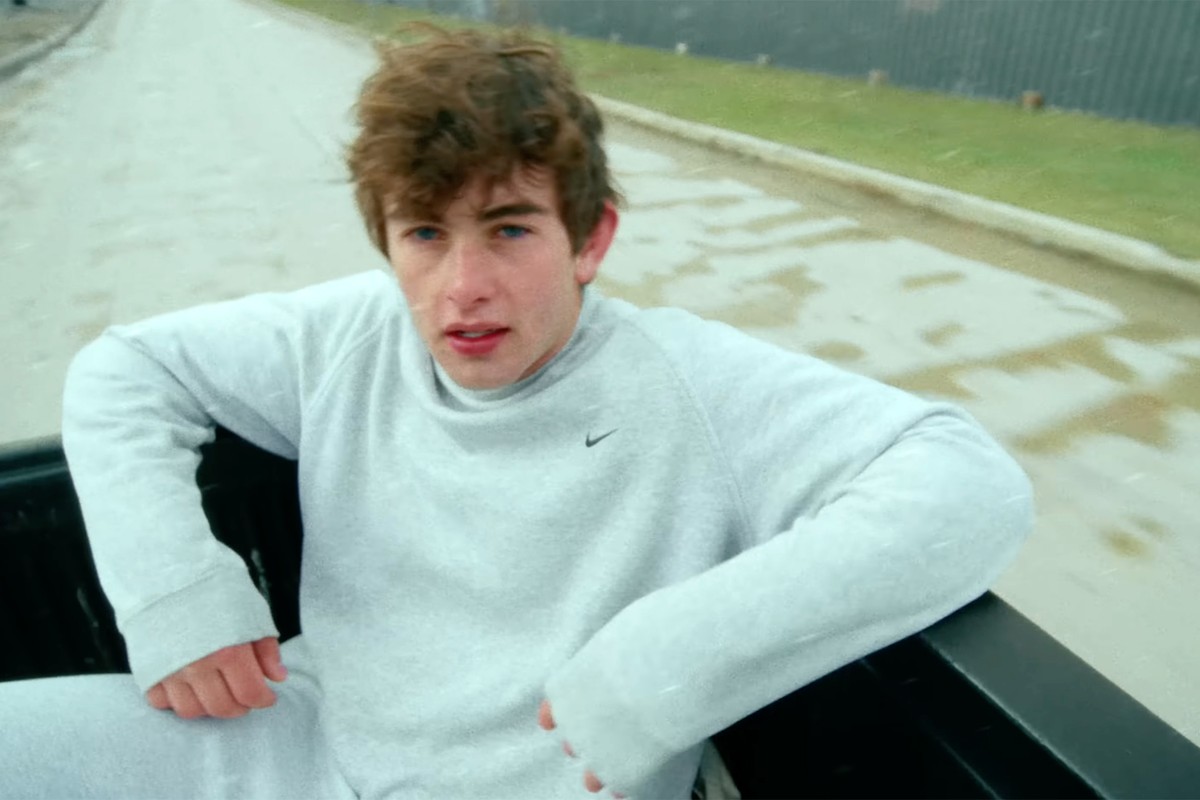

A year after hip-hop’s 50th anniversary, and only a few weeks after Kendrick Lamar’s feud with Drake culminated in a chart-topping track where he calls Drake a “colonizer,” the hottest topic on the rap internet right now is a white kid from St. Louis rapping over vintage-sounding Atlanta rap beats. Ian, whose debut mixtape, Valedictorian, caps off a run of viral hits that have quickly caught the attention and ire of rap fans online, leans heavily into the dissonance between his look and his sound. In the video for his From the Block performance, he sits at a dinner table in a nice-looking suburban home, rapping into the mic as his quintessentially white American family passes dishes back and forth. His mixtape opens with prolific Atlanta rap figure DJ Holiday joking, “This the coldest motherfucker I seen in a long-ass time, dressed white as hell though.”
Ian’s breakout song, “Figure It Out,” quickly jumped to a million streams on SoundCloud when it was released in February. Up to that point, he’d made a decent name for himself in underground circles, with brooding, slightly more melodic raps over industrial-sounding, left-field production. “Figure It Out” introduced a new sound, complete with trap drums and a slight southern drawl. Even so, to Ian’s credit, there’s a lo-fi sensibility to his vocals that adds something distinct to his delivery. That his most common comparison is to Yeat makes sense. Occupying a space between hip-hop, rock, and electronic music, Yeat’s meteoric rise over the past several years is a perfect representation of the current generation of young rap fans, whose early experiences with music were far less culturally specific than in previous eras.
But Ian is only part of a broader continuum of white artists occupying space in Black music, a trend you can trace back to Elvis. The difference now is how quickly, and thoroughly, styles get consumed in today’s landscape. Ian might very well be the best white rapper we’ve seen in a while, but not for reasons of skill or proficiency. The proliferation of rap online, particularly with the rise of social video platforms like TikTok, has fostered an environment where cultural voyeurism is very much the norm. No scene or subculture can exist outside of view of the mainstream when smartphones are omnipresent. A generation of musicians from all backgrounds who were raised on a diet of Chief Keef and XXXTentacion is now growing up — it was only a matter of time before we’d see a surge of white, rap-adjacent artists. Atlanta even joked about it in the fourth episode of its final season, where rappers enlist “Young White Avatars” to make it on the charts.
Another inescapable example right now is Tommy Richman’s hit “Million Dollar Baby,” which opens with the line “I ain’t never repped a set, baby,” and slyly plays on the juxtaposition of Richman’s look and sound. One tweet compared him to Bobby Caldwell, the jazz and R&B singer responsible for hits like 1979’s “What You Won’t Do For Love,” and who many fans spent years thinking was Black. (I’d wager that at least one person reading this is coming into this information for the first time.) As with the late Caldwell, Tommy Richman and Ian don’t partake in the cynical pandering of, say, Lil Mabu, the prep-school-educated New York drill rapper whose music lacks even an ounce of self-awareness or respect for rap culture. Ian’s music, for one, isn’t all that bad. Much like how Yeat’s sonic palette manages to offer his music a distinct sensibility, Ian’s vocal style — an airy, controlled delivery that feels as indebted to Atlanta rap as it is to modern pop acts like Billie Eilish — is a compelling evolution of an admittedly well-trodden formula. The same goes for Richman, who put in the groundwork to develop his sound into something more than simple mimicry.
The current moment brings to mind the seemingly endless jokes about a supposed “White Boy Summer,” popularized in 2021 by Chet Hanks, the son of Tom Hanks, whose penchant for Caribbean patois catapulted him to viral fame a year earlier after a red-carpet clip at the Golden Globes where his voice and appearance offered a similar kind of dissonance as Ian. Last week, the younger Hanks went viral yet again after sharing a screenshot of him explaining the intricacies of the Drake and Kendrick feud with his dad via text, a perfect microcosm for the moment, as rap culture is filtered through the mass audience generated on social media, and drifts further from any origins in Black music. Chet Hanks, too, has made an appearance on Atlanta.
Pitchfork’s Alphonse Pierre recently wrote: “There is something unsettling about ian’s fast rise. He’s stumbled onto a simple, repeatable blueprint that absorbs Black influences while presenting and marketing himself as if he isn’t.” On TikTok, many creators have pointed out the often transactional relationship to rap culture that exists for some white artists, noting how Post Malone rose to fame making southern-infused rap tracks before his more recent pivot towards country music.
Even so, there’s no denying rap’s current position in mainstream culture. This is the language that young people of all races have come to understand the world with. It is indeed an existential moment for the genre, as its commercial interests drift further away from its origins but, as Vince Staples recently told Rolling Stone, it’s been a good run. “If hip-hop dies, the Black voice doesn’t die,” he says. We’re experiencing a moment in rap’s history that certainly feels bizarre for older generations, but that doesn’t mean Black music is at risk of disappearing — just that it’s changing.
Take “White Boy Wasted,” by Houston rapper Mighty Bay, which has racked up tens of millions of plays on TikTok thanks to the video of the rapper and his friends, dressed in the same type of frat boy gear Ian wears on his album cover, managing to subvert the essentialist idea of racialized aesthetics better than whatever Ian might think he’s doing. While there’s a genuine concern that white acts could someday be replicated by record companies at the expense of developing Black talent, it’s more likely that Black artists continue to innovate faster than they can be copied.