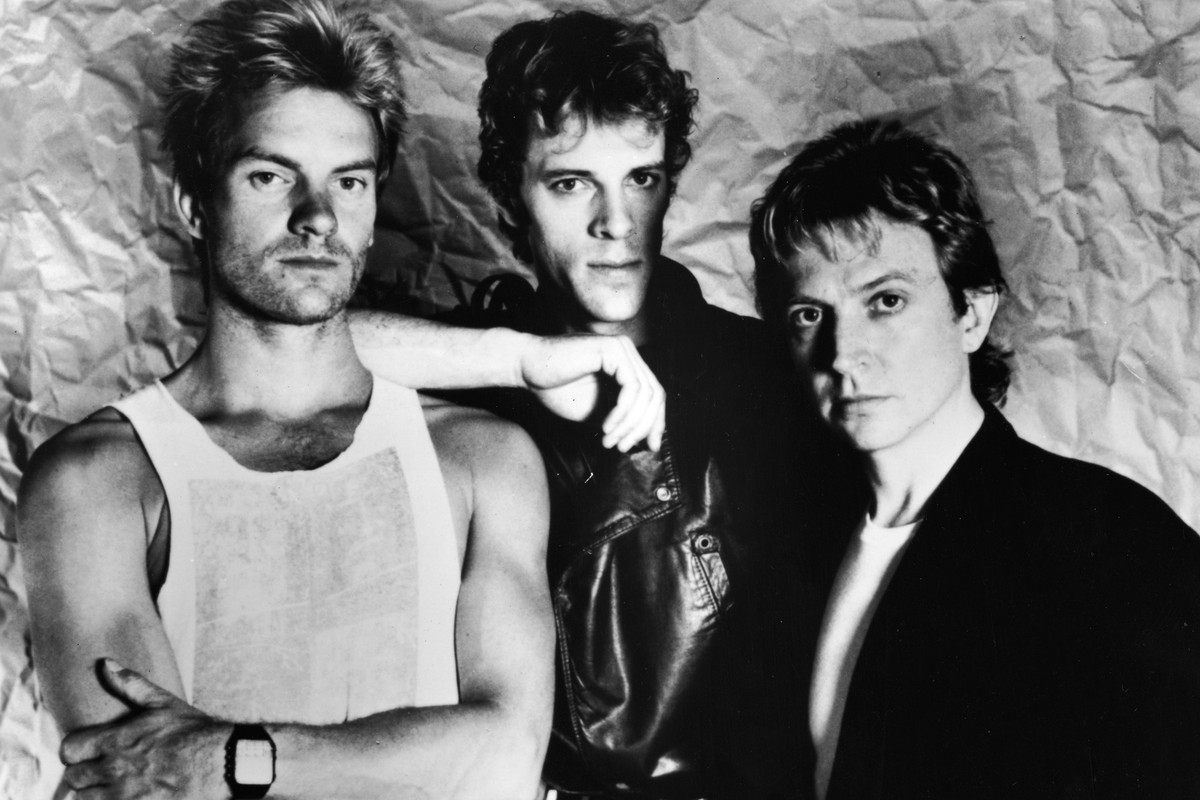

In 1983, sometime between the M*A*S*H finale, the shock of seeing Darth Vader’s face, and the Cabbage Patch Riots, the Police issued the year’s music blockbuster. The trio’s fifth and final album, Synchronicity, was almost immediately the best-selling LP released that year.
The record, now octuple platinum, was a cultural force: The New York Times likened it to Sgt. Pepper’s Lonely Hearts Club Band for pairing highbrow conceptualism (can you explain psychiatrist Carl Jung’s 1960 theory of “synchronicity”?) with tunes you could hum (who cares!). Meanwhile, Rolling Stone dubbed the album “a work of dazzling surfaces and glacial shadows.” It won the band three Grammys, and its centerpiece, “Every Breath You Take” was the year’s top single, while “Wrapped Around Your Finger” and “King of Pain” made the Top 10. The Police’s MTV-sponsored Synchronicity tour was one of the year’s biggest, and then a few years later the Police executed their biggest trick by breaking up at their commercial peak with no bad (let alone criminal) records to their name.
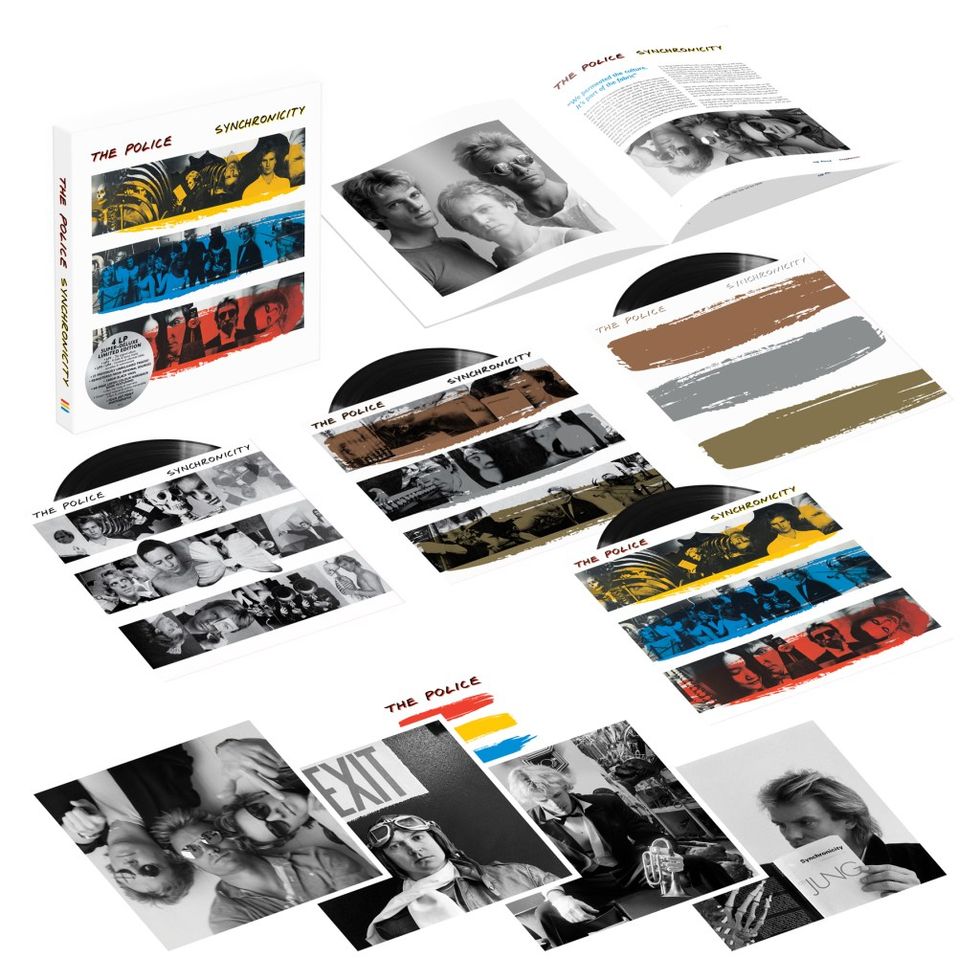
Now, a new super-deluxe, six-disc box set, Synchronicity (40th Anniversary Edition), reveals all of the magicians’ tricks with hours of demos, alternate versions of the songs with different lyrics, outtakes, and live recordings. Some of the archival material sounds better than what made the album, some of it is cringe-inducing, and all of it shows the process of what goes into making a record worthy of comparison to Sgt. Pepper.
It begins with the original album, remastered, but the sort of people who would spend over a hundred bucks on a six-disc Synchronicity box set are likely already familiar with every song, as well as the B sides and hard-to-find curiosities on the second disc. Nevertheless, they will likely appreciate nice-sounding versions of oddities like “Every Bomb You Make” and the karaoke-ready backing track to “Roxanne” (which Eddie Murphy desperately needed in 1982). The real appeal of the collection is its two discs’ worth of unreleased versions of every track, as well as a few castaways.
The most revealing moments lie in comparing Sting’s demos to the full band’s renditions of songs, since you can hear how guitarist Andy Summers and drummer Stewart Copeland made the songs sound like the Police. The demo for “Synchronicity I” (or, as it was originally known, “A Causal Connecting Principal [sic]”) sounds kind of bland with only Sting’s Oberheim synth providing the music. The key is lower, and Mr. Sumner has to sing the lyrics really fast, since he ended up overlapping them later. Similarly, the “OBX” synth version of “O My God” sounds funky (in a bad way) with simplistic drums, but the outtake of “O My God” sounds funky in a good way literally with Sting playing Bootsy Collins–style rubber-band bass. The demo of the same song is a big jazz jam like Sting’s later solo music. The demo synths on “Wrapped Around Your Finger” sound even better than the album version.
The demo for “Every Breath You Take” is the apotheosis of Eighties synth-rock, recalling Kenny Loggins, mid-decade Rod Stewart, and the keyboard room at every Guitar Center auditioning rhythms at the same time. The lyrics and vocal melody are there, but the gauzy synths sound sleepy as they enfold Sting’s leering words. When you compare it with the outtake of the same song, a recording-studio rehearsal, you can hear how Summers’ jazzily ambiguous add9 and sus2 chords turn it into the Police; Summers even plays the finished song’s descending piano notes (which do sound better as piano notes on the album version). Meanwhile, the demo for “Murder by Numbers” is an upbeat ska track and not the snaky reggae jam it would become when Summers stepped up with some new music.
The alternate version of “Walking in Your Footsteps,” Sting’s meditation on dinosaurs and human peril, contains different lyrics: He sings “20 million years ago [dinosaurs] walked upon the planet” instead of the somewhat more accurate “50 million years ago” of the studio version. He also wisely cut verses like, “They live in a museum, it’s the only place you’ll see ’em” and, “Are we an endangered species when we walk in our own … feces?” And the extended version of “Synchronicity II” contains a bridge, titled “Loch,” on which Summers plays Brian Eno–style atmospherics on a synth guitar. For better or worse, Sting’s “that’s my soul up there” responses on the “King of Pain” chorus are more coherent on the alternate versions than on the album version.
Lackluster studio outtakes like Copeland’s “I’m Blind” and “Ragged Man,” which both surfaced on his Rumble Fish soundtrack, and Summers’ “Goodbye Tomorrow,” which later became the excellent Police B Side “Someone to Talk To,” justify why the band abandoned them at the time. Similarly, two ultra-reggae-fied covers of oldies — Eddie Cochrane’s “Three Steps to Heaven” and Chuck Berry’s “Rock and Roll Music” — show why it was right for them to reconsider making a covers album as their next record (which they apparently actually considered doing).
The live discs, recorded at Oakland’s Day on the Green before an audience of nearly 60,000 in the fall of 1983, show the band at its biggest. Synchronicity had already displaced Thriller as the bestselling album a couple of times, and the audience sounds thrilled to sing along with every word of “Every Breath You Take.” The backup singers, Michelle Cobb, Dolette McDonald, Tessa Niles, whose names are curiously missing in the box set’s booklet, help make the songs bigger. They echo Sting’s “They say the meek shall inherit the earth” on “Walking in Your Footsteps” (which has some insane jittery drumming by Copeland) and take over his brilliant “I can’t stand losing” refrain in “Can’t Stand Losing You” since Sting really couldn’t stand losing.
Plus, it’s a thrill to hear tens of thousands of people sing along with the globalism anthem “One World (Not Three),” joining in as Sting entreats, “It may seem a million miles away/But it gets a little closer every day” even if they probably went home without the song’s message sinking in. Nevertheless, the message is there.
The band members famously couldn’t play in the same sandbox together (maybe the song should have been “One Band (Not Three)”) and had to record Synchronicity in their own rooms, so the excellence of the original album seems like even more of an accomplishment when contextualized with all of the source material in the box set. Much like Talking Heads, the trio deftly funneled their loves of Caribbean and African music into pop-rock with literary lyrics. Also like the Heads, they never put on airs of being anything other than British and American musicians. The Police wanted to write Billboard hits and sell out, something they attempted by appearing in a Wrigley’s gum ad before even releasing an album in 1978, and that spirit drove hit singles like “Message in a Bottle,” “Don’t Stand So Close to Me,” and “Every Little Thing She Does Is Magic.” They even titled an album Reggatta de Blanc (or “white reggae”); they knew the score, and this tour was their ultimate victory.
Listening to the original Synchronicity now, Sting’s ambition on the two title tracks still astounds. The way he’s able to reference W.B. Yeats’ “spiritus mundi” and Jung’s concept of meaningful coincidences in Part 1 and lead Broadway-style drama, contrasting a sense of English resignation with the birth of the Loch Ness monster in the second — and get a hit out of “Synchronicity II” — is inexplicable. (There still hasn’t been a better song in the past 40 years to include a lyric quite like “a humiliating kick in the crotch.”) And “O My God” still takes the biscuit with Sting playing the riff to “Day Tripper” on his bass while howling against God. Even the uncanniness of Summers’ “Mother” (a Middle Eastern–influenced Norman Bates blues song in 7/4, which Summers himself sings, making it the Ringo tune of the bunch) and Copeland’s short-and-sweet “Miss Gradenko” (which Sting wisely sings) help build a bridge to the record’s flawless second side.
“Every Breath You Take” still sounds seductive and quixotic (is it about an obsessive stalker or feuding Cold War nations?) and that’s why it has endured as the best of the songs on the album (though the less said of these days Puff Daddy’s “I’ll Be Missing You” the better). Sting wrote the song, as well as the two that follow it — “King of Pain” and “Wrapped Around Your Finger” — at James Bond novelist Ian Fleming’s desk in Oracabessa, Jamaica just after he left his wife for her best friend. Even if they both feel melodramatic (“Wrapped Around Your Finger” is both about relationship dynamics and a metaphor for a wedding ring), the music is still powerful. “Tea in the Sahara,” which takes its title and plot from a minor story in Paul Bowles’ novel, The Sheltering Sky, ends the album warmly with Summers’ atmospheric guitar and Sting’s bass taking the lead. (The bonus track, “Murder by Numbers” is just good fun.)
It feels like a time capsule and somehow head boy Sting never comes off preachy with all his dissertations the way he would within a year or two when he revisited the same subjects as a solo artist backed by jazz musicians on the breakup song “If You Love Somebody Set Them Free” (an update on “Wrapped Around Your Finger”) and the Cold War commentary “Russians” (a more direct “Every Breath”?). Like with the demos in the box set, it’s hard to picture Sting’s solo music a la carte becoming Police songs, which speaks volumes to how the trio’s dysfunction at the time worked in its favor.
Summers and Copeland rose to Sting’s ambitions and made them something bigger and more palatable, and all three members deserve credit for recognizing they wouldn’t be able to repeat the feat of Synchronicity (even if they did briefly reunite in 2007). Taken as a whole, the box set shows how perfect synchronicity happens only in fleeting moments — even if there’s a lot of woodshedding necessary to make it happen at all.