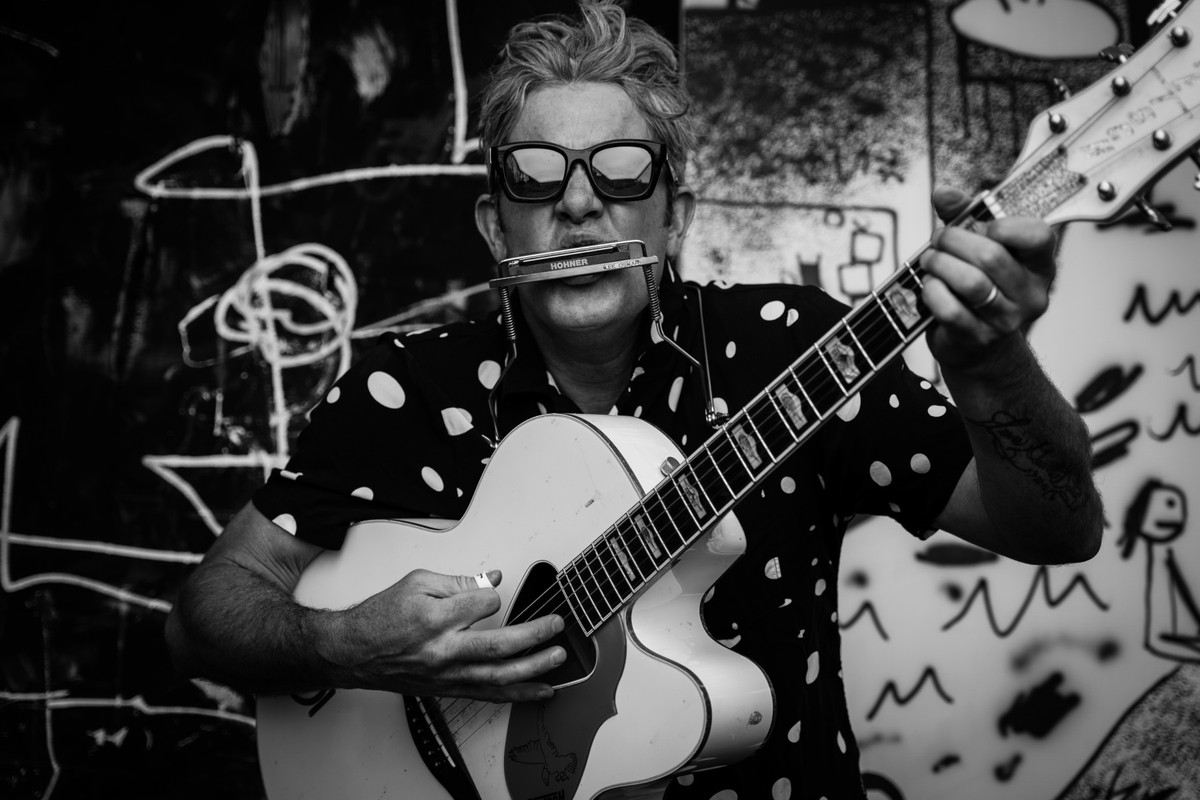

G. Love & Special Sauce’s self-titled debut album was an out-of-left-field record upon its release in May 1994. An innovative concoction of rock, hip-hop, blues, and jazz music, its lead single “Cold Beverages” quickly overtook radio stations coast-to-coast that summer, but the band was none the wiser of its unusual, unexpected success.
“It was getting played on MTV, played on Beavis and Butt-Head,” G. Love tells Rolling Stone. “It was a hit record, but we didn’t know it was blowing up ‘cause we were doing 250 shows a year in a van — we were just moving with our head down.”
Sitting at a table in the middle of an empty dancefloor before a recent sold-out gig at the Visulite Theatre in Charlotte, North Carolina, G. Love — real name: Garrett Dutton — ponders what that first album means to him 30 years on. The group is in the midst of a nationwide tour celebrating the anniversary.
“To look back now, 30 years later, is to see that the record was the catalyst,” Dutton says. “It was a launching point for my whole career, for our whole careers.”
The enduring allure and sonic grandeur of G. Love & Special Sauce — reissued earlier this year as a remastered, expanded edition — lies in its breadth of knowledge of jazz and, especially, the blues.
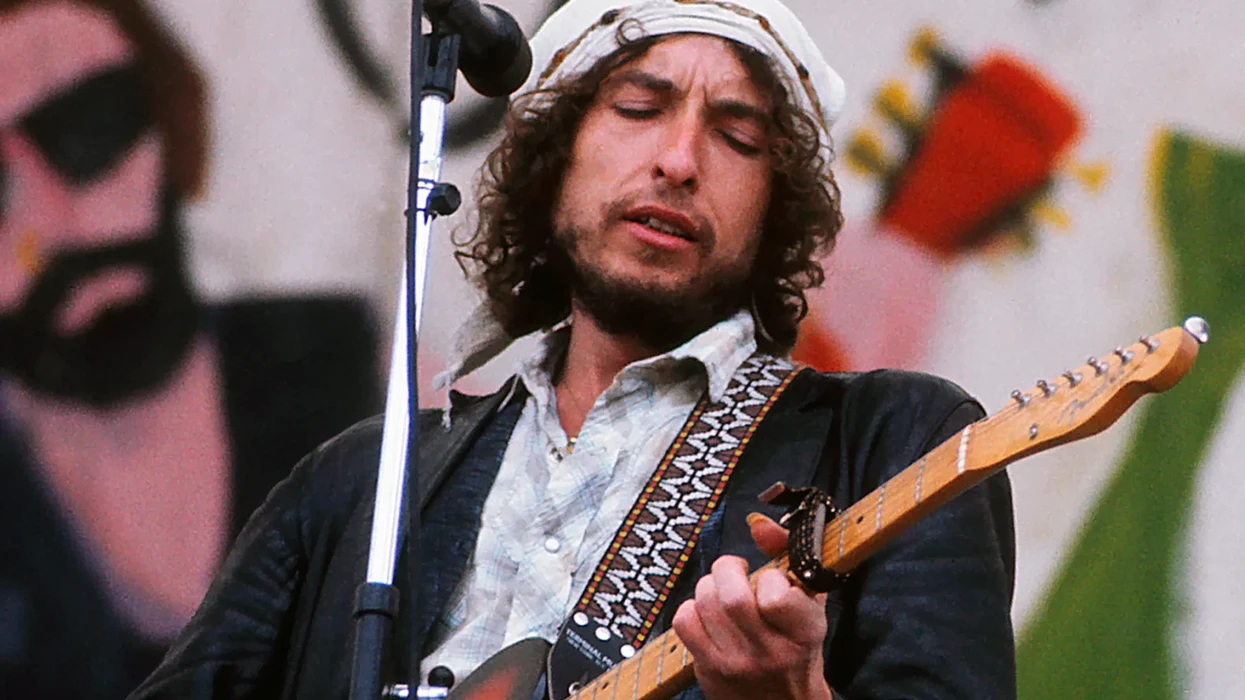
“A lot of what I do onstage is emulating the blues artist John Hammond,” Dutton says. “I used to study him when I got to see him play. His facial expressions, what he’d do with the harmonica, how he stomped his feet, how his body language was — he’s a tremendously powerful performer.”
Growing up near South Street in the heart of Philadelphia, Dutton would wander the numerous record stores as a teenager in the early 1980s, immersing himself in the vinyl albums of Hammond, Lightnin’ Hopkins, and Robert Johnson. He was playing guitar, soon to add harmonica.
“My father started taking me to shows around Philadelphia,” Dutton says. “I got to see Taj Mahal, Junior Wells, James Cotton, B.B. King, George Thorogood.”
Dutton added hip-hop to the mix, and to listen to G. Love & Special Sauce is to recognize a thick thread of those influences. Dutton has a lifelong passion for street poetry and a gift for both phrasing and delivering lyrics. But he’s also fully aware that he’s a white man who had success with a Black art form.
“You spend a lot of your early years having to prove yourself and I’ve felt a lot of pressure,” Dutton says. “It was like, ‘How can you be appropriating Black music? Hip-hop, jazz, and blues? And be a white kid from Philadelphia?’ I was just playing the music that I loved.”
“This Ain’t Living” was a high point of Dutton’s 1994 debut. Clocking in at six minutes and 34 seconds, the melody simmers, carefully bubbling up into a work of jazz and spoken word. Dutton and Jasper (a fellow street musician from Dutton’s Boston busking days) tag-team the track: “Yo check my beat dig my rhythm/Me belly full but me hungry so me fill it/Once I start gaining the taxes start taking/Cause the governments perfected funk faking.”
“I never considered myself a rapper, but I loved hip-hop,” Dutton says. “And as a kid, I grew up living in hip-hop. I was a graffiti writer, skateboarder, break dancer, running around on rooftops, running from the cops, doing what all the city kids were doing.”
When G. Love & Special Sauce was released, Dutton was a mere 21 years old. Before that, he spent much of his teenage years busking on the streets of Philly. In 1992, he made his way to Boston, working heavy foot-traffic areas like Copley and Harvard squares.
“I moved to Boston to be completely unfettered, completely focused, and with no distractions,” Dutton says. “And you could get a street performer’s license in Boston. Then, a friend of a friend [there] had a room available.”
Boston is also an enormous college town. For Dutton, the city represented endless opportunities to hone his craft on a nightly basis at bars and cafes. It was also within that scene where Dutton met drummer Jeff “Houseman” Clemens, a musician well-versed in jazz and rock, in 1992.
“We played our first gig in January 1993 and signed to Epic Records that October,” Dutton says of the fast-paced trajectory of G. Love & Special Sauce. “So, from January through October, we played all the venues in Boston, including a residency at the Plough & Stars [in Cambridge].”
Not long into that incubation period before inking the record deal, standup bassist Jim “Jimi Jazz” Prescott came into the fold. Now a bona fide trio, G. Love & Special Sauce started crafting demos to send to music conferences. One entry in particular, the Philadelphia Music Conference, was accepted.
“That’s when we met our producer, Dave Johnson,” Dutton says. “It was us opening for the Roots, who were also trying to get signed.”
According to Dutton, Johnson seemed unimpressed with G. Love & Special Sauce, at least initially, a ragtag bunch of blues and jazz cats in an era dominated by grunge and hip-hop attitudes and aesthetics.
Johnson told G. Love & Special Sauce to prepare for a couple of days in the studio. But the offer went cold when the band arrived in Philly. Then Johnson saw their live show.
“We come off the stage and he goes, ‘Be in the studio at 10 a.m.,’” Dutton chuckles. “He heard us play and saw what we were trying to do. The live performance was dialed in. The next day, we started recording demos that would be the first record.”
By the time Epic signed the band, they already had half the debut album finished. Once the record was completed in December 1993, G. Love & Special Sauce hit the road for a tour crisscrossing America in search of an audience.
“It was a wild time and I was a kid,” Dutton says. “We went from being street musicians living on the fringe of society to working for one of the biggest corporations in the world. Overnight, everything changed.”
Even today, Dutton is touring as frequently as his younger days, upwards of 150 shows in a calendar year. That manic pace and heartfelt purpose underscores a simple truth — G. Love was born to entertain. During the pandemic, he encouraged fans to escape the boredom and isolation of quarantine by submitting homemade clips for his own “Shake Your Hair” video.
“The first word that comes to mind is desperation,” Dutton says of continuing to record and tour. “I feel like there’s so much at stake. I have young kids, and this is my job. What’s propelled the whole thing is ‘cause I truly love it.”
Onstage, Jimi Jazz is still slapping the bass alongside Dutton. Houseman has since stepped off the bus to transition into a quieter lifestyle. In his place is Chuck Treece, a drummer, former professional skateboarder, Philly native, and longtime friend of Dutton.
Together, they’re keeping an album released 30 years ago not only alive, but vital to Philly music.
“You know, I wrote those songs when I was 20 years old. I’m 51, but they still mean so much to me,” Dutton says. “I still connect with them, and connect with that kid, too, that person I was when I wrote it. It makes me emotional a lot of times.”