
When Anderson .Paak appeared last August on the popular podcast Drink Champs, he regaled host N.O.R.E. about his travels to South Korea and love for its famed local spirit soju. The host, however, needed some clarification: “But you’re not Korean yourself?”
It’s a question the 40-year-old hip-hop-soul sensation, born Brandon Paak Anderson, has heard his whole career. He is, in fact, one-quarter Korean. His mother was part of the Korean War’s baby boom, born in the country to a Korean woman and African American sailor in the U.S. Navy, abandoned in an orphanage with her brother, and later adopted by a Black naval construction worker in Compton, California.
Paak, who grew up 60 miles north of Los Angeles in Oxnard, has never hidden or downplayed his Korean heritage. Quite the opposite. It’s right there in his middle-turned-last name, and in the tattoos covering his left arm, which include a Korean flag and an era-appropriate bomber plane. It’s just taken folks a while to catch on.
“Ever since I started working with Bruno [Mars], it got more awareness after that,” Paak says, referencing the Grammy-winning funk revivalist duo Silk Sonic he founded with Mars, who is part Filipino, in 2021. If Chappelle’s Show rebooted its 2004 skit “Racial Draft” — where different ethnic groups select famous biracial people like Tiger Woods or Lenny Kravitz to be one of their own — Paak would be a prime candidate for today’s version. After Silk Sonic, “More Koreans wanted to claim me,” he says with a laugh.
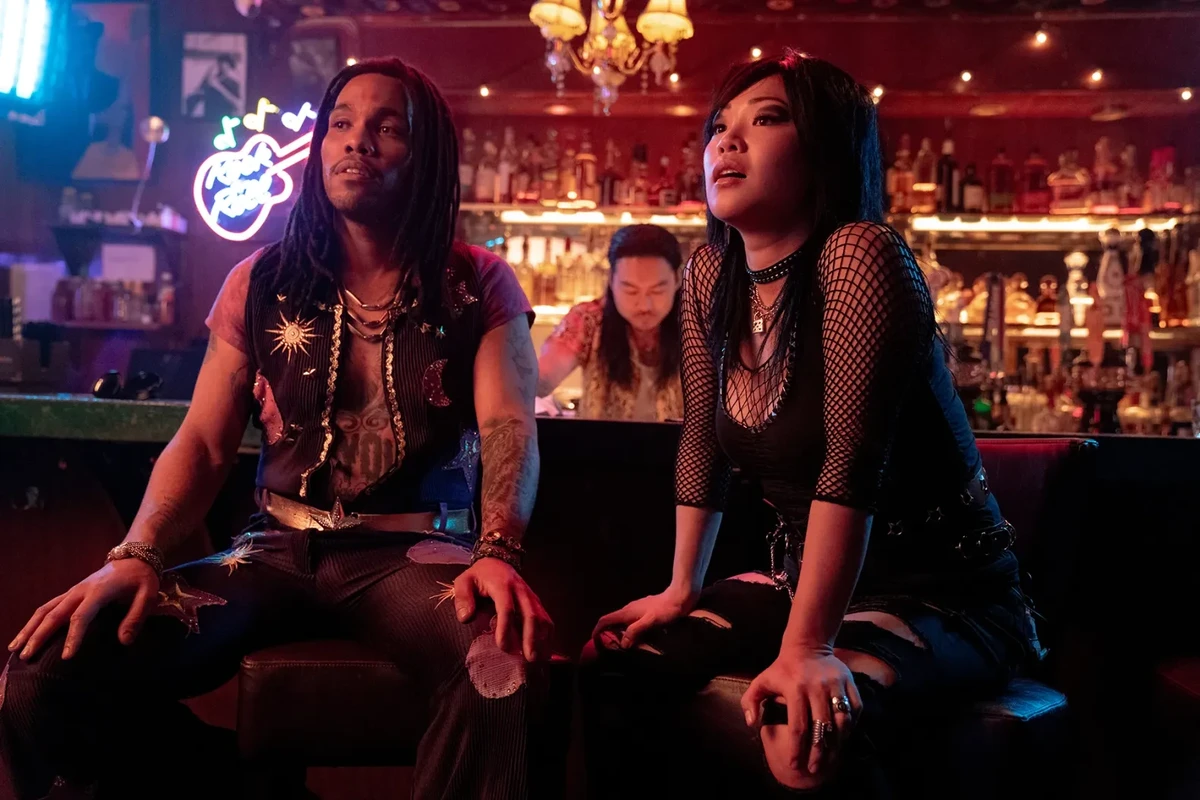
Any uncertainty over Paak’s heritage should subside with Friday’s release of K-Pops!, a feature film the musician co-wrote, produced, directed, and stars in. The comedy follows struggling L.A. musician BJ (Paak), who takes a gig as the drummer of the house band for the fictional top-rated musical competition series Wildcard, only to discover one of the contestants is the son (played by Paak’s real-life son Soul Rasheed) he never knew he had.
Initially determined to cozy up to Wildcard’s heavily favored ace Kang (former U-Kiss singer Kevin Woo) to kick-start his music producer career, BJ instead takes the “lower percentile” contestant Tae Young (Rasheed) under his wing to try to guide him to an upset. Once they realize the connection, making up for lost time and bonding over chicken wings and Earth, Wind & Fire ensue.
The origin story of K-Pops! is fittingly familial. After a rigorous touring schedule that saw Paak on the road for the better part of four years promoting his solo releases — 2014’s Venice, 2016’s Malibu, 2018’s Oxnard, and 2019’s Ventura — he was finally able to spend quality time with his family during the pandemic lockdown in 2020.
“I was having a lot of fun just learning about their interests,” Paak says of his two sons, Soul and Shine. Shine was still a toddler at the time, but Paak found himself fascinated by the passion that Soul, then 8, had for two pop-culture touchstones: “He was showing me that he wanted to be a YouTuber. I didn’t know what the hell that was. And he was showing me how much he loved K-pop; my whole family was into that. I didn’t know what the hell that was, either.”
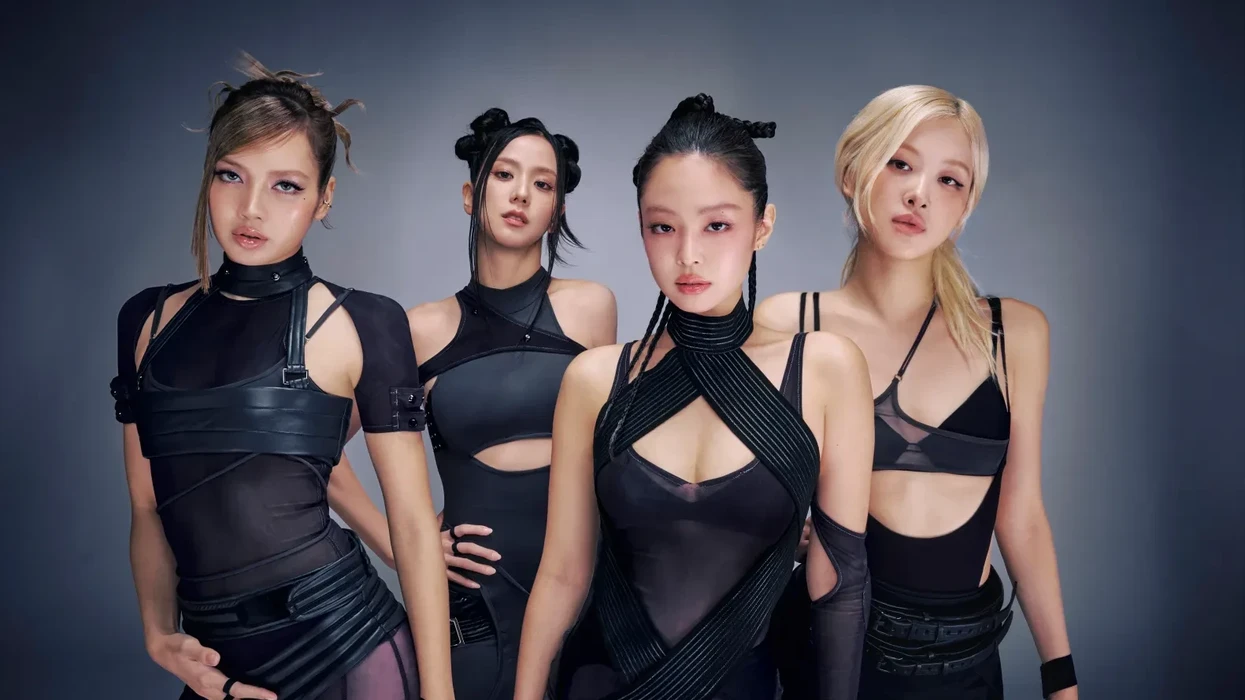
But Paak was receptive and even related to his son, thinking back to the home videos he used to shoot and edit when he was a kid. And K-pop, the genre that’s exploded into a global phenomenon over the past decade with the rise of collectives like BTS and BLACKPINK, reminded him of the pop and R&B groups he and his sisters listened to back in the day, like New Edition, TLC, SWV, and New Kids on the Block.
As Paak and Soul started recording father-son YouTube skits, Paak discovered that Soul was magnetic and hilarious on camera. Paak didn’t want their collaborations to end once the world reopened, so he hatched a new plan for them to work together: a feature film script. Co-written by Khaila Amazan, K-Pops! explores the musical educations Paak and Soul had given one another IRL while also tapping into Paak’s own fish-out-of-water experiences visiting Korea with now-ex-wife Jaylyn Chang (who performs as gospel singer Jae Lin).
Paak eagerly transitioned to Hollywood multihyphenate for the project. As “Director .Paak” (using his job title as an honorific in another nod to his Korean roots), he used his prior experience helming music videos for Leon Bridges (“Motorbike”), Hailee Steinfeld (“Coast”), and himself “Cut Em In”. He teamed up with prolific hip-hop and R&B turned K-pop producer Dem Jointz for the soundtrack. And he stepped up his acting, which to this point had been limited to a voice role in two Trolls movies and the little-seen Johnny Knoxville baseball comedy Sweet Dreams. “Man, I got my ass kicked [taking on so much],” he says. “Fortunately my character [in K-Pops!] isn’t too big of a stretch from me… So thank God it wasn’t me trying to be, like, some gangster or FBI agent.”
K-pop, meanwhile, has only gotten more massive since he began conjuring the story, and the recent record-smashing success of Netflix’s Oscar-nominated animated film KPop Demon Hunters has proved there’s a huge public appetite for stories about the genre.
Paak says he “could’ve pulled from a lot of different things in my life” for his first feature-film script — his father struggled with drug addiction and was sentenced to 14 years in prison after brutally attacking Paak’s mother in 1993 (his father died in 2011). Instead, he chose to focus on the lighter side. “I thought K-pop could be a good sandbox to live in,” says Paak. “It’d be like a 10-hour movie if you talk about what my mom went through, or my father went through, or what I went through. There’s a lot of trauma. But I was inspired to make my first movie something that was joyous and based around the things that helped me cope with a lot of the trauma: music, family, laughter.”
K-Pops! was filmed in Los Angeles, South Korea, and Saudi Arabia in 2023, and premiered at the Toronto International Film Festival in September 2024 to a warm response. Variety praised how it “lovingly embraces both Korean and Black cultures.”
Precisely Paak’s intent.
“I thought this could be a cool opportunity to do a movie that blended both cultures and showed how much we had in common,” he says. “And I had fun with K-pop because I was able to put these unique experiences that I had growing up in a Black household and then later on being introduced to my Korean heritage through the mother of my two sons. I don’t know very many movies like that. Growing up, I had Rush Hour. That was about it.
“Something like this had never been done before,” he adds. “It was necessary.”
And then there’s the added bonus of announcing, in a way, his own dual heritage. “People still don’t know,” he says. “But hopefully this helps spread the word a little bit.”