
Even when he was alive, there was a sense of lore that surrounded Anthony Bourdain. He had the allure of someone with a true mythology, which he offered up throughout his writing and TV shows. His memoir Kitchen Confidential: Adventures in the Culinary Underbelly, released in 2000, established much of what we know about him — his early years in New York City kitchens, his drug use, his willingness to reveal tricks of the trade. The book famously recounted the three summers he spent in Provincetown, Massachusetts, as a young man, one of his earliest legends.
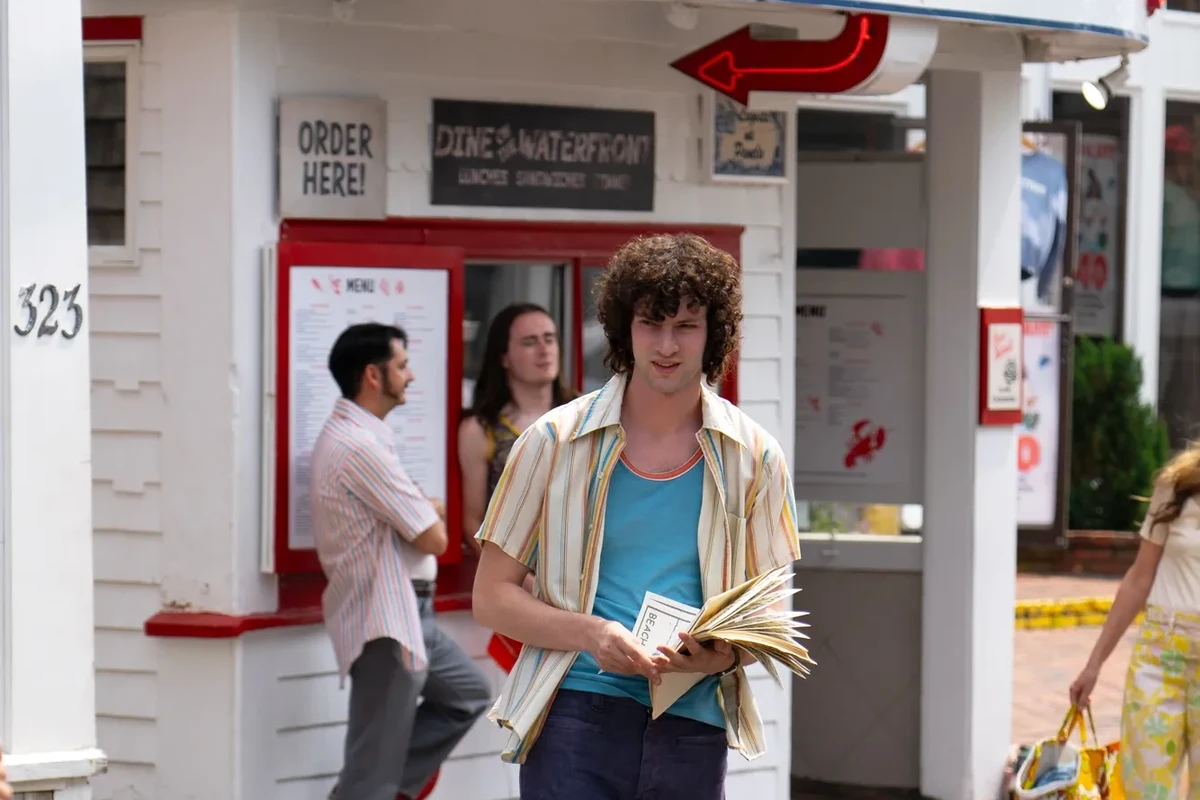
That time period is the focal point of Tony, a biopic of sorts from Canadian writer-director Matt Johnson. Dominic Sessa stars as Tony, a surly 19-year-old not yet formed into the Bourdain we have since anointed into culinary sainthood. Although the film is sanctioned by the Bourdain estate, the coming-of-age tale isn’t overly concerned with facts. Instead, Johnson conjures the same feelings one might have looking back at their own early years.
“I wanted this to feel like a memory that Bourdain would have that was totalizing his youth,” Johnson says, speaking over Zoom from Los Angeles. “For me, that’s going to summer camp [for] over a decade. I don’t think about it in a linear, year-to-year way — it’s a flash and a color and a feeling and maybe four or five conversations. This movie is trying to do that with a person who unfortunately can’t speak for himself [anymore]. He can’t tell you how close we got to it, but that’s the aim: to put you in the same place that Bourdain was in as he matured from this thoughtless young lout, as he put it, into somebody who started taking himself seriously.”
Johnson, 40, didn’t seek Tony out. After making the 2023 film BlackBerry, about the formation and rise of the mobile phone company, he was offered a “deluge of other biopic, true-story films,” he says. One of them was Tony, a Black List script (an annual list of the most popular unproduced screenplays in Hollywood) written by Todd Bartels and Lou Howe that centered on Bourdain’s formative time as a dishwasher and budding cook in Provincetown. Although the script was interesting, the filmmaker passed. He didn’t want to do another based-on-real-life story.
At the time, Johnson was developing a comedy about the TSA with Josh Safdie and Ronald Bronstein for A24. About two years ago, during one of his trips to New York City to meet with them, Johnson and his producer, Matt Miller, took a casual meeting with Sessa, who Johnson had seen in the Oscar-nominated, prep-school-set story The Holdovers. Johnson wanted to find something to make together, and happened to mention the Tony script. Neither Johnson nor Sessa were fans of Bourdain, but as they talked, they became interested in approaching his formative years as a way of exploring their own youthful experiences and emotions.
“It was one of those conversations where you have a whole new perspective on something,” Johnson says. “Immediately, I knew I wanted to make the Anthony Bourdain movie and frame it around our shared ideas about role models and family and being young and what it’s like to try to find yourself at the exact age that he was.”
Sessa, 23, found the approach liberating. “I could never imagine myself doing, like, an impression of [Bourdain], trying to pretend to be a chef in a kitchen,” he says, speaking separately via Zoom from New York City. He adds that the haziness surrounding the chef’s life during that time period was a gift. This version of a Bourdain biopic was “an opportunity to not only further understand this person [but] to showcase a part of his life that even the biggest fans of him didn’t have access to.”
“The reality is there’s 100 minutes of ‘footage’ of Bourdain at this time, and it’s this movie,” Sessa says. “But for Matt and I, we were also able to work a lot of our own history into it. We had so much artistic freedom. Every aspect of it felt like an opportunity to highlight something about this person who’s really well respected, but also learn about ourselves.”
A24 CAME ON BOARD shortly after Sessa and Johnson spoke, and offered to put the TSA project on hold until after Johnson made Tony. Johnson and Sessa signed on with the understanding that they were making an unofficial Bourdain biopic. That was Johnson’s experience making BlackBerry, which had no participation from the tech company’s co-founders Douglas Fregin and Mike Lazaridis.
“I’m very comfortable in that,” Johnson says. “I like making movies about things I don’t know anything about, and about people who I can keep at arm’s length because I’m trying to be curious about them and observe them but not necessarily do what they would want me to do.”
Bourdain, despite being a cultural touchstone for so many, fit the bill. Johnson had only seen one episode of Bourdain’s series Parts Unknown, which ran for five years and 12 seasons on CNN; it was an early Season One installment where the chef traveled to Quebec. Otherwise, Johnson wasn’t really aware of Bourdain’s work or life. To learn more, he moved to Provincetown from Canada in March of 2025 and spent several months in the remote Cape Cod town, interviewing people who’d known the chef and imagining Bourdain’s life there.
“Other than that episode, which is so crazy to say, I had never seen anything,” Johnson says. “I’d never read Kitchen Confidential. I understood the power of this man’s legacy. I knew about him, but I had no emotional take on him. He wasn’t important to me in the way that I’ve realized he’s so extremely important to other people, especially my generation. But in the same way as with BlackBerry, that proved to be very useful to me.”
 Antonio Banderas’ character, Chef, is an amalgam of several mentors from Bourdain’s life. Seacia Pavao/A24
Ultimately, Johnson allowed himself to discover Bourdain through his writing (“Matt read every single thing Bourdain wrote, and everything written about him,” Sessa says). But he encouraged Sessa, also a Bourdain novice, to go into the project more or less cold.
“I had probably watched some YouTube videos of Anthony Bourdain, and I had seen maybe a couple episodes of his show, but I was not a Bourdain fan,” Sessa says. “Nor was I really aware of the level of fandom around him.” Still, he says, “Matt wanted me to not really concern myself with watching No Reservations and trying to be that guy. It was [about] understanding the loose facts of the story and then, for me, digging deep into my own life and trying to find the parallels.”
Sessa had extensions added to his hair to reflect Bourdain’s tousled look from that era, but he didn’t want to mimic the chef’s voice or mannerisms. He channeled his own experiences, including his time working in a bakery in Ocean City, New Jersey. His memory of being given a cigarette for the first time one summer on the beach made its way into the script.
“Obviously, Bourdain smoking cigarettes was a part of his character,” Sessa says. “We decided it would be cool if [his friend] Sal was the person who gives him a cigarette for the first time in the movie, rather than him smoking already. Little things like that were relatable to me and I was able to put these characters in a place in my mind that felt real.”
‘TONY’ INCORPORATES WHAT IS known about Bourdain’s time in Provincetown into a dramatized version of events. The film opens with a famous quote from Kitchen Confidential, which inspired much of what Johnson wrote: “I was — to be frank — a spoiled, miserable, narcissistic, self-destructive and thoughtless young lout, badly in need of a good ass-kicking.”
After the fictional Tony fails to get a summer writing fellowship, he follows a crush to Cape Cod, where he flounders until a local restaurant owner — an amalgam character here known only as Chef (Antonio Banderas) — takes him under his wing. Bourdain described his experiences in the town in Kitchen Confidential, but that time period only spans a few pages in the book. Bourdain later went back for a Season Four episode of Parts Unknown, in which he reflected on working at the seafood restaurant The Flagship as a dishwasher.
Johnson says he wasn’t constrained by factual accuracy, but did feel “a deep obligation to get at the truth.” “I’m looking at Bourdain’s life not as these two chapters in Kitchen Confidential, where he’s in Provincetown, but the whole arc of his youth from age 10 to about age 25,” he says. “I’m trying to compress as much of that as I can into the narrative space that I have to work with, which is when he’s 19 years old and it’s 1975. I am taking liberties with what happened, definitely.”
“What is Anthony Bourdain if not the pirate captain of a kitchen?”
There are moments Bourdain fans will recognize from his work: Tony witnesses one of his co-workers having sex with a new bride in the back of the restaurant. There’s the memorable fishing frenzy where, as Bourdain writes, “the striped bass jumped right out of the water and onto Cape Cod’s dinner tables.” The fledgling chef grabs a hot pan with his bare hand.
But other moments are fictionalized, as are some of the characters. Emilia Jones plays Nancy, an interpretation of Bourdain’s high school sweetheart and eventual first wife Nancy Putkoski. Chef, a mentor to the wayward Tony, represents several people who were formative for Bourdain, including the cook and writer Howard Mitcham.
Leo Woodall’s brash cook Sal blends Dmitri from Kitchen Confidential with the unnamed sous chef Bourdain later describes working with in New York. For Johnson, Sal combines the “culture of these pirate, libertine, drink all day, have sex all night, indestructible as a Clorox bottle” guys into one character.
“I’m trying to take these archetypes that Bourdain writes about and synthesize them into one personality, so that we as an audience feel as though we know a person,” Johnson says. “The fact is, Bourdain probably had 50 friends that summer, and each of them had an effect on him. But I can’t explore that in a way that is anything but cumbersome.”
Johnson also wanted to take the persona of Anthony Bourdain and “represent those facets in the other characters.” Both Sal and Chef, he says, represent to some degree who Bourdain was.
“What is Anthony Bourdain if not the pirate captain of a kitchen?” Johnson says. “His great duality is he’s an iconoclast who says ‘Fuck it, we’re gonna break the rules and we’re gonna live hard and go crazy.’ But he’s also the boss who says, ‘You’re gonna be here on time because I’m gonna be here on time and I’m gonna work like a dog until we get this done.’ That’s such an unbelievable contradiction: I’m going to be the hardest working, most diligent, almost militaristically strict person, and I’m also going to drink everybody under the table.”
Putkoski was a particular mystery. Bourdain didn’t speak about her often, either in the press or in his writing, and she has largely stayed out of the public eye. Johnson describes her as his “big question mark” going into the film in terms of backstory and research. He ultimately decided not to reach out to her to ensure he wasn’t in a position of disappointing anyone.
 Johnson (left) with Sessa on set Seacia Pavao/A24
“Because this was Bourdain’s film, I needed to restrict myself to the things I could read him writing,” Johnson says. “He seemed to keep her a bit secret. He talks a lot about them watching television together and what they were like as kids. But she’s a very private person. I’m trying to grant her dignity by not wrapping her up in this.”
AS THE FILM PREPARED to shoot, it was suggested that Johnson meet with Kim Witherspoon, the literary agent who represented Bourdain and the literary executor of his estate. Witherspoon endorsed Tony and signed on as an executive producer. “We chose to support Tony because it is not a standard biopic and doesn’t attempt to summarize a life,” Witherspoon said in a statement in May, calling the film “an interpretation, as that part of Tony’s life will always remain somewhat unknown.”
Bourdain’s close friend Eric Ripert, who found Bourdain’s body after his suicide in France in 2018, also came on board for a cameo role. He appears in the closing scene as one of the chefs interviewing Tony for admission to the Culinary Institute of America. It was one of the first scenes filmed, and both Johnson and Sessa recall Ripert asking to rehearse because he wanted to get the moment right.
“He didn’t really talk much about Bourdain or tell any stories,” Sessa says. “He came on set and he wanted to nail his lines. That alone meant a lot. There didn’t have to be an exchange of, ‘Oh, yeah, I’m really happy with what you guys are doing.’ The fact that he treated the set with respect, treated us with respect, and read the script and liked it, and then wanted to be in the movie, gave us a lot of confidence.”
The film’s Tony contains glimpses of the real Bourdain’s eventual swagger and charisma, but focuses more on his vulnerability. He’s moody and unsure. He lies to Nancy about why he’s in Cape Cod. He’s a version of Bourdain we haven’t really seen before, which can be unsettling at times. And, perhaps, it’s a version of the man who never actually existed. But Sessa says Tony reflects on how Bourdain may have become the “mythic figure” he remains today.
“He didn’t come out of the womb with tattoos and ear piercings and smoking cigarettes and traveling the world,” Sessa says. “All of those elements are from these people that he met and who affected him, especially working in the kitchen.”
“He is not the charming, effortless rogue that people are coming to this movie expecting to see,” Johnson adds. “And, of course, this is by design. I’m trying to create a relationship in the audience who knows Bourdain between what their expectation is from what they’ve seen of him and the young man in this film. I want them to ask: Why is he not the adult that I know?”
Johnson is aware that Bourdain’s legacy inevitably looms over the film. Since his death on June 8, 2018, which occurred during a trip he and Ripert were filming for Parts Unknown, the myth of Bourdain has grown even larger. His shows, including Parts Unknown, No Reservations, and The Layover, remain exceptionally popular, as does Kitchen Confidential. Morgan Neville’s 2021 documentary, Roadrunner: A Film About Anthony Bourdain, centered on the decline of his mental health and his final, tumultuous relationship with actress Asia Argento. The chef hanged himself shortly after reading a tabloid story about her being seen with another man. Many viewers will watch Tony armed with this knowledge, adding a layer of complexity to the story.
“I think the film I made is actually quite hopeful,” Johnson says. “But every life ends, [and] in this case it’s a true tragedy, and a mystery, in a way. One of the reasons that Eric Ripert is in that final scene is because he was literally there — he was the last person with him and the person who found him. That is going to be coloring the entire viewing experience of this movie for people who know it. But it also needs to work as a film for people who have no idea who Anthony Bourdain is.”
Despite the deep dive Johnson has now taken into Bourdain’s life, making Tony hasn’t illuminated his death for the filmmaker. “I don’t have any answers because I never knew him, and I don’t pretend to understand why he did what he did,” Johnson says. “But the movie is trying to capture the insecurity he felt around how certain people saw him, and how a lot of his self-worth, at least at this age, was tied up in others’ opinions of him.”
“We wanted the movie to be a hopeful one, because that’s why people connect with this guy,” Sessa adds. “He’s a symbol. He’s a beacon of hope. He is proof that your life can always change in a massive way.”