
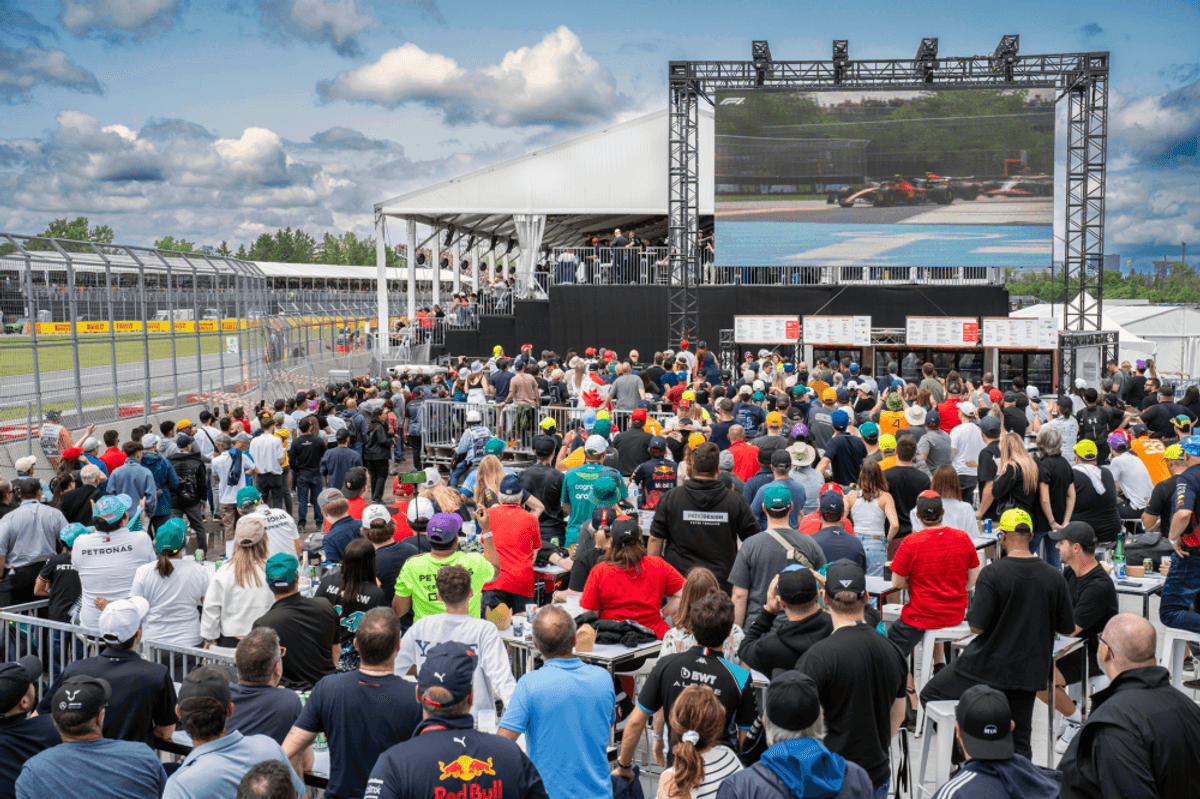

In Montréal, Grand Prix weekend is always a very special time of year. It's when you really feel that winter is behind us: the days get longer, patios fill up, and the city hums with the roar of engines.
This year, Bell GPCanada, the promoter of the Formula 1 Lenovo Grand Prix du Canada, is rolling out a project it has been developing for several years: turning the race weekend into a full-scale celebration, running alongside the competition at Circuit Gilles-Villeneuve.
While motor racing remains the soul of the experience, a new format adds a high-profile music program. The new concept, called CGV Experience, combines daytime racing at Circuit Gilles-Villeneuve with evening concerts in the same area, on a section of Jean-Doré Beach at Parc Jean-Drapeau, from May 22 to 24.
“We have been working on this idea for several years,” explains Sandrine Garneau, COO Brand & Strategy for the Canadian Grand Prix. The goal, she says, is to fully integrate music into the overall Grand Prix experience, in line with what is already happening at other stops on the championship calendar. “We wanted programming that reflects the local reality of Montréal and what F1 is aiming to become as a cultural platform.”
Concretely, CGV Experience offers a single ticket that grants access to general admission at the circuit and to a dedicated beachside area. The experience is built around live race broadcasts on giant screens as well as concerts, in an environment designed to host audiences over extended hours. The site includes a curated food offering, dedicated rest areas, and bar service.
When the sun goes down, the format truly shifts gears.
Each day, the music program takes over directly on site. Friday opens with Matt Lang and Simple Plan, Saturday follows with Dean Brody and Bryan Adams, while Sunday features The Beaches and Alessia Cara. A deliberately Canadian lineup, fully embraced by Sandrine Garneau: “For this first year, we wanted a strong local identity, with artists who resonate with audiences here.”
The 2026 Canadian Grand Prix weekend also expands on the sporting side, with the addition of F2, the return of F1 Academy, alongside F1 and the first-ever sprint race in Montréal.
The increased focus on music also reflects a shift in the F1 audience. Driven in part by the success of Drive to Survive, the event now attracts a younger, more diverse crowd that is less exclusively focused on racing. Culture as a whole is becoming as important an entry point as the race itself. “Montréal is already a city of festivals, food and music. It was natural that this would be reflected in our approach to the Grand Prix,” says Sandrine Garneau. With capacity limited to around 10,000 people for the CGV Concerts area, the experience is intentionally kept intimate.
To help our readers experience the Grand Prix at its fullest, Rolling Stone Canada is partnering with CGV Experience to offer a chance to experience this new format from the inside. We will be giving away tickets to the CGV Experience VIP Lounge on Sunday May 24, as well as access to a meet and greet with Toronto pop star Alessia Cara, the headliner of that day’s music lineup.
To get tickets for CGV Experience, visit the official website.

Across Canada, country music is synonymous with gatherings. It lives in the dust of a summer rodeo, the sticky floor of a neighborhood dive bar and the reverberating rafters of an arena filled with thousands of voices singing back every word. While most of the music industry spent the last decade adapting to a digital-first reality, country music continues to derive its power from physical spaces.

Taylor Swift and Bad Bunny in a split image
Taylor Swift and Bad Bunny Dealt With Trump Quietly. It’s a Smart Move
Taylor Swift and Bad Bunny are both major superstars — and they’ve shared some parallels in their careers and discographies for several years. Now, they’re even using the same playbook to deal with taunts and baiting from Donald Trump and the White House’s social media teams.
Since Trump took office during his second term, he and his administration have been using social media as part of their communication strategy. The propaganda-like, rage-bait-style clips often lean into internet culture and use popular music to make light of Trump’s most egregious actions, like his immigration policy and war-hungry foreign policy.
Olivia Rodrigo, Katy Perry, Ariana Grande, and Noah Kahan are just some of the artists who have had their music used in these videos without their permission — and vehemently spoken out against these actions and against the president. In the past couple of weeks, the Trump administration seems to have wanted to provoke a response from two of the world’s biggest superstars: Bad Bunny and Swift.
On July 30, the official White House TikTok used “La Mudanza” for a particularly tone-deaf video about immigration that celebrated the number of deportations under Trump. A week later, a video with text that said, “mood because it’s August and Donald Trump is your president” set to Swift’s “August” was uploaded by Team Trump, the president’s official campaign account. The caption was an overt provocation: “I’m sure Taylor Swift is going to be super excited we used her song,” it read. Days later, another clip from the same account featured an edited version of Swift’s Red album cover with text that said, “Did you know that Taylor Swift wrote a whole album about the color of the Republican Party?”
Neither musician has released a public statement denouncing the use of their music in Trump’s videos. Instead, two of the world’s biggest superstars quietly removed their songs from videos posted by official accounts linked to the Trump administration. (It’s unclear if there is a TikTok feature that allows selective sound muting on videos or if the respective teams reached out to the social media accounts directly.) The tracks are still available for other TikTok accounts to use in their videos, making their silence a pointed — and smart — approach. Both Bad Bunny and Swift seem to recognize the president and his administration’s tactics for what they are: antagonizing moves that keep the Trump conversation centered on his social media presence, rather than his actual policies and the harm they commit. Why would they add their star power to the conversation and stoke the flames when that’s exactly what the White House appears to want?
Some people argue that celebrities should wield their platform to denounce Trump at any chance if they are truly not politically aligned with his MAGA politics. But because they hold so much influence, these superstars need to be strategic about how they use it.
Benito, in particular, has been incredibly outspoken about his politics. He stood on two of the world’s biggest stages and used them to voice pro-immigration messages, denounce Trump’s policies, and highlight Puerto Rico as it struggles with the effects of U.S. imperialism. “Before I say, ‘Thank God,’ I’m going to say, ‘ICE out,’” the Puerto Rican superstar said at the 2026 Grammys. “We’re not savage. We’re not animals. We’re not aliens. We are humans and we are Americans.” Last summer, Bad Bunny’s music video for “Nuevayol” used a voice that sounds a lot like the president’s to deliver a pro-immigrant message. “I made a mistake. I want to apologize to the immigrants in America. I mean the United States. I know America is the whole continent,” the voice bellows out of a Seventies radio toward the end of the video. “I want to say that this country is nothing without the immigrants.”
Fans were convinced that Benito would speak out against the official White House TikTok account when it used one of his most political songs. But commenting on the video would only blow up the discussion for a wider audience. When Rodrigo, Perry, Grande, and Kahan made public comments, spokespeople for the White House used the opportunity to spread hateful rhetoric. “We’ll say this one last time: what’s actually barbaric, inhumane, and heinous are the criminal illegal aliens who have injured and murdered innocent American citizens,” Abigail Jackson said in a statement to Rolling Stone after Grande spoke out. It’s the antithesis of what Benito said during his Grammys speech this year: “The only thing more powerful than hate is love.”
Swift, on the other hand, has dealt with Trump and the right-wing’s instigations for years, each one crazier than the last. The TikTok videos from the last week aren’t even the first time that the administration has used the singer’s music for social media videos. Last fall, both the official White House TikTok account and Team Trump used songs from Swift’s then-newly released The Life of a Showgirl in separate videos. One plucked the lyrics “pledge allegiance to your hands, your team, your vibes” from “The Fate of Ophelia” to celebrate Trump, Vice President JD Vance, and the first and second ladies. The others boasted about Trump by using “Father Figure” and honored Melania Trump’s Patriot of the Year award with “Opalite.” As of Aug. 10, the audio is not available under all of these specific videos.
The pop superstar has not spoken publicly about these instances. But she has made her disdain for Trump clear. Over the years, Swift has criticized Trump’s autocratic leadership. On X, she wrote “we will vote you out” and endorsed Joe Biden and Kamala Harris in the 2020 and 2024 elections, respectively. In 2019, Swift told Rolling Stone, “There’s literally nothing worse than white supremacy. It’s repulsive. There should be no place for it.”
Even though she’s shared her liberal viewpoints on issues like abortion, LGBTQ+ rights, and racial inequality, Swift has still faced ridiculous claims of being MAGA-aligned and folding in right-wing dog whistles to her music — and that’s without ever naming Trump. If Swift were to make a statement about her music being used by the Trump administration, the attention-seeking president would absolutely revel in it. Getting Swift and Bad Bunny to weigh in is exactly the type of headline grabber he would love to draw attention from his remarkably unpopular presidency.