
For the past two decades, modern gaming has been dominated by a few platforms: PlayStation, Xbox, Nintendo, and PC. With the four platforms in a competitive gridlock over the years, it was difficult for a new player to break in on equal footing or innovate. The Nintendo Switch successfully blurred the lines between console and handheld, and Xbox Game Pass revolutionized the gaming subscription service, with PlayStation following suit with a revamped PlayStation Plus. But even for massive tech companies like Amazon or Google, the gaming market seemed impenetrable despite their deep pockets.
Of the two, only Amazon currently remains in the race. But why?
Google tried to separate itself from the competition by ditching the traditional home console setup with the cloud gaming service Stadia in 2019. While PlayStation, Xbox, and Nintendo offer cloud gaming options as additions to the main console, Stadia’s model was entirely dependent on it. Games couldn’t be purchased or downloaded, only streamed online like a Netflix show (if your bandwidth permitted it). Google also downplayed internal development or investing in third-party exclusives to focus on licensing popular existing games and franchises.
Its reach was wide yet still too narrow, only available on browsers like Google Chrome or on Chrome and Android-based devices like the brand’s mobile phones, laptops, and TV streaming devices. Google’s attempt to join the gaming giants was admirable, but with a lack of compelling exclusive content and underbaked features, Stadia ultimately folded in January 2023.
Amazon Games has taken a different approach. In addition to Luna, its own cloud-based streaming Stadia competitor, it’s placed a greater emphasis on not just licensing third-party games but developing its own for other platforms. Since launching in 2012, Amazon Games has also kept a relatively low profile, starting out with releasing smaller games on the Amazon Appstore, iOS, and Google Play.
Since then, Amazon Games has dramatically increased its presence with large scale MMO (massively multiplayer online) games like New World (2021) and Lost Ark (2022), which have received modestly positive reviews. Now, Amazon Games is publishing titles like the upcoming King of Meat, a cooperative multiplayer game by U.K. studio Glowmade. Unlike Amazon Games’ recent track record of large-scale releases, King of Meat is a smaller kind of cooperative game that is targeting more casual online players than the more insular MMO audience.
Rolling Stone spoke with Amazon Games vice president Christoph Hartmann about how the studio aims to succeed where others have failed, as well as Glowmade studio head Jonny Hopper and design director Mike Green, about the how King of Meat is going bigger than they’d ever planned.
Making the meat
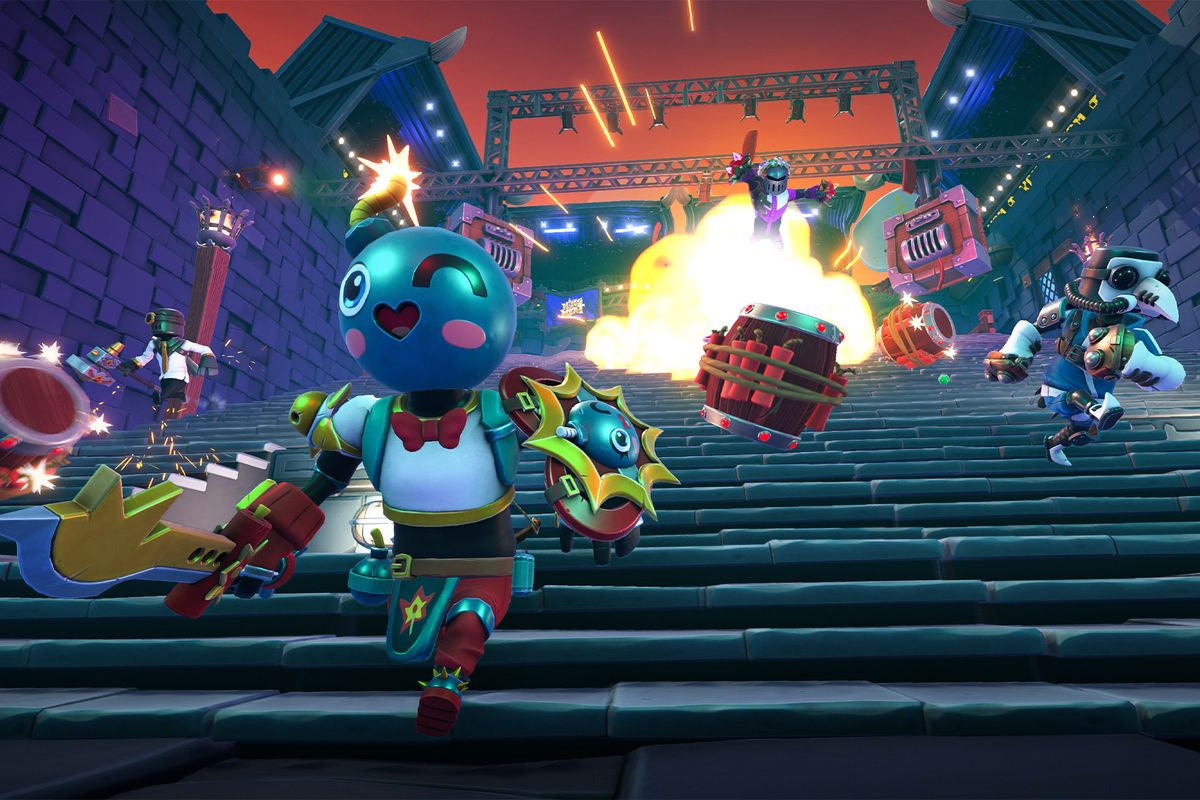
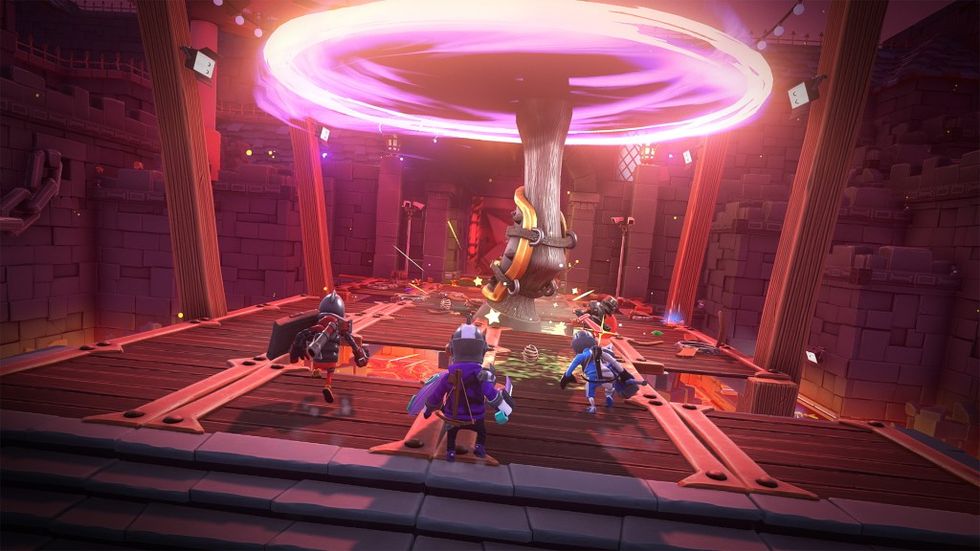
As seen in its announcement trailer during this week’s Gamescom 2024, King of Meat’s premise is set up like a reality survival show, reminiscent of the pandemic-era smash hit Fall Guys. Instead of competing against each other, up to four players can tackle dungeons created by the Glowmade team and user-generated levels from the community, similar to Fortnite Creators or Super Mario Maker. These dungeons consist of obstacles, traps, and monsters to overcome, unlocking new abilities and skins for players.
At first, King of Meat was intended to be a self-published game that looked and felt smaller, played from a top-down perspective. However, the opportunity to pitch to Amazon’s head of product development, Greg Gobbi, pushed Glowmade to change the game’s look to a third-person style, closer to what audiences expect of a modern premium experience.
“We went from wanting to self publish it to trying to ask for some money. Like how do we make it look like it’s worth more?” Hopper laughs. “When I showed [Greg] that, he came back with ‘I think you should ask for more money,’ and I were like, ‘Yeah I can do that.’”

“It’s a lot bigger than what we’d imagined it was going to be, than we originally pitched,” Hopper says. “Amazon saw what it could be and said, ‘Here’s our resources and here’s how we can help.’”
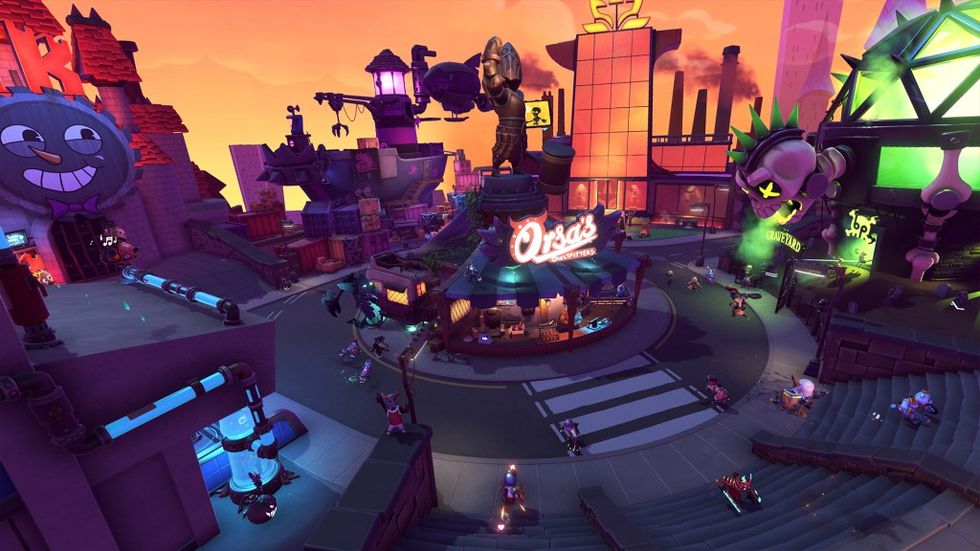
One of King of Meat’s standout features is its art style. Its cartoony 3D character models and buildings juxtapose the comic book-style corporate advertisements that play on the screen when in dungeons. The Iron Law Plaza is a hub world where players can spend in-game currency they’ve earned from completing dungeons at various shops, and it’s reminiscent of the Inkopolis and Splatsville areas in Nintendo’s premier multiplayer shooter Splatoon.
These colorful buildings populate an urban metropolis, giving players a sense of community, but King of Meat’s Iron Law Plaza brown and wooden infrastructure reflects the grimy dungeons players have to trek through. In contrast, the shopkeepers’ 2D character portraits are vibrant and striking, similar to the ones found in Hades, and add a lot of personality and visual expression.
Working with Amazon-level of money allowed Glowmade to reach its full potential, such as creating background characters to populate its world and expanding the plaza for players to interact with each other. Green confirms that Splatoon was an influence for him.
“I loved Splatoon too,” Green says, “and it’s a big part of trying to build a bigger world, especially when Amazon came along and helped push us to make us feel confident in being able to make this game.”
Letting indies stay independent
Hartmann said that not only was the art style a selling point of the game, but so was the gameplay, whose twist on popular genres was something that felt right for Amazon. So far, Amazon Games has been synonymous with MMO games. How does Glowmade and King of Meat fit into Amazon’s portfolio? For Hartmann, it’s a combination of the realities of game development and wanting to evolve.
By expanding into third-party publishing to finance development from external studios, Amazon is able to release more games while still focusing on the ones in development internally. As a former 2K and Take-Two executive, Hartmann is intimately familiar with the business of blockbuster video games, and he believes that Amazon is in the space for the long haul.

“You don’t have to make short-term moves just to do something, and that fits in with my belief that games should not be rushed,” Hartmann says. “Creative teams should really have the chance to breathe and figure it out. I mean, it’s like cooking. The best meals are the ones which cook slowly.”
There’s also the wider question of how Amazon Games fits within the industry. Like many other entertainment sectors, the modern video game industry is heavily driven by the need for content volume. In particular, PlayStation and Xbox have been opening up new studios and acquiring existing ones in an arms race to secure exclusive content. During the past few years, Microsoft acquired both Fallout developer Bethesda and Call of Duty developer Activision Blizzard, while Sony acquired Destiny developer Bungie. However, it seems like Amazon Games still prefers the traditional approach of simply signing third-party publishing deals for games for various lengths of exclusivity.
“I think sometimes studios actually do better when they stay independent,” Hartmann says. “It doesn’t always have to be, but if I’m not adding anything outside of just owning them, I’d rather have them doing their game and being really focused.” It’s a more methodical and steady approach, but he doesn’t rule out the possibility of Amazon Games eventually acquiring a studio.
The future of Amazon Games
With all of its vast resources, why would Amazon just stick to third-party publishing and internal first-party development, rather than go into the hardware business? After all, Stadia’s failure proved that traditional consoles are here to stay for the foreseeable future.
Amazon has its own cloud gaming platform in Luna, but the biggest difference between it and Stadia is that Amazon didn’t try to create an entire gaming platform and ecosystem around it. While cloud gaming technology is slowly becoming better, it’s still very much a feature that compliments hardware, not a market unto itself. Google made the mistake of selling Stadia games piecemeal without giving customers any ownership of their digital purchases, which existed solely in the cloud. Amazon seems to have learned the lesson by mostly sticking to the subscription model.
Although, it’s confusing as to why Amazon’s own games, like Lost Ark and New World, aren’t available on Luna. Despite being on PC and coming soon to consoles, including them in the service would’ve been a great way to reach more players. Console sales have plateaued, which is something that Microsoft has realized.
Recently, Microsoft made a deal with Amazon to bring Xbox cloud gaming to Fire TV sticks, allowing people to play Xbox games without even owning a console, just a compatible Bluetooth controller. Similarly, Luna can be operated on a variety of devices, including TVs, PCs, and mobile phones. This is aimed to get a casual, non-gaming person to try games without owning a console.
While Stadia and Luna are very similar in concept, the way Amazon approached its cloud gaming service as a compliment to the games it develops rather than the sole feature is the reason why Luna is still kicking after Stadia’s demise.
Hartmann is confident that going the content route was the right approach for Amazon, believing that, whether it’s a streaming service or game console, a deep content library is what really attracts users. He points to Stadia as an example, suggesting that if it had compelling content, then it could’ve been in a different position today.
“Google is a great company. They would have learned super fast, but they were running out of content and running out of ideas on how to make it work,” Hartmann explains. “It was not the engineering, and was purely the content, I think, which made it challenging for them.”
Given that AAA games take on average three to five years to finish, and Google had only established its first-party development division in March 2019, a few months before the Stadia’s launch, there was absolutely no way there would be a God of War or Halo-level killer app ready in time to help sell the service. Without the burden of hardware or platform to sell, Amazon Games doesn’t necessarily feel that pressure to rush development.
Amazon Games isn’t worried about future content, either. Outside of King of Meat, it’s publishing NCSoft’s MMORPG Throne and Liberty on PC and consoles next month as well as releasing the PlayStation and Xbox versions of New World in October. It’s also developing an untitled MMORPG based on The Lord of the Rings. While Amazon Games is still leaning heavily into the MMO well, it also has a deal with Crystal Dynamics to publish the next major Tomb Raider entry, signifying a move into cinematic single-player games with a hugely popular franchise from out the gate.
Within the next few years, Hartmann hopes that Amazon Games will have shipped the 10 or so titles that are currently in development either internally or with its third-party partners. He also mentions how Amazon, like many other tech companies, embraces the “fail fast” mentality. This usually means testing out different ideas and using lessons learned to reiterate. However, Amazon understands that video games are a unique beast and take much longer to develop.
“Knowing it’s Amazon, we’re not just going to double down, but we’re going to triple down on all the things that work. Some others won’t work, which is just the nature of entertainment,” Hartmann says. “Business wise, in five years, I hope we’re gonna start scratching on the door of being a top-four publisher.”











 Cherry Torres, Jay Armstrong Johnson, Jimin Moon, Ryan Duncan, and Ryann Redmond Matthew Murphy*
 Cherry Torres, Jimin Moon, Ryann Redmond, Jay Armstrong Johnson, and Ryan Duncan Marc J Franklin*