Skip to content
Search

Wally Amos, Famous Amos Cookies Creator, Dead at 88

Wally Amos, Famous Amos Cookies Creator, Dead at 88

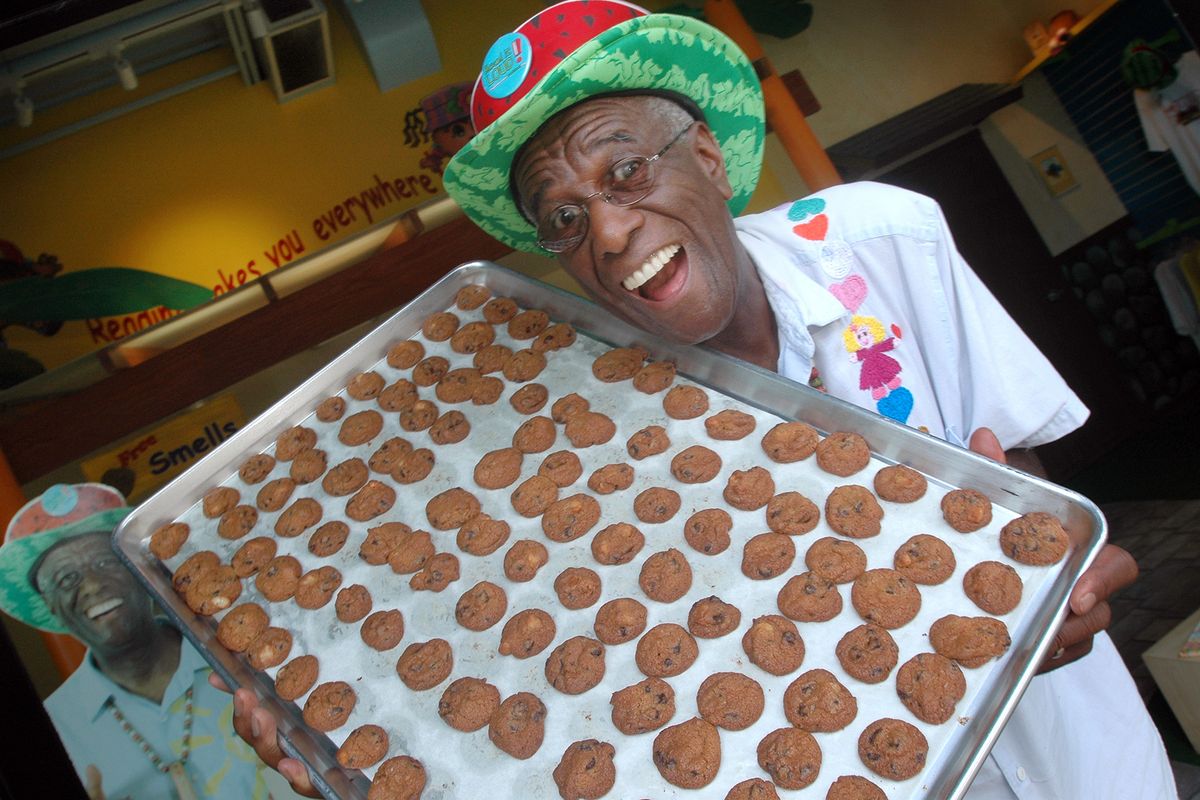
Wallace “Wally” Amos, the founder of Famous Amos cookies, has died at the age of 88. The company founder’s children Shawn and Sarah announced Tuesday that the cookie creator died at his Honolulu home on Aug. 13 due to complications with dementia, according to the New York Times.

Throughout his life, Amos had talked about how he promoted his cookie in a similar way that he’d promote artists when he was an agent at William Morris Agency, where he was the first Black talent agent in the industry, according to the History Channel. In his 2002 book, The Cookie Never Crumbles, Amos wrote that he would include a photo of the cookie and provide little plastic bags with the cookies stapled so you could “taste the cookies.”


Amos even got R&B legend Marin Gaye to invest in his sweets company early on.

“Marvin Gaye had returned my call and wanted me to get back to him,” Amos wrote in the book, per LAist. “I called him from that waiting room, got him on the line, and started right in describing what it was I was up to with The Cookie and Famous Amos, and my store and all. He stopped me in mid-pitch and said, ‘Wally, Wally…hey, wait a minute, man. If you’re doin’ it, that’s Ok, I’ll invest in it.'”

“And just like that, he was in for the $10,000 I needed,” he added. “My shortfall set me back only a week, and thanks to Marvin, my plans were back on track.”

Born Wallace Amos Jr. in Tallahassee, Florida, on July 1, 1936, he lived his teen years in New York City’s Harlem borough. Amos got his G.E.D. while in the Air Force before he joined Willam Morris Agency. There, he signed talent such as Simon and Garfunkel, and worked with the Supremes, Diana Ross, Sam Cooke, and Dionne Warwick.

“I’d go to meetings with record company or movie people and bring along some cookies, and pretty soon everybody was asking for them,” Amos told The New York Times in 1975. That year, he launched his company and its first store on the east side of Sunset Boulevard in L.A.

According to History, the Famous Amos Cookie Company sold $300,000 worth of cookies during its first year and made $12 million in revenue by 1982. (About $42 million in today’s currency.) Four years later, President Ronald Reagan awarded Amos an Award of Entrepreneurial Excellence. In 1986, Amos sold his company to Ferrero Group for $4 million and the remainder of his stakes to the Shansby Group for $3 million.

In the early Nineties, Amos launched a new cookie company called Wally Amos Presents, but he was sued by the new owners of Famous Amos for copyright infringement. He changed the name of the company to Uncle Noname, and after a two-year legal battle, he renamed to Uncle Wally and sold muffins instead, opening a bake shop in Hawaii and later sold his portion of the company.

Outside of cookie-baking, Amos appeared as a guest on The Jeffersons and Taxi, and also The Office. The entrepreneur was also a passionate advocate for literacy, and in 1981, became the spokesman for the Literacy Volunteers of America, an organization focused on teaching adults to read. He eventually wrote several books, including The Cookie Never Crumbles cookbook and The Path to Success is Paved with Positive Thinking.
More Stories

Get to know: The.97, Toronto's most prolific director
Mihailo Andic

Get to know: The.97, Toronto's most prolific director

With over two hundred music videos directed in a single year and a growing creative empire, The.97 has become a defining force in Canadian visual culture. His work with artists like Coi Leray, Fridayy, Chris Brown and Yung Bleu has earned international recognition, and his influence continues to expand far beyond Toronto. We sat down with him to talk about his journey, his creative discipline and what it takes to build a legacy in today’s visual landscape.

Rolling Stone: You recently did a panel with Gary Vee’s VaynerMedia at their New York office. That is a major crossover moment between creativity and business. How did that come together, and what was that experience like for you?

The.97: Gary DM’d me personally one day, completely out of the blue. It caught me off guard because I had followed his content for years, and seeing him recognize my work meant a lot. He invited me to his New York office, and that visit turned into something much bigger. I met Mike Boyd and the whole Vayner team, and it instantly felt like I was in a room full of people who understood brand storytelling and creative scale. After that, they brought me to Cannes for their events, and that experience shifted my mindset. You see how the biggest agencies in the world think and how they connect art and commerce seamlessly. It was validating and inspiring. It reminded me that Toronto creativity belongs on that same world stage.

Keep ReadingShow less
Cops Who Falsified Warrant Used in Breonna Taylor Raid Didn’t Cause Her Death, Judge Rules

Cops Who Falsified Warrant Used in Breonna Taylor Raid Didn’t Cause Her Death, Judge Rules

A federal judge in Kentucky ruled that two police officers accused of falsifying a warrant ahead of the deadly raid that killed Breonna Taylor were not responsible for her death, The Associated Press reports. And rather than the phony warrant, U.S. District Judge Charles Simpson said Taylor’s boyfriend, Kenneth Walker, was responsible for her death because he fired upon the police officers first — even though he had no idea they were police officers.

The ruling was handed down earlier this week in the civil rights violation case against former Louisville Police Detective Joshua Jaynes and former Sgt. Kyle Meany. The two were not present at the March 2020 raid when Taylor was killed. Instead, in 2022, Attorney General Merrick Garland accused the pair (along with another detective, Kelly Goodlett) of submitting a false affidavit to search Taylor’s home before the raid and then conspiring to create a “false cover story… to escape responsibility” for preparing the phony warrant. 

Keep ReadingShow less
Meet the Nigerian Creators Going Global

Meet the Nigerian Creators Going Global

In June, Nigerian comedian Isaac Olayiwola — known as Layi Wasabi on TikTok and Instagram, where he has more than 3 million combined followers — took his first trip to London. There, he had his beloved skit character “the Law” endure U.K. hijinks as if it was his first time as well. In one skit, the Law — a soft spoken but mischievous lawyer who can’t afford an office — bumps into a local, played by British-Congolese creator Benzo The1st. In sitcom fashion, the Law breaks the fourth wall to wave at an invisible but audible studio audience as Benzo watches on, confused and offended. In another, Olayiwola links with longtime internet comedy creator and British-Nigerian actor Tolu Ogunmefun to have the Law intervene in the relationship of a wannabe gangster and his fed up girlfriend. In another, he goes to therapy complaining that he can’t find clients in London (“Everything seems to work here in the U.K.”).

Olayiwola wasn’t in London just to film content — it was a reconnaissance mission, too, sitting for interviews and testing ­­stand-up sets to see how his humor might translate. After breaking out as one of Lagos’ most popular creators, he’s set on becoming a top comic — not just in his region, but in the world.

Keep ReadingShow less
‘Black Myth: Wukong’ Is a Hit. But Why Is the Game So Controversial?

‘Black Myth: Wukong’ Is a Hit. But Why Is the Game So Controversial?

The expectations for Black Myth: Wukong have been sky-high since its first reveal back in 2020, which teased an action RPG with breathtaking graphics, set in a world based on the classic Chinese novel “Journey to the West” with a Dark Souls-style wrapping. After six years of development by independent studio Game Science, Black Myth: Wukong was released on Aug. 20 for PC and PS5, causing a stir in terms of sheer number of players amassed in just a few days.

At the time of writing, there are over 2.1 million concurrent players on Steam alone, as well as 132,000 viewers on Twitch watching dozens of streamers playing it. Black Myth: Wukong is, based on numbers alone, a rampant success. Beyond the stats, critical reception paints a mixed picture of a game mired in technical issues on the PC version, and multiple controversies surrounding both its development and the days around launch.

Keep ReadingShow less
Here Are the People Who Lost Millions Backing Musk’s Twitter Takeover

Here Are the People Who Lost Millions Backing Musk’s Twitter Takeover

Elon Musk took Twitter private in 2022, but he didn’t do it alone: the deal was backed by his wealthy allies in Silicon Valley, embattled hip-hop mogul Sean “Diddy” Combs, and holding companies based in Saudi Arabia and Qatar, according to a court document ordered unsealed by federal judge on Tuesday, which were first seen by the public late Wednesday night.

The list of shareholders was made public thanks to a motion filed by nonprofit group the Reporters Committee for Freedom of the Press on behalf of independent tech journalist Jacob Silverman, who has argued that the public deserves to know “who owns an important site for public discourse and whether its free-speech fundamentalist majority shareholder is doing business with censorious dictatorships.” Musk’s company, now branded X Corp., had until Sept. 4 to comply with U.S. District Judge Susan Illston’s order to disclose the investors.

Keep ReadingShow less