
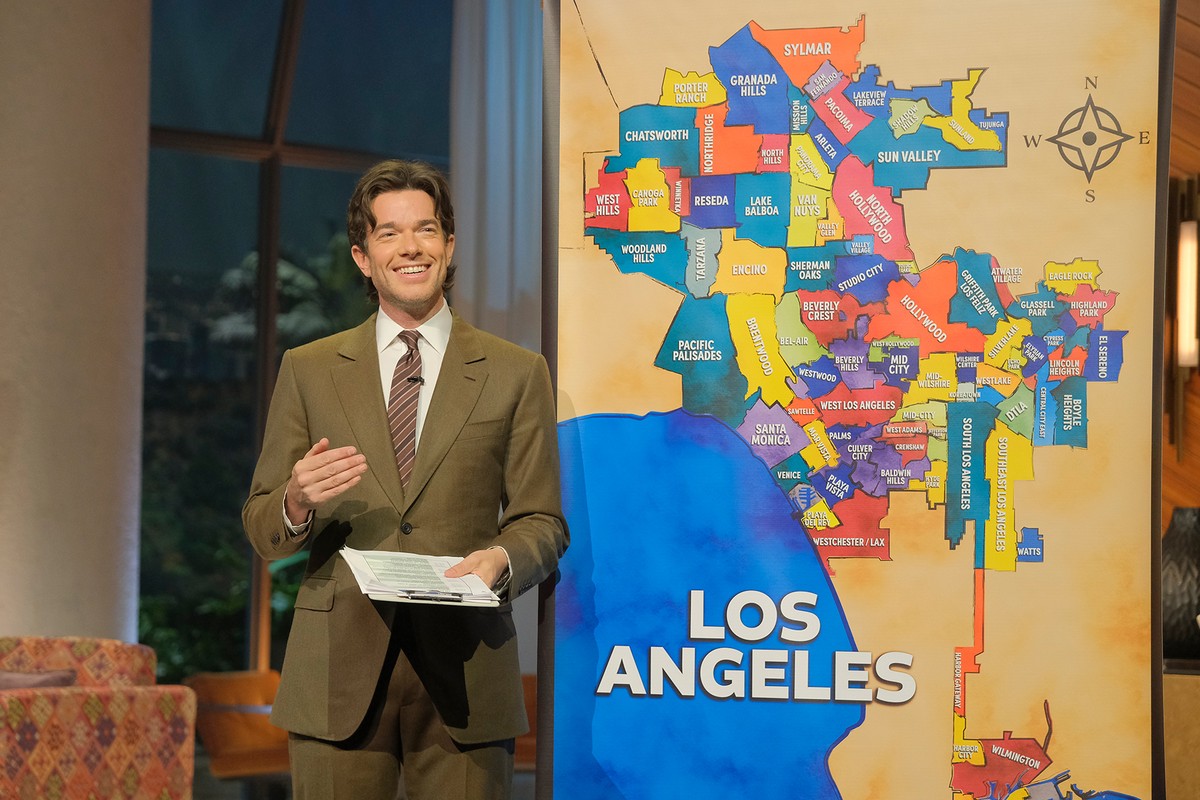

There’s a moment in the first episode of Everybody’s in L.A., John Mulaney’s delightfully chaotic live Netflix special, in which Mulaney asks special guest Jerry Seinfeld why he decided to make his Pop-Tarts origin movie Unfrosted (which was released on — you guessed it — Netflix the same day Mulaney’s special aired, because there’s nothing more on-brand for a special about Los Angeles culture than cross-promotional synergy) .
“I don’t know. Because they let me,” Seinfeld responds, referring to Netflix. “Probably the same reason why you’re doing this. It makes sense to them, I guess, why they wanted to make it.”
Considering Seinfeld is seated next to wildlife expert Tony Tucci at the time to discuss the topic of coyote preservation — and that a few minutes later, the trio will field a long-winded and pointless call from a normie about her experience being trailed by the animal while microdosing on a nature hike — it’s hard not to concede that he has a point. There’s no real reason for Everybody’s in L.A. — a six-episode live special interspersed with man-on-the-street interviews and pre-recorded sketches featuring the lineup of the average Comedy Central roast — to exist, and there are moments where you feel genuine empathy for the Netflix junior executive who had to convincingly pitch this to his boss. (“It’s like Eric Andre meets How To With John Wilson, but live and with jokes about LAPD officers’ taste in eyewear. Also, Ray J will be here, and we can’t ask him about the sex tape, but we can ask him about his divorce.”)
Yes, Everybody’s in L.A. is a gratuitous vanity project almost exclusively intended for the small sliver of Mulaney’s audience that knows what Erewhon is — not, to borrow the parlance of Seinfeld himself, that there’s anything wrong with that. But as vanity projects go, it’s a pretty goddamn charming one.
As Mulaney explains in his opening monologue, the Netflix special, which will air live in six parts throughout the next week, was intended to capitalize on the annual Netflix Is a Joke festival, during which seemingly every comedian in North America is in the Los Angeles metropolitan area. Billed as a cultural celebration of Los Angeles, Everybody’s in L.A. intersperses field pieces with Mulaney’s unique brand of standup, a melange of observational humor and fey self-deprecation. Each episode (ostensibly) has a Los Angeles-centric theme, and the first one is devoted to coyotes, which Mulaney compares to a dog that has “lost all its money and switched from powder cocaine to base.”
Mulaney has, famously, had a rough few years. At the height of the Covid-19 pandemic, he entered rehab for drug and alcohol addiction; a few months later, he announced his separation from his wife, artist Annamarie Tendler, before tabloids reported that the famously child-averse Mulaney was also expecting a child with actress Olivia Munn. In last year’s Baby J, Mulaney recounted the circumstances surrounding his stint in rehab and briefly alluded to the dissolution of his marriage in a cheeky summary of the events of the pandemic: “We all went to rehab and we all got divorced, and now our reputation is different.”
Mulaney’s issues with substance abuse serve as an omnipresent backdrop of his material in Everybody’s in L.A., from the start of his opening monologue: “Why even do this show? I dunno. But it gives me something to do. And structure is key for me,” he cheerily notes as a chryon reads, “recovering alcoholic, and other stuff.” Seinfeld also remarks at one point that it “does seem a guy coming out of rehab would do a show like this… someone who’s going through something, and this is how they’re expressing it.”
What Seinfeld means by “a show like this” is somewhat difficult to describe. In many ways, Everybody’s in L.A. is a fairly standard live late-night talk show, featuring a wide range of guests who would normally never interact with each other, kind of like a surrealist dinner party. Unlike most late-night shows, however, which gloss over the artifice of that scenario, Everybody’s in L.A. beautifully delves into the awkwardness, such as when Mulaney, Seinfeld, and sidekick Richard Kind (in top form, as usual, playing the Martin Scorsese to Mulaney’s Fran Lebowitz) interrogate wildlife expert Tony Tucci about the best ways to ward off coyotes. (Tucci recommends carrying around an airhorn.)
At one point, the trio take calls from viewers about their own encounters with coyotes, and the two A-listers can barely conceal their contempt for people’s long-winded and mundane stories — which should come off as smug, but instead comes off as wildly endearing. There are also occasional interjections from “wildlife correspondent” Brook Linder, who is stationed in Eagle Rock to report whether he has seen a coyote (spoiler: he doesn’t); a delivery robot; and Will Ferrell, making a cameo appearance as audience member-slash-record producer Lou Adler, trying to convince Mulaney to fall off the wagon (“You turned your back on party culture!!!” he bellows).
The pre-recorded segments of the show are far less successful, such as man-on-the-street interviews featuring a guy fishing in the Los Angeles River and a billboard installer; and a tepid House Hunters parody starring Mulaney, George Wallace, Chelsea Perretti, Stavros Halkias, and Natasha Leggero. (“I could really see myself cranking it in here,” Halkias observes as they check out the bathroom, and it is telling that that is probably the best line from the segment.) There is also a performance from St. Vincent, which feels tacked on to adhere to the standard late-night format.
Everybody’s in L.A. is really about Mulaney: his idiosyncratic persona, his hyperspecific interests, and his self-effacing stage presence that translates into boyish charm. (Also, his hair. He grew out his hair, and it looks great.) Unlike, say, a Fallon or a Meyers or a Colbert, he doesn’t really have much aptitude for or interest in pretending he’s deeply interested in what his guests are saying, but that’s also kind of the point. This is a special that could only have sprung from Mulaney’s brilliant, off-kilter mind, not to mention Netflix’s prodigious budget. (Seriously, despite the pearl-clutching about the state of streaming, if Everybody’s in L.A. serves as any sort of bellwether, Netflix is doing just fine.) It’s chaotic, odd, unpredictable, and totally unnecessary, and that’s what makes it great.










The Trump Administration’s Lies Insult the Intelligence of Every American