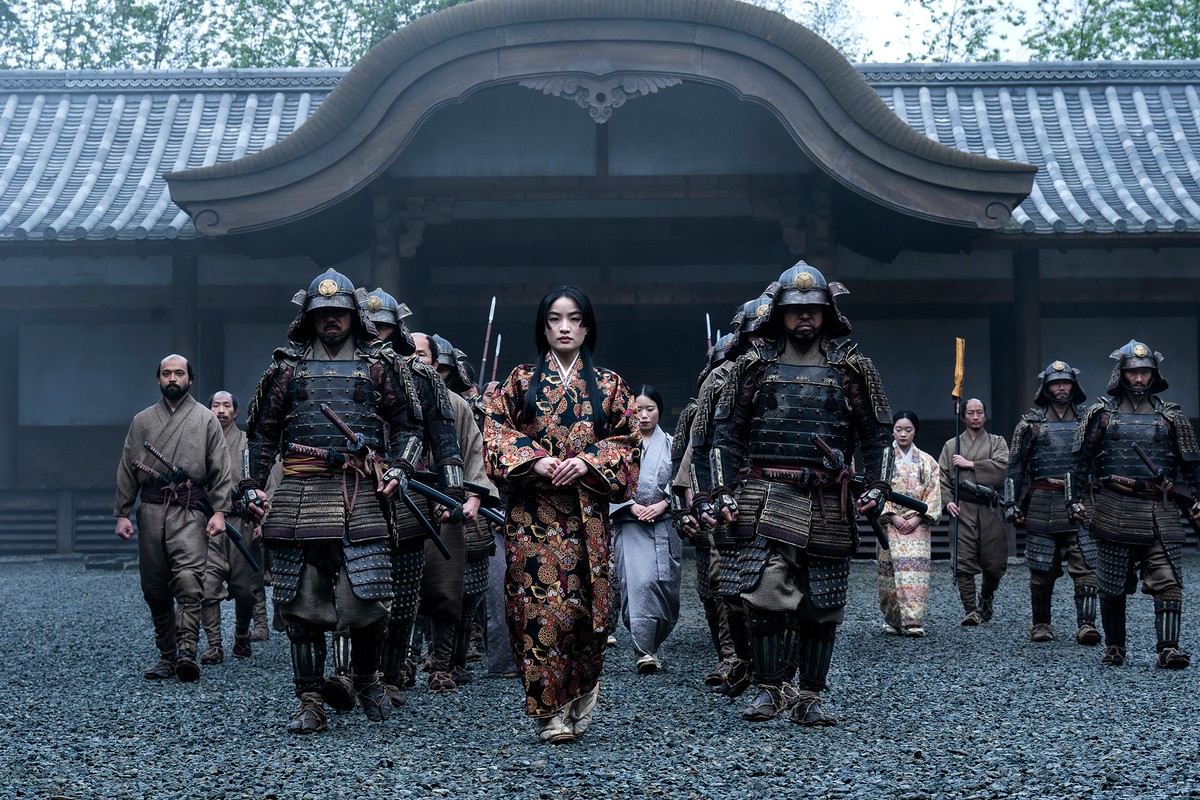

“Accepting death isn’t surrender. Flowers are only flowers because they fall.”
This is Toda Mariko in the penultimate episode of Shōgun, FX’s epic adaptation of James Clavell’s novel about a civil war in feudal Japan. Mariko says this because (spoiler alert) she knows that she is the flower who is about to fall, not only accepting her impending demise, but welcoming it.
But the people who made Shōgun don’t seem as willing to accept the series’ death. Though its 10 episodes covered the entirety of Clavell’s book, in May, the parties involved put out a statement declaring that “FX, Hulu, and the Estate of James Clavell are working to extend … the saga with two additional seasons of the drama series.” The phrasing suggests these two seasons aren’t guaranteed: Producers Justin Marks and Rachel Kondo are running a writers room this summer to figure out how, or perhaps if, they can continue a story they seemingly finished.
The announcement qualified as one of the least surprising showbiz developments in recent memory — and one we greet with a mixture of both cautious optimism and faint dread. Shōgun is the early front-runner for best TV show of 2024, and FX says it’s the network’s “most watched show ever based on global hours streamed.” Nobody says goodbye to a hit if they can help it(*), even if there’s no obvious story left to tell. HBO’s Big Little Lies similarly recounted the whole plot of the novel that inspired it, got big audiences, acclaim, and awards, and came back only because it seemed silly not to try. But even with the addition of Meryl Streep, the second season struggled to justify its existence. (There’s somehow still talk of a third season, because who is going to say no to the combined forces of Nicole Kidman, Reese Witherspoon, and Laura Dern?)
(*) In this case, it also helped that the drama series field at the Emmys was as wide-open as it’s been in decades, while the limited series categories were fairly crowded. By announcing potential future seasons, FX got to submit as a drama, and received a whopping 25 nominations.
TV history is unfortunately littered with series that could have been immortal had they ended after their first years, but instead stuck around long past the point at which anyone had any interest. In a sliding-doors reality, Showtime’s Homeland ends after a single season with Damian Lewis blowing himself up in a terrorist attack, and it goes right to the hall of fame; instead, it was so popular that it galumphed along for seven more seasons — eventually, after a long creative drought, reinventing itself as a slightly classier 24.
On occasion, a seemingly unwise continuation turns out to be brilliant. HBO’s The Leftovers also finished adapting a book by the end of its first season; the next two installments, which told new, audacious stories set in the same grief-stricken world as the novel, put it on the short list of all-time greatest TV dramas. The first season of NBC’s high school football drama Friday Night Lights very loosely fictionalized H.G. Bissinger’s book, then followed with one of the worst second seasons you will ever see, including a wildly off-brand subplot where two of the kids covered up a murder. Yet it rebounded with additional seasons that were on par with the first. Phoebe Waller-Bridge used up most of the material from her one-woman stage show in Fleabag’s first season, but was able to eventually write an even more iconic second batch of episodes that felt like a miracle.
Television, by its very nature, tends to defy restraint: If the audience is willing and there’s money to be made, then shows will keep coming back. Some shows benefit from this model, particularly shows with big ensembles and/or ones with some kind of distinct episodic hook, and the gradual but inescapable shrinking of seasons, and series, has cost television a lot of what makes it distinct and special. But with other shows, particularly intensely serialized ones, and/or ones based on close-ended material, the more episodes you make, the harder it is to maintain the quality with which you began. This reality can manifest itself in minor disappointment, like Russian Doll following its immaculate first season with a much messier but still entertaining second. Or it can lead to embarrassing calamities, like everything that followed the first year of Heroes.
Game of Thrones, one of the few series ever produced on a scale bigger than Shōgun, got into trouble toward the end, when George R.R. Martin ran out of novels for the showrunners to lean on. Some of the show’s best moments in its glory years were a result of the producers going off-book, like Arya Stark and Tywin Lannister meeting in the ruined castle of Harrenhal, or Jon Snow witnessing the White Walkers’ zombie attack on Hardhome. But such memorable scenes were the exception rather than the rule.
Few pop-culture pleasures are more deeply satisfying than a work of art that knows exactly when, and how, to end. Would a Fleabag that continued after the Hot Priest’s exit still have been entertaining? Possibly. But by having Fleabag herself turn to the audience and wave goodbye, it became transcendent.
Marks and Kondo already told us how Lord Yoshii Toranaga would win the war, and there is a huge risk that showing it to us, rather than adapting one of Clavell’s other Japanese novels, will rob the original ending of its power. But if Mariko can bring down the ruler of Japan with little more than a poem, maybe additional Shōgun seasons can defy TV history, and make us happy the flowers haven’t all fallen just yet.



 Jeremy Strong and