
Most folks were not at Woodstock, Altamont, or Wattstax. Many of us were not a gleam in our parents’ eyes when Monterey Pop took place. We didn’t attend Bob Dylan’s numerous performances at the Newport Folk Festival in the 1960s, and we were not lucky enough to catch the Talking Heads do a four-night stand at the Pantages Theater in Hollywood in 1983. For every person that was at the Fillmore on Thanksgiving 1976, watching the Band give a massive farewell show, there are hundreds of thousands who have never set foot in the storied venue.
But we know these legendary events and performances like the back of our proverbial hands, thanks to the movies. Someone was smart enough, savvy enough, or simply lucky enough to have cameras rolling and boom mics at the ready when history was being made, one flaming Fender Stratocaster or boombox-accompanying “Psycho Killer” at a time. There were online comments galore about Paul Thomas Anderson and Benny Safdie sightings at Cameron Winter‘s show at Carnegie Hall in December of last year, and how both of these namebrand auteurs were running around with Panavision rigs on their shoulders. Thus, folks had a hunch that some sort of visual chronicle of a landmark show would make its way in to the world at some point. You figured it would be special. Even knowing who was pounding the keys and who was calling the shots, however, you might not have guessed it would be something so sublime as to make you so teary and euphoric.
Cameron Winter at Carnegie Hall is, in many ways, as simple and straightforward as its title, a document of the Geese frontman’s solo gig at a venue that’s played host to everyone from Benny Goodman to the Beatles, Lenny Bruce, and Robert Zimmerman. Anderson’s understanding of how to meld sound and vision in a way that’s ultra-cinematic is a given (we still think about that “Dirty Work” needledrop in One Battle After Another on a weekly basis), and he’s cut his teeth on enough short- to medium-form music videos for Radiohead, Joanna Newsom, Fiona Apple, and Haim to know how to use visual ideas to harmonize with a song. The filmmaker is also fluent in the language of Vintage Music Docs 101, which is why his movie kicks off with well-dressed patrons grinning into the camera, tickets being procured and scanned, and an establishing shot of a building that takes up a whole midtown Manhattan corner and requires practice, practice, practice to tread on its boards. There will be rapturous audience reaction shots.
 Cameron Winter, Benny Safdie and Paul Thomas Anderson, backstage at Carnegie Hall. Lewis Evans*
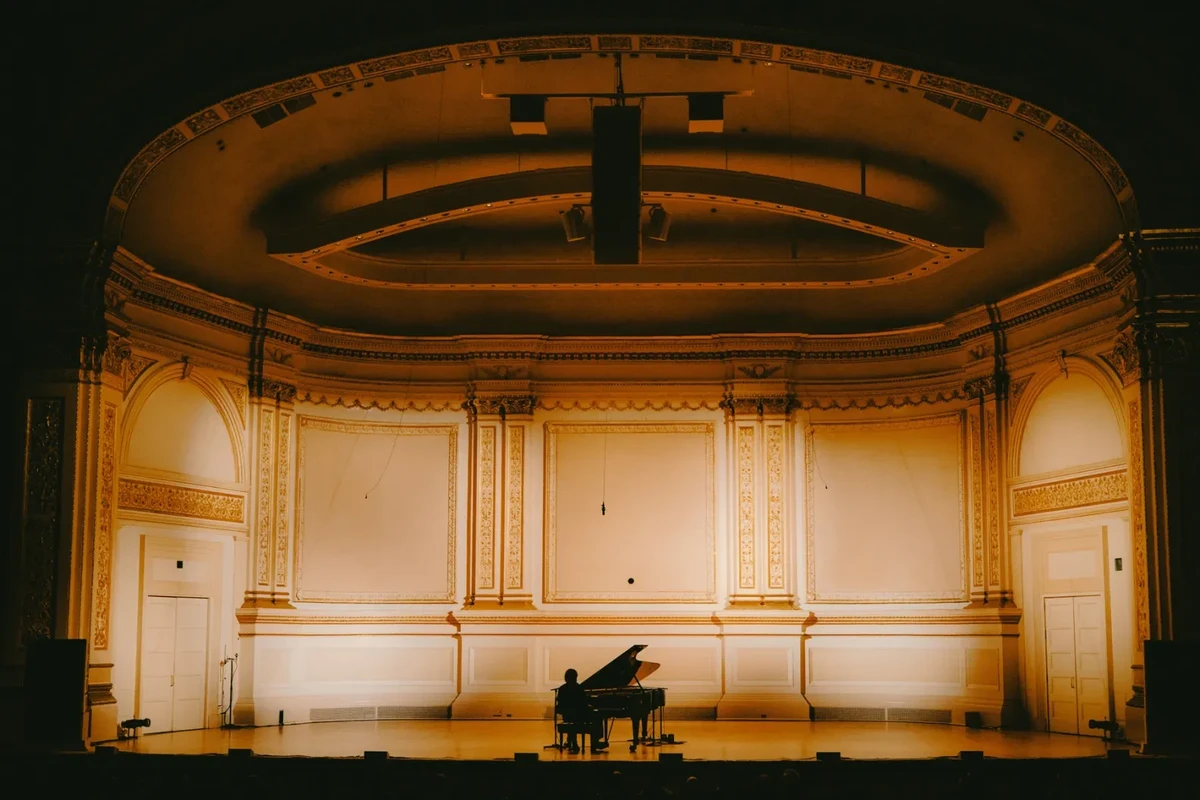
Winter’s show was little — “little” — more than a man, a piano, and two-taped-together microphones. That’s what is in PTA & Co’s viewfinders. That’s what shows up onscreen. Songs like “It All Fell in the River,” “The Rolling Stones,” and the exquisitely titled “Cancer of the Skull” don’t require being goosed with high-concept ballyhoo, especially not in the stark presentations Winter gives them here. But like all great concert films, Anderson’s portrait understands both how to capture a performance and how to elevate it. And while Cameron Winter at Carnegie Hall does give you various best-seat-in-the-house viewpoints, it’s the cuts to wide shots that frame the singer in a lone spotlight and the intimate close-ups of the musician hunched over a Steinway, channeling poetry and pain, that makes it transcendental.
It’s not just a point-and-shoot affair. There’s a slightly jarring moment where viewers find themselves backstage, the doors open from the wings, and you ride shotgun as someone brings out a camera mid-song. Then you watch the rest of the number perched on the other side of the instrument, Winter deep into his own playing, eyes shut, his baritone occasionally breaking. A few shaky handheld moves suggests PTA, Safdie (who does double duty as cameraman and producer), and their cohorts have graduated from the D.A. Pennebaker School of Direct Cinema, Music Division, with honors. There’s one shot that puts you directly under Winter in medias yowl, as light flares stream from the ceiling and across his face, that will take your breath away. But showing off or gussying things up is the last thing on Anderson’s mind; high concepts aren’t listed on the program. The director knows what he’s got in Winter as a subject, a performer, a piano man who feels like a zero-dollar man. That’s more than enough to grace a 35mm strip of celluloid and a soundtrack.
So many people point to Stop Making Sense as the benchmark for how to transform a live performance into something more than an ephemeral moment happening in front of a lens. Anderson is a self-confessed Jonathan Demme superfan — as all cinephiles worth their salt should be — and can probably recite cut-for-cut sequences from that Talking Heads movie by memory. The real touchstone here, however, is a different Demme production: his music video for New Order’s “The Perfect Kiss.” Four people in a room, playing together, cameras catching all of their wordless communication, their concentration and their intensity in full focus. Some shots dwell on the band member’s hands working their instruments. Others are literally in their faces. It’s a celebration of the humans who are making this music.
Anderson, like his hero, is a humanist at heart, and you get the sense watching Cameron Winter at Carnegie Hall that he’s fascinated and slightly in awe of the 23-year-old human gracefully tickling ivories and singing stream-of-consciousness doggerel with a weariness beyond his tender young age. That act of baring himself is worthy of being preserved for posterity. As PTA himself might declare, it’s great music made by a great new artist. What the fuck else do you need, man?!
For the record, Mr. Anderson did not say that when he took the stage, along with Winter, to present the documentary’s world premiere at the New York Film Festival. Both he and his subject thanked the festival director Dennis Lim; Winter thanked “Andrew” (as in Carnegie). Neither of them felt the need to say much beyond expressing their gratitude, with Anderson wisecracking “You don’t talk so much” to his nearly silent partner staring up at the screen behind him. You could have heard a moth flap its wings during the movie itself, with the crowd greeting every song with hushed reverence. At one point, the audience tentatively started clapping then quickly quieted back down. There was a sense that we were being taken to church by this movie, as much as the attendees of that concert must have felt watching Winter play. Anderson’s collaboration with this gifted young man nails the one thing that every great concert movie tries gift to those who could not be their for the original moment. It does not just put you inside the theater. It makes you feel like you’re inside the music.




 Jeremy Strong and