
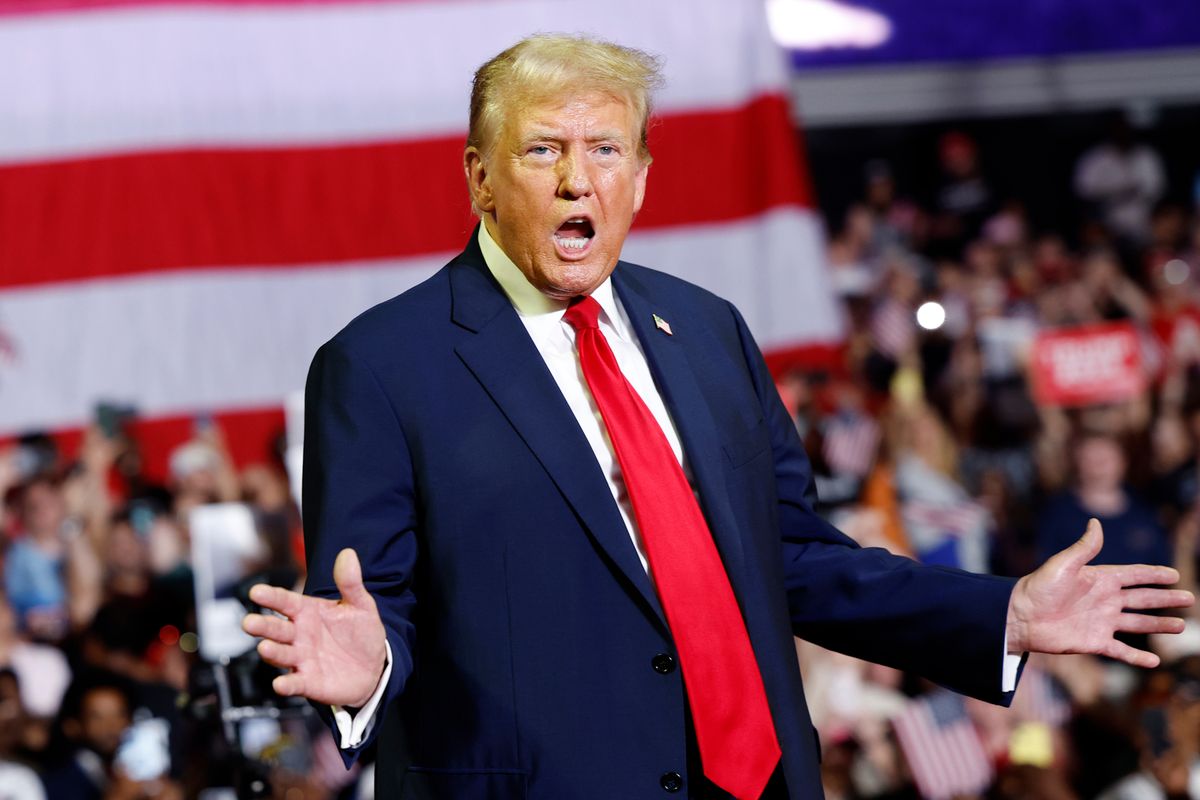

Donald Trump got away with it.
That’s the result, anyway. Monday’s Supreme Court decision is a little more detailed: The court, by a 6-3 vote along partisan lines, granted the once-and-maybe-future president immunity from prosecution over most of his actions to overthrow the government in 2020 and 2021.
But that’s the end result: Donald Trump may never face accountability for his actions to overturn the 2020 election. And it comes in the context of other Stay-Out-Of-Jail-Free cards he’s been handed, like District Judge Aileen Cannon’s inexplicable delays of his “Classified Files in the Bathroom” case, and the delays in the Georgia election interference case against him.
None of these will be resolved before November, when, at present, a majority of American voters say they’ll vote for him to be president again, believing he can tackle inflation. Only the Stormy Daniels case will have been decided in time.
What’s remarkable about the Supreme Court’s decision is how novel it is. Conservative justices are supposed to dislike decisions with “no firm grounding in constitutional text, history, or precedent.” That’s what the Dobbs opinion, written by Justice Samuel Alito, said about Roe v. Wade. But it’s equally true of Monday’s decision in Trump v. U.S. There is no constitutional, statutory, or other basis for declaring presidents immune from criminal prosecution. Chief Justice Roberts’ opinion recognizes as much. But, he says, “criminally prosecuting a President for official conduct undoubtedly poses a … threat of intrusion on the authority and functions of the Executive Branch.” And that violates the constitutional separation of powers.
Presto! Presidents are now immune from criminal prosecution, as long as the acts in question are “official acts.” President Bill Clinton can still get sued for lying about his affair with Paula Jones, but Donald Trump cannot get sued for trying to steal an election.
The court did leave the door open a crack in terms of the specific charges against Trump. Some of Trump’s actions, it said, were partly official and partly not. So, Roberts instructed the trial court to review items such as Trump’s pressuring state officials to annul election results, creating fraudulent sets of alternative electors, cajoling Vice President Mike Pence to refuse to certify the election on January 6 (which he had no authority to do), and, of course, inciting an angry mob that violently attacked the Capitol on January 6.
For each of those charges, the district court is supposed to determine whether prosecuting Trump for that conduct “would pose any dangers of intrusion on the authority and functions of the Executive Branch.” If so, he’s immune. If not, not.
But of course that crack won’t matter much if Trump wins the election, because this is ultimately a federal case brought by the Department of Justice, and he can call it off next January 20. Presto again.
Now, despite this doctrine of presidential immunity being completely new and made up out of nothing, there are some good reasons for it. As the court’s opinion points out, we don’t want to become some banana republic where each president prosecutes the preceding one out of spite, right?
Then again, as Justice Sotomayor’s fiery dissent points out, that’s why we have, you know, laws and stuff. As the House Republican impeachment managers have recently discovered, you can’t just press charges against someone because you hate them. They need to have actually allegedly done something criminal that you can indict them for doing. Which is one reason there’s almost no precedent for a case like this: Because there has never before been a president like Donald Trump. (Richard Nixon, who doesn’t really come close, was pardoned.)
On the flip side, what’s more “banana republic” than allowing a president to do whatever he wants, free from consequences, as long as it’s within his “official capacity” to do so? Here’s Sotomayor again: “When he uses his official powers in any way, under the majority’s reasoning, he now will be insulated from criminal prosecution. Orders the Navy’s Seal Team 6 to assassinate a political rival? Immune. Organizes a military coup to hold onto power? Immune. Takes a bribe in exchange for a pardon? Immune. Immune, immune, immune.”
As colorful as these examples are, arguably they’re too tame. Trump is a former president who, when he lost an election, tried to steal it. The only form of accountability the court leaves in place — the will of the voters — is exactly what was attacked by Donald Trump’s schemes and plots. And Trump is now a candidate promising to use the Department of Justice to go after his enemies; the Supreme Court has now given him carte blanche to do so
This is what people mean when they use words like “fascism” and “dictatorship”: unjustly utilizing the levers of state power to consolidate them behind the bold, charismatic leader. These aren’t “official acts” for which a subsequent president might seek revenge. They are craven, illegal acts in the cloak of official power. They are the essence of authoritarianism.
These aren’t the fever dreams of a liberal Rolling Stone columnist. Project 2025, the 900+-page blueprint for the next Trump presidency, lays out in exquisite detail the Christian Nationalist Right’s plan to dismantle the administrative state and install partisan lackeys at all levels of government. And the court is helping. Last week, in a little-covered decision that was earth-shattering in its impact, the court overturned the forty-year-old “Chevron doctrine” that required courts to defer to agency interpretations of laws. And on Monday, the court similarly opened up longstanding federal regulations to new legal challenges. Bit by bit, our country’s guardrails against authoritarianism are being dismantled.
Unlike some of my peers in the press, however, I want to suggest that Monday’s opinion may not matter much in terms of the 2024 election.
First of all, the court had already delayed issuing this opinion for five months; while it rushed out its opinion ruling that Trump couldn’t be kept off state ballots for inciting an insurrection, it refused to expedite this case and left the decision for the final day of the term. Even had they ruled against Trump, it’s hard to imagine a conviction would have come before November.
Second, as we saw with the Stormy Daniels case, verdicts don’t necessarily matter much to voters. Sure, getting convicted for insurrection is more serious than getting convicted for falsifying business records to pay off an adult film actress. But would a guilty verdict really have moved the needle that much anyway?
Voters are focused on the economy; many, especially younger ones, see that the system is rigged, and see Trump as a chaotic figure who might just shake it up — even though Trump’s policies rewarded the 1 percent to a greater extent than any previous president’s. Many older voters have, putting it gently, traditionalist views about American society. If they haven’t paid attention to Jan. 6 yet, I’m not sure a court case would’ve changed that.
And remember, this is how fascism often takes root. The Nazis won their 35 percent plurality on the basis of economic and social discontent; nationalists in France and Italy have capitalized both on fear of immigration and on economic woes. We are not any different.
In the larger context of this moment of American history, however, the Supreme Court has once again failed — perhaps intentionally — to recognize the gravity of this moment, the seriousness of Trump’s attempts to overthrow the government in 2021, and the threat he presents now. At least two justices, of course, appear to support his authoritarian designs (or at least don’t mind if their wives do). But all six of the court’s conservatives seem to regard his actions as mere misconduct, or “official acts” like pardoning the Thanksgiving turkey.
In so doing, they have perhaps willfully lost the plot. If the Supreme Court is meant to be a check against governmental tyranny, a protector of the vulnerable against the strong, and a defender of the democratic order, it has utterly failed us.



 A Canadian flag flies along the waterfront of Lake Ontario, on Aug. 27, 2026. Cole Burston/AFP/Getty Images


The Supreme Court Fails Again