
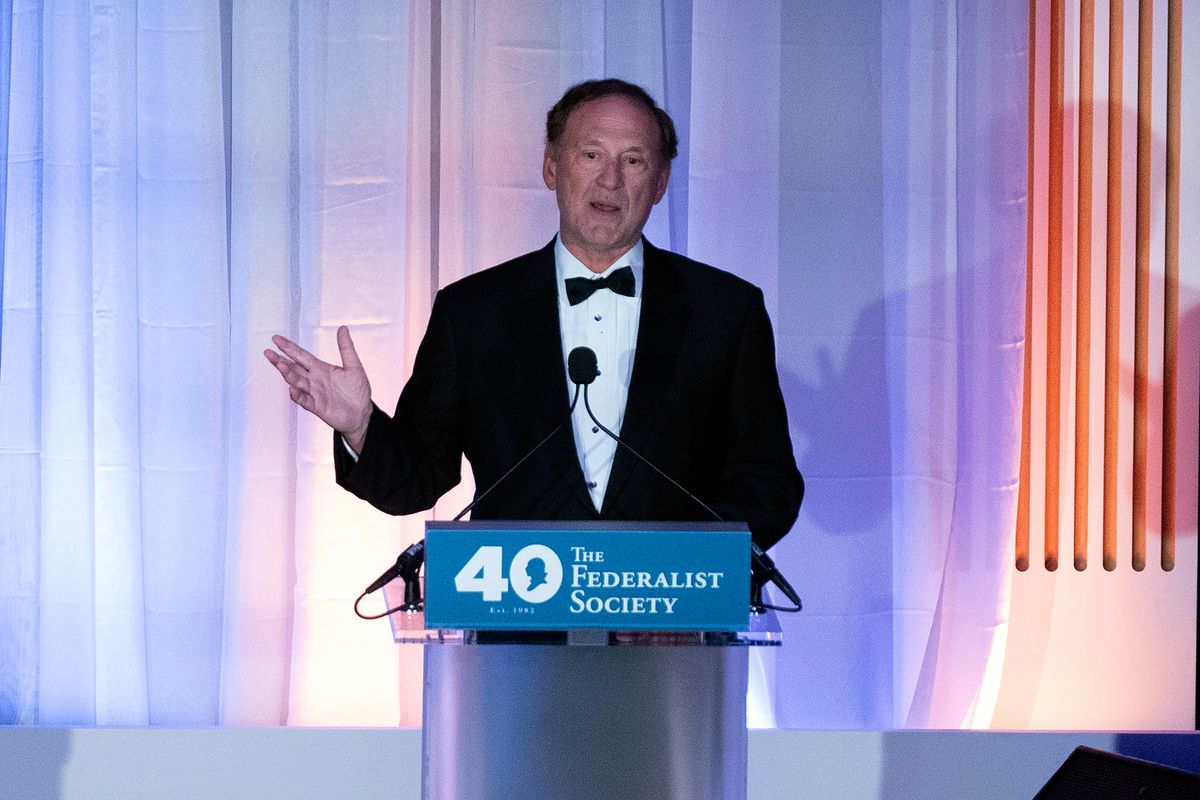
In a new recording, Supreme Court Justice Samuel Alito lashes out at the news organization ProPublica, describing its Pulitzer Prize-winning coverage of the Supreme Court as driven by political animus, insisting: “They don’t like our decisions.”
Alito was captured on tape at a June 3 event hosted by the Supreme Court Historical Society. The recording was provided exclusively to Rolling Stone by Lauren Windsor, the liberal documentary maker, who has paid annual dues to the society and spent $500 for a ticket to attend the dinner. Windsor’s colleague, Ally Sammarco, attended as well, and spoke with Alito, recording their conversation.
The questioner approached Alito with flattery, calling him an “American hero,” and engaged the justice in a discussion of media scrutiny of the Supreme Court: “Why do you think the Supreme Court is being so attacked and being so targeted by the media these days?”
Alito answered: “They don’t like our decisions, and they don’t like how they anticipate we may decide some cases that are coming up. That’s the beginning of the end of it,” he said. But Alito didn’t stop there. He volunteered: “There are groups that are very well-funded by ideological groups that have spearheaded these attacks. That’s what it is.”
Asked to elaborate, Alito got specific. “ProPublica,” he said. “ProPublica gets a lot of money, and they have spent a fortune investigating Clarence Thomas, for example. You know, everything he’s ever done in his entire life.” Alito then pulled his own experience into the conversation. “And they’ve done some of that to me, too,” he said. “They look for any little thing they can find, and they try to make something out of it.”
The Supreme Court’s nine unelected jurists are entrusted with vast powers to shape individual and collective rights in America. In 2024, ProPublica won a Pulitzer Prize for its “groundbreaking and ambitious reporting” on the high court and “how a small group of politically influential billionaires wooed justices with lavish gifts and travel.”
In essence, Alito is now accusing ProPublica of being unduly influenced by the media organization’s own financial patrons. A spokesperson for ProPublica defended its investigative journalism to Rolling Stone. “ProPublica exposes abuses of power no matter which party is in charge, and our newsroom operates with fierce independence,” the spokesperson said. “No donors are made aware of stories before they are published, nor do they have a say as to which stories reporters pursue.” The news organization claims more than 55,000 donors of “every stripe,” and also posts a list of its “larger donors,” which includes many mainstream foundations.
In a series of stories over 2023, ProPublica reporters uncovered hundreds of thousands of dollars’ worth of private travel and vacations taken by Thomas and paid for by billionaire Texas businessman Harlan Crow. ProPublica found Crow also bought a house from Thomas and paid his grandnephew’s boarding-school tuition. Another friend of Thomas loaned him $267,000 to buy a luxury RV, and then forgave all or most of the loan. ProPublica separately revealed that Alito flew on a private jet paid for by the billionaire financier Paul Singer during a 2008 luxury vacation in Alaska.
When ProPublica reached out to Alito for comment in June 2023 for its story, he declined to respond. Instead, he preempted ProPublica’s story with an opinion piece in The Wall Street Journal defending his decision not to report the Alaska excursion on his ethics forms. ProPublica later wrote that, through this strange maneuver, Alito had accused the media outlet of “misleading readers in a story that hadn’t yet been published.”
Though Alito dismissed the outlet’s reporting as focused on “little” things, ProPublica’s stories prompted the court to issue a new code of conduct, signed by all nine justices, in November 2023. A statement by the court said the document “largely represents a codification of principles that we have long regarded as governing our conduct.”
Following ProPublica’s reporting, Thomas disclosed a new private-jet trip provided by Crow and a real estate deal with the billionaire donor which had featured prominently in ProPublica’s reporting. A statement accompanying the disclosure by Thomas’ attorney acknowledged “prior reporting errors,” but called them “strictly inadvertent.”
Last week, Thomas’ 2023 financial disclosure was released to the public. He included a note amending his 2019 financial disclosure to acknowledge two free vacations he received from Crow — trips that were previously reported by ProPublica — writing that the items were “inadvertently omitted at the time of filing.”
“The fact that Clarence Thomas amended his past filings to formally disclose trips that were paid for by billionaire Harlan Crow speaks for itself,” adds the ProPublica spokesperson. “Those gifts, and Justice Alito’s fishing trip to Alaska with a person whose hedge fund later had a case decided by the Supreme Court, would not have been publicly known without our reporting.”
Windsor has released two additional recordings from the Supreme Court Historical Society — both of which were provided as exclusives to Rolling Stone. In the first recorded conversation, Alito spoke about the difficulty of expecting the left and right to live “peacefully” given their “differences on fundamental things that really can’t be compromised.” He also said he agreed with the idea that people in America who believe in God must fight “to return our country to a place of godliness.”
In the second recording, Windsor spoke with the justice’s wife, Martha-Ann Alito, who complained about having “to look across the lagoon at the Pride flag for the next month,” and discussed wanting to design and fly her own flag with the Italian word for “shame,” apparently in response.
Windsor has been working on a documentary, Gonzo for Democracy, which will chronicle the growth of Trumpism, election denial, and religious extremism.
She tells Rolling Stone that Alito’s comments about ProPublica are “really indicative of the sort of grievance that he carries — or this sort of thumbing his nose at ethical standards he thinks he should not be subjected to.”
She adds, “I don’t think anybody in their right mind would consider a free RV, your nephew’s tuition, or buying your mother’s house a ‘little thing.’ These are all purchases from a donor — gifts from a donor — that I think any reasonable person would consider to be extraordinary.”


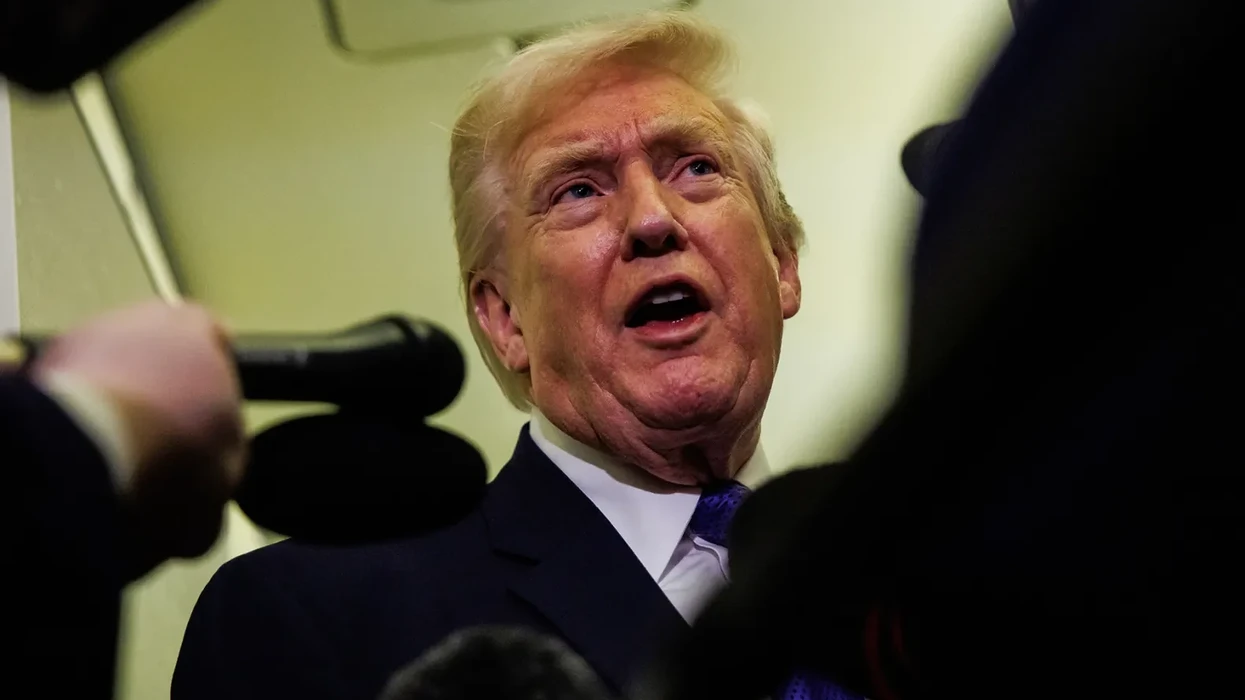


Donald Trump speaks to members of press aboard Air Force One
Trump’s Year of Media Capture
This was the year when public broadcasting was gutted and hyper-partisans prospered, when the First Amendment was exhaustively praised and opportunistically abandoned. It was the year when media capture came to America.
Before 2025, “media capture” was a term used exclusively overseas, describing the compromise of a free press to curry favor with the regime in power. Sometimes this happened through threats and intimidation, greased by partisan group think. Other times, the cudgel was money: wealthy administration allies would buy independent news organizations and neuter them to fall in line with the state-backed version of facts.
Hungary is often cited as a prime example of media capture — and so it seemed notable that Hungary’s elected autocrat Viktor Orban was repeatedly praised by Donald Trump and Republicans during the 2024 election. It was a clear sign of intent.
One year later, we’ve gotten used to Baghdad Bob-like lies from Trump administration flacks and absurd sycophancy from Cabinet secretaries. We expected spinelessness from the vast majority of congressional Republicans. But the lack of leadership inside news media when faced with an explicitly hostile executive branch has been surprising, largely driven by corporate owners who hid behind a fig leaf of “fiduciary responsibility” to shareholders and genuflected when threatened. They shoveled out millions to Trump for perceived slights (and there is always a perceived slight) that never would have held up in court.
The total is more than $90 million dollars to date. ABC News agreed to pay Trump $15 million for his library after anchor George Stephanopoulos discussed Trump’s conviction for sexual abuse against E. Jean Carroll. Likewise, Paramount paid Trump $16 million for the routine process of an edit to a CBS 60 Minutes interview — in this case, of then-Vice President Kamala Harris — during the 2024 campaign, after Trump refused to participate. Editing a long interview down to time is not evidence of bias; it is a normal part of the news business. But it seemed that parent company Paramount needed to pay the vig in order to sell its company to the Trump-friendly Ellison family — and so it was paid. In a totally coincidental move, CBS announced it would shut down the one of the highest-rated broadcast late-night shows in America, hosted by the beloved comic and frequent Trump critic Stephen Colbert.
Trump has sued the New York Times (subsequently calling them an “a serious threat to the national security of our nation”) and the Wall Street Journal (over their reporting on the Epstein files) — who admirably refused to back down. He sued YouTube, who decided to abandon the protections of Section 230 just this once and pay Trump $24 million dollars for suspending his account after the January 6 attacks. Meta and X forked over millions, as well. Showing that capitulation only encourages more aggression, Trump just announced an absurd $5 billion suit against the BBC for editing the speech he gave before the attack on the Capitol. This would be a bad joke if it didn’t come from the president of the United States.
America’s leadership in the world has always been based on the power of our example as much as the example of our power. And just as the ideals of the “good America” as a beacon of freedom and democracy have been undermined, the voice of America to the wider world has been silenced. Right out of the gate, one of Trump’s first actions was to shut down the Voice of America and public diplomacy stations that offer free information to autocratic nations.
Vladimir Putin has long railed against Radio Free Europe and Radio Liberty — which began broadcasting into the Soviet Union during the Cold War and helped destabilize that totalitarian regime. Trump was quick to give Putin that gift, freezing more than $75 million in funding previously appropriated by Congress. Their struggle to secure new revenue streams led to the legendary R.E.M. to remix and re-lease their first single Radio Free Europe as a promotion. (Full disclosure, my wife Margaret Hoover is the host of Firing Line on PBS and sits on the board of RFE/RFL.)
While Secretary of State Marco Rubio has long believed that the Cuban people should be freed from the Castro-founded communist regime, he presided over the abrupt shutting of Radio Marti. As a New York Times headline succinctly stated, “Trump Did What the Castro’s Couldn’t: Take Radio Marti Off the Air.” Likewise, Team Trump talks tough about standing up to Beijing, but they gave China’s Communist Party a boost by dismantling Radio Free Asia. It’s springtime for autocrats around the world.
Conservatives have been threatening to kill the Corporation for Public Broadcasting since the 1960s, when Mr. Rogers famously saved it with his congressional testimony. The expense is a rounding error and the benefits include offering kids in remote rural areas and inner cities alike access to educational programing — and their parents a dose of culture the algorithms don’t deliver. Trump put it on his hit list and of course congressional Republicans obligingly voted to pull the trigger on Bird Bird. Among the casualties of these cuts is the award-winning documentary series the American Experience. One of the greatest communicators of civic education is silenced in time for America’s 250th birthday. It is darkly ironic and entirely fitting.
The greatest, currently incomplete media acquisition of 2025 had to do with the fate of Warner Brothers Discovery, the parent company of HBO and CNN. During negotiations, the Ellisons were seen as having the upper hand for federal merger approval precisely because of their close relationship to Trump. This was stated as fact in straight news articles — ignoring what a complete rupture such partisan favoritism reflected on the American system. I’m actually sympathetic with David Ellison’s stated aim of creating news for the middle 70 percent of Americans. But reports that the Ellisons offered Trump assurances that their programming would be more friendly to his administration and even offered to fire specific CNN news anchors with whom Trump is apparently displeased showed the contradictions in this position. The latest news that the CBS editor-in-chief Bari Weiss — a heterodox opinion journalist who founded the now Ellison-owned Free Press — apparently spiked a 60 Minutes story on forced deportations to Salvadoran prisons hours before it was set to air, recommending that journalists get Trump senior adviser Stephen Miller’s perspective included in the segment, did little to re-center perceptions. As it stands, Netflix made the successful bid for WBD streaming and studio businesses and CNN’s future remains unclear. But the world needs a strong and independent CNN.One of the great debates of the 2024 election inside legacy newsrooms — including CNN — was whether Trump should be covered like any other candidate. Like many colleagues, I felt that covering Trump fairly required crucial context, including his previous attempt to overturn an American election on the back of a lie that led to an attack on our Capitol. Some executives felt that calling out Trump’s lies was divisive, that it was already baked in the cake of public opinion. But the day that a news organization decides that lies will go unchallenged from people in positions of power is the day that news organization loses its true north star.
One year later, the list of degradations is endless. To anybody who rationalized their 2024 support for Trump because they didn’t like “woke” kids on social media, they got a full jettisoning of objective journalists at the Pentagon because real news organizations refused to sign what amounted to an administration loyalty oath in exchange for access. Likewise, the White House press pool created special seating for right wing bloggers while the Associated Press was banished for refusing to go along with Trump’s renaming of the Gulf of Mexico to the Gulf of America. The Washington Post purged much of its editorial board to project a more Trump-friendly face while ditching its traditional center-left liberalism. The Federal Communications Commission is run by a Project 2025 contributor who removed the description of his agency as being independent to reflect its fealty to Trump and threatened ABC to suspend late-night host Jimmy Kimmel. Taken together, it is a cartoonish caricature of worst-case scenarios floated before the 2024 election.
This is not simply partisan warfare conducted through the press. The Trump administration and its apologists are creating an architecture of alternative facts. The greater danger is that we will be unable to reason together as fellow citizens — and that is how American democracy works.
Right now, the bad guys are winning. But just because the truth is under attack does not mean that facts cease to exist. Trump can use his election lies as a loyalty litmus test for appointees but that does not mean that American citizens need to surrender their conscience or common sense. The fact that so many corporations have felt they have a financial obligation to kiss the ring when confronted with threats speaks ill of the incentive system we’ve created. Going forward, it will be up to independent journalists and independent minded owners of news organizations to help fuel a fearless, fact-based alternative to the media capture that is making American citizens more compliant at a time when we need to be courageous.