

This article was originally published by In These Times, a magazine about labor and social movements.
From his new studio apartment in Austin, Texas, Barry Jones, 62, finds it easy to keep up with doctors’ appointments and pick up the medications he relies on. In the month since he was finally awarded a permanent housing voucher, he’s felt his anxiety abating.
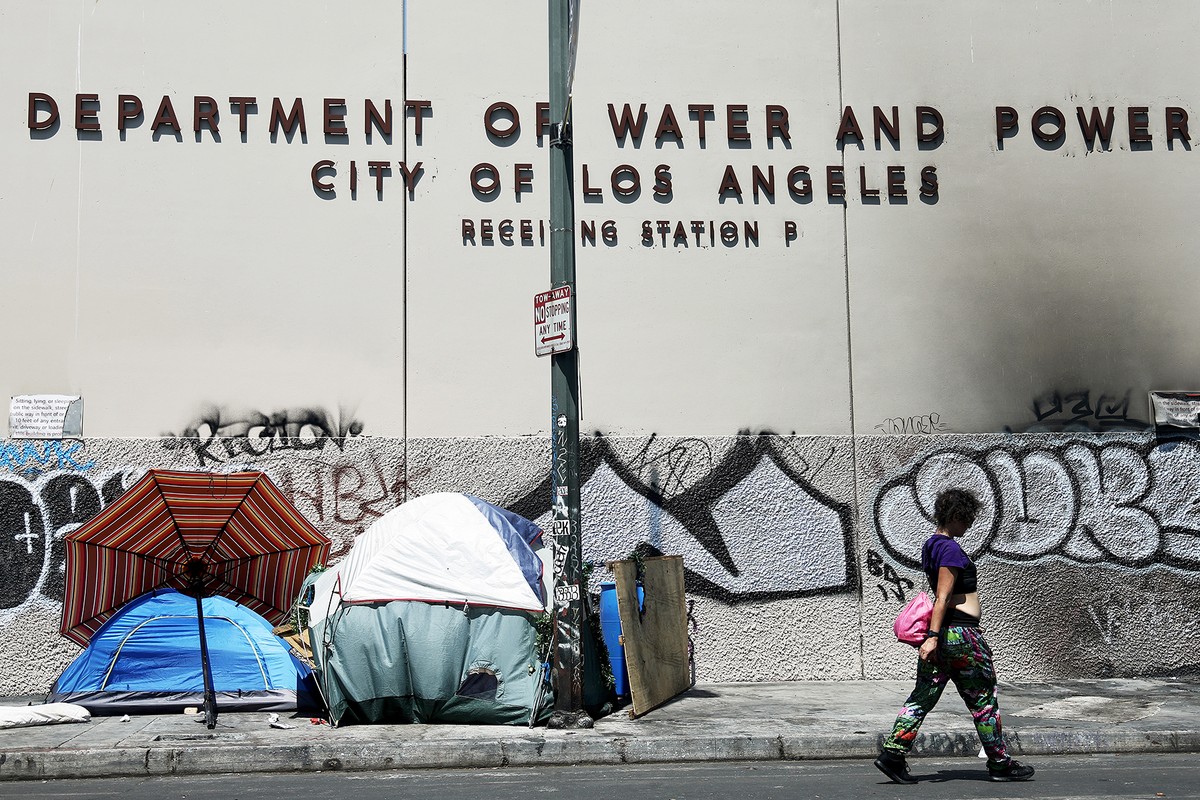
But during the years he spent sleeping on the streets — nearly a quarter of his life, on and off, much of that spent on waitlists for assistance — Jones would regularly wake up in the middle of the night with his heart racing. The everyday stress of unsheltered life was compounded by the threat of city police sweeps that could mean losing his medications, survival gear, or the documents he needed to continue accessing services.
“It makes you feel hunted, you know, like a fugitive,” Jones says of local laws that criminalize sleeping in public spaces. “It’s hard for me to get across just how counterproductive these sweeps are.”
Three years ago, Austin reinstated a ban on downtown homeless encampments through a ballot referendum campaign financed by the city’s elite — including Joe Lonsdale, the venture capitalist now leading a pro-Donald Trump Super PAC. Since then, the city has issued more than 900 citations for the crimes of sleeping, lying down, or pitching a tent in public spaces. But the estimated number of people without housing only continued to rise as Austin saw some of the nation’s steepest pandemic rent hikes. In 2022, just 21 affordable apartments were available for every 100 extremely low-income households. Housing advocates have long argued that cities can’t simply arrest their way out of homelessness — and within Austin, even proponents of the camping ban complain that it has not had its desired effect: Real-estate and business interests are currently suing to compel an even harsher crackdown.
That hasn’t stopped an Austin-based think tank founded by Lonsdale from holding the city up as a success story in order to cast the growing number of tent cities nationwide as a problem of lax enforcement — not rising rents. Staff of Lonsdale’s Cicero Institute have criss-crossed the country to sell state legislatures on the idea that Austin’s ban is working, and that other states can best address rising homelessness by criminalizing it more thoroughly. The group made the same case in an amicus brief to the Supreme Court this year. After a majority ruling in June gave cities the green light to sweep tent cities, regardless of whether alternative shelter is available, Lonsdale declared victory — thanking conservative legal activist Leonard Leo, who engineered the judiciary’s rightward lurch, for his “advice and support of our brief.”
In the wake of the Supreme Court ruling, California Gov. Gavin Newsom last month ordered state agencies to begin clearing homeless encampments, a possible move to ward off the kind of right-wing attacks Lonsdale has helped lead as Newsom gears up for a future Democratic presidential run.
A co-founder of the surveillance technology firm Palantir who decamped to Austin from San Francisco in 2020, Lonsdale denounces “the Marxist idea that American capitalism causes homelessness, and that only far-left activism can fix it.” The Cicero Institute has helped transform homelessness policing from a niche fixation of a segment of Silicon Valley into a rallying cry in the culture war, bringing new levels of both visibility and cruelty to the issue. Vice presidential candidate J.D. Vance repeated the Cicero Institute’s talking points at a Senate hearing last year, and some of the group’s preferred measures are included in Project 2025, the conservative blueprint for a second Trump term. Those measures include eliminating funding for the kind of permanent supportive housing assistance that’s helping Jones get back on his feet in Austin.
At least 100 cities nationwide already have laws on the books prohibiting sleeping or lying down in public space. But in the Cicero Institute’s approach, advocates see something more alarming: a push to defund long-term solutions and instead force municipalities to sweep the housing affordability crisis under the rug through increasingly draconian measures. Template state legislation authored by the group allows an up to $5,000 fine for repeat violations of camping bans and makes it easier to commit people to psychiatric institutions. It also financially punishes cities with higher-than-average rates of homelessness and redirects funding for permanent housing to short-term shelters.
Elements of the group’s cut-and-paste bill have now been introduced in 15 states and passed in eight, according to the National Law Center on Homelessness and Poverty — Utah, Texas, Oklahoma, Kentucky, Tennessee, Georgia, Florida, and Missouri, though the Missouri Supreme Court overturned its ban. The Cicero Institute also advocates legislation allowing new private prisons to enter the market and empowering governors to circumvent elected attorneys general by appointing “special prosecutors” to combat “public lawlessness.” The group’s political arm has spent at least $1.3 million on lobbying to date, according to federal tax filings. One of Lonsdale’s companies, Lonsdale Enterprises, has also donated more than $100,000 to Republican politicians — including $50,000 to a committee controlled by Florida Gov. Ron DeSantis, who was the headliner at a Cicero Institute event last spring — and more than half a million dollars to the Republican Governors Association.
But the Cicero Institute’s policies fly in the face of decades of social scientific research showing that criminalization is expensive, counterproductive, and sometimes deadly — when sweeps seize life-saving medications or displace people to hazardous locations. By saddling unhoused people with criminal records or unpayable fees, such measures make it harder for unhoused people to exit homelessness. One recent study of the aftermath of local criminalization ordinances in 100 major U.S. cities concluded that the measures did not lead to a decrease in the number of people counted as homeless.
“It’s honestly false advertising,” Hannah Lebovits, a professor of public affairs at the University of Texas at Arlington and the study’s co-author, says of the Cicero Institute’s approach. “You are fooling cities and states into putting a lot of money, time, and personnel into investments that will not provide the return that you are telling them you are going to offer.”
The Cicero Institute did not respond to a request for comment.
FEDERAL ACTION TO END homelessness was once a bipartisan affair. The George W. Bush administration was the first to embrace a “housing first” framework, which emphasizes stable housing for the chronically unhoused as a step toward services like mental health counseling and drug treatment (rather than requiring people get sober or stay sober to be housed). Researchers have noted ways that this framework can fall short, given that its implementation often relies on unaccountable private landlords and overstretched caseworkers. But in recent years, right-wing provocateurs like Christopher Rufo, best known for his campaigns to demonize critical race theory, have weaponized “housing first,” reviving four-decade-old arguments that drug use and mental illness — not a 7-million-unit-and-counting crunch in available affordable housing units — are the root causes of homelessness.
A key purveyor of such arguments was Ronald Reagan, who in 1984 told viewers of Good Morning America that many people sleeping on the streets were “homeless by choice.” During the next three years, Reagan presided over a doubling of the estimated number of unhoused individuals as he halved the budget for the federal housing department. The cuts decimated public and low-income housing, and in their place, cities turned increasingly to local laws criminalizing homelessness.
Austin passed its original anti-camping law in 1996 at the urging of business leaders — and over the criticism of the local police department, whose spokesperson saw the move as little more than a political stunt, according to an Austin Chronicle article that year. Two decades later, a series of reports by city auditors painted the ban’s enforcement as expensive and counterproductive to the goal of reducing homelessness. Thousands of citations were turning into arrest warrants after unhoused people failed to appear in court, impeding their ability to get apartments and jobs while increasing jail costs paid to the county.
“Even if a citation does not result in a criminal record, it does not appear to be an effective means of connecting that individual to the services they need, nor is it an efficient use of City resources,” according to the 2017 report.
Austin housing activists launched a campaign to repeal the ordinance. At a 16-hour City Council meeting in 2019, unhoused residents testified about friends who’d drowned while sleeping in creek beds or tunnels in order to evade the ban. The City Council voted to decriminalize sleeping and camping in most public spaces, so long as the public right of way remained clear.
The change triggered an immediate backlash from business owners and conservative activists in Austin — and an escalating feud between city officials and Texas Gov. Greg Abbott, who spent years scaremongering and spreading misinformation about tent encampments in Austin as part of a suite of attacks on the city’s more progressive policies on policing. After threatening to dispatch state troopers, Abbott ended up deploying the state transportation department to remove personal belongings from highway underpasses.
Into the fray stepped the newly formed Cicero Institute, which Lonsdale incorporated in 2020, according to tax records, and where he serves as board chair. After relocating from California to Texas the same year, Lonsdale quickly made inroads in Abbott-world. The governor’s former chief of staff is a senior advisor to 8VC, Lonsdale’s venture capital firm; Abbott’s daughter is its events coordinator.
When Abbott proposed a first-of-its-kind statewide camping ban in 2021, with penalties for counties and municipalities that didn’t comply, Cicero Institute staff testified on behalf of the bill and the group’s political arm spent at least $93,000 lobbying Texas officials that year, according to disclosures. The state camping ban passed — and Lonsdale’s group took Abbott’s playbook on the road.
JUST A MONTH AFTER testifying before the Texas legislature in support of Abbott’s statewide ban, Judge Glock, a senior advisor at the Cicero Institute, testified virtually at an April 2021 hearing in Tennessee. State lawmakers were considering legislation that made unauthorized camping on public land a felony offense, and Glock testified that such penalties could provide the “extra push” unhoused individuals needed to accept help, citing a 2019 study that found that about three-quarters of people living on the streets self-reported a mental health condition.
But the same study also concluded that unsheltered people with major health challenges are already heavily policed in lieu of receiving appropriate care. Those surveyed reported an average of 21 police contacts and seven jail visits during the previous six months.
That kind of misdirection is a hallmark of the Cicero Institute’s approach, says India Pungarcher, the associate director of advocacy at Open Table Nashville, a nonprofit that testified against the criminalization bill: “They’re using data that homeless advocates and researchers and service providers use all the time, but they’re experts at twisting it.”
The felony penalties passed in Tennessee, but last year advocates defeated a separate Cicero Institute-authored bill banning the use of state housing development funds to construct permanent supportive housing.
This year, Florida, Kentucky, and Oklahoma adopted legislation enacting the Cicero Institute’s preferred measures. In communications with legislators and an amicus brief to the Supreme Court, the group asserted that Austin’s unsheltered homeless population declined in the wake of the 2021 camping ban — a sign that the measure was working, according to the group.
But that decline is disputed. The Cicero Institute relied on a specific set of data from Austin’s Ending Community Homeless Coalition (ECHO) — a one-night “point in time” count of homeless people, conducted with the help of volunteers every year. After the pandemic paused the exercise in 2021 and 2022, Austin’s one-night count the following year turned up 300 fewer people living outside than in 2020. But ECHO published this data with a host of caveats — including that criminalization of public camping makes it harder to find and count people, and that 700 unhoused people were in jail the day of the 2023 count.
“I just don’t think that our data supports that in any way,” says Chris Davis, ECHO’s communications manager, of the Cicero Institute’s argument about the ban’s positive impact. “There’s simply no evidence that we’ve seen that threatening people with tickets and arrests has any meaningful impact on a community’s ability to house people.”
It’s notoriously difficult to say how many people are experiencing homelessness at any given moment. ECHO points to a different data set, which it aggregates from area service providers, that indicates that the number of people seeking shelter in Austin has actually risen since 2021, a year when average rents in the city surged by more than 30 percent and eviction filings began climbing again after a pandemic pause. While the city is in the process of adding more than 1,000 new permanent supportive housing units, there still aren’t enough short or long-term shelter options to accommodate the more than 6,000 people ECHO estimates are currently unhoused in Austin.
Last year’s point in time count did find that, since 2020, more people living unsheltered in Austin had dispersed into parks and greenbelts in more remote areas of the city. Enforcing camping bans downtown makes it more likely that unhoused residents will flee to far-flung places where it’s harder to access services, according to ECHO — not that they’ll get the help they need.
THIS MONTH, advocates are bracing as a sweeping criminalization law takes effect in Kentucky. The law contains standard Cicero Institute elements, including a reduction of the requirements to involuntarily commit someone to a psychiatric facility, plus a frightening addition: an expansion of the state’s “Stand Your Ground” law to include unlawful camping among offenses that could justify deadly force.
That could set the stage for vigilante violence against unhoused people, says Eric Tars, senior policy director at the National Homelessness Law Center, who adds, “These laws are morphing, evolving, and getting more harmful.”
Meanwhile, this spring, Florida passed legislation hailed by Lonsdale as a “homelessness revolution.” He met personally with Republican lawmakers from the state, including House Speaker Paul Renner, at a Napa winery last year, according to correspondence obtained by In These Times through a public records request.
The Florida law contains a little-noticed provision allowing residents and business owners to sue municipalities that they believe are failing to enforce camping bans — a trend encouraged by red state preemption laws that seek to box in progressive cities on issues ranging from housing to guns to immigration.
UCLA sociology professor Chris Herring has documented how 911 complaints by business owners and other third parties already help drive policing of tent encampments — an exercise that one San Francisco police officer likened to “a big game of Whac-a-Mole.” Even when arrests don’t result, the outcomes of those complaints for unhoused people, Herring found, ranged from lost property to unpayable debts to increased vulnerability to violence. Baking the legitimacy of those complaints into state legislation — and incentivizing dramatic crackdowns — is “new and distinct and incredibly worrying,” according to Herring.
In Missouri, where the state Supreme Court struck down legislation based on the Cicero Institute’s template in 2023, advocates successfully fended off a new version earlier this year, but are bracing for its reintroduction.
“With the Supreme Court decision, we know that that’s going to strengthen the resolve to get this passed,” says Misha Smith, an affordable housing policy manager for the group Empower Missouri who’s also involved with a push to unionize tenants in the state.
Smith sees the issues of fighting criminalization and building tenant power as deeply intertwined. “These bills are being put in place, funding is being cut, rent’s going up, and the solution is to criminalize anyone who ends up on the streets as a result,” they say. “When the common issue in all of this is there’s not enough affordable housing for everyone who needs it.”




War Is Peace: Trump’s Regime-Change Reversal
As American and Israeli rockets fly into Tehran, with the stated goal of regime change, anyone who bought into the self-evidently absurd idea of “Donald the Dove” ending America’s forever wars ought to be suffering from a bloody form of buyer’s remorse.
It was always bullshit. But that’s what the Trump team was selling hard. Take human ghoul Stephen Miller’s tweet days before the election: “Kamala = WWIII. Trump = Peace.”
The Trump team reads George Orwell’s 1984 like an owner’s manual and so of course “war is peace.” Their undermining of NATO and the dismantling of American alliances in favor of a “might makes right” foreign policy executed by a sycophantic kakistocracy is a guarantee of more war amid autocratic power grabs worldwide, with a side order of corrupt crony capitalism to profit from the chaos.
If you voted for Trump and believed him, this is on you. And that includes self-styled Palestinian peace activists who thought that Biden and Harris were the worst of all possible worlds and stayed home. We will no doubt see protests for the innocent lives lost in these strikes — but I’d have a lot more time for those folks if they were also seen protesting the estimated 20,000 to 30,000 Iranian lives snuffed out by murderous mullahs in the last few months alone.
The Islamic Republic of Iran has been despotic and dangerous from its inception. The Iranian people have been oppressed and denied basic freedoms for decades. But this is an extreme example of a war of choice. The American military strikes against Iran’s nuclear weapons facility last year were justified because Iran cannot be trusted with a nuclear weapon. That is true. But the much trumpeted total obliteration of those facilities is apparently not true — or so goes the justification for this war. And don’t forget that it was Trump who pulled the U.S. out of an Obama-era deal to stop Iran from developing weapons — arguing absurdly that the imperfect anti-nuke deal needed to be blown up to stop Iran from developing a bomb. Iran’s subsequent progress toward a bomb then created the rationale toward these strikes. This is a self-inflicted state of emergency. Peace is war and war is peace.
Pity the willful dupes in Congress who deluded themselves into thinking that Trump deserved the Nobel Peace Prize. They’ll probably rationalize that he would’ve been peaceful if he got the honor. Now it will be read as a cautionary tale for not sucking up. The chairman of the Board of Peace is now bored of peace. While Rand Paul remains admirably consistent, it’s Lindsey Graham who is pirouetting around the Senate floor while the Gimp Speaker Mike Johnson is unable to speak for the basic constitutional principles of separation of powers let alone authorization to go to war.
If you’re feeling shell-shocked trying to keep up with Operation Epstein Distraction, get ready for the inevitable next crisis — regime change without a plan for replacement. This is what the Trump administration did in Venezuela — kidnapping the socialist dictator Maduro but keeping his regime in place in exchange for crude oil access. The opposition is still in exile and its leader María Corina Machado gave her Nobel Peace Prize to Trump in exchange for exactly nothing.
One of the clear lessons of history is that if you don’t win the peace, you don’t win the war. The Saudis and their Sunni allies will back the U.S. and Iran because they hate the Shia Iranians (who, incidentally, are not Arabs), but beyond removing the Iranian regime, the plans for replacement and stabilization seem TBD — and with Trump’s inability to stay focused on anything beyond his immediate self-interest, solid plans are unlikely to emerge. Maybe a leader will come from the underground opposition; maybe it will be the Shah’s son, who has been living in the U.S. waiting for a restoration like many members of the diaspora. The upside is that Iran has a distinguished history and an accomplished Persian culture: The Islamists don’t represent the entirety of the people of Iran and never have.
But the path ahead will be messy at best. It will require concerted effort and civil commitment, not just an open call for private investment from Mar-a-Lago members. If the United States is now kidnapping and killing dictators without direct provocation, it establishes a dangerous precedent which will come back to bite us after demolishing our moral authority in the world.
It is the unexpected effects, the cascades of consequence where we cannot always plan ahead, that cause most responsible statesmen to try to keep the peace. But Trump has the carelessness of a rich-boy bully who can always buy or bluster his way out of trouble. He’s a con man who has found his ultimate mark in his followers, who fool themselves into thinking that a reflexive liar is the one man with the courage to tell the truth.
Perhaps the most prominent example is the vice president himself — a bright guy who not that long ago compared Trump to Hitler and a deadly narcotic but then convinced himself that careerism demanded an abrupt conversion. After all, he endorsed Trump less than two years ago with this very serious column headlined “Trump’s Best Foreign Policy? Not Starting Any Wars,” explaining, “He has my support in 2024 because I know he won’t recklessly send Americans to fight overseas.”