
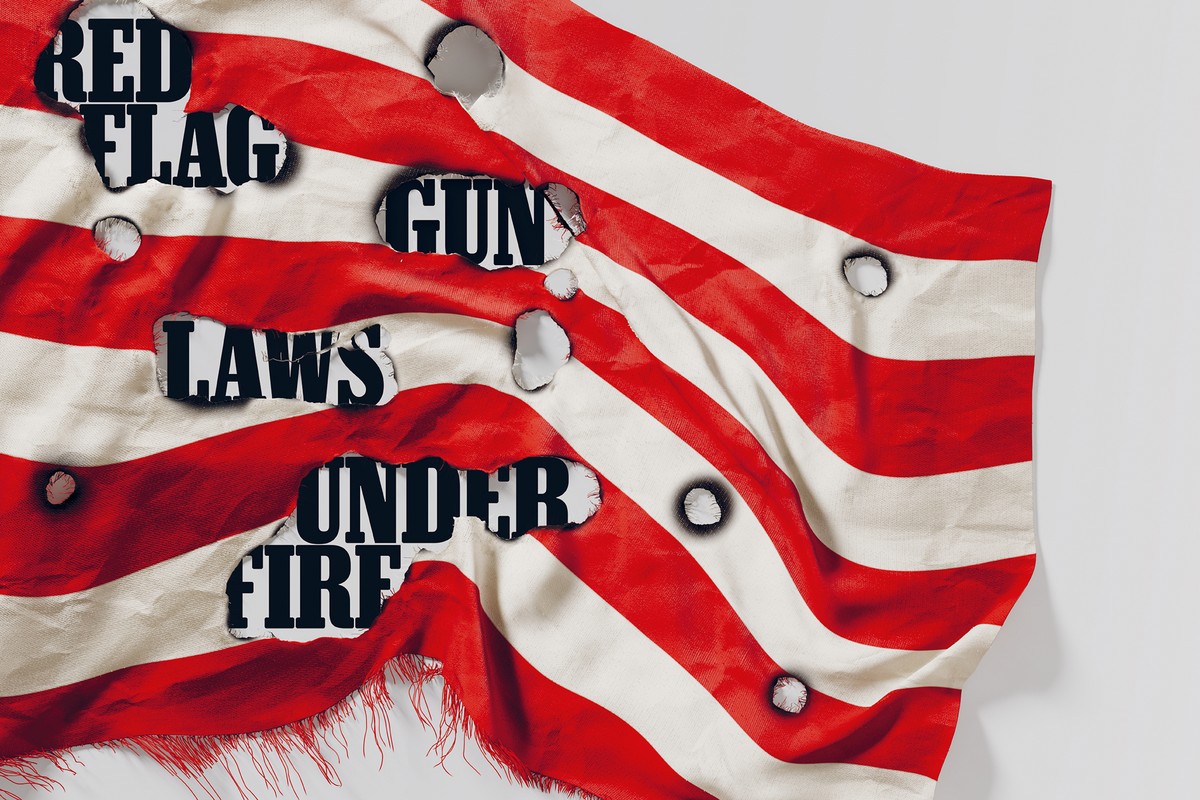

This story was published in partnership with The Trace, a nonprofit newsroom covering gun violence. Subscribe to its newsletters
SUSAN WEBB STOOD with her colleague on Parks Road. The Chesapeake Bay and the abandoned store with the sagging roof were behind them, the smell of discarded crab lingering in the air. Once again, someone had lodged a complaint against the ramshackle property that belonged to Donald Willey.
The home was on Hoopers Island, an isolated speck of land off Maryland’s Eastern Shore, connected by a narrow road that often took on water during high tide. On that day in April 2021, Webb had been working for six months as assistant director of planning and zoning for Dorchester County, which encompasses the island plus a handful of communities that depend on the water for their livelihood. This was her first visit to Willey’s place, though he was locally infamous. Over the previous 18 years, he had been involved in one feud after another. There were repeated warnings, court dates, and jail. Once, he was featured on an episode of Hoarding: Buried Alive.
Webb looked at the 42,000-square-foot property as her colleague, an inspector named Tom Esham, made meticulous notes and took photographs. The place looked more like a junkyard than a home. Multiple commercial flatbed and dump trucks were strewn about, along with passenger vehicles, a late-model Ford pickup, a camper, numerous boat trailers — some with boats loaded on top — and a reddish motorcycle. Countless containers and drums were mixed in, as well as household appliances, scrap metal stored in bins, heaps of piping, and piles of wood and tires. A skid loader and an excavator were in disrepair. The cab of a broken-down backhoe was packed with still more junk.
Tucked amid the chaos was an unfinished two-story house, where Willey lived. The first level was made of concrete bricks, and held more discarded items that were visible through the windows. The second level had an ornate wooden front door, but there were no stairs leading up to it. Willey’s property was on a residential street. One neighbor shared a fence with him, and Willey’s belongings cascaded right up against it. After Webb and Esham left, the inspector composed a letter to Willey. It informed him that he was in violation of a county code that barred people from using land “for the storage of junk, rubble, untagged vehicle(s), or junk vehicle(s).” Everything had to be removed, properly tagged, or screened from outside view by June 4. If Willey failed to comply, he would receive a fine, and the county would clean up his land and bill him afterward.
Without knowing it, Webb had entered the beginning of an ordeal in which she faced an unyielding antagonist who struggled with his mental health, was known to have guns, and had a reputation for lashing out at anyone who stood in his way. A month later, there were two massive fires on Willey’s property. In two years, Webb heard from community members that he intended to shoot her if she stepped onto his land again.
A government attorney encouraged Webb to use Maryland’s red-flag law and submit a petition for an extreme-risk protection order, or ERPO. This involved explaining to a judge, under oath, that Willey presented an imminent risk to Webb and her team, and why his guns should be temporarily confiscated.
When the judge ruled in her favor, it seemed the story might end. But Willey was a lifetime member of the Second Amendment Foundation, a gun-rights group that filed lawsuits around the country to overturn gun restrictions. The SAF sued Webb, the county sheriff, and the attorney general of Maryland on Willey’s behalf.
The organization had already reshaped America once. More than a decade earlier, it brought a case to the Supreme Court about individual gun rights, and the majority ruled, for the first time, that states could not ban a law-abiding citizen from owning a firearm. While fights over gun-reform legislation would increasingly dominate the attention of Americans, that victory placed the SAF at the vanguard of a hidden legal war, which continues, in ever greater ways, to challenge the gun regulations that are already on the books. The group and its copycats have effectively flooded the courts, making it almost impossible for any one lawsuit to draw sustained scrutiny.
By casting Webb as a vindictive abuser of power, and Willey as an innocent veteran, the SAF hopes to change the country again. But a vast trove of decades-spanning documents, obtained through public-records requests, and months of reporting, reveal that the narrative was distorted and composed to serve an agenda. The SAF is using the case to promote its nationwide legal campaign called Capture the Flag, which could render unconstitutional the red-flag laws that have been adopted in nearly two dozen states.
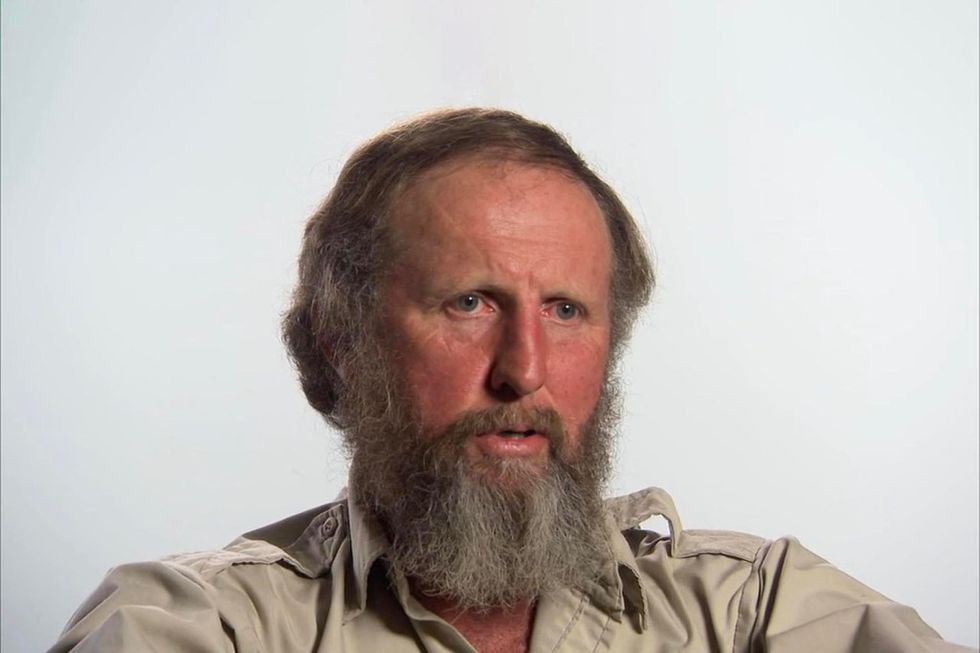
Willey is suing to overturn Maryland’s red-flag law with the help of the SAF.
In response to a long list of detailed questions from The Trace and Rolling Stone, an attorney representing the SAF and Willey emailed, “We do not comment on pending litigation or matters relating to pending litigation. The papers that we have filed in Mr. Willey’s action accurately set forth our position on the matters at issue.”
After the Parkland, Florida, school shooting in 2018, red-flag statutes had broad bipartisan support. The National Rifle Association was open to them. As president, Donald Trump had called for their implementation. Gun violence and suicide were unrelenting scourges. Shooters often displayed troubling behaviors, struggled with mental health, telegraphed their deadly acts. If political consensus around restricting firearm ownership on the front end remained elusive, perhaps there was hope of intervening on the back end.
But then, rather quickly, a reactionary view took hold. Opponents reframed red-flag laws as tools of retribution. In 2021, the National Association for Gun Rights circulated a petition that falsely claimed the statutes were easily abused by “disgruntled family members, neighbors, co-workers, and/or current or ex-romantic partners, or roommates.” That same year, Sen. Ted Cruz asserted that red-flag bills were “being pushed by Democrats and gun-control activists” to “deprive Americans” of a “fundamental right.” Soon, the NRA reversed its stance, predicting that red-flag laws would be used to punish anyone who voiced “political views the government disfavors.”
The right-wing echo chamber expanded, until there was consensus. Red-flag statutes violated due-process rights and protections against unreasonable search and seizure. They also lacked a historical analogue, and, according to a controversial 2022 Supreme Court decision, were therefore incompatible with the Second Amendment.
These arguments would form the basis of Willey’s lawsuit, serving up the fresh outrage the gun-rights movement requires to sustain itself. Instead of one enemy, Webb suddenly faced an onslaught: “Congrats on the lawsuit, you dumb cunt!” one person emailed. “You vindictive little Karen you,” wrote another. “You are screwed.”
“People Would Like Us to Go Back to the Good Old Days”
SUSAN WEBB WAS 47, with dark features and thick, black glasses. She had raised two children, now in their early twenties, and was known to be mild and empathetic. She was not, according to people who knew her from work and the community, a political person. There was an element of conflict baked into her job, but Webb, who had entered the field of code compliance in 1995, kept her composure in difficult situations and had a reputation for neutrally applying the law.
Webb had spent most of her career in Salisbury, outside of Dorchester County, rising through the government ranks there until she became the director of housing and community development. “None of the landlords ever had an issue with Susan,” says Kevin Adams, who owns residential and commercial real estate in the area. “She just stayed in her lane. She would tell you, ‘Stay within the code, and you’re good.’ ” Adams adds, “Susan was honest as the day is long.”
In 2018, Webb was hired to run building and safety services in the city of Cambridge, Dorchester’s county seat. The community there could be hidebound and skeptical of outsiders. Longtime locals have been known to take a binary view of residents, either placing them in the category of “come here” or “been here.” Barbara Stangl, a retired schoolteacher, moved to Cambridge from Pittsburgh soon after Webb had taken the new job. Stangl was troubled by the blighted state of a number of properties in the city, which, she guessed, were running afoul of local ordinances. “We’re very isolated on the Eastern Shore,” she remarks. Stangl reached out to Webb, who was just starting to implement reforms. “I had been told that code enforcement prior to Susan was inconsistent, selective, and sometimes discriminatory,” Stangl says. “And that didn’t happen when Susan was here. She has never been anything but fair. She goes by the book. The law is the law, and she will follow it.” Still, Stangl says, “people would like us to go back to the good old days.”
Webb’s boss in Cambridge was a man named Odie Wheeler. He also viewed her as someone unlikely to make impulsive, unilateral decisions about enforcement. Punitive action was a last resort. Wheeler had witnessed Webb’s patience firsthand: “I’ve seen people be downright rude to her, and I’ve never seen her be rude or out of line.”
On May 4, 2021, Esham returned to Willey’s property on Hoopers Island with a laminated copy of the violation letter. It was stapled to a stake, which he drove into the ground of Willey’s yard. He then returned the next day, government documents show, and introduced himself to Willey. Esham explained the violation, and what Willey would need to do to fix it. This, for Willey, was not an unfamiliar situation.
“It’s the Tail End of a Bomb”
WILLEY WAS AN IMPOSING MAN, even at the age of 62. He is six feet tall and 220 pounds. Like a manual laborer, he wears his strength as an extra layer of bulk across his arms, chest, and shoulders. He’d spent more than 25 years in the Marines, serving in operations Desert Storm and Desert Shield, and saw himself as a devoted patriot. He maintained his erect bearing, but was seldom clean-shaven, his beard sometimes growing long and bushy. He was raised on the island, and known by virtually everyone there. But his life was a solitary one. Over the years, he had taken in a variety of animals: dogs, a parrot, a mini horse often tied up outside, and goats that wandered in and out of his rubble, like survivors of a tornado.
According to a Veterans Affairs document filed in court, he had been diagnosed with a hoarding disorder, post-traumatic stress disorder, and attention deficit hyperactivity disorder. As with others in the area, he speaks with a Southern accent and identifies with the heritage of the region. He delights in his resemblance to Stonewall Jackson, and has sometimes portrayed him during Civil War reenactments. He is not shy about his politics or Christian faith. “I need to get another Trump hat,” he wrote on Facebook in 2020. “One for work and another when I’m casually dressed and going out in public. I’m not afraid to show my colors.” He posted memes about God and championed the Confederate flag.
It is hard to pin down exactly when Willey’s troubles in the community began, but the documents date them as far back as June 2003, when an inspector showed up to his property to investigate complaints. Over the next year, the inspector made “numerous visits,” watching as Willey’s yard continued to fill with “junk.” He repeatedly spoke with Willey, but to no avail. On Jan. 21, 2005, a frustrated community member wrote to a district judge, lamenting that while a number of properties on the island were in various states of dilapidation, Willey’s was “a new high-water mark.” In May, a neighbor wrote to the planning and zoning department, “Mr. Willey is in effect stealing from all of us. He has robbed us of our homes’ values. He has robbed us of a peaceful neighborhood. Last night when my husband and I left our home, Mr. Willey shouted obscenities to us as we passed. He is a threatening person.”
County officials soon forcefully intervened, clearing away a portion of Willey’s junk at a cost of more than $7,000, a fraction of what it would cost in future years, as a pattern played out in an endless loop: Willey or the government would make modest improvements to his property, and then, before long, the land would return to its prior state, and get worse still, as if it were trapped under a spell. Records show that over the past two decades authorities have successfully taken Willey to criminal court, subjected him to multiple liens, fined him, jailed him, and placed him on probation. None of it made a difference, leaving his neighbors in agony and fear.
In early 2011, according to a police report, Willey called the sheriff’s office on the people next door. He accused a resident of that house of flicking cigarette butts over a fence and into his yard. The neighbor denied the allegations, and said running tidewater sometimes carried debris. Then he suggested that the complaint was about retribution, since Willey believed the neighbor “called the county about the large amount of stuff stacked up on Willey’s property.” The neighbor insisted he had done no such thing and “wishes Willey would just leave him alone.”
Later that year, Willey appeared on an episode of the television show Hoarding: Buried Alive. The dire state of his home, which extended to the inside, seemed unusually perilous, even by the standards of the series. He gave the cameras a tour, appearing as if he were wading through a massive landfill, navigating around piles of granite here and an 800-pound gas tank there. At one point, he turned to a twisted piece of metal. “What it is, it’s the tail end of a bomb,” he said. “I figured it could go outside and hang it on the side of the garage or something.”
“If Planning and Zoning step foot on his property,” an anonymous island resident wrote in a letter, “he is threatening to use gun violence.”
During the episode, Willey spoke about his mental health. “Sometimes I just get so depressed,” he said, “and I just — week after week after week — just lay in bed.” He sat down with a psychologist, Becky Beaton, and told a story about leading a convoy during the Persian Gulf War. “We’re at the front gate, and all of a sudden four rounds went off,” Willey, whose story could not be independently verified, said. “Boom-boom! Boom! Boom!” He began to cry. “It’s gone over my mind many, many, many times. That same sound, that same sequence.”
The acknowledgment of trauma was presented as a breakthrough, but on “haul-away” day, when the show sends in a crew to clean up the property at issue, the effort was stymied by Willey. “This is the most frustrated I’ve ever been at a haul-out ever,” Beaton remarked. “He keeps getting in the way.”
In the episode, Willey was by turns contrite, defiant, a bit ominous. On one occasion, he told the camera, “The county or whatever has just got me under their thumb, and they’re just trying to push me down, and down, and down, as hard as they can.” He went on, “No matter what I do, I feel like I keep getting spit on.… It’s devastating. I don’t believe in suicide, but, you know, where is it going to end?”
Two years later, Willey pleaded guilty to illegally storing junk and rubble in his yard, and received a year of probation, which he violated that summer by failing to bring his property into compliance. An inspector for the county asked a judge to consider that Willey have a period of incarceration with a psychiatric evaluation and be compelled to seek the required treatment if needed.
In November 2013, Willey sent the judge a letter containing a surprising disclosure. Because he was found guilty of breaking his probation agreement, Willey wrote, “an order resulted that forbids me to be in possession of firearms until September 23, 2014.”
Maryland did not yet have a red-flag law, so it is not clear why Willey was forced to surrender his guns. Still, he remained impervious to consequences. One summer day in 2016, the sheriff’s department received a complaint about a dead dog that had been on Willey’s property for a few days. Officers came by in the afternoon, and found the animal in the front yard. The police report noted that it appeared the dog had died recently. Willey told the officers the animal had strangled itself on its leash that morning. The officers were satisfied, and apparently did not inquire why Willey had left the carcass in the yard. In January 2018, the county once again stepped in to remove junk from the property, at a cost of more than $21,000.
On the afternoon of May 21, 2021, Willey was burning trash at his home when the fire got out of hand. As the blaze grew, it engulfed a pile of rubber tires, sending a massive column of black smoke billowing into the air. The sky darkened, and, video showed, it appeared the flames might spread to neighboring properties. The fire department arrived and got the blaze under control, leaving behind a mess of charred rubber, metal, and wood.
Willey’s deadline for bringing his property into compliance came and went. On June 8, Webb and Esham returned to the home to conduct a final inspection, confirming that little had been accomplished. Out went another enforcement letter, and the next day, Willey contacted Webb’s then boss, who set up a meeting for the four of them in the foyer of the zoning and planning building in Cambridge. When they gathered, according to Esham’s notes, Webb’s boss informed Willey of his rights and explained, again, how he was out of compliance and what could be done to avoid court action. Going forward, Esham would conduct weekly visits to the property.
Three days later, another fire erupted at Willey’s Parks Road address, in a gray barn that stood beside his house and was filled with personal items. This one was electrical, and again threatened to spread to neighboring properties. According to an incident report, firefighters arrived around 10 a.m. They were unable to gain close access to the building because of the state of Willey’s land, and had to use water cannons from afar to get the flames under control. As the ground became saturated, photographs of the event show, water mixed with oil pooling into the road.
More than six months went by, and, according to Esham’s notes, Willey’s property was still a shambles.
On July 5, 2022, after well more than a year, the county sued him, stating that Willey had deliberately failed to comply, and had refused to let the county enter his land and fix it for him. In November, the judge issued Willey a consent order requiring him to remove much of what was on his property by May 31, 2023. The judge gave the county express authority to determine Willey’s compliance, and permission to enforce the order if he did not follow the ruling. That meant the county could officially enter the property, haul away the junk, and place a lien on Willey’s home.
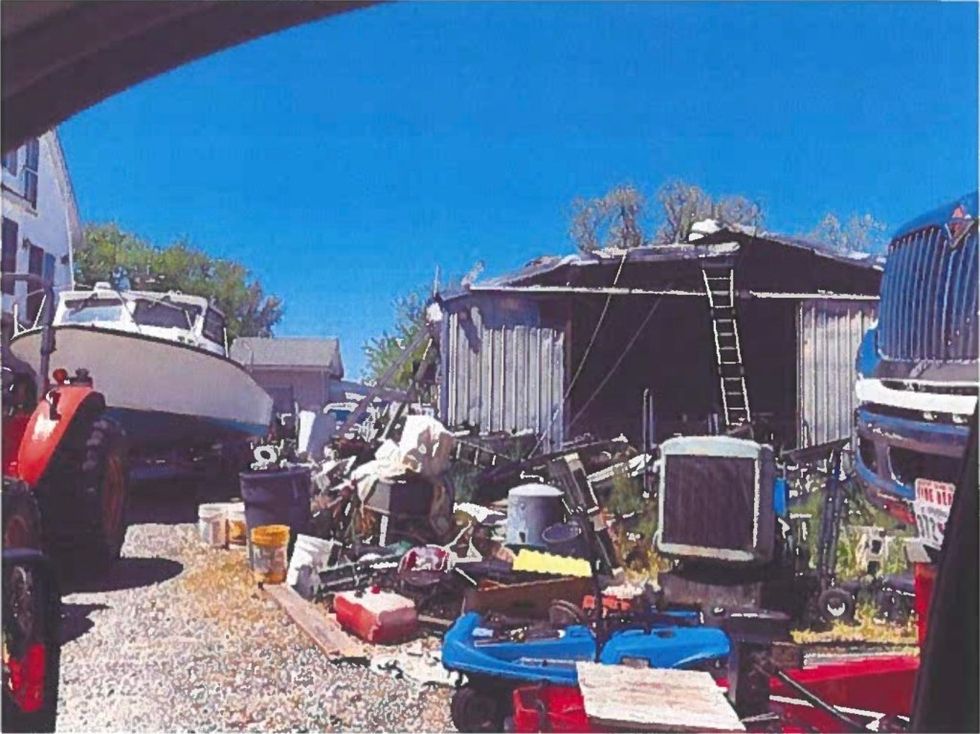
Neighbors complained about the junkyard conditions around Willey’s home in Maryland, and most suspected the former Marine had guns on the property.
The May 31 deadline officially passed. In early June, Webb and zoning inspector Tyler Bennett went to the island to post new violation notices. When they drove up to the Parks Road property, Willey was in his yard. According to a sworn affidavit he later filed, Willey said he “respectfully declined” to accept the letters. He asserted that Webb then “became visibly irate,” and “walked over to my boat, which I was storing in my yard, and caused the notices of violation to be violently affixed to the fiberglass covering of the boat using a staple gun or other similar tool.”
But a police officer’s report notes that the covering was in fact filling in a section of Willey’s makeshift fence. It was not part of a boat, and instead resembled a large piece of rotted wood. Webb, meanwhile, had the presence of mind to document a portion of the encounter. A photograph she’d taken captured Bennett stapling the laminated paper to the rotted wood. The crucial act in Willey’s retelling of the confrontation is false.
“He Is Waiting for Us to Come, and He Is Waiting to Kill Me”
ON JUNE 5, 2023, a new email sent from one of Willey’s neighbors appeared in Webb’s inbox. The tone was despondent. Willey’s property, it said, was “worse than it’s ever been,” and when he missed the cleanup deadline imposed by the court, “my heart sank.” The letter went on, “There have been so many issues over the years with my neighbor’s ‘Junk Yard’ and him moving junk from one property to another. Plus he comes after us when he thinks we are the ones complaining to the county. My mental, physical, and emotional well-being has been so effected … that all I do is cry.”
After the county requested bids to clean Willey’s land, a contractor placed the total cost at $43,400. Willey, meanwhile, had spray-painted “private property no trespassing” across his fence, and posted a “no trespassing” sign that included the penned words “Dorchester County Planning + Zoning This Means You!” On June 7, the contractor backed out of the project. According to a zoning-inspector report, the contractor spoke with “two to three individuals that are familiar with Mr. Willey. These individuals have made the comment that Mr. Willey is unstable and will more than likely shoot at anyone that may attempt to enter upon his property.”
Then Webb received a letter in the mail. It said, “Per our telephone conversation today, I wanted to advise the County in writing regarding the verbal threats I have been hearing from neighboring citizens around Hoopers Island from Mr. Donald Willey stating that if Planning and Zoning stepped foot on his property, he is threatening to use gun violence.” The writer withheld their name; they wanted to stay anonymous “for my own safety.”
On June 14, Webb emailed Amanda Leonard, a Maryland state’s attorney whose jurisdiction encompasses Dorchester County, saying that the county manager and the county council president had suggested she reach out for guidance. Webb provided some background about her experience with Willey and then wrote, “I have been receiving phone calls for a few days from people who live in close proximity of him, warning me that he is telling many people that when I come back to his property for enforcement that he plans on shooting me and anyone else that comes there. He has even stated this to a county councilman.” Webb added that she did not feel the threat was “immediate,” but acknowledged that she “may be complacent.”
Leonard responded, “I’m so sorry any of this is happening.” She promised to call the next day and determine what “legal/criminal action might be available” and said she would “touch base with law enforcement.”
When Webb and Leonard spoke, Leonard advised Webb to petition a judge for an extreme-risk protection order against Willey. If the judge agreed that Willey presented an imminent threat, this would allow police to temporarily seize his guns.
Webb showed up to the hearing later that day with her inspector, Tyler Bennett, who could corroborate her allegations, which she made under oath. She recounted the recent events, starting with the confrontation at Willey’s house, followed by the contractor’s story, the call that prompted the anonymous letter, and the warning from the councilman. “He is waiting for us to come, and he is waiting to kill me and anybody else from the department that comes,” Webb said. “I am concerned about the safety of my staff. I am concerned about the safety of him coming into the office for myself.”
Based on her testimony, the judge issued an order that would, for a brief period, force Willey to surrender his firearms. The judge further ordered, as the law allowed, that Willey undergo an emergency psychological evaluation, and set a follow-up hearing, where Willey would have the opportunity to challenge Webb’s testimony, for June 22.
As a Marine, Willey became an expert in the use of firearms, earning rifle and pistol awards, and serving as a marksmanship instructor. Like many veterans, guns were part of his life, and because he had never been involuntarily committed or convicted of a felony, there was nothing to stop him from buying or owning them. But that did not mean there weren’t signs to look out for. An FBI report on active shooters found that, on average, each displayed four to five concerning behaviors observable to those around them. “The most frequently occurring,” the report said, “were related to the active shooter’s mental health, problematic interpersonal interactions,” and openly communicating “violent intent.” It went on to say that, in the majority of cases, shooters obtained their firearms legally, and “at least one of the victims was specifically targeted.”
Red-flag laws are a backstop, designed to fill gaps in the system. Typically, only an individual’s family, household members, or law enforcement — a category that includes Webb — can file for an ERPO. A 2022 study, published in Preventive Medicine, examined nearly 7,000 red-flag cases across six states and found that 10 percent of them were in response to a threat of murdering at least three people. Of those, 22 percent involved a named target. The statutes have not yet been linked to statistically significant reductions in homicide, but red-flag laws largely exist to thwart specific categories of violence, such as mass-casualty events. Moreover, most statutes are still new, and many people remain unaware of them or how they can be used.
After the hearing, that same day, officers from the sheriff’s department went to Willey’s house and removed three rifles, three pistols, two double-barrel shotguns, and seven boxes of ammunition. Willey was then taken to a local hospital, where he underwent a mental-health evaluation, the details of which are private. A week later, Webb and Willey came to court for the final hearing, where they revealed they had come to an agreement: Going forward, Willey would no longer communicate with zoning officials, leaving his lawyer to take over. In exchange, Webb dropped the ERPO.
On June 27, Willey’s guns and ammunition were returned to him. In total, he had been without them for 12 days.
“Winning Firearms Freedom, One Lawsuit at a Time”
WHENEVER A MASS SHOOTING OCCURS, Republican lawmakers and gun-rights activists work to steer the national conversation away from gun access and toward mental health. This allows them to frame their opposition as principled rather than obstructive. But in 2018, after 17 people were murdered at Marjory Stoneman Douglas High School in Parkland, the pressure to go beyond lip service was overwhelming. Donald Trump, then president, convened a school-safety commission, which endorsed red-flag laws. “We must make sure that those judged to pose a grave risk to public safety do not have access to firearms, and that if they do, those firearms can be taken through rapid due process,” Trump said. “That is why I have called for red-flag laws, also known as extreme-risk protection orders.” The National Rifle Association, still at the peak of its influence, made the same argument. “We need to stop dangerous people before they act,” declared Chris Cox, then the group’s top lobbyist. “So Congress should provide funding to states to adopt risk protection orders.” It appeared to be something of a grand compromise.
Then in 2022, after a mass shooting at an elementary school in Uvalde, Texas, Congress faced renewed pressure, and passed bipartisan gun-reform legislation that included nearly $1 billion for states to implement red-flag laws. That same year, though, in New York State Rifle & Pistol Association, Inc. v. Bruen, the Supreme Court issued a landmark Second Amendment decision. It directed lower courts to exclusively rely on history and tradition when evaluating the constitutionality of a gun law, and to disregard public health. The guidance placed many firearm regulations in jeopardy. Gun-rights groups that focused on litigation, such as the Second Amendment Foundation, were well poised to take advantage of the new paradigm.
Despite bipartisan support, President Joe Biden became the face of red-flag laws. When he signed the 2022 bill, it was a historic event, the first time gun legislation had reached the White House in almost three decades. “God willing,” Biden said, “it’s going to save a lot of lives.” For some, the policy was now associated with him and took on the appearance of another tyrannical Democratic initiative. In August 2023, the SAF, on Donald Willey’s behalf, filed a lawsuit in federal court, suing Susan Webb, Maryland’s attorney general, and the Dorchester County sheriff. Willey was the subject of a false red-flag petition, the suit asserted, and his constitutional rights had been violated. Willey was also entitled to money, in an amount to be determined in a jury trial. Moreover, Willey’s SAF attorney said Maryland’s red-flag law was “unconstitutional on its face.”
“If I had to choose who would commit a mass shooting in our area,” recalled Eddie Dean, a lifelong member of the area, “it would be Donny Willey.”
The SAF, a nonprofit, was founded 50 years ago by an eccentric conservative activist named Alan Gottlieb. Now in his late seventies, he vaguely resembles the Monopoly Man, but with wire-rimmed glasses and a trim mustache. In the 1980s, Gottlieb was convicted of filing a false federal-income-tax statement. In 2023, he revealed his organization was under investigation by the Washington state attorney general for self-dealing and illegal misappropriation of charitable donations. The SAF maintained it complied with all laws, and in response it sued the attorney general, accusing him of harassment. According to an analysis by The Wall Street Journal, from 2010 through 2021, the SAF and a related nonprofit have paid Gottlieb, relatives, or entities tied to him at least $22 million.
Over the course of its existence, the SAF has been involved in scores of federal cases over gun laws, and has dozens in progress at any given moment. Its motto is “Winning Firearms Freedom, One Lawsuit at a Time.” While the group is relatively small, with more than 720,000 members and average annual revenues below $7 million, its impact has been outsize. In addition to its 2010 Supreme Court case that barred states from banning lawful gun ownership, it has helped successfully challenge assault-weapons bans, magazine-capacity limits, and age restrictions on handgun sales. Known for being at the forefront of the push to adopt hard-line positions against regulation, Gottlieb was an early critic of red-flag laws, raising concerns about the potential for abuse. “You’re guilty until proven innocent,” he said in 2019.
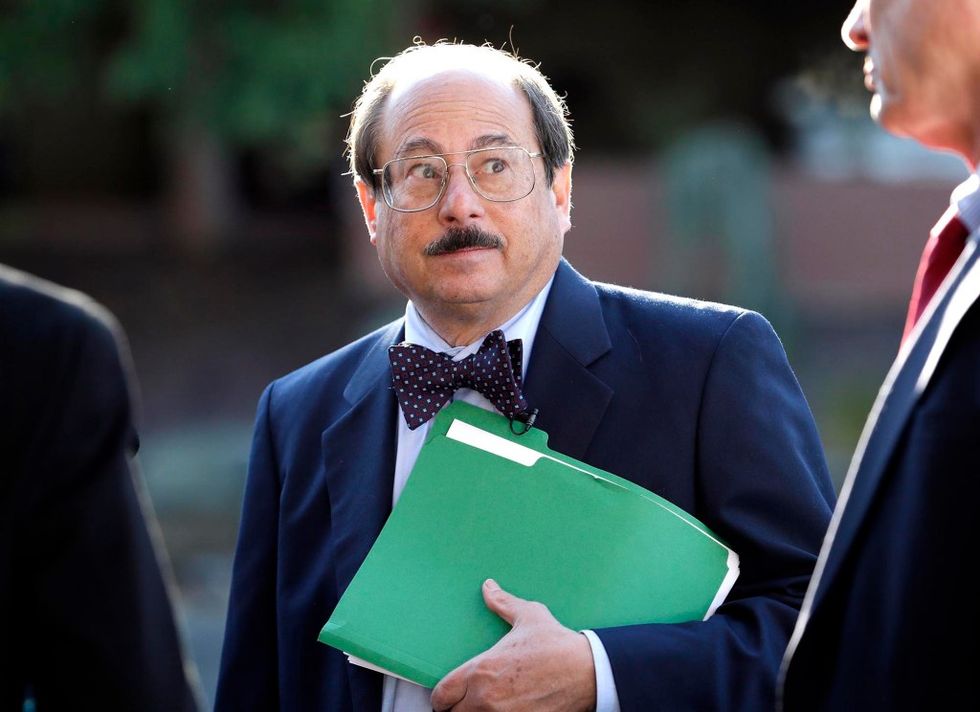
Conservative activist Alan Gottlieb runs the SAF and has targeted red-flag laws.
The SAF lawsuit filed on behalf of Willey reconceived virtually every aspect of Willey’s history with Dorchester County. In its telling, he was an innocent victim “relentlessly pursued” by government authorities who, for two decades, had been engaged in a “pattern” of harassment. It did not concede the treacherous state of Willey’s property, the many chances and extensions he had been given to clean it up, or that it had been featured on an episode of Hoarding: Buried Alive in 2011. It did not acknowledge his various disputes with neighbors, whose complaints drove the county to take action. And it did not mention the health and safety hazards posed by Willey’s junk, including the two fires on his land in 2021. Instead, Willey was a “decorated combat veteran who selflessly served the United States of America as a Marine with distinction and honor for over 25 years.” He was “bewildered” and “struggled to comprehend the surreal turn of events set into motion by Webb.” He was “forced to remove his clothes and don a hospital gown” at the medical center. The “the Kafkaesque experience” was “beyond stressful, even for a retired Marine and combat veteran.”
Meanwhile, the suit tarred Webb; she was, according to the SAF lawyers, crazed and drunk on power. Unable to “inflict what she believed to be sufficient punishment upon Willey for his alleged property infractions and perceived insolence,” she “decided on a different approach to get her pound of flesh.” The suit did not disclose that Webb had filed the red-flag petition under the guidance of the state’s attorney. It accused her of perjury and asserted that Willey “had never threatened violence of any kind against Webb or her subordinates on any occasion, let alone three occasions, and Webb knew this.” Her allegations were “false and malicious.”
“I’ll Walk Into the County Office With My Guns and Clean the Whole Place Out”
THE LAWSUIT CONTAINED eight letters vouching for Willey’s good character, written by people who had known him for many years. One person said he was “one of the finest men I have the honor to call my friend.” Another referred to him as “helpful, respectful, and kind.” The writers, including the nurse practitioner who was treating Willey at the VA, said they had not known him to act violently toward others. The nurse’s short medical note mentioned his various diagnoses, and that he was taking Concerta to treat his ADHD.
One letter, unlike the others, took a more nuanced approach. It was written by a man who had known Willey since 1996. He said it was his “firm conclusion” that Willey “would not harm anyone,” but disclosed that Willey’s “zeal for life and his relentless drive to fulfill his dreams have led to confrontations with others who didn’t know him personally.” The letter went on: “He totally believes in harmonious relationships and in the live-and-let-live principle. While this approach worked well in the past, it has its problems in our modern life with its modern rules. Recent confrontations have even been quite heated.”
The letter did not point to specific examples, but one might have involved a man named Eddie Dean, who grew up in Dorchester and now lives in Salisbury. In 2020, Dean says, he and Willey worked together on a project to restore a local graveyard. But the partnership fell apart. On Facebook, Willey accused Dean of “disrespect,” and “implying that my motives are self-serving.” A month later, according to a police report, Willey called an officer over to a decrepit abandoned building he owned. He said that someone had broken into it and “threw a firebomb inside.” He gave the officer Dean’s name. “Next thing I know,” Dean recalls, “I’m getting a call from the fire marshal. We laughed about it, and that was the end of that.” Dean adds, “If I had to choose one name of an individual who would commit a mass shooting in our area, it would be Donny Willey.”
Dean was one of the few people who would talk about Willey on record. Neighbors, citing fear of retribution, would not. The defendants in the SAF case, such as Webb, as well as their colleagues, declined for legal reasons.
A 79-year-old man named Charles Kraushaar was another exception. He lives near Hoopers Island and considers Willey a friend. The two men have known each other for 20 years, and from time to time, Kraushaar and his wife would help Willey clean his home. Kraushaar said he believes Willey is unstable. “He can go from zero to 200 in a heartbeat,” he remarked.
Last summer, as the hostilities between Willey and Webb reached a zenith, Willey spoke candidly with Kraushaar. “He mentioned to me, almost word for word, ‘They keep trying to run me out of here, and my family’s been here for generations. I’ll walk into the county office with my guns and clean the whole place out, and then we’ll see what they have to say.’ ” Kraushaar went on: “I will not lie for Donny.”
“A Karen Tries to Destroy This Man With a Red-Flag Law”
WILLEY’S STANDING IN MARYLAND allows the SAF to pursue its larger goal, which is striking down red-flag laws. The Maryland statute’s “unconstitutionality,” the complaint said, was “illustrated by the disturbing story” about “Webb’s weaponization” of the law against Willey. The overarching problem was national, since all of the red-flag laws that had been adopted in recent years were “conceptually identical and structurally similar.” They violated the “history and tradition” guideline set out by the Supreme Court, as well as the Fourth and 15th amendments, which guard against search and seizure without probable cause and the deprivation of due-process rights. The suit said the laws called to mind the 2002 science-fiction film Minority Report, in which criminals are arrested “by use of ‘foreknowledge’ provided by … purportedly infallible psychics called ‘precogs.’ ”
In Minority Report, people are imprisoned in an induced coma. But extreme-risk protection orders are a civil matter. When a temporary order calling for gun confiscation is issued in Maryland, it can last no more than 21 days. After the final hearing that must occur during this period, in which the respondent can present contrary evidence and confront witnesses, the judge can throw out the case or impose an order that can last up to a year. In either event, the decision is subject to appeal.
Two days after the SAF filed Willey’s lawsuit, the group announced its “Capture the Flag” initiative. The purpose is to take similar legal actions against red-flag laws in other states, using the Maryland case as a model. The SAF set up a web page for the project to recruit potential plaintiffs. “If you have been subjected to an extreme-risk protection order, risk protection order, or emergency gun violence restraining order in California, Florida, Maryland, Massachusetts, New Jersey, and Washington, please use the form below to contact us,” it said.
The lawsuit and the campaign were covered by popular pro-Second Amendment outlets. One was the YouTube channel Guns & Gadgets, which is hosted by a former police officer named Jared Yanis and has more than 700,000 subscribers. A bald man with a gray goatee, Yanis has stated he was among those who flocked to the Capitol on Jan. 6, 2021. During his segment on Willey, he wore a black T-shirt that said “ungovernable.” He told his viewers, “We all know that red-flag laws are blatantly unconstitutional,” but “until one case gets to the Supreme Court — which this might be the one — we’re gonna have to fight ’em, right?”
Yanis then attacked Webb. “So here we have a county Karen whose job is to tell people how to cut their grass and stay in code and all this other bullshit,” he said. “Now here is where Karen goes off the deep end and tries to destroy this man with a little bit of governmental stroke, thanks to a red-flag law.”
The video inspired nearly 2,000 comments from viewers who were incensed and agreed that Webb should be severely punished. They echoed Yanis’ focus on gender. “Karen needs to be terminated for abuse of authority and do some time in the county jail for perjury,” one person said; @bendover4154 exclaimed: “Either the local government is going to make that veteran extremely wealthy or it’s going to end red-flag laws nationwide. Hopefully both.”
Webb’s inbox filled up with hate mail. She was “a coward,” a “tyrant,” and “a horrible person.” One person wrote: “It is people like you that our forefathers envisioned when they established our 1st, 2nd, and 4th amendment rights,” then they bid farewell: “Good luck Karen!”
“That’s Like Making Al Capone a Bank Teller”
ONE DAY IN OCTOBER, Webb and the Dorchester County manager received a visit in their office building from an elderly man they’d never met before. His name was Charles Kilmon, and he owned an antique shop in town. He had information he thought he should share.
Kilmon had an employee who was in a relationship with a close friend of Willey’s, and she told Kilmon that, according to her boyfriend, Willey had received advance notice that the police were coming to confiscate his guns and asked the boyfriend to help him hide dozens of “unregistered” firearms. That might have meant handguns that were purchased without a license after 2013, which is illegal in Maryland, or it could have been a reference to assault weapons, the possession of which is largely banned in the state. The boyfriend, according to Kilmon, had stored the guns in his home and in his Subaru.
The interaction between Webb and Kilmon was memorialized in an email she wrote to the county’s lawyers, and the details were later confirmed by Kilmon, who says he would willingly undergo a deposition or sign a sworn affidavit attesting to the story. His former employee, who is in her eighties, denies the account. Recently, Kilmon saw her by chance, and, he said, she gave him the finger.
The inventory of Willey’s firearms taken by the sheriff’s department gives other reasons to believe that he did not turn over all of his weapons. Willey has a permit to carry a concealed handgun, but the pistols he relinquished are either antiques or replicas; they require black powder to fire. “You’d never carry anything like that for protection,” says Carl Leisinger, a ballistics expert. “It would be ridiculous.” The inventoried rifles were of a similar nature, and the shotguns were decades old. The confiscated ammunition, however, was modern and incompatible with all of the weapons. “Many of them would explode,” Leisinger says.
The federal judge in the case recently asked Maryland’s Supreme Court to provide him with a definitive interpretation of the state’s red-flag statute, placing the lawsuit on hold. But he indicated that the plaintiff’s narrative carried weight. The court, the judge wrote, “is no doubt sympathetic to the experience Willey endured as he described it.” These were victories in their own right, a degree of validation that also preserves the status quo for Willey, whose property remains unchanged. In addition to the overwhelming detritus, the barn that caught fire in 2021 has not been repaired and resembles a hulking, bombed-out shell. Willey’s place has the feel of a forgotten wasteland.
This April, a neighbor emailed the office of planning and zoning, lamenting the situation. “We are in the process of selling our home due to the fact I cannot deal or live next to this junk longer,” the neighbor wrote. “I’m done! I can’t take any more.”
By the end of May, it had been a year since Willey had blown the cleanup deadline issued by the judge in the consent order, and more than three years since Webb first visited Parks Road. Charles Kraushaar, who had heard Willey’s threats firsthand, learned around this time that his friend had a concealed-carry permit. “That’s like making Al Capone a bank teller,” he said.
Tyler Bennett, the inspector, expressed a similar anxiety in an email to Webb. He and his colleagues had noticed Willey lurking around their office building, and they were feeling vulnerable. He pointed out that Willey lives 40 minutes away, and that most county business could be handled remotely. “It would seem,” Bennett wrote, “that these visits are purely intentional, either to potentially intimidate or further inflame the situation.” Whenever Willey pulled into the rear of the parking lot, no one knew what might happen next. There was a sense that Willey was circling, watching, and on the verge of closing in.








The Rise of the Digital Oligarchy
On Jan. 11, 1994, I drove to UCLA’s Royce Hall to hear Vice President Al Gore deliver the keynote address at the Information Superhighway Conference. I was in the early stages of building Intertainer, which would become one of the first video-on-demand companies. The 2,000 people crowded into that auditorium did not know it, but they were crossing a threshold. The roster of speakers read like a who’s who of industrial power: TCI’s John Malone, Rupert Murdoch, Sony’s Michael Schulhof, Barry Diller of QVC. These were among the richest and most commanding figures in American communications. Today, their combined force and fortunes are a rounding error beside Elon Musk, Mark Zuckerberg, Peter Thiel, Jensen Huang, Jeff Bezos, and Marc Andreessen. The world the Hollywood moguls walked back out into would not, in any meaningful sense, be the world they had left.
Gore’s UCLA speech now reads like a confident moment in the early‑Clinton fantasia of managed modernization: the assumption that a lightly guided market, properly “incentivized,” could be coaxed into building a new civic commons. He framed the whole project as a public utility constructed with private capital, insisting that “the nation needs private investment to complete the construction of the National Information Infrastructure. And competition is the single most critical means of encouraging that private investment.” What is striking, in retrospect, is not the technophilia but the blithe certainty that “competition” would safeguard pluralism and access, that state‑designed market rules would prevent the emergence of bottlenecks and private tollbooths. The actual trajectory of the internet — toward a stack dominated at each layer by a handful of firms from carriers to platforms to ad brokers — renders the scene almost allegorical: an administration hymning competition as the guarantor of openness while midwifing, in practice, the consolidated, quasi‑monopolistic order that would eventually narrow and privatize the very public sphere it imagined itself to be creating.
For 150 years since the Industrial Revolution, Americans had trusted that science and technology would bind the nation together, just as railroads and the telegraph had once compressed its continental distances. The historian John P. Diggins observed that “whereas the very nature of politics in America implied division and conflict, science was seen as bringing forth cohesion and consensus.” That faith was about to be tested to destruction.
Within two years, Gore and Newt Gingrich collaborated to pass the Telecommunications Act of 1996, and buried inside it was a provision — Section 230 — that would prove more consequential than anything else in the bill. It granted the new platforms a liability shield unavailable to any other business in America: immunity from responsibility for the content their users generated, moderated, or amplified. The effect was to hand the architects of the digital age a license to build without obligation. Welcome to the Wild West; the platforms own the sheriff.
What followed was an era of rapacious accumulation. In 1994, the largest company in America by market capitalization was Exxon, valued at $34 billion. Today, Google is worth $3.7 trillion. And when Donald Trump took the oath of office in January 2025, flanked by the very technocratic elite whose fortunes had grown beyond all precedent, the possibility loomed that the preceding 10 years was crystallizing into a name: techno-fascism — an authoritarian, corporatist order in which a narrow caste of technocratic elites deploys digital infrastructure and artificial intelligence to automate governance, intensify surveillance, and erode democratic accountability, all while presenting their dominion as the neutral application of expertise.
For the past decade I have written about the almost theological divide between two competing creeds. The gospel of nostalgia promises to “make America great again” — its default logic being that the America of the 1950s, when white men’s assumptions went unchallenged by people of color, women, immigrants, or queer individuals, was a more stable and legible world worth recovering. The gospel of progress, as Andreessen has written, holds that “there is no material problem — whether created by nature or by technology — that cannot be solved with more technology.” Its default logic is simpler: stop complaining. Flat wages, rising social media–induced mental illness, falling homeownership, a warming planet — perhaps, but at least we have iPhones. But the philosopher Antonio Gramsci had foreseen this dialectic in 1930: “The old is dying and the new cannot be born. In this interregnum many morbid symptoms appear.”
After the Republican midterm disappointments of 2022, Thiel called for a party that could unite “the priest, the general, and the millionaire”— a formula that reads, with hindsight, as a precise blueprint for Trump’s second administration: Christian nationalism, military force deployed at home and abroad, and a financial oligarchy powerful enough to steer the state. By the election of 2024, the gospel of nostalgia and the gospel of progress had concluded a short-term bargain to elect Trump. The result is the rise of an oligarchy of fewer than 20 American families.
The Copernican Moment
A deep unsettlement runs beneath our society today. Just as Nicolaus Copernicus displaced the Earth from the center of the cosmos, we are now displacing the human from the center of consciousness. New discoveries about cognition in other animals and organisms — octopuses dreaming, bees counting, trees retaining memory of drought — suggest, as Michael Pollan has written, that thought and feeling are not human monopolies but properties of life itself. The first Copernican revolution humbled our astronomy; the second threatens to humble our very being.
Yet the revelation carries its twin anxiety. If mind is no longer our exclusive inheritance, what becomes of that inheritance when machines begin to mimic it? Artificial intelligence poses not merely a technical challenge but a metaphysical one. It asks whether consciousness can exist without vulnerability — without the pulse and jeopardy of a life that can be lost. The Portuguese neuroscientist Antonio Damasio reminds us that the brain evolved to serve the body, that consciousness begins in feeling. Machines, however elaborate, know no hunger, no pain, no desire. To be conscious in the human sense is to participate in necessity — to be held by one’s own fate.
The real danger is not that machines will become like us, but that we will become like them: efficient, unfeeling, exquisitely programmable. A people habituated to passivity and optimized for consumption may eventually forget the work of building a world together. What once belonged to politics — the imaginative labor of collective destiny — has been quietly surrendered to the corporate logic of the algorithm. The result is not enlightenment but enclosure: a society awake to everything except itself.
This interregnum, then, is not a pause but a rupture — a suspended time in which institutions still stand yet no longer persuade, in which the future arrives in forms no one quite intended. What began for my generation as the optimistic dream of a communications revolution has matured into a general condition of American life: a digital oligarchy adrift between orders, armed with enormous power but uncertain whom, or what, it serves. Some of us glimpsed the terrible risk when it was still only a risk — that the principles of kleptocracy would become America’s own. That grim vision is now arriving, in real time, in the person of Trump. As David Frum wrote in The Atlantic, “The brazenness of the self-enrichment now underway resembles nothing from any earlier White House, but rather the corruption of a post-Soviet republic or a postcolonial state.” And the techno-fascist oligarchs are at the trough, waiting to be fed.
The Age of Surveillance and Simulation
The first clear sign that the promise of the digital commons had curdled came with Edward Snowden’s disclosures in 2013, when Americans learned that Google and Facebook had opened their back doors to the security state. What had been marketed as an architecture of connection revealed itself also as an infrastructure of monitoring.
By the mid-2020s, the fear had hardened into habit. A 2025 YouGov survey found that nearly a quarter of Americans admitted to censoring their own posts or messages for fear of being watched or doxxed. Surveillance no longer needed a knock at the door. The mere awareness of a watching eye did the work. What had been a public square had become, almost imperceptibly, a panopticon of self-restraint.
Into this apparatus stepped a new class of private overseers. Palantir, the data-mining firm Thiel co-founded, grew from a counterterrorism instrument into a generalized engine for correlating personal information — tax filings, social media traces, the bureaucratic exhaust of ordinary life. Insiders warned that data citizens had surrendered to the IRS or Social Security for basic governance could be recombined for far more intrusive purposes. The point was not simply that we were being watched, but that we were being rendered legible — sorted, scored, and classified in ways invisible to us. As Anthropic’s CEO Dario Amodei told The New York Times, the Fourth Amendment’s prohibition on unreasonable search and seizure is effectively nullified by AI:
It is not illegal to put cameras around everywhere in public space and record every conversation. It’s a public space — you don’t have a right to privacy in a public space. But today, the government couldn’t record that all and make sense of it. With AI, the ability to transcribe speech, to look through it, correlate it all, you could say: This person is a member of the opposition — and make a map of all 100 million. And so are you going to make a mockery of the Fourth Amendment by the technology finding technical ways around it?
We are witnessing the first serious moral battle of the AI era, and its front lines run straight through the boardrooms of Silicon Valley. Anthropic drew them first. The company refused to allow its systems to be turned on the American public in the name of security and declined to let the Pentagon wire its AI into autonomous weapons capable of identifying and killing without human authorization. To the Defense Department, accustomed to purchasing compliance along with contracts, the idea that a vendor might set moral limits on military use was borderline insubordinate. Secretary of Defense Pete Hegseth designated Anthropic a supply-chain risk to national security. President Trump, on Truth Social, called the company “radical woke” and ordered federal agencies to stop using its technology. Anthropic had been, in effect, blacklisted for conscience.
What happened next revealed something important about the moral landscape of the AI industry. OpenAI, which had publicly positioned itself as sharing Anthropic’s red lines — Sam Altman insisted his company, too, opposed mass domestic surveillance and fully autonomous weapons — moved swiftly to fill the vacuum. While Anthropic was being frozen out of Washington, D.C., OpenAI quietly negotiated and signed a deal of its own with the Pentagon, granting the Defense Department access to its models for deployment in classified environments. OpenAI then published a blog post with a pointed aside: “We don’t know why Anthropic could not reach this deal, and we hope that they and more labs will consider it.” The company that had stood shoulder to shoulder with Anthropic in principle had, in practice, used Anthropic’s exclusion to capture the contract.
The backlash was swift — and came from inside the house. Caitlin Kalinowski, who had led OpenAI’s hardware and robotics teams since late 2024, publicly announced her resignation. Her statement, posted on X and LinkedIn, was brief and precise: “AI has an important role in national security. But surveillance of Americans without judicial oversight and lethal autonomy without human authorization are lines that deserved more deliberation than they got. This was about principle, not people.”
The formulation was careful, almost scrupulously fair to her former colleagues. But the substance was damning. A senior technical executive, one who had spent her career building the physical systems through which AI meets the real world, had concluded that OpenAI had crossed lines it had publicly promised not to cross — and had done so without the internal deliberation those lines deserved. Some users canceled their ChatGPT subscriptions in protest. Claude, Anthropic’s AI assistant, became the number-one free app in the Apple App Store, displacing ChatGPT. The market, in its way, had registered a verdict.
What the episode exposed is the hierarchy of pressures operating on every AI company at this moment. Altman’s public statements and OpenAI’s private negotiations inhabited different moral universes, and the gap between them is a measure of how quickly principle buckles under the combined weight of government contracts, competitive anxiety, and the intoxicating proximity to power. Hegseth and Trump have sent the clearest possible signal: Companies that draw lines will be punished; companies that erase them will be rewarded. The outcome of this first moral battle of the AI era will do much to determine the shape of every battle that follows.
But erasure, in this case, is not incidental — it is the business model. The questions that seem separate — who controls the weapons, who watches the citizens, who owns the culture, whose labor trains the machine — are in fact a single question, asked of us all at once: whether humanity will remain the author of its own story, or be quietly written out of it.
The Technocracy’s Bargain
Artificial intelligence functions in this landscape not only as a tool, but also as an ideology. The systems that now summarize our news, grade our tests, and generate our images are built entirely from accumulated human expression, yet are heralded as replacements for the slow, wayward work of thought. By design they remix rather than originate; they automate style while evacuating risk. The consequence is a flood of synthetic prose and imagery that feels like culture but carries none of the scars of experience. Anyone with a prompt can simulate the surface of artistry, further collapsing the distinction between the crafted and the merely produced.
We need to insist on the human self as something more than a flicker of circuitry or an echo of stimulus — to hold that our consciousness is not reducible to mechanism, that our art, our music, our capacity for beauty and sorrow carry a dignity no machine can counterfeit. We need to imagine a future in which humanity still governs its own creation — not as the object of its inventions, but as their author and their measure. A world that offers consumption in place of purpose courts a different and more corrosive kind of unrest.
The outlines of that unrest were already legible by the middle of the decade. In labor reports and think-tank bulletins one could trace the quiet unmaking of the white-collar world. Young graduates, credentialed and deeply indebted, were discovering that the jobs they had trained for no longer existed in familiar form; whole categories of administrative and creative work were being absorbed by AI or retooled around its efficiencies. Commentators spoke of an “AI job apocalypse” not as metaphor but as demographic fact — an educated stratum slipping downward, its ambitions collapsing into precarity. History offers a warning: When a surplus of the educated meets a scarcity of opportunity, turbulence and unrest follows. The clerks and interns of the knowledge economy can become the dissidents of a new era.
But many of the technocrats already sense what is coming and prefer to prepare their escape. They buy compounds in New Zealand, secure airstrips in remote valleys, fortify estates on distant islands stocked and wired for siege. The gesture betrays everything: They, too, expect the storm. They simply mean to watch it from a safe distance — beyond the reach of the graduates, the strivers, the displaced millions who will inhabit the world their machines made. In that distance — the gap between those who build exits and those who have nowhere to go — the interregnum takes on its most recognizable shape: a society waiting, with gathering impatience and anger, for a new settlement that has yet to arrive.
Sean O’Brien, president of the Teamsters, said something recently about AI and labor that hangs in the air like a change in pressure: For once, those who have never known economic danger are about to feel what it means to be exposed — to live without insulation from the market’s weather. According to The New York Times, “The unemployment rate for college graduates ages 22 to 27 soared to 5.6 percent at the end of last year.”
For 30 years, the country has drifted ever further from the world of things. The old economy of matter — of tools, factories, and physical production — was gradually exchanged for an economy of signs. We learned to believe that the future belonged to those who trafficked in abstractions: the managers of systems, the manipulators of symbols, the custodians of information. That belief became the moral core of the professional class. To think was noble; to make was obsolete.
For decades, the professional class watched the industrial world hollow out and mistook the spectacle for confirmation of its own permanence. It confused exemption with destiny. Now, the correction is arriving — not from the shop floor, but from the circuits.
This is one meaning of the interregnum: a pause in which the old class myths no longer align with material reality, and no new story has yet cohered. In the space between, people who once felt like authors of the future are discovering that they were also characters, written into a script whose logic they did not fully control.
Yet another path exists, if we can summon the imagination to take it. Rather than waging a doomed Luddite resistance, we might seek a grand bargain with the architects of the new order — entering into direct negotiation with Big Tech over the political terms of the transition. The question is not whether AI can be stopped; it cannot. The question is whether its spoils can be shared.
How much of the immense stream of revenue flowing through the platforms and hyperscalers could be redirected toward a sovereign fund, a common dividend for those whose labor has been displaced? Anthropic’s Amodei has suggested a tax of three percent of AI revenues to seed the sovereign fund. It is a moment that calls less for purity than for negotiation — an uneasy but deliberate partnership between humanists and technologists, aimed at keeping a frustrated graduate class from becoming the raw material of a larger revolutionary breakdown.
Marshall McLuhan believed that new media were creating “an overwhelming, destructive maelstrom” into which we were being drawn against our will. But he also believed in a way out. “The absolute indispensability of the artist,” McLuhan wrote, “is that he alone in the encounter with the maelstrom can get the pattern recognition. He alone has the awareness to tell us what the world is made of. The artist is able [to give] … a navigational chart to get out of the maelstrom created by our own ingenuity.”
Our great inquiry now must be: How do we quit the politics of national despair — a maelstrom that our own ingenuity has created? It will be hard, because a vast media industry depends on your engagement with its outrage. Three companies — X, Meta, Google — monopolize the advertising revenue that flows from that outrage. Seventy-eight percent of Americans say these social media companies hold too much power. To break the spell, we need to understand the roots of the phony culture war they have cultivated — and remember that America has had a real promise. Only when we recover that memory can we begin to imagine what the new promise of American life might look like.