
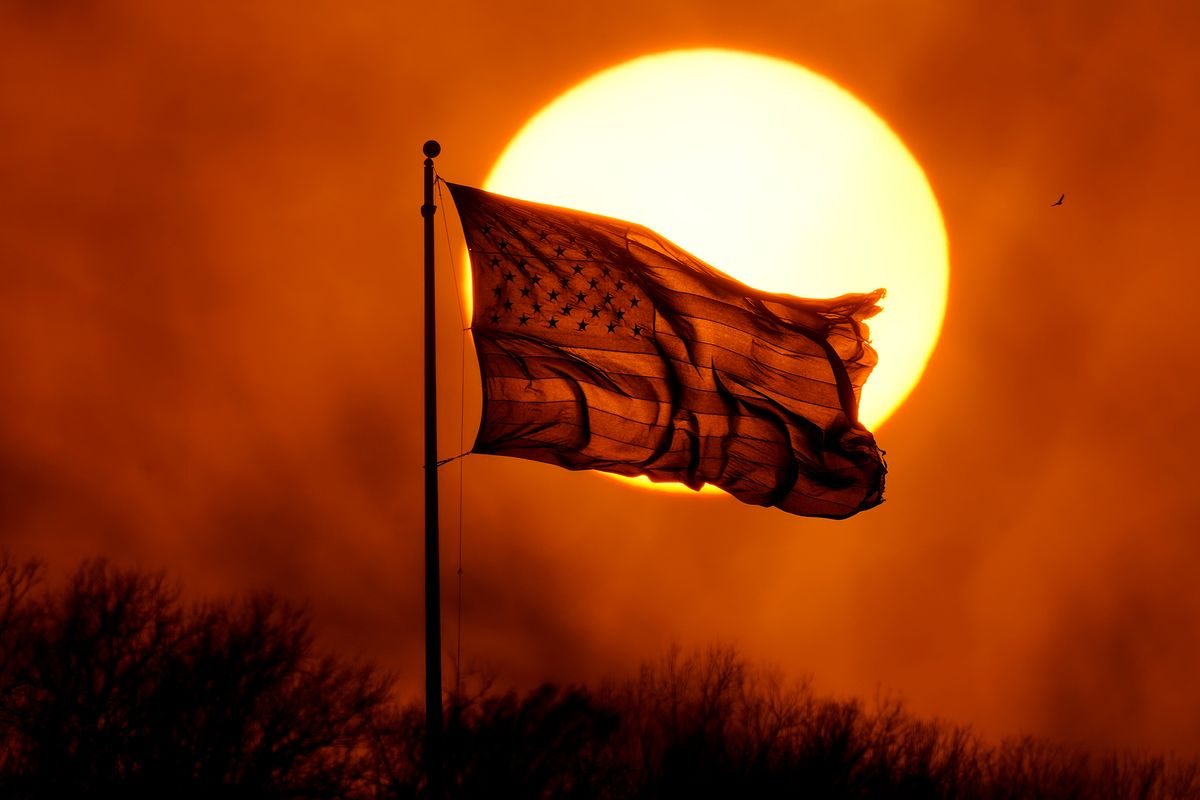

ODESA, Ukraine — The American Century is ending, with external adversaries outmaneuvering the United States in critical strategic contests worldwide, while internal extremists destroy American leadership.
Whether one believes — as American officials say they do — that the purpose of U.S. power is to enforce a “rules-based” liberal international order and defend human rights, or whether one believes — as Russian President Vladimir Putin and his friends say they do — that the U.S. uses its espoused ideals as cover for rapacious empire-building, it’s clear Washington is capable of doing neither effectively.
Watching C-17s packed with fleeing Afghans take off from Kabul in the summer of 2021, this was easy to understand.
Certainly America’s adversaries understood. Less than three years later — and two years into the full-scale invasion of Ukraine — authoritarian regimes are tearing apart America’s strategic projects. Washington’s response is paralysis, the gears of its political machinery seized, corroded by partisan malice.
“The breakdown of the U.S.-led global order is the underlying cause of what we are seeing,” says Ian Morris, a professor of history at Stanford and author of Why the West Rules — For Now, adding that the trend since the end of the Second World War has been a narrowing of technological and economic disparities between “the West and the rest.”
“We shouldn’t be unduly surprised that, as the strategic gap narrows with the relative decline of the American global position, we see people becoming more and more willing to challenge the superpower,” Morris says.
Of the 27 active global conflicts tracked by the Council on Foreign Relations, 17 are now characterized as “worsening” — including four that could have a “critical” impact on the United States.
In Ukraine, war is bursting out of the cage in which U.S. policymakers hoped to keep it contained. The continuing loss of towns like Avdiivka after protracted fighting incentivize Ukraine to strike deep inside Russia, while Moscow increases pressure on NATO trying to break up the alliance supporting Kyiv. There is talk of nuclear war with rhetoric that would make Nikita Khrushchev blush.
The Biden administration can no longer help Ukraine defend itself, thwarted by former President Donald Trump, who has seized control of the Republican Party while claiming he will let Russia “do whatever they want” with American allies.
The MAGA movement has gone all-in on backing Russia, with billionaire Elon Musk providing money and a platform for nativist agitators like Tucker Carlson to advance Putin’s agenda, while House Speaker Mike Johnson (R-La.) and GOP Sens. J.D. Vance (Ohio), Tommy Tuberville (Ala.), and Mike Lee (Utah) run interference. Together they spread the lie that halting aid for Ukraine will stop the war, when in reality it will only help a tyrant continue murdering an oppressed people.
President Joe Biden has also handed adversaries a propaganda coup by helping Israeli Prime Minister Benjamin Netanyahu embark on a months-long campaign of violent retribution in Gaza after a massive terror attack by Hamas on Oct. 7, which is deepening divisions over foreign policy and shattering claims of moral standing. As a result of all this, American allies now view Washington as more an agent of geopolitical chaos than stability.
The timing couldn’t be worse. An ad-hoc authoritarian alliance — including Russia, Iran, China, and North Korea — is coalescing into “a mosaic of overlapping strategic interests,” willing to use all available means to destroy the global order, grab territory, and achieve hegemony.
To make matters worse, it’s working. Putin is inserting himself directly into the Gaza conflict by inviting Palestinian factions — including Hamas — to meet in Moscow on Feb. 26, while Tehran just revealed it is helping Russia attack Ukraine by supplying hundreds of ballistic missiles. The current U.S. showdown with Iran is itself the result of a decade-long cooperative effort by Iran and Russia to challenge American military supremacy.
After more than 30 years of Middle East military intervention, the U.S. has not only failed to achieve its strategic goal of containing Iran — Tehran’s influence is peaking. This is seen in the cycle of violence that began when Israel responded to the Oct. 7 attacks with a war that has claimed thousands of lives, most of them civilian.
Over ensuing months, the conflict grew: Israel bombed Hamas, Hezbollah, and Iranian targets in Lebanon, Syria, the West Bank, and Gaza; the U.S. hit Iranian targets in Syria and Iraq; Iran-backed Houthi militants in Yemen fired missiles at ships in the Red Sea; the U.S. and U.K. bombed the Houthis; Iran carried out missile strikes in Iraq, Syria, and Pakistan; Pakistan carried out air strikes against Iran; Turkey bombed Kurds in Syria and Iraq; Jordan bombed Iranian-backed “drug dealers” in Syria; even Somali pirates are getting in on the action.
Despite signs neither Washington nor Tehran is keen to escalate, the trouble with proxy wars is proxies aren’t easily managed. If Iran and the U.S. do fight a broader war, it will likely start somewhere most Americans have never heard of — and couldn’t find on a map.
On Jan. 28, three American soldiers were killed and dozens wounded in a drone attack on a military base called Tower 22, near the ancient Baghdad-Damascus highway, close to the Syrian-Iraqi-Jordanian border.
On Feb. 2, American strategic bombers responded, launching 125 missiles against 85 targets in Iraq and Syria.
Their primary target was Kataib Hizbollah, which is “the premier militia in Iraq, operating under Iran’s direct command,” according to researchers at the Washington Institute for Near East Policy. The militia claimed responsibility for the attack on Tower 22, but Kataib Hizbollah has been killing Americans since 2007 — part of Iran’s shadow war against U.S. forces in Iraq.
That illustrates an uncomfortable truth: American policy in the region is a checklist of failures, including the decision to invade Iraq under false pretenses in the first place. While the U.S. military became skilled at finding and killing HVTs — high-value targets — in Iraq, Washington never developed a strategy that didn’t rely on using high explosives to solve complex problems.
This inability to master political dynamics left the door open for others working on longer timelines toward concrete goals. As one military leader from an allied Arab state told his Marine counterpart in 2009: “All America is doing in Iraq is handing it over to Iran.”
The U.S. Air Force is now hitting “the same strategic locations we were hitting back in my time,” says Col. Steve W. Davis, the retired commander of Marine Regimental Combat Team-2, who ran counterinsurgency operations in the Iraqi city of Al Qaim, across the border from Syria, from 2005 to 2006. The city was a Sunni insurgent redoubt, run by militants and smugglers with overlapping tribal allegiances, “but there was no Iranian influence that me or my team was aware of when we were in Al Qaim.”
During and after Davis’ deployment, the Marines worked to stop Al Qaeda-linked fighters flowing into Iraq. They spent years developing relations with tribal leaders, partnering with government forces and compiling intelligence about criminals and insurgents operating in the area.
But America grew tired of this. It withdrew, leaving a weak Iraqi central government entangled in sectarian strife. Security forces jockeyed for influence against Kurds in the north and Shia militias — some backed by Iran — across the country. Al Qaeda and other extremists became an afterthought.
The Syrian Civil War began in 2011, the same year the U.S. ended the Iraq occupation, and with its onset, Al Qaim became a conduit for fighters traveling to Syria to battle the regime of President Bashar al-Assad.
The result was a disaster: Sunni militants declared the Islamic State in 2013, and swept across Iraq and Syria. The U.S. and its allies openly sought to oust Assad — with Washington secretly backing generally ineffective rebel groups to do so — but the Islamic State now became a more critical threat.
“Safe back in the States, we watched with great disappointment how quickly [the Islamic State] took territory and caused Iraqi army formations to disperse,” says a Marine officer who served in Al Qaim. “What could we have done? Not withdrawn prematurely. Nobody wants ‘forever war’ — but this work takes years.”
The Obama administration assembled an international coalition to fight the Islamic State — downplaying that Washington helped create the power vacuum in which the group flourished — putting planes in the air, boots on the ground, and throwing resources at Iraqi security forces, Kurdish peshmerga, and Syrian rebels.
America now shared an enemy with its enemies: Russia, Iran, and the Assad regime also wanted to fight the Islamic State, while Moscow and Tehran hoped to retain a friendly government in Damascus.
As the Islamic State grew, the Marine officer says, “we were in the strange position of rooting for the Shia” to take control of Sunni territory and oust the militants.
Iran obliged, flooding the region with advisers, fighters, and weaponry to stop the spread of the Caliphate — and expand Tehran’s influence, part of its strategy to oppose the Israeli-American alliance.
But Iran lacked the firepower needed. So in July 2015, Qasem Soleimani, commander of the Quds Force — the clandestine and extraterritorial operations unit of Iran’s Islamic Revolutionary Guards Corps — met with Putin and Defense Minister Sergei Shoigu in Moscow, hashing out a deal to coordinate operations in Syria.
Soleimani’s trip laid the foundation for military cooperation in Syria, says Dr. Nicole Grajewski, an expert in Russo-Iranian relations and a fellow at the Carnegie Endowment for International Peace. “The relationship became a lot closer than it used to be, and many of the contacts were institutionalized.”
By September, Moscow sent a naval flotilla, thousands of soldiers and advisers, and dozens of bombers, attack aircraft, and helicopters to Hmeimim Air Base in Latakia, on Syria’s Mediterranean coast. At its height, the Russian mission involved perhaps 6,000 military personnel — a surprisingly light footprint to save an ally.
“The Russian intervention in September 2015 provided decisive air power to Syrian and Iranian-backed ground forces, expanding Assad’s territorial control and solidifying the regime’s hold on power,” Grajewski says. “In short, the Russo-Iranian partnership in Syria succeeded in achieving its main goals. The Kremlin saw this as an opportunity to contest U.S.-led interventionism.… But for Iran, Syria is much more important. It’s part of the ‘axis of resistance’ against U.S.-Israeli power.”
While the U.S. and its coalition succeeded in dismantling the Islamic State, they failed to oust Assad. Iran, on the other hand, had effectively created a “ground line of communication” all the way to its proxy Hezbollah in Lebanon.
By 2017, Al Qaim had been retaken by Kataib Hizbollah, opening the border and Euphrates corridor to Iranian proxies. And American soldiers were in the middle of the growing Iranian shadow state in eastern Syria.
The U.S. forces deployed to combat the Islamic State were subsumed into America’s strategy to contain Iran. That the Islamic State could resurge provides a shield with which to ward off accusations of “mission creep” on Capitol Hill. But American forces in the region are primarily engaged in combat with Iranian proxies, rather than Islamic State dead-enders.
This is why Tower 22 was attacked by Kataib Hizbollah. And although the U.S. assassinated Soleimani in Baghdad in January 2020, the enduring legacy of his mission to Moscow can be seen in the Iranian-designed drones exploding in Ukrainian cities.
Despite bungling its “regime change” strategy in Ukraine, two years after the invasion Russia holds much of the territory it seized. Moscow is weathering economic sanctions and a flood of Western weapons provided to Ukraine. Iran is giving Russia drones, technology, and armaments — as are China and North Korea.
For decades, Russia was the world’s second-largest arms exporter, after the United States. The war in Ukraine has effectively turned the flow around: Now, Moscow is buying back weapons from its former customers.
Meanwhile, the coalition Washington rallied to Kyiv’s cause is fractious, unable to deliver promised guns and money amid internal bickering and lack of political will.
Moscow continues to test Western resolve with aggressive provocations. Russia’s missiles and drones wander into Polish and Romanian airspace, while its planes routinely fly with their transponders off over the Baltic Sea, sending NATO aircraft scrambling to intercept — more than 300 times last year.
In the Black Sea, Russia’s sea mines and missiles have hit foreign-flagged commercial ships, its fighters intentionally downed an American drone, and it threatened to shoot down manned French patrol aircraft. The Kremlin carries out frequent cyberattacks and electronic warfare targeting NATO members. It is fomenting violence and discord in the Balkans between its ally Serbia and independent Kosovo, where 4,500 NATO soldiers are deployed to keep the peace.
Moscow recently added Estonian Prime Minister Kaja Kallas to a wanted list, another sign Russia is laying the groundwork to use the Baltics as a wedge to pry NATO apart. Danish officials delivered a sobering assessment, saying Russia could attack a NATO member within three years.
The Kremlin is also challenging America in the Pacific, conducting naval exercises with China in the Bering Sea, while hardliners claim Putin issued a decree last month “voiding” Imperial Russia’s treaty selling Alaska to Washington. Even Norway is alarmed at Russian-Chinese cooperation, warning the two have a “revisionist agenda in which they seek to reshape the international order.”
Russian officials now regularly shuttle between Tehran, Beijing, and Pyongyang on a quest for sanctions-busting deals. By creating a self-sustaining “axis of the sanctioned,” Russia, Iran, North Korea, and China have found an effective way to blunt the impact of Western tools of economic coercion.
Amid all of this, Pyongyang is increasing missile testing in the Sea of Japan, while China grows aggressive in the South China Sea and Taiwan Strait, with experts seeing a crisis this year as likely. One U.S. official told me: “Don’t underestimate the level of coordination in all of this.”
As Russian forces advance in Ukraine, Washington is deadlocked. The Biden administration, neutered by Trump loyalists, is unable to execute meaningful foreign policy as the country approaches what could be the most consequential election since 1860.
That there is a rabid core of diehard isolationists on the right is nothing new: What’s surprising is that MAGA has so effectively compromised America’s international position, even with the movement’s leader out of office.
Unfortunately, American isolationism is no more intellectually consistent than is American exceptionalism. Even as some denigrate Ukrainian resistance to Russia as another “forever war,” they urge direct military action against Iran. The trauma of George W. Bush-era incompetence in the Global War on Terror (GWOT) sent the right careening down a path that whipsaws between total strategic disengagement and violent interventionism bordering on sociopathy.
The left spent the past 20 years caught between hawks living in a neoconservative fantasyland where dropping bombs on the Taliban might create a better future for Afghan women, and a coolly naive internationalism where dictatorships could be turned into democracies through the seductive force of TED Talks. Mainstream Democrats have been happy to support just enough militarism to avoid being called peaceniks, while whispering to themselves, “If we close our eyes, our peer adversaries can’t see us.”
Even as Barack Obama dispatched Reaper drones to shoot Hellfire missiles at Yemeni wedding parties and bombed Libya like a born-again Reagan, he let Putin have his way in Crimea — and kept “turning the corner” in Afghanistan until it was Biden who ultimately decided to end decades of failure in the Graveyard of Empires.
But Washington never forsook its love for GWOT. So when Hamas attacked Israel on Oct. 7, Biden gave Netanyahu the greenlight to indulge the same counterproductive bloodthirst America embraced after Sept. 11. As Israeli forces kill thousands of civilians in Gaza and Biden earns the moniker “Genocide Joe” from his critics, the White House must have found it a relief when the Houthis joined the fray, giving the U.S. Navy targets for Tomahawks, relatively unencumbered by Palestine’s moral complexities.
None of it equates to a coherent strategy. In its unhinged War on Terror, America lost the understanding that a firm voice and a holstered gun often keep the peace better than a loudmouth brandishing a nightstick. Live, laugh, launch cruise missiles: So long as America is doing something, why worry about the end game?
“In reality, everything is heading towards the use of nuclear weapons and possibly the destruction of humanity,” writes Alexander Dugin, the sage of Russian neo-imperialism.
If nuclear saber-rattling doesn’t work, the authoritarian crowd is happy to leverage technology and potent identity politics to wrench apart democracies through active measures. Even as Starbucks socialists rally in support of Islamic extremists and post TikToks praising authoritarian regimes’ “anti-imperialism” in the name of intersectionality, far-right propagandists mix anti-liberalism with antisemitism, Islamophobia, and White Replacement Theory — until many social media platforms seem more Beer Hall Putsch than digital town square.
It is revealing that Dugin is particularly pleased that MAGA and Marxists alike are aligned in opposition to American aid for Ukraine: “Together, they are committed to dismantling liberal dominance.”
Although ideologues have been easily suckered by adversaries packaging actual wars as extensions of the culture wars, a clear majority of Americans understands these conflicts as threats to the national interest. For Republicans to embrace the idea that America should only unsheath its sword to serve a global protection racket, while Democrats prove themselves inept at besting any military challenge that can’t fit in the back of a Toyota pickup, it’s understandable many of my security sources have begun embracing a fashionable nihilism. But nihilism is a weak peg on which to hang the future.
Lost amid American torpor is the reality that conflicts don’t always just work themselves out. From the Sahel to the South China Sea, security crises are expanding into major multinational conflicts. One of the deepest fears of the national security establishment for generations, that the U.S. could again face two “major theater wars,” no longer seems a Cold War-era fantasy.
Far from the bombs falling on Gaza, rockets landing in Israel, drones flying into Ukrainian cities, or cruise missiles hitting Yemen, Syria, and Iraq, Americans can indolently ponder: What are U.S. soldiers doing in Syria? Will bombing the Houthis work? Is there an Israeli-Palestinian future that doesn’t involve genocide? Will America aid Ukraine? Will China invade Taiwan? Will NATO fight Russia?
The answer: “We have no idea.”
But don’t worry if America doesn’t have a plan.
Vladimir Putin surely does.





Canadian Prime Minister Mark Carney speaks at a press conference in Ottawa, Ontario, on Aug. 22, 2026.
How Mark Carney Became Leader of the Free World by Standing Up to Trump
In Canadian Prime Minister Mark Carney, Donald Trump has finally met an adversary who truly understands the art of the deal — and it could threaten the entire premise of his presidency.
There have been many self-inflicted catalysts to Donald Trump’s ruination: epic corruption, inflation and the soaring price of gas, the ceaseless angry old man posts and memes, ICE’s assault on the rule of law, the Supreme Court’s mullah-like extremism, his vanity, self-pity, cruelty, and of course the unprovoked, catastrophic failed war on Iran. They are all derived from Trump’s delusional belief in his nonexistent superpowers. But the downfall of Trump will also be forever dated to a small, inexplicable and quixotic folly: his attack on Canada.
Despite the president’s incessant, bizarre claims that he can destroy Canada economically as he wages a trade war against America’s neighbor to the north, in the last few weeks Prime Minister Carney has quietly but effectively ended Trump’s ability to lead the free world in any way other than as an extortion racket and disorganized crime syndicate.
In a potlatch, in the tradition of indigenous peoples of the Pacific Northwest, a head man would display his tribe’s wealth and power by lighting their most precious possessions on fire. The destruction appeared pointless to European eyes, but First Nations peoples understood the significance of the rite: If the chieftain of the tribe could squander incredible riches, what possible hope did a rival have in waging war against such an overwhelmingly powerful enemy? The mindless waste of resources in a potlatch, as every Canadian schoolchild learns, was actually a finely tuned demonstration of dominance, and a way to avoid conflict.
Trump, the self-described big chief of America, has concocted a new and perverse version of the potlatch that better resembles setting himself on fire. By lawlessly declaring an unprovoked trade war on Canada, Trump has set alight the most valuable assets of the United States: international alliances, the Constitution, respect, friendship, trust, goodwill, the rule of law (hell, the whole idea of law). Instead of displaying his power, Trump has demonstrated his fundamental weakness and loosening grip on reality. In Trump’s form of chaotic destruction, with his historical illiteracy and rat-like cunning combined with his desire to humiliate his perceived enemies, he isn’t pursuing trade policy or a geopolitical strategy. For Trump, domination is the point. The absurdity of farmers and fishermen and auto workers on both sides of the Canadian border having their lives set ablaze in service of the president’s ego trip is the end in itself.
Measured in a simpleton’s economic terms, America appears to have the upper hand in a trade war with Canada. The economy of the United States is more than a dozen times as large as Canada’s, so a trade war that represents a national cataclysm north of the border will barely register in Trump’s America. Trump’s pretextual use of an alleged “trade deficit” to justify his trade wars is concocted according to his whims, urged on by fanatical anti-trade sycophants and enablers, the ever-changing metric a means of blackmail, the nonstop stream of insults and half-witted social media posts somehow managing to be simultaneously enraging and mind-numbingly boring to my fellow Canadians.
“Just watch,” Trump trolled last week as he promised to gratuitously punish Canada, like an old drunk sitting in his underwear yelling at his television set — only with the powers of the commander-in-chief. “All we have to do to cut our trade deficit with a country is not trade with them,” he said in the Oval Office over Labor Day weekend, adding that America will also stop trading with Europe, Mexico, and Switzerland, threatening in one unhinged rant to end trillions of dollars in commerce. As if to underscore his madness, he followed it up with a meme showing the American colors covering all of North America, as well as Greenland and Iceland. But for reasons known only to himself, he has focused his true menace on my home and native land: “If we don’t do any trading with Canada, if we just end all trade with Canada, we’d save ourselves $90 billion. Canada would be in a heap of trouble. I don’t think they’d exist. Because, again, they do 95 percent of their business with us.”
If you don’t think this is the unhinged talk of a confused old fool showing signs of dementia, take a look at the bond market.
After Trump illegally breached America’s free trade agreement with Canada last year, imposing tariffs that were based on transparent lies about fentanyl crossing the border, he proceeded to gaslight America’s ally with a steady stream of infantile ALL CAPS derision.
Living inside a constant reality TV show, with fake deadlines and formulaic melodrama, Trump then imposed a 30-day timeline for a new accord, or he would unilaterally impose additional 50-percent tariffs relying on a never-before-used statutory justification — a preposterous gambit under America’s binding trade treaty with Canada. Confronted with the prospect of constantly changing trade terms in an increasingly lawless America, Prime Minister Carney didn’t take the bait, engaging in talks in good faith but with eyes wide open (and elbows up, as they say in Canada). Using one of the oldest tricks from an increasingly pathetic and obvious set of bullying tactics, Trump then prematurely announced that a deal with Canada had been reached when there was no such agreement — an attempt to box Carney in. But again, Carney didn’t cave like so many other world leaders.
Like the many con men I’ve written about over the years, Trump is convinced of his own genius, certain that the world is a ship of fools and that he — and he alone — can see through the tissue of lies and deceptions. The problem, inevitably, is that grifters are never as smart as they think they are, a fatal flaw compounded when they start to believe their own lies — and then encounter someone who can see through their act.
As his second term has illustrated, Trump is certain that everyone will cow in the face of his “Hulk Smash”: the Supreme Court, television networks, Ivy League universities, white shoe law firms, the abject former UK Prime Minister Keir Starmer chasing after the president’s windblown papers like a schoolboy — an image that quickened his downfall. Changing the basic terms of the proposed agreement at the last moment is a classic power play in any negotiation. So it was with Canada this summer. At the last minute before Trump’s invented time limit expired, as the clock ticked towards midnight, Trump’s minions attacked Canada’s profoundly important French culture — ridiculing the notion that there is such a thing as a distinct Canadian nation at all. He slapped tariffs on the automobile industry, lumber, steel, aluminum, and for kicks and giggles, hockey sticks to shove his version of reality directly up the ass of the milquetoast Canadians.
Under the new terms Trump purported to impose, the United States (which is to say Trump) would have control over any other Canadian trade agreements. Trump then reserved the right to change the deal at any time in the future, for any reason, with no notice — meaning the deal wouldn’t be worth the pencil it was written in, as Carney noted.
Lake Ontario, that’s now Lake America, and your prime minister is a governor, and you’re going to wish that you were the 51st state by the time I get through with you.
But then something bizarre happened to Trump’s bonfire of the vanities. In Carney, the president discovered that he had encountered a man who was not looking for a fight — but who equally wasn’t afraid of him. For all the bluster and menace and braggadocio, Trump didn’t realize that he had walked into a trap. By agreeing for negotiations to happen this summer, a year ahead of the larger deal for the renewal of the North American treaty, Carney had picked the time and place for the inevitable looming confrontation; with Trump vulnerable in the coming election, the canny Carney had managed to create real leverage. Carney then cleverly enlarged the dispute and raised the stakes by accurately calling America’s attack a declaration of war, surprising the flat-footed American negotiators who apparently didn’t take Trump’s threats seriously themselves — adding another layer of leverage to Canada’s supposedly weak hand.
In Carney, it turned out, Trump has met a leader of real strength, the understated but steely and confident kind reflecting Canada’s national character. The irony is that Carney was elected last year almost entirely as a result of Trump’s Kafkaesque trade war, defeating a weak-kneed conservative who very likely would have meekly submitted to America’s neocolonialist threats. Another irony is that the politically inexperienced Carney turns out to have genius-level instincts. The whippet-thin banker is an unassuming figure, the opposite of Trump, but every bit as ruthless in his way. He is a self-made man and intellectual with degrees from Harvard and Oxford, who epitomizes the meritocracy. The child of schoolteachers in the far north Alberta, raised in a home that prized education and social responsibility, Carney earned his way to the absolute heights of global finance through his intelligence and diligence. His resume is almost a parody of accomplishment, with stints as the head of the banks of both Canada and England, as well as years with Goldman Sachs and working for the likeminded businessman-turned-politician Michael Bloomberg. Faced with the global financial crisis of 2008 and then Brexit, Carney witnessed the idiocies of economic self-destruction in the 21st century, preparing him with a unique set of experiences to confront Trump’s lawless trade war — to Canada’s great good fortune.
In truth, Carney was elected specifically to deal with such a crisis, and Canada has had decades to prepare for this conflagration. Living next to an elephant requires a certain amount of caution and awareness, so Canadians understand American politics down to the last looney. Knowing your enemy is the greatest asset in war, as the ancient Chinese philosopher Sun Tzu said, and Carney’s deeply intimate awareness of America gives him the ability to exploit Trump’s obvious weaknesses: a thin skin, hubris, impulse control, arrogance
Plan beats no plan is a truism of all crisis management, an acknowledgement that any executive, sports coach, or sentient human being understands. If you want to shape events and succeed, do the work to anticipate and understand what lies ahead so you don’t live in a state of constant surprise, chaos, and disarray. Planning is also the ultimate expression of Carney’s life force, the guiding principle of his meticulously accumulated achievements and triumphs. While Trump, like so many fools throughout time, doesn’t read or listen to contrary opinions or care to prepare, trusting his gut and native intelligence, Carney is a careful student of power dynamics and the deep lessons of history. Control what you can control, Carney explains to Canadians as he describes the need to diversify and de-risk the relationship with a declining United States. Europe might seem distant geographically, but Russia’s attack on Ukraine and self-inflicted withdrawal of its resources from Europe present an opportunity for a resource-rich nation like Canada. Membership of the European Union seems fanciful now, perhaps, but there is no question that Canadian distrust of America is hardening into real anger and dismay. The same logic applies to the countless opportunities in Asia, with Carney traveling the world signing new free trade agreements as Canada pursues a strategy to end its dependence on the undependable Americans. There is also no turning back the clock as Canada duly notes how few friends it really has in the political and media classes of the United States.
Given Trump’s use of Manhattan real estate brute force strong-arm tactics, imagine Carney’s eyes lighting up when he realized that American negotiators were attempting to attack the French-speaking peoples of Canada and the entire notion of a national culture. There was obviously no way the Canadian people were going to accept such humiliation and subjugation at the hands of an amoral gangster. As Trump’s designated thug Howard Lutnick piled on the bad faith, last-minute demands, it became evident that Carney had no choice but to walk away — despite the awful short term pain America could inflict.
Thus Carney’s plan has been put in action, with the backing of a nation unified in outrage at America’s belligerence. Trump can harm Canada, but that street runs two ways. By standing up to Trump, Carney has lured him on to the economic battlefield at the precise moment when his presidency is collapsing, with the calamitous midterm elections looming. Tight races are being run in many states that are heavily dependent on trade with Canada — Ohio, Maine, New Hampshire, Michigan, Wisconsin, Pennsylvania, Alaska — the exact jurisdictions Canada will target with long-planned tariffs aimed at specific economically sensitive economic sectors, in order to increase the pressure on the ill-prepared president.
Apart from cheap shots and idiotic put downs, Trump has no history of seeking compromise and no real plan in response, as usual, apart from lashing out like a cornered animal. Trump also has vanishingly little popular support in America for his personal grudge match with Canada, an obsession that looks weirder with each passing insult. The struggling North American car industry has been jerked around by Trump’s vengeful destruction of the electric vehicle, losing billions in the process. and taxes described as tariffs will make life even more unaffordable for working American consumers. Uncertainty and unpredictability are lethal to any investment strategy, as actual business people and union leaders understand. Across the rust-belt industries Trump proclaims he is protecting, his tariff-taxes are disrupting and distorting markets and driving up costs for no purpose other than his insistence on harming America’s neighbor and ally, an enemy only in the president’s fevered imagination.
But to what end? It’s a question with no sensible answer.
Many Americans like to think foreigners draw a distinction between Donald Trump and themselves. But this self-serving piece of evasion is rapidly disappearing for Canadians, as the United States wages a war of aggression to impoverish a friendly nation, and heedlessly attack its history and sense of place and purpose. When Trump threatens the Canadian dollar, implicitly saying that he will do all he can to make the country economically uncompetitive, the statement is front page news in Canada, while it barely rates a mention in the American press. The American politicians who register tepid defenses of Canada are remarkable not so much for standing up for their neighbor or the rule of law, but for how few and far between they are — and how feckless.
As the trade war escalates this week — or evaporates into another TACO (Trump Always Chickens Out) — the damage done to America’s reputation will be lasting. Once American arrogance is seen in broad daylight, it suddenly is everywhere, in Secretary of Treasury Scott Besant likening Canada to a “yipping dog,” or in former President Barack Obama distractedly turning up to a speaking engagement in Toronto carrying his cardboard coffee cup as if he can’t wait to collect his fee and return to Chicago to gaze admiringly at the shrine he has built to himself.
Damnatio Memoriae is the Latin term for the ancient Roman ritualistic destruction of all memorials to a tyrant, a kind of reverse branding deal with posterity that Trump is furiously trying to counteract with his White House bunker and ballroom and sad sack victory arch that memorializes no victory — structures very likely to be torn down or repurposed when Trump’s presidency expires.
With a mid-term election tsunami gathering force, Trump has already become a lame duck in the eyes of the world, albeit a particularly dangerous one facing richly deserved corruption investigations and possible impeachment. But the damage to the nation’s brand as ugly Americans and wannabe neocolonialist hegemon will be impossible to erase. As the trade conflict intensifies and Canada retaliates in a measured defensive way, taxing golf clubs to counter Trump’s childish hockey stick impost, Trump’s impulsive provocations will only reveal his inability to formulate anything like the concept of a winning strategy. When reality descends and he leaves office or is forced to finally end his mindless war and inevitably declare himself the winner, as his fragile manhood requires, Trump will further diminish himself and his country in the eyes of the world. Under Trump, America risks ending up like the president: alone, lost, friendless.
Despite Trump’s flailing efforts at waging a mutually destructive internecine war, foreign investment is growing in Canada, with a summit taking place this month for investors representing a trillion dollars to extol the virtues in backing a reliable, trustworthy country governed by the rule of law. Holding Canada’s main weapons in reserve, in accordance with Carney’s disciplined plan, if necessary Canadians can fight back with damaging export taxes on oil, gas, electricity, potash for America’s farmers — truly damaging countermeasures that will be employed only as a last resort. But Canada is already showing the world that it is possible to defy Trump, even when the country has so much to lose. Bullies like Trump can’t survive defiance because it reveals their true nature. In that sense, Mark Carney has become the new leader of the free world, fighting on behalf of nations too afraid to confront the American despot. As a result, incredibly, under Carney’s leadership Canada is becoming a kind of law-abiding underdog badass outlaw nation, in its understated but determined way — a reality I could palpably sense when I was in London in recent days and my 15-year-old English cousin expressed awe at my homeland’s willingness to stare down the bully-boy president.
“I would kill to be a Canadian,” he said.