Skip to content
Search

Tyler, the Creator Has a Point About ‘Meme’ Musicians

Tyler, the Creator Has a Point About ‘Meme’ Musicians

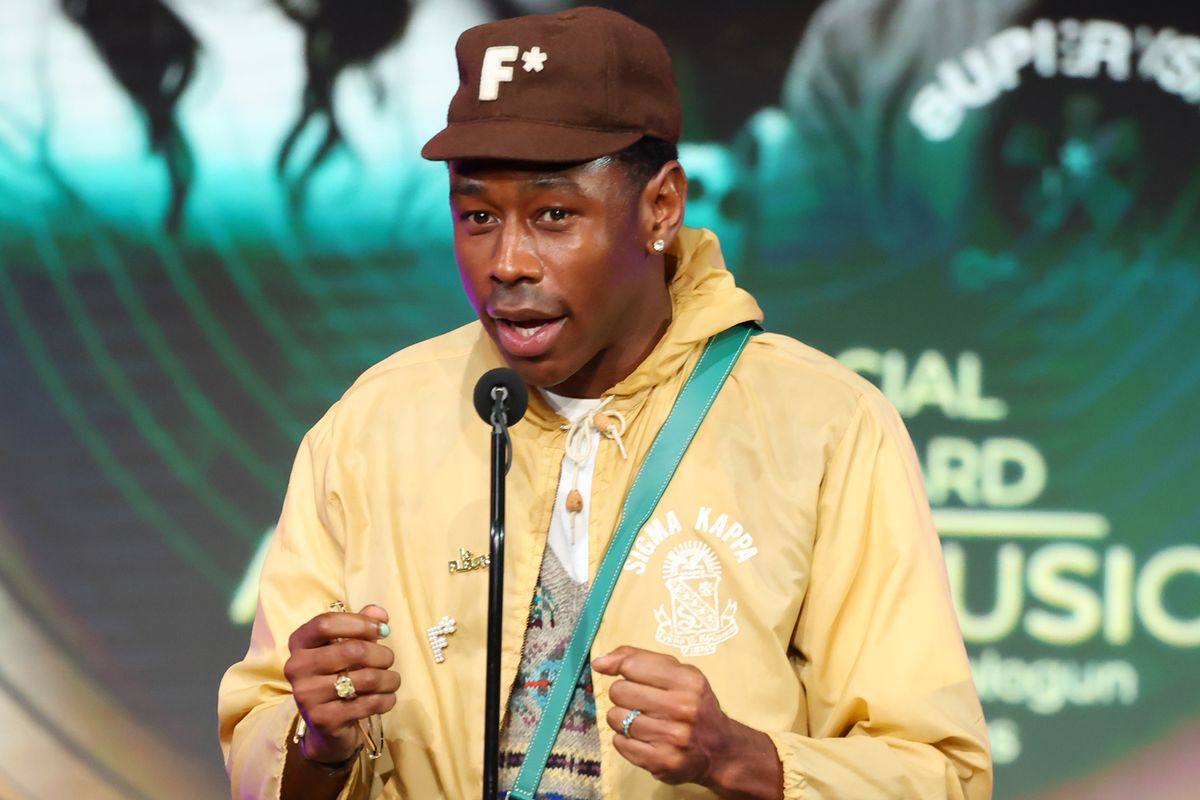
On a newly released episode of the web series Mavericks with Mav Carter, Tyler, the Creator managed to stir up controversy from every corner of the rap internet. In a clip that’s circulated online all week, he tells host Maverick Carter that “There’s so many niggas out right now that aren’t musicians that are getting treated like musicians because they make meme records — publicly will be like, ‘I don’t give a fuck about music. I just do this shit for money.’”

The designation of “meme” records caught the ire of some who claimed many of Odd Future’s early releases could be considered meme records and others who saw the comments as proof that Tyler, who turned 33 this year, is becoming out of touch. In the same interview, Tyler went on to comment about a white rapper he’s been seeing online who he believed was doing a pastiche of Atlanta rap icons like Gucci Mane and Future. Many online have come to think Tyler was referring to Ian, the viral rapper with cosigns from the likes of Lil Yachty, whose appeal relies heavily on the dissonance between his look and sound.


Both of Tyler’s comments seemed to coalesce online as a rebuke of the current generation of rap musicians. Bu Thiam, Ian’s manager and the EVP of Columbia Records, posted a response to Tyler’s comments in a since-deleted Instagram Stories post last night: “i signed Ian & im from Atlanta. He sounds nothing like Gucci or future lol. It’s called influence,” he wrote. “But i never though I’d see the day where you become old & hate on the youth lol.”  It’s a frustrating defense and one that’s regularly deployed in this generation’s rap discourse (never mind that Bu, an industry veteran, is roughly a decade older than Tyler). Nobody wants to be called “old” and thus people refuse to engage critically with anything shiny and new, instead chalking it up to the amorphous and apparently unimpeachable notion of youth culture. 

Except, citing the whims of young people is almost always a red herring. “The idea that youth culture is culture created by youth is a myth. Youth culture is manufactured by people who are no longer young,” The New Yorker’s Louis Menand wrote in 2019, referring to his own generation of Baby Boomers. “When you are actually a young person, you can only consume what’s out there. It often becomes ‘your culture,’ but not because you made it.”

The distribution pathways that dominate the way today’s young people experience music — mediated by multibillion-dollar tech companies helmed, by and large, by old white men — are not a representation of the values of the younger generation, but rather the conditions they’re forced to operate within. Ian, or any viral superstar of this moment, is less a symbol of what moves young people and more a product of what works in an economic system that young people have no control over. The moment we’re living in could be described as one of “context collapse,” the flattening of multiple audiences into a single context. The endless “For You” feed, consuming any fleshy reality of modern culture and spitting back the bland, inoffensive background noise an entire generation has been conditioned to see as art.

Last month, shares of UMG fell 30 percent after the company announced a slowdown in streaming growth, marking the end of an era of what seemed like limitless expansion in the space. Thanks to deals made with tech giants like Spotify, YouTube, and Apple, much of the music industry’s success over the past decade has been tied to Silicon Valley. Now, avenues like A.I. and licensing artists’ catalogs for use on social platforms have brought the music industry even closer to the tech world, transforming its central product from a cultural concern to a technological one. In other words: Meme music.

None of this is surprising. By now, it’s no secret that viral success has become an essential part of any new musician’s marketing strategy. The flaw here, as Tyler rightly points out, is thinking that this has anything to do with music or artistry. And more often than not, those trying to sell the increasingly soulless music that proliferates on social platforms as part of this generation’s culture are members of the old guard who stand to profit off of them regardless.

More Stories

Florence Welch: ‘Anxiety is the Hum of My Life — Until I Step Onstage’
Thea Traff

Florence Welch: ‘Anxiety is the Hum of My Life — Until I Step Onstage’

If you talk to Florence Welch on any given day, it’s safe to assume she’s feeling a little anxious. “Anxiety is the constant hum of my life,” she says. “Then I step out onstage, and it goes away.”

Luckily, that’s where she is right now: draped in a long white dress, sitting comfortably in front of a 150-person audience at New York’s beautiful Cherry Lane Theatre, a storied downtown venue known as the birthplace of off-Broadway theater. It’s a week before the release of Everybody Scream, the excellent sixth album she made with her band, Florence + the Machine, and Welch is here for the first-ever live edition of the Rolling Stone Interview, the magazine’s long-running deep-dive conversation series. (The interview is also the first-ever video podcast version of the franchise — check it out on Rolling Stone’s YouTube channel and wherever you get your podcasts.)

Keep ReadingShow less
Prevost: the Québec company behind the biggest tours
Photo via Prevost

Prevost: the Québec company behind the biggest tours

If you’ve ever wandered backstage at a festival or through the private parking lot of an arena during a concert, you’ve probably noticed something: a long row of tour buses. And if you looked closely, you may have seen the same name on every single one: Prevost.

The story of these coaches, like that of nearly every tour bus in North America, doesn’t begin in Los Angeles but just outside Québec City.

Keep ReadingShow less
Rolling Stone Québec Future of Music 2025
Drowster

Rolling Stone Québec Future of Music 2025

Alexandra Stréliski

We could list a lot of impressive figures to showcase Alexandra Stréliski’s success: 600 million streams, 100,000 concert tickets sold, 10 Félix awards, 2 Polaris nominations, 1 Juno…

Drowster

Keep ReadingShow less
Dominique Fils-Aimé Follows Her Heart and Own Rules

Kaftan: Rick Owens/Jewelry: Personal Collection & So Stylé

Photos by SACHA COHEN, assisted by JEREMY BOBROW. Styling by LEBAN OSMANI, assisted by BINTA and BERNIE GRACIEUSE. Hair by VERLINE SIVERNÉ. Makeup by CLAUDINE JOURDAIN. Produced by MALIK HINDS and MARIE-LISE ROUSSEAU

Dominique Fils-Aimé Follows Her Heart and Own Rules

You know that little inner voice whispering in your ear to be cautious about this, or to give more weight to that? Dominique Fils-Aimé always listens to it — especially when people push her to go against her gut instinct. The jazz artist doesn’t care for conventions or received wisdom. She treats every seed life drops along her path as an opportunity to follow her instincts. To go her own way. To listen to her heart. And it pays off.

The Montreal singer-songwriter tends to question everything we take for granted. Case in point: applause between songs at her shows. Anyone who’s seen her live knows she asks audiences to wait until the end of the performance to clap, so as not to break the spell she creates each time.

Keep ReadingShow less
Pierre Lapointe, Grand duke of broken souls

Cotton two-piece by Marni, SSENSE.com / Shirt from personal collection

Photographer Guillaume Boucher / Stylist Florence O. Durand / HMUA: Raphaël Gagnon / Producers: Malik Hinds & Billy Eff / Studio: Allô Studio

Pierre Lapointe, Grand duke of broken souls

Many years ago, while studying theatrical performance at Cégep de Saint-Hyacinthe, Pierre Lapointe was given a peculiar exercise by his teacher. The students were asked to walk from one end of the classroom to the other while observing their peers. Based solely on their gait, posture, and gaze, they had to assign each other certain qualities, a character, or even a profession.

Lapointe remembers being told that there was something princely about him. That was not exactly the term that this young, queer student, freshly emancipated from the Outaouais region and marked by a childhood tinged with near-chronic sadness, would have instinctively chosen for himself. Though he had been unaware of his own regal qualities, he has spent more than 20 years trying to shed this image, one he admits he may have subtly cultivated in his early days.

Keep ReadingShow less