
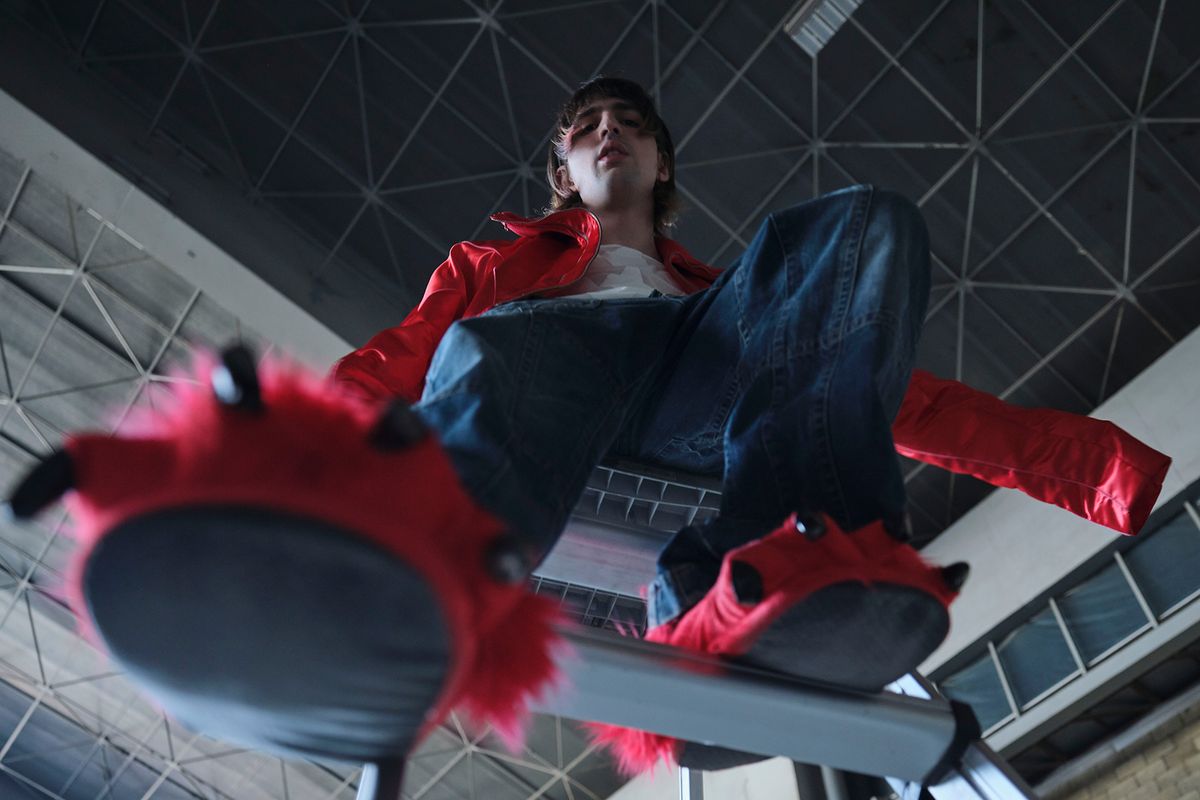

MySpace effectively died years ago, taking its top-eight ranking system and maximalist interface to the grave with it. Visiting anyone’s profile on the website felt like an immediate visual and auditory assault. There were always some zany graphics flashing against an ornate background, and always some thunderous song set to auto-play the second the page loaded. It was bizarre and unpredictable in a way few corners of social media are now — a chaotic curation of individualism before the stakes of online perception got so high. It’s too bad that was swept away before Porter Robinson could release SMILE! :D. It would have fit perfectly.
“Cheerleader,” the first single from the musician’s third studio album, is the kind of song that indicates a palpable shift, not unlike the way music on MySpace would often break pivotal players in niche scenes. Back then, it wouldn’t even be an artist’s official profile that served as the primary vehicle for discovery. Most of the time, it was regular people being shaped and transformed by whatever they were hearing. The ease of access social media provided allowed them to seek out community online with other fans and, notably, the artists themselves. Like the bulk of SMILE, “Cheerleader” is a conceptually adventurous and sonically indulgent examination of a fundamental holdover from that era: parasocial dependencey.
In the music video for the single, Robinson sits on the floor with amps, guitars, and MIDI keyboards scattered all around him. A little cheerleader figurine watches him from the edge of a drum pad, dancing and kicking her feet while he pays her no mind. In actuality, she’s just a girl sitting in a room with his face plastered across everything, and he’s a figure in the model city she made for him to live in until he breaks the fourth wall. “She’s got hearts in her eyes/And she draws me kissing other guys/Her love, the type where she don’t know where to draw the line,” Robinson observes as the bass kicks up. “Cheerleader, thought she needed me, but I need her.” It’s clear that he’s had time to think about this — SMILE is his first release as a lead artist since his album Nurture arrived in 2021.
Nurture was Robinson’s most significant sonic shift away from the dance and electronic music that he broke through with more than a decade ago. It was atmospheric and created a foundation for him to build around vocally. This new album operates in the opposite direction, with his vocals and lyrics leading his explosive pop production towards a creative breakthrough. Despite how comfortable he sounds in the format, diving over the edge of pop didn’t come without some anxiety for Robinson. His audience often latches onto specific versions of him, and when he makes these big shifts it’s never clear if they’ll ever get those old versions back. His anxiety doesn’t seem to stem from the change itself, but from how it might be perceived.
“Knock Yourself Out XD” — reminiscent of an old mall arcade with punchy lyrics about Taylor Swift and Bugattis — examines the codependency he explores across the record. “Crying at the airport /‘I’m sorry, can I get a pic?’/Telling me a sad story/Another reason not to quit,” he sings. Later, on the straightforward pop cut “Perfect Pinterest Garden,” he dives deeper into whatever it is he seems to represent for his audience. “I’ve got your name on my sweater and your life in my hands,” he starts, seemingly shifting into their perspective. “I don’t need my fucking money, I need you to pretend/Just a little simulation of being a friend/I think we all feel better when you play the game.” In the “Cheerleader” video, the girl with hearts in her eyes plays a more literal game centered around Robinson on Porter-Builder-v3.net.
A fan noticed after its release that the domain was still available and purchased it. “Let me take the opportunity to say thank you for all the beautiful things you’ve created and the love that you’ve showed your fans over the years,” a note to Robinson on the actual site reads. “You’ve impacted the lives of countless people in so many amazing ways.” Even when he’s tangled in the wires of needing and being needed, he cherishes how it feels being in front of those people. “I’ll be one of your things/And maybe I’m addicted to the look in your eyes/It’s hard to say you’ve had enough when you get this high,” he resigns on “Everything to Me,” the ballad that closes the album. “I shouldn’t say ‘I love you’/I don’t know your name/But I’ll just say it anyway/‘cause it feels the same.”
Robinson delivers his clearest vocal performance on the idiosyncratic standout “Year of the Cup,” a pseudo ballad that builds around audio from a 2009 Lil Wayne interview about the link between substance use, creativity, and success. Robinson is sober now, but acknowledges the thrill he gets from commanding an audience as a point of vulnerability. Wanting people to like him, he says, is his achilles heel. In an instance of true defenselessness, he narrates a scene where memories of his worst moments play out as he tries to fall asleep. “My mind keeps ringing with times that I laid out everything wrong with me up on stage/It’s embarrassing,” he admits. “‘Fuck you, you don’t deserve me,’’ the bus went totally silent /‘Help me’ is what I meant to say.”
When he was entrenched in the EDM scene, Robinson saw versions of this call for help play out around him all the time. He has previously pointed to Avicii’s death by suicide in 2018 as being a “wake up call” for the scene, and offers insight into his own experience with depression and suicidal ideation on “Russian Roulette.” The song is an eclectic mix of sounds that fluctuate in volume and runs for nearly seven minutes, making it the longest on the album. “I wanna try to change one more time/I wanna live I don’t wanna die,” he sings over airy acoustics that ramp up into an explosive, distorted break where he declares more intensely: “I wanna live.” The last line of the song is a robotic voice reminding him: “Don’t kill yourself, you idiot.”
Robinson grows more comfortable with change across SMILE, even as he expresses regret about getting veneers on “Kitsune Maison Freestyle,” where he mourns: “I can’t get the teeth my mom gave me back in my mouth.” He knows he can’t go backwards. On “Is There Really No Happiness?” a woman tells him: “You know, Porter, some people die of nostalgia.” The song’s melodies and harmonies create a sense of movement, like he’s running towards or away from something. It’s a study of memory that acknowledges that we can’t always trust our own approximations of the past, even if our version is more comforting than the truth. He calls back to the memories that he talked about earlier on “Russian Roulette,” the ones he wanted to experience one more time, like messing around on the family computer.
Robinson’s old MySpace page is long gone by now, but it’s not hard to imagine clicking into his profile and immediately hearing “Mona Lisa” on auto-play. It’s the only collaboration on the album, a rock-driven number with an assist from the pop duo Frost Children. They’d likely be in his top eight alongside his co-writers and producers Gavin Bendt, Mikey Freedom Hart, Luke Shippey, James Ivy, and Michael Stone. Maybe he’d have one of his cheerleaders in the mix, too, for good measure. The webpage would be as brazen and audacious as SMILE is — a rejection of sterile minimalism with a status update that recites one of the record’s most defining lyrics: “If I never changed, would you love me?”





Jack White Responds After Uproar Over Taylor Swift Songwriting Comment
This is why we can’t have nice things.
Jack White posted a statement on Instagram Monday evening after numerous publications took his comments in an interview with The Guardian out of context. When discussing poetry and songwriting, White mentioned fellow musician Taylor Swift‘s style of songwriting, and explored his own approach to storytelling when creating music. Unfortunately, online outlets framed his words as a critique of the Tortured Poets star, especially when it came to headlines that quickly circulated on the internet.
“Putting this up for a day and then taking down to just put this to bed,” wrote White in the since-deleted post. “I didn’t say that I think Taylor Swift’s music was ‘boring’ or whatever click bait the net is trying to scrape together. What I was trying to say in an interview I did about poetry and lyric writing, was that I don’t find it interesting at all for ME to write about MYSELF in my own lyric writing and poetry because I think that it could be repetitive for ME to always write about and It could be uninteresting for people who listen to my music to delve into, and that imaginary characters are more attractive to me as a writer.”
White went on to acknowledge the “tremendous success” of Swift and other songwriters who have their own process, while stating that just “because I say I have a way of doing things doesn’t mean that I think that EVERYONE should do it the same way.” He added, “They should do what works for them, And they do, and it is obviously appealing to many people, and I’m glad to hear that.”
When asked by The Guardian in the article published Sunday, if any of any of his songs were entirely autobiographical, White replied, “Not too much. Now it’s become very popular in the Taylor Swift way of pop singers writing about all of their publicly aired break-ups, which I don’t find interesting at all. I think it’s a little bit boring for me to write about myself.”
White further explained, “Even if I’ve had a really interesting day, I feel like I’ve already lived that, I don’t need to go through it every time I sing this song. If it’s something really painful, I’m not going to put this important, painful thing that I went through out there for some idiot on the internet to stomp all over. So I put a percentage of that into what I do and then morph it into somebody else’s character. I can’t really learn about myself until I put it into somebody else’s shoes.”
Editor’s picks
The 250 Greatest Albums of the 21st Century So Far
The 100 Best TV Episodes of All Time
The 500 Greatest Albums of All Time
100 Best Movies of the 21st Century
In his Monday statement, the Rock and Roll Hall of Fame inductee said that at times he has been “made less and less interested in doing interviews” amid the “age of this massive demand for click bait and content.” Any “scrape of anything interesting” can be used as drama and “spit out as bait,” he continued, leading White to “not want to answer questions with any sort of romance or passion or reflection as I’m too busy having to worry about accidentally triggering nonsense like this from so called ‘journalists’ and ‘editors.'”
Trending Stories
Jack White Responds After Uproar Over Taylor Swift Songwriting Comment
Watch Hilary Duff's Intimate Performance of 'Roommates' on 'Fallon'
Rihanna Shooting Suspect Held for Attempted Murder on $10.2 Million Bail
Amy Klobuchar Slams Live Nation Settlement: 'Every Sign Points to a Backroom Deal'
He ended his response to the wave of backlash following his interview by saying, “This has always been a problem as it encourages artists to give ‘safe’ answers to any question and stifles artistic vision and imagination and pushes all of us to not share anything interesting, which was one of the points I made about keeping private things private in that same interview. But yeah, content.”
ADVERTISEMENTWhite recently released Jack White: Collected Lyrics & Selected Writing Volume 1, a collection of lyrics from the artist’s solo recordings including No Name, The Raconteurs, and more, plus selected poems and writings by White, and essays by poet Adrian Matejka.