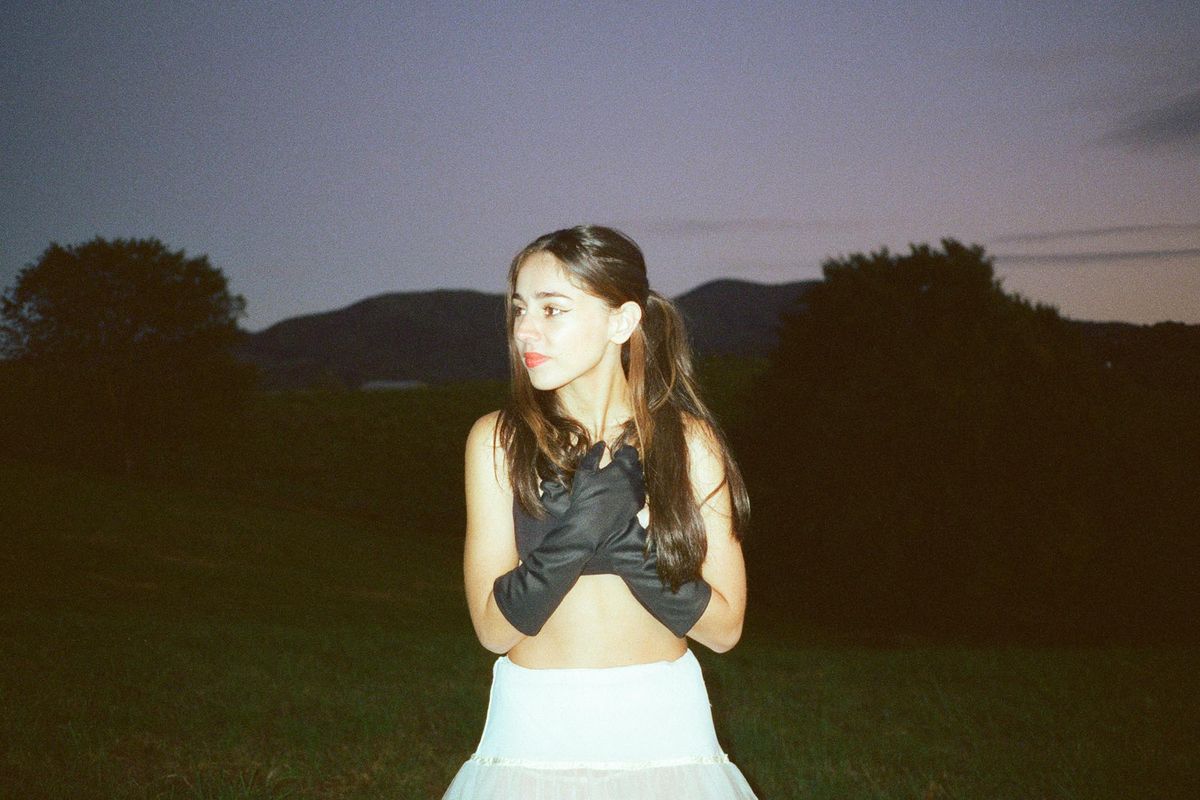

Towards the end of her song “Amelia,” Samia walks into a party. “I’m writing a poem, somebody stop me,” she sings over balmy synths and a chirpy beat. It’s less of an actual threat and more a self-aware quip from the 27-year-old musician who’s better than almost anyone at turning fleeting moments into poetry.
“I love romanticizing shit, and I always have,” Samia says. “I was an internally dramatic child. There’s something really powerful and something that feels like protest sometimes in writing [my thoughts] down in a song.”
Samia’s discography exists as an endearing years-long documentation of both the mundane and pivotal moments of her life, and her phrasing is sharp-witted enough to convey that they’re really one and the same. Over the course of her two albums — 2020’s The Baby and last year’s Honey — Samia has cemented herself as one of indie rock’s most poignant and brazen songwriters. Her songs paint visceral, sometimes violent scenes, stuffed with vivid imagery and jolting metaphors that bring the listener along like her shadow into any room she enters.
On Honey‘s opening track, “Kill Her Freak Out,” Samia leans into full hysterical theatrics when telling a past lover “I hope you marry the girl from your hometown/And I’ll fucking kill her/And I’ll fucking freak out,” but her vocal delivery remains stoic and vacant over a wobbly, sparse organ composition. (Is it any wonder that Olivia Rodrigo left a TikTok comment calling it the “best song ever?”) The Baby’s “Winnebago” — a masterclass in memory — finds her hurling herself into a pool and making a scene after someone made her cry: “I danced for all the party guests/I do only ever as I want, and especially if it’s a test.”
“That one took me forever to write and I just cared so much about it,” she says. “It was a year’s worth of horrible feelings. It was just really triumphant when I finally got that one out.”
Another version of “Winnebago” exists on streaming, too — a stripped-down, heart-twisting cover by Charlie Hickey. There’s actually an entire collection of covers from The Baby and Honey that Samia put together, inviting fellow artists like Hovvdy, Blondshell, and Bartees Strange to contribute their own takes on her songs as a “re-imagining” project.
“I’m just such a big fan of my friends’ work and I feel so inspired by people I know, because I understand their process and their sources of inspiration,” she says. “I feel so lucky to get insight into that. The whole reimagined thing was masturbatory for me, especially spending so much time with those songs in my own head and in my own voice…Getting to hear them as songs that had nothing to do with me felt really special.”
Samia is a beaming champion of her friends, and she’s established herself as the designated historian of the circles she runs in. The hallmark of her lyricism is its stream-of-consciousness hyperspecificity, full of name drops and tiny stories stacked on top of each other. “I just always loved that,” she says. “The lore of that in different music communities in history, seeing how they influenced each other and the inception of little moments that were just from friendships and relationships.”
Born in Los Angeles to actor parents Kathy Najimy and Dan Finnerty, Samia spent her early years close to the entertainment industry. “The greatest gift for me that came from that privilege was deciding how I wanted to enter this stuff,” she says. “Because I love making art, I love writing.” Most of her musical identity, though, was shaped during her teenage years in New York City which she considers to be more of her hometown. “I would play a bunch of open mic nights and beg everyone to let me join their bands.”
Samia spent a stint in Nashville, but as of a few months ago, she’s back in L.A. — “doing mushrooms and biking a lot,” and working on a new album. “My second record was an interesting challenge because I felt really rushed compared to the first record, and I learned a lot,” she says. “Certain ways I like to write and also stuff that I won’t do again.”
One thing she’s committing to on this new record: taking her time. “I had a tough year last year and made a lot of big transitions and small transformations…I felt more inspired last year than I have in five years,” she says. “This new thing I’m doing, most of it is poems again — poems that I turned into songs and a lot of stuff that I’ve written on my own on the piano. I’ve also been studying historical muses and doing this research project that is inextricable now from the songs that I’m writing.”
Samia fell in love with writing in the sixth grade, when an English teacher she admired helped her develop a voice in poetry. She cites Anne Sexton, the National, and Elliott Smith as early writing influences, and says that having that outlet is the thing she feels luckiest to have in her life.
“It’s allowed me to feel sadness all the way, every time,” she says. “For some reason, as much as I was a chronically embarrassed child, I would never stop myself or filter myself when I was writing…I felt it all the way, and [songwriting] has allowed me to move on from shit that I don’t think I have the emotional intelligence to process without the writing.”
And audiences are resonating. Last fall, Samia posted a clip on Instagram of a live performance of her singing “Kill Her Freak Out” at All Things Go Music Festival, capturing a reverent crowd of fans screaming the rage-filled, furious chorus back at her, nearly drowning out her voice. She turns around and walks slowly to the back of the stage during the outro, and the camera blurs out everything but her. It’s a private, plaintive moment, and it seems to last forever. When Samia finally turns back towards the audience, she’s met with roaring cheers, and her face is stricken with an array of emotions: relief, pride, sincere gratitude.
“People make fun of me because they’re like, ‘You always look like you’re in disbelief,’ and I am,” she says. “I’m really genuinely surprised. I write songs when I feel crazy. The best-case scenario is being met with a cacophony of strangers’ voices being like, ‘You’re not crazy.’”