
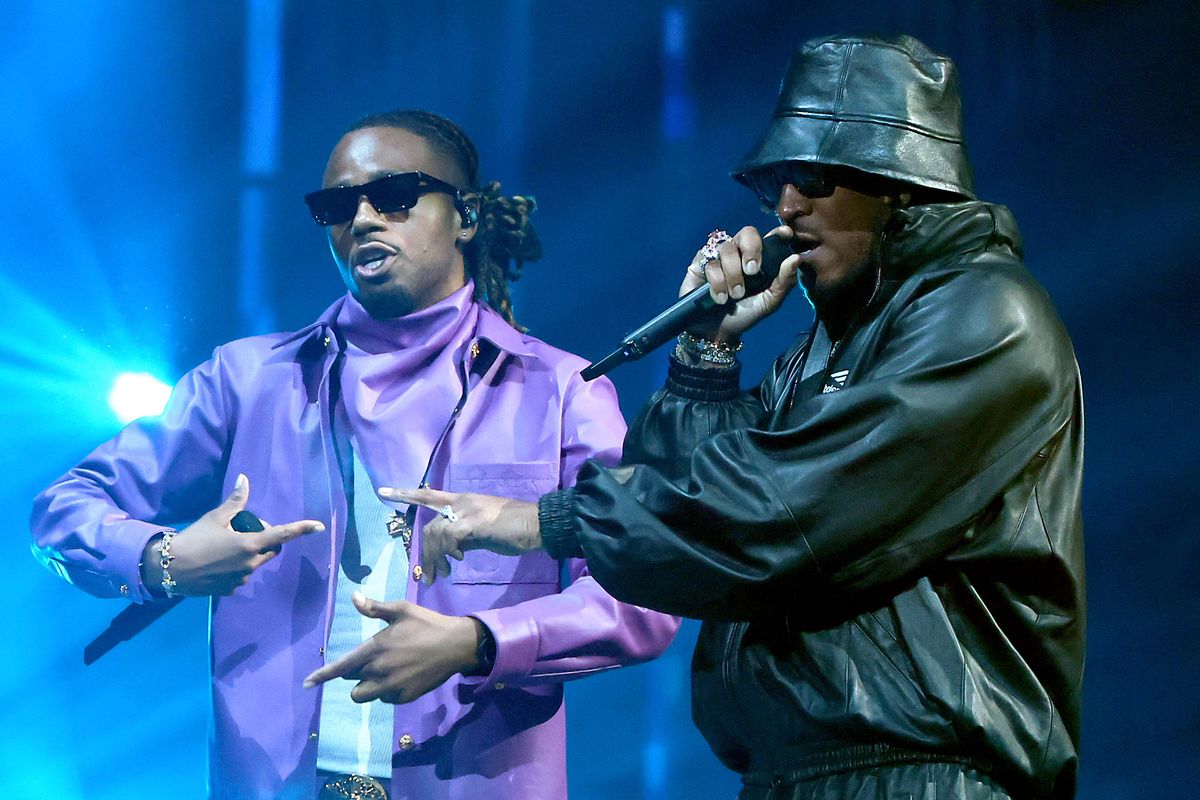

As of this writing, it has been over two days since Future and Metro Boomin dropped their first full-length collaboration, We Don’t Trust You, and it has almost been completely overshadowed by a Kendrick Lamar cameo. The track on which he appears, “Like That,” prominently features Rodney O and Joe Cooley’s 1987 single “Everlasting Bass,” and Metro uses it like Three 6 Mafia did throughout their discography, from “Where Da Bud At” to “Who the Crunkest.” Thanks in part to the Mafia, “Everlasting Bass” has become an avatar of Jheri-curled hardness, and an ominous allusion to the predations of the crack era. Metro summons the vibe while blending in Michel’le’s nursery line from Eazy-E’s “Eazy-Duz-It,” to boot. “Muthafuck the Big 3/It’s just big me!” charges Lamar, apparently calling out rivals Drake and J Cole as well as referencing Ice Cube’s Big 3 basketball circuit.
The ripple effects of Lamar’s “Like That” verse have galvanized rap fans, inspired too many social-media explainers on his references — the shoutout to E-40 and The Click, Melle Mel, and Prince (“Nigga, Prince outlived Mike Jack[son]”) — the 6 God’s beleaguered fan base to rally around him, and led Drake himself to make a defensive, albeit vague remark during a concert in Sunrise, Florida. Suddenly, it’s 2013 again, with Lamar kicking over the Round Table just as he once did on Big Sean’s “Control.” But in 2024, the stakes seem much lower. Both Lamar and Drake are in the mid-thirties, with their aesthetic contrasts firmly well established. A decade ago, the two seemed representative of different paths mainstream rap could take; now, they’re just maintaining empires. Any ensuing lyrical dispute, whether it’s more of the “sneak dissin’” the two have engaged in for years or a full-on rap battle, will feel more akin to Lebron vs. Curry in the play-in tournament, not the championship.
Thankfully, that can’t be said for Metro Boomin, who has embraced maximalist, cinematic gestures in an era when the genre feels too niche, too reducible to TikTok clips and 15-minute-long EPs. Unlike Heroes and Villains, his solid albeit portentous effort from 2022, We Don’t Trust You doesn’t come packed with Morgan Freeman as the voice of God. However, the St. Louis-born, Atlanta-based producer culls heavily from several snippets of a boisterously entertaining Prodigy interview where the late Queensbridge rapper called out his competition. “We the professionals, son! We professionals at what we do! Like, cut it out!” Prodigy roars in a clip inserted at the beginning of “Claustrophobic.”
All of Metro’s symphonic textures — the spooky tones of “Ice Attack,” his sampling of Mobb Deep’s “Quiet Storm” on “Seen It All” — offer opportunity for a compelling leading man to weave magic. On that level, Future is only intermittently successful. The Atlanta rapper’s mannered, free-associative delivery doesn’t naturally yield the kind of electric sparks that Lamar generates on “Like That.” And unlike Playboi Carti, whose strangely hoarse cameo on “Type Shit” will continue to fuel debate around his increasingly weird style, Future doesn’t attempt any major creative shifts on We Don’t Trust You. He remains a rapper-singer who burrows into tracks as he conveys his reality of sensual delights and opiate-numbed paranoia. Love it or hate it, he’s going to give you a lot of bars about drinking codeine and serving amphetamines. He may not rise to Toxic King levels here, but he’s still got “these regular hoes/I got superstar hoes/Taking pictures of me like a Fed” on “Young Metro.”
Future serves as the eye at the center of the storm as Metro orchestrates a whirlwind of old-school verisimilitude, guest appearances from the likes of Rick Ross and Travis Scott, and haughty, post-platinum angst reminiscent of Missy Elliot’s attack against her haters on Da Real World. The Atlanta rapper offers a notably strong chorus on “Running Out of Time,” and bounces energetically on “Fried (She a Vibe).” But his performances on tracks like “GTA” and “Ain’t No Love” sound dreary. We Don’t Trust You feels longer than its hour runtime, despite several decent cuts. The album isn’t bad: Metro remains a fascinating producer, and Future manages to hold his own despite his well-worn tics. But it only takes a single Lamar verse to show what the game’s been missing.





Jack White Responds After Uproar Over Taylor Swift Songwriting Comment
This is why we can’t have nice things.
Jack White posted a statement on Instagram Monday evening after numerous publications took his comments in an interview with The Guardian out of context. When discussing poetry and songwriting, White mentioned fellow musician Taylor Swift‘s style of songwriting, and explored his own approach to storytelling when creating music. Unfortunately, online outlets framed his words as a critique of the Tortured Poets star, especially when it came to headlines that quickly circulated on the internet.
“Putting this up for a day and then taking down to just put this to bed,” wrote White in the since-deleted post. “I didn’t say that I think Taylor Swift’s music was ‘boring’ or whatever click bait the net is trying to scrape together. What I was trying to say in an interview I did about poetry and lyric writing, was that I don’t find it interesting at all for ME to write about MYSELF in my own lyric writing and poetry because I think that it could be repetitive for ME to always write about and It could be uninteresting for people who listen to my music to delve into, and that imaginary characters are more attractive to me as a writer.”
White went on to acknowledge the “tremendous success” of Swift and other songwriters who have their own process, while stating that just “because I say I have a way of doing things doesn’t mean that I think that EVERYONE should do it the same way.” He added, “They should do what works for them, And they do, and it is obviously appealing to many people, and I’m glad to hear that.”
When asked by The Guardian in the article published Sunday, if any of any of his songs were entirely autobiographical, White replied, “Not too much. Now it’s become very popular in the Taylor Swift way of pop singers writing about all of their publicly aired break-ups, which I don’t find interesting at all. I think it’s a little bit boring for me to write about myself.”
White further explained, “Even if I’ve had a really interesting day, I feel like I’ve already lived that, I don’t need to go through it every time I sing this song. If it’s something really painful, I’m not going to put this important, painful thing that I went through out there for some idiot on the internet to stomp all over. So I put a percentage of that into what I do and then morph it into somebody else’s character. I can’t really learn about myself until I put it into somebody else’s shoes.”
Editor’s picks
The 250 Greatest Albums of the 21st Century So Far
The 100 Best TV Episodes of All Time
The 500 Greatest Albums of All Time
100 Best Movies of the 21st Century
In his Monday statement, the Rock and Roll Hall of Fame inductee said that at times he has been “made less and less interested in doing interviews” amid the “age of this massive demand for click bait and content.” Any “scrape of anything interesting” can be used as drama and “spit out as bait,” he continued, leading White to “not want to answer questions with any sort of romance or passion or reflection as I’m too busy having to worry about accidentally triggering nonsense like this from so called ‘journalists’ and ‘editors.'”
Trending Stories
Jack White Responds After Uproar Over Taylor Swift Songwriting Comment
Watch Hilary Duff's Intimate Performance of 'Roommates' on 'Fallon'
Rihanna Shooting Suspect Held for Attempted Murder on $10.2 Million Bail
Amy Klobuchar Slams Live Nation Settlement: 'Every Sign Points to a Backroom Deal'
He ended his response to the wave of backlash following his interview by saying, “This has always been a problem as it encourages artists to give ‘safe’ answers to any question and stifles artistic vision and imagination and pushes all of us to not share anything interesting, which was one of the points I made about keeping private things private in that same interview. But yeah, content.”
ADVERTISEMENTWhite recently released Jack White: Collected Lyrics & Selected Writing Volume 1, a collection of lyrics from the artist’s solo recordings including No Name, The Raconteurs, and more, plus selected poems and writings by White, and essays by poet Adrian Matejka.