
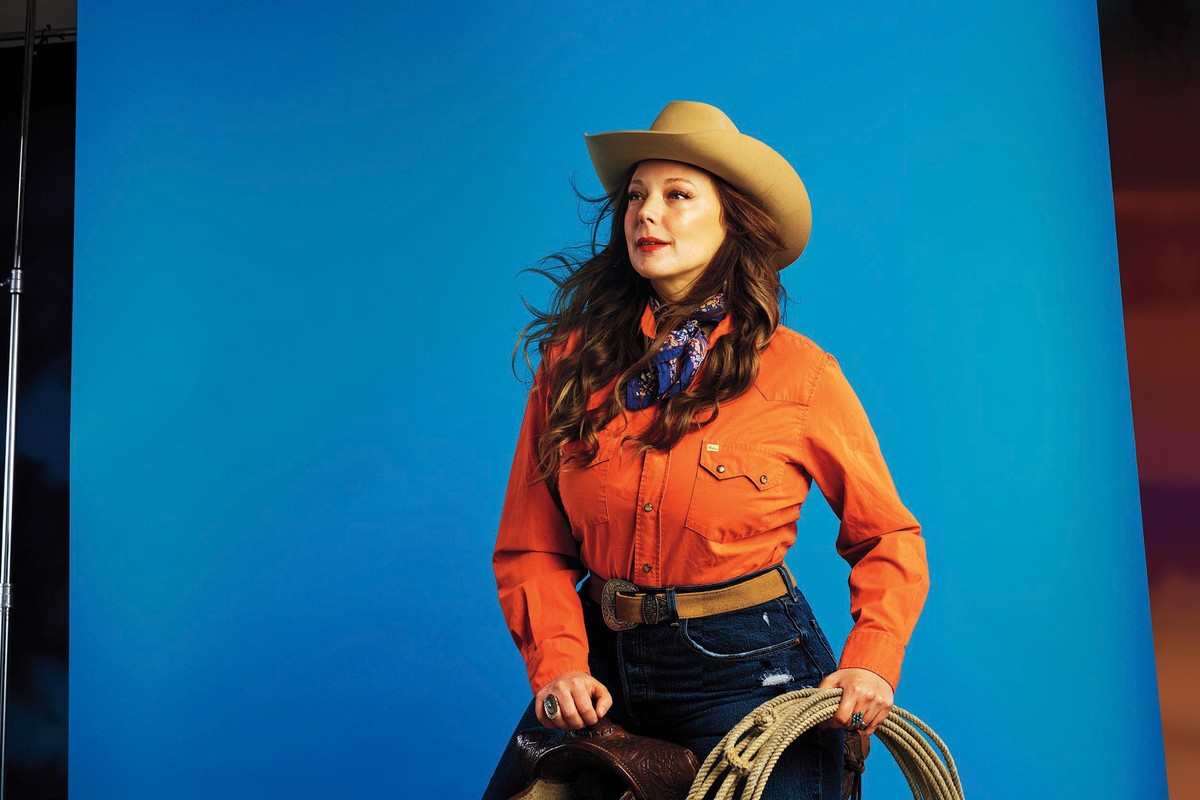

KAITLIN BUTTS IS SITTING IN an East Nashville coffee shop, wondering if she should tell Vince Gill that “Come Rest Your Head on My Pillow,” their romantic duet from her new album, Roadrunner!, was actually inspired by a woman in a funny but slightly crude tank top.
“It had ‘cowboy pillows’ written across her chest,” she says, laughing quietly and pulling her cow-print jacket up to her face like a privacy screen. Butts had been wandering around after her set at the Two Step Inn Festival in Texas when she spotted the shirt — a festival where she was beckoned back onstage for an encore with rowdy chants of “We want Butts!” She jotted down the phrase “cowboy pillows” in her phone, and eventually worked up a tender love song about a woman providing comfort (or a soft place to rest) to a man. She thinks Gill would appreciate the backstory, however impolite: They’re both from Oklahoma, born of a songwriting tradition that, as she puts it, embraces “an unrefined edge” and a little real-life humor.
“It’s nothing I’ve ever been able to put my finger on,” Butts says, sitting cross-legged on a couch in black leggings and running shoes, her long red hair tossed to the side. “But I can feel an Oklahoma artist when I’m listening to one.”
Though she’s a new name to many, Butts is establishing herself as one of the most dynamic artists to grow out of the Oklahoma Red Dirt scene, unafraid to test boundaries for which the regional (and male-dominated) sub-genre is known. Her 2022 sophomore album found her fiercely fighting for a reclamation of power for her characters and herself, wading through domestic violence, addiction, and family trauma. Since then, she’s covered Kesha’s “Hunt You Down,” released a disco remix of Shania Twain’s “That Don’t Impress Me Much,” made a music video with drag queens, and created Roadrunner!, out June 28th via Soundly Music, which is a 17-track modern redo of Butts’ favorite musical, Oklahoma!.
Butts may still exude Oklahoma, but she’s lived in Nashville since 2019, in a house by the park with her husband Cleto Cordero, frontman of the Texas-bred band Flatland Cavalry. It’s a rare instance when they’re both off the road, which means days on the couch under a weighted blanket and nights at a local lesbian bar for karaoke. (Her go-to is “I Don’t Want to Miss a Thing” by Aerosmith.) Sometimes she and Cordero consult their list of “normal people things,” which includes going to Sam’s Club on sample day. Such mundane activities are a balm when you’ve spent the past decade singing “sad yeehaw country about generational trauma” in any honky-tonk that’ll allow it.
Roadrunner! meets Butts at the intersection of everything she’s ever loved: musicals, country, and her home state. And it lets her lean into the theatricality and drama she’s always sprinkled into her persona and live show, where the costumes are fringed to the heavens and her huge voice fills the room even on the gloomiest songs.
That theatricality, though, is everything that the Red Dirt genre isn’t stereotypically known for. Generally referring to the songwriting scene that grew out of Stillwater, Oklahoma, in the Seventies into Texas and now encompasses a certain kind of roots, country, and rock amalgam that includes pioneers like Bob Childers and Cross Canadian Ragweed, it’s also getting a national platform. Oklahoma boy Zach Bryan sells out stadiums, while bands like Turnpike Troubadours are crossing beyond state lines into the mainstream. “It’s cool to see these artists have a bigger moment,” says Butts, poised to be next in line.
Dierks Bentley, with whom Butts is touring this summer, agrees. “When I first started out, I spent a lot of time touring with artists in the Red Dirt scene,” Bentley says. “They have a spirit and passion for authentic storytelling that rivals anyone out there. I’m really drawn to those artists and Kaitlin fits right in. I love her voice, and her lyrics are just raw and honest. She adds a little extra dash of Oklahoma honky-tonk.”
Butts has always checked as many Red Dirt boxes as she defied. She was born in Tulsa, but didn’t grow up listening exclusively to country music. She didn’t even live on rural land until she and her post-divorce mother moved into a farmhouse, where they bought donkeys because they were “feeling manic.” She drove a Lexus, not a truck. And she was a supremely gifted musical theater kid, who went to see a local production of Oklahoma! every summer. Looking back, she finds more synchronicity between the worlds than she realized.
“There’s so much shared between country and musical theater,” Butts says. “There’s great songwriting, there’s emotion, there’s humor, there’s witty one-liners. There’s murder! All those things have made me the performer I am.”
The switch from musical theater to country music came during a show by the Wreckers, the country duo of Michelle Branch and Jessica Harp that released one album in 2006. “It wasn’t poppy stuff,” she says, remembering how she was awestruck by the two women, wielding instruments and singing country songs that weren’t danceable or happy, but just told the truth. “It was just pivotal.” She picked up the guitar and began writing her own music soon after. It’s a moment she later referenced in her acceptance speech for “Best Honkytonk Female” at the Ameripolitan Awards in February. “As soon as I saw them, I knew that was what I wanted to be,” she told the crowd. “And I believe that if you can see it, you can be it.”
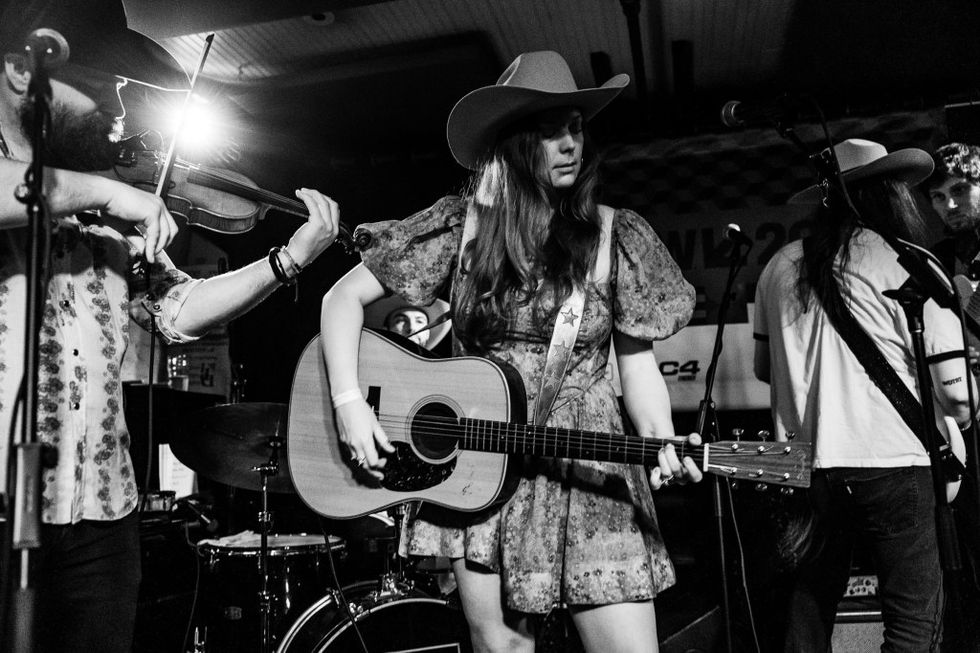
BUTTS WENT TO Oklahoma City’s Academy of Contemporary Music as the only country-focused artist in her class, so the school started sending her to gigs in Stillwater. It was a steep and fast learning curve to acclimate herself with the historic local scene. “I had no idea about the Red Dirt community,” she says. She remembers turning to her mother to help fill in the blanks. “She told me about Mike McClure and Randy Rogers and Stoney LaRue.”
Though the scene wasn’t exactly hospitable to women, she did find kinship in the close-knit community that remains to this day. Recently, Cordero and Butts hosted rising Red Dirt star Wyatt Flores at their Nashville home, after he canceled some shows to look out for his mental health. She sent him a care package of vitamins, one of her beloved weighted blankets, and some other items to help relax when he’s off the road. The surge in popularity for Red Dirt music has left a lot of musicians burnt out and exhausted, with someone like Flores going from anonymity to playing sold-out rooms in a matter of months. “I’m fully schooling him on how to take care of himself,” Butts says.
Most recently, she’s been worried about Lainey Wilson, wondering if the rapid rise of her career has left her any time for self-care. She tears up talking about it, especially thinking of all the extra hours Wilson puts in to make it in a genre that barely allows one female star at a time. “She’s just an incredible singer and writer,” Butts says, wiping her eyes and the accompanying mascara. “It’s just hard to see how much harder she has had to work.”
Butts, who has been fighting to be heard on the Red Dirt and country scenes for over a decade, would know. She released her first album, Same Hell, Different Devil, in 2015, and then took a seven-year pause before What Else Can She Do. It was a gap heavily weighted by trauma. Her parents divorced, and she and her mother moved into her grandmother’s garage to escape the often tense fallout. Domestic violence and substance abuse were just things that she and her loved ones lived, and so she turned it all into music. “Going to the courthouse, my mom would come out shaking,” she says. “It was really uncertain times, and all the songs came from that.”
What Else Can She Do is at times heartbreaking and serious, but never without a little sly humor or a flair for the theatrical. For the title track’s music video, which dropped just before legislation aimed at criminalizing drag was proposed in Tennessee, Butts recruited Texas-based drag queen Paris Van Cartier to star as a waitress. She wasn’t trying to make it political, but she didn’t mind if anyone took it that way. “At the time, I was just trying to think of the most glamorous person I knew,” Butts says.
Butts grew up around the queer community: Her acting and tap teachers were a married gay couple who were also best friends with her mom. “It’s been normal since I was five years old,” she says. “They’re the people who built me up, or told me when I was being sloppy.”
Country music, and the Red Dirt scene, was the opposite of the inclusive environment she found in musical theater. Butts realized this early on watching Shut Up and Sing, the 2006 documentary about the Chicks, and was initially nervous about wading into political waters. Eventually she felt inspired by artists like Kacey Musgraves who found a way to make the music they loved without sacrificing their point of view.
“I think we’re in a different age now,” she says. “And when someone doesn’t believe in the core principles of who I am, which is really that we’re all equal human beings, then you can see yourself out the door. I want people to feel welcome at my shows, and at country shows. I want my gay friends to be able to kiss and dance, because there are shows they can’t even go to and hold hands.”
Roadrunner! is sure to widen her platform. The idea came to Butts in the boredom of quarantine, when she and Cordero decided to watch some musicals — he’d never seen one, let alone Rodgers and Hammerstein’s Oklahoma!, his wife’s favorite. Roadrunner! is not a song-by-song response to Oklahoma!, but each track does correspond to a certain plot point or pivotal moment in the story. True to Butts’ approach, the songs flip the classic tale of small-town love into one where the women are “liberated and hitting on guys” instead of waiting for their attention, and fighting for their own independence. Or, in the case of that Gill duet, being the dominant caretaker instead of the other way around.
Butts’ version of Kesha’s “Hunt You Down” fit right in. Her Oklahoma snarl is perfect when she mischievously coos the words, “I love you so much, don’t make me kill you!” Butts recruited Cordero for a campy music video in which they play a couple with a light chance of murder. Butts loves Kesha, and pop in general, and Taylor Swift is on constant rotation at home. Plus, “[Kesha] is so frickin’ country,” Butts says.
Covering Kesha was also the perfect way to venture into new waters, and appeal to crowds outside of the country music sphere. This summer, she’s playing Lollapalooza, and she’s not worried about whether her music stays neatly in a Red Dirt box. Like the soil it’s named for, she views the genre as a place to bloom from instead of being endlessly rooted.
“I don’t ever want to be the kind of artist where people can nail me down,” Butts says before heading home to pack for a long van trip down to Texas. “Red Dirt is where I learned the basics of storytelling. But I want to be unpredictable.”
This story is part of Country’s New Cowboy Era, a look at trends in country music that’s running in Rolling Stone’s May print issue.

As Trump Dithers, Ukraine War Is Approaching a ‘Fatal Point of No Return’