
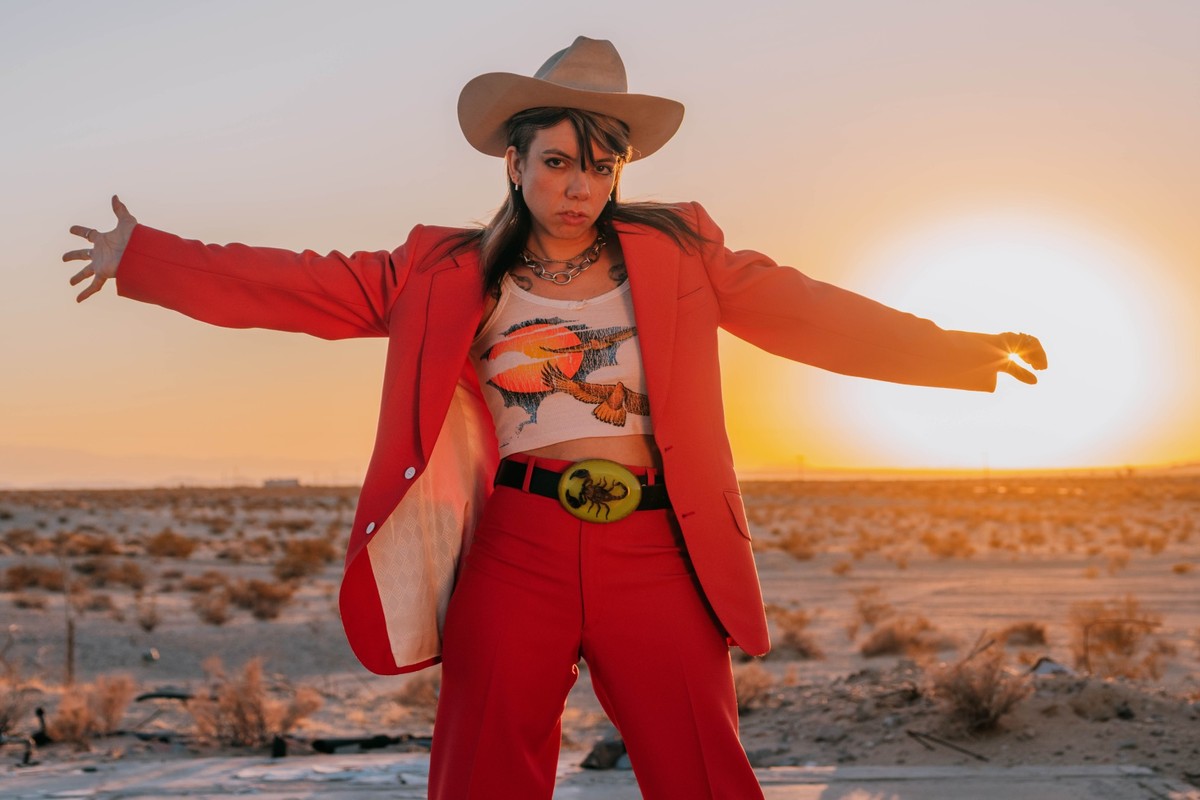

One week before Alynda Segarra’s father died, he mailed them a package. It was a box of all the music Segarra had sent him over the span of nearly 20 years, ever since they’d left their childhood home in the Bronx to travel the country. Everything they’d recorded, from burned CDs for street and jazz bands they’d played in, to records from Segarra’s own band of more than a decade, Hurray for the Riff Raff, was in there.
“He had absolutely every single thing I’d given him since, like, 2006, maybe even earlier,” says Segarra, who uses they/them pronouns, over a Zoom call from their home in New Orleans. “I guess he was cleaning up his apartment, and he mailed it to me. And now I’m like, damn, I’m so lucky I have this.”
Segarra was due to enter the studio in less than a month to record Hurray for the Riff Raff’s next album, The Past Is Still Alive, when their father, Jose — a musician and music teacher — died suddenly in the winter of 2023. “I felt so scared. I felt like I was going on a fucking rollercoaster,” Segarra admits. “[But] I was so grateful to have a project. I felt like it was a gift from my dad.”
As a result, the songs on The Past Is Still Alive, out now, took on a new meaning for the 36-year-old. Rather than the big-picture concepts that fueled their previous two records, The Navigator and Life on Earth, the album is a laser-focused reflection on personal relationships. What Segarra hadn’t perceived until Jose’s death was that it was also a tribute to the many friends they’d lost over the years — be it to drugs, to tragic accidents, or simply falling out of touch.
“I realized that so many of these songs are about saying goodbye and letting go, while also deciding, like, how do I do that?” Segarra says. “Like, what do you let go of? What do you carry?”
Hurray for the Riff Raff’s songs have long chronicled the lives of those on the fringes, building alternate histories around their stories, and often mourned those whose stories got cut short. But this time it hits differently. “I’ve never experienced grief like this,” Segarra acknowledges, “so something I’ve noticed is it’s made me be like, damn, is the rest of my life just gonna be super heavy goodbyes?”
The Past Is Still Alive doesn’t get lost in those grim revelations, even as it stares down the darkest corners of its grief. Segarra’s writing has a fresh urgency, a directness that’s enhanced by the upbeat, singsong melodies — a stripped-down return to the band’s folk roots. People and places, from the swamplands of Florida to the bookstores of San Francisco, flash by in a swirl of color and energy, even when the action takes place against the backdrop of the apocalypse, as it does on grand finale “Ogallala.” When they chant in that song’s teetering crescendo, “I made it right on time to watch the world burn,” it’s an invocation not of annihilation but possibilities.
Yet, the most devastating moments operate on a smaller scale. “You don’t have to die if you don’t want to die,” Segarra implores on the album opener, “Alibi,” a song about the moment they realized a childhood friend was addicted to heroin. “It’s straight-up just being like, how do I possibly convince the listener that they deserve to live?” Segarra says. They let the question linger momentarily, their eyes wide with concern. “And also recognizing I can’t convince somebody of that. Or the only person I can actually convince is myself.”
Like many other songs on the record, “Alibi” is rich with detail from Segarra’s life — in this case, growing up in New York City and attending marches against the Iraq War. Elsewhere, “Colossus of Roads” takes its name from a real-life boxcar artist, while “Hawkmoon” features as its main character the extravagant Miss Jonathan, the first transgender woman Segarra met. “It’s my way of trying to create this memorial to her, even though I don’t even know where she is,” Segarra says.
The details of Segarra’s life are part of Hurray for the Riff Raff’s lore. Raised by their aunt and uncle after their parents split up, they ran away from home at age 17, hopping train cars, living on the streets, and eventually finding safe harbor in New Orleans. But until now, they haven’t felt comfortable delving into their past in song. The pandemic changed that. “I was like, damn, this shit could all be over. My career could be over,” Segarra says.
Releasing Life on Earth, which dealt with issues like sexual abuse and the border and climate crises, in 2022, and then returning to touring, brought that internal conflict to an inflection point. “I felt really raw,” says Segarra. “And I felt like, well, I had this big, ambitious idea, and now I’m kind of out of big, ambitious ideas. All I have are these feelings and these memories, and this confusion and longing about how to live life.”
Segarra began writing The Past Is Still Alive while on the road in summer 2022 with Bright Eyes, whose front man, Conor Oberst, makes an appearance on “The World Is Dangerous.” Their frustrations with the state of the world became palpable. On “Colossus of Roads,” the singer, lamenting yet another mass shooting — in this case, the one at Club Q, a gay bar in Colorado Springs, in November 2022 — argues for the collapse of the American political system.
“With past albums, I felt this pressure to be very hopeful, and to give people hope, and it started to really make me uncomfortable,” Segarra says. “I wanted to free myself of that role, and say that things are gonna have to fall apart for us to build something new.”
A similar catharsis was necessary when it came to confronting Segarra’s past selves. “Hourglass,” the starkest song on the record, lays bare many of their insecurities, from being a high-school dropout to, at times, homeless. Segarra credits their producer, Brad Cook, with convincing them it was even worthy of being a song. “I think it was mostly me being nervous about being that for real,” Segarra concedes. “It’s not even that poetic. It’s just me being, like, ‘I used to eat garbage. I’m surrounded by a lot of music school kids, and I feel like I’m an alien.'”
One of the biggest breakthroughs for Segarra was finally becoming comfortable with their own identity. Being queer, being a woman in the music industry, being a Puerto Rican American but not a native Puerto Rican — they’d never fully felt like they fit in anywhere. Coming out as nonbiary prior to Life on Earth‘s release provided a means of reconciliation. Segarra says it still makes them emotional to think about.
“It’s had a huge impact on looking back on younger me, and being like, ‘Oh, yeah, I’ve always been like this,'” Segarra says. “But then I just felt like I had to button up, and try to look presentable, and try to do all this stuff that felt really foreign to me. And I felt like I kept failing.”
Segarra explores those struggles touchingly on “Snake Plant (The Past Is Still Alive),” the incandescent coming-of-age tale that forms the emotional core of the album. In it, they articulate the conflicted sense of obligation they felt toward their father, wanting to “be a good daughter” despite being “born with a baby boy soul.” Segarra describes Jose as a “hilarious dad,” who taught them to play music as a child and had a freethinking outlook. “It’s such a lucky thing to have an outsider dad,” Segarra says.
It wasn’t always easy to appreciate the similarities the two shared. Jose, a Marine who served in the Vietnam War, went decades with undiagnosed PTSD, so Segarra was only able to visit with him growing up. Eventually, he sought treatment. “Then he really took the time to repair our relationship,” Segarra says, including writing them letters after they’d settled in New Orleans. “And he really started to treat me like an equal.”
Now, those letters, along with the box of music Jose sent before his death, are among the artifacts Segarra has to hold onto. So are the voice memos they saved from him, a handful of which are included as the final word on The Past Is Still Alive. The roller-coaster ride hasn’t stopped, but Segarra’s learned to appreciate that their grief, too, is an expression of love.
“It was a really special relationship. And even though it’s super fucking hard,” Segarra says, biting off each word for emphasis, “it’s also, like, I do feel like he’s with me, and I feel like our love transcends time and space. You know? So I’m trying to learn to be at peace with that.”


Jack White Responds After Uproar Over Taylor Swift Songwriting Comment
This is why we can’t have nice things.
Jack White posted a statement on Instagram Monday evening after numerous publications took his comments in an interview with The Guardian out of context. When discussing poetry and songwriting, White mentioned fellow musician Taylor Swift‘s style of songwriting, and explored his own approach to storytelling when creating music. Unfortunately, online outlets framed his words as a critique of the Tortured Poets star, especially when it came to headlines that quickly circulated on the internet.
“Putting this up for a day and then taking down to just put this to bed,” wrote White in the since-deleted post. “I didn’t say that I think Taylor Swift’s music was ‘boring’ or whatever click bait the net is trying to scrape together. What I was trying to say in an interview I did about poetry and lyric writing, was that I don’t find it interesting at all for ME to write about MYSELF in my own lyric writing and poetry because I think that it could be repetitive for ME to always write about and It could be uninteresting for people who listen to my music to delve into, and that imaginary characters are more attractive to me as a writer.”
White went on to acknowledge the “tremendous success” of Swift and other songwriters who have their own process, while stating that just “because I say I have a way of doing things doesn’t mean that I think that EVERYONE should do it the same way.” He added, “They should do what works for them, And they do, and it is obviously appealing to many people, and I’m glad to hear that.”
When asked by The Guardian in the article published Sunday, if any of any of his songs were entirely autobiographical, White replied, “Not too much. Now it’s become very popular in the Taylor Swift way of pop singers writing about all of their publicly aired break-ups, which I don’t find interesting at all. I think it’s a little bit boring for me to write about myself.”
White further explained, “Even if I’ve had a really interesting day, I feel like I’ve already lived that, I don’t need to go through it every time I sing this song. If it’s something really painful, I’m not going to put this important, painful thing that I went through out there for some idiot on the internet to stomp all over. So I put a percentage of that into what I do and then morph it into somebody else’s character. I can’t really learn about myself until I put it into somebody else’s shoes.”
Editor’s picks
The 250 Greatest Albums of the 21st Century So Far
The 100 Best TV Episodes of All Time
The 500 Greatest Albums of All Time
100 Best Movies of the 21st Century
In his Monday statement, the Rock and Roll Hall of Fame inductee said that at times he has been “made less and less interested in doing interviews” amid the “age of this massive demand for click bait and content.” Any “scrape of anything interesting” can be used as drama and “spit out as bait,” he continued, leading White to “not want to answer questions with any sort of romance or passion or reflection as I’m too busy having to worry about accidentally triggering nonsense like this from so called ‘journalists’ and ‘editors.'”
Trending Stories
Jack White Responds After Uproar Over Taylor Swift Songwriting Comment
Watch Hilary Duff's Intimate Performance of 'Roommates' on 'Fallon'
Rihanna Shooting Suspect Held for Attempted Murder on $10.2 Million Bail
Amy Klobuchar Slams Live Nation Settlement: 'Every Sign Points to a Backroom Deal'
He ended his response to the wave of backlash following his interview by saying, “This has always been a problem as it encourages artists to give ‘safe’ answers to any question and stifles artistic vision and imagination and pushes all of us to not share anything interesting, which was one of the points I made about keeping private things private in that same interview. But yeah, content.”
ADVERTISEMENTWhite recently released Jack White: Collected Lyrics & Selected Writing Volume 1, a collection of lyrics from the artist’s solo recordings including No Name, The Raconteurs, and more, plus selected poems and writings by White, and essays by poet Adrian Matejka.