
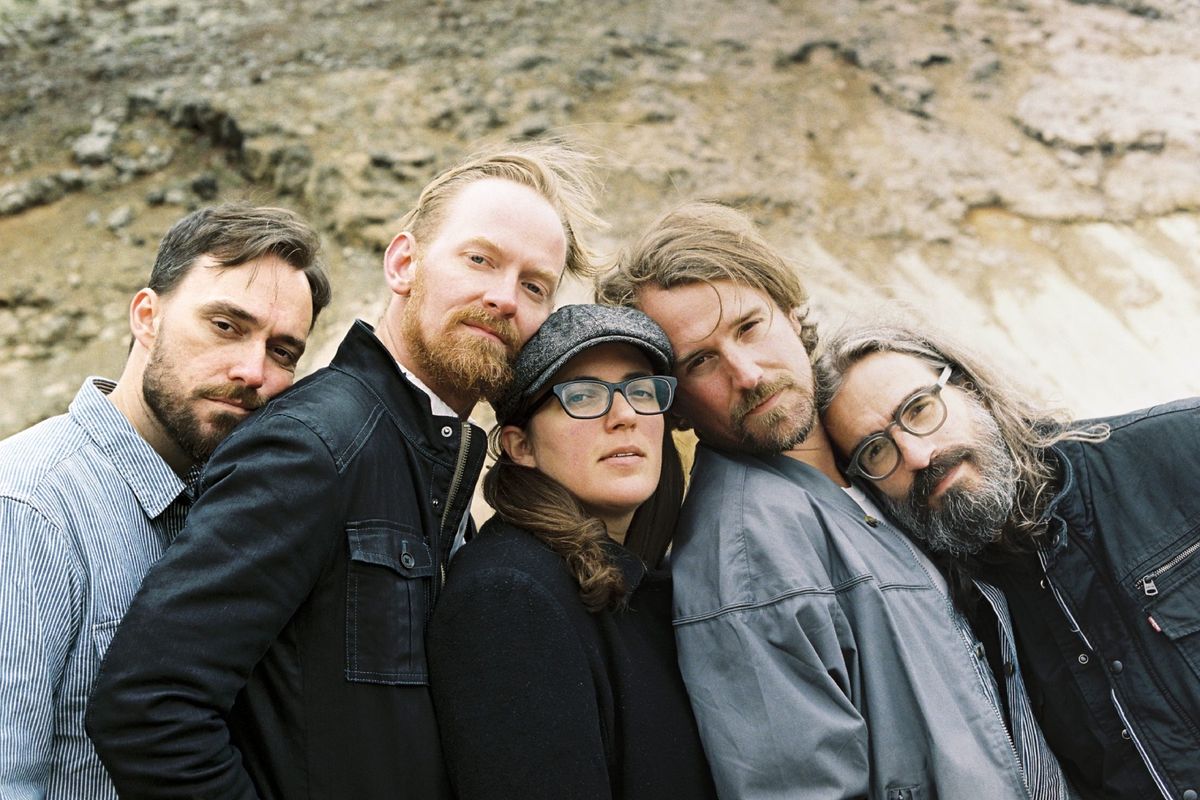

Before the three founding members of Fruition had their first face-to-face encounter after the Covid-19 pandemic, they weren’t sure what the future held for their band. The Portland Americana act were inseparable for more than a decade, but when lockdowns started they didn’t see each other for more than a year. It could’ve all been over.
“There were definitely moments where you just question everything that you’ve done in your life and [ask], ‘Is this a band? Are we done?'” says singer and guitarist Jay Cobb Anderson over a Zoom call with his co-songwriters and lead vocalists, Mimi Naja and Kellen Asebroek. “You know, we’ve been a band for a long time. Do we have anything else to say?”
Meeting up to jam on a friend’s farm in Oregon in June 2021 put all those fears to rest. “The moment we all got back together again and played music together again, I was like, ‘Oh, man, there’s the magic. It’s still there,'” Anderson says. “There’s definitely more to be said and more to be done.”
The band’s new album, How to Make Mistakes, out today, is both a marker of the growth that all five members have experienced in the past four years and a return to Fruition’s harmony-laden roots as a group of scrappy buskers on the streets of Portland. During their time apart, they’d gotten married, become parents, gone to rehab. But, above all, they’d learned to have fun playing music again.
“We’d really achieved a lot of benchmarks: We were making a living out of it; we’d played Red Rocks; we were on tour,” Asebroek, who, like Naja, is a multi-instrumentalist, recalls of the band’s fortunes prior to the pandemic. “But no matter how much we grinded, we were always doing just that: we were fucking grinding.”
It didn’t help that, throughout 2019, the band had begun dispersing across the country. Anderson left for Seattle, Naja to Atlanta. Even their drummer, Tyler Thompson, and bassist, Jeff Leonard, relocated to the East coast. Only Asebroek stayed in Portland. “We had to really fight to stay connected,” Asebroek says.
Their lives took equally divergent paths in the intervening months. While Thompson and Leonard both became fathers, and Anderson was married, Naja got sober. “I went to rehab three-and-a-half weeks into lockdown after, like, my darkest, darkest time,” she says. “And, yeah, it’s the best thing that could have happened to me, both personally and as a band member being able to sustain the touring lifestyle.”
Like so many of their peers, Fruition felt they’d had real momentum going when the pandemic hit. “Dawn,” their most recent single, had gotten airplay on Triple A radio, and they noticed a new influx of fans showing up to their shows. All the same, they’d felt like they’d gotten boxed in.
“We were kind of in this jamgrass scene for some reason that we still don’t fully understand,” Naja says. “And they nurtured us and supported us, but we don’t jam and we don’t play bluegrass. So we really wanted to take this opportunity to present ourselves in a way that we feel like we should be heard.”
That, to their ears, was Americana. They dropped the rock elements that crept in on recent albums — which, they admit, was a conscious effort to differentiate themselves from bluegrass — and focused on plugging back in to one another. For their first run of shows in the summer of 2021, they toured as an acoustic trio, just like when they started 13 years prior.
When it came time to record How to Make Mistakes, the key was that they did everything live in the studio, with no overdubs. In all, they cut 17 songs in seven days, 13 of which made it onto the record. “Part of that was just hit the songs. Go for it, get as many takes as we can of one song, move on to the next thing,” Anderson recalls. “It was just kind of a way to get the ball rolling.”
The sentiment of the album’s title was one the band embraced in the music itself — nothing left hidden, blemishes and all. Loosening that grip on control helped bring them closer together, too. Until now, Anderson, Naja, and Asebroek always came up with their songs independently and brought them to the group. This time, they opted to cowrite.
“It’s always been a very personal thing for each songwriter, and we decided to bust out of that a little bit,” Anderson says. “We had some hard conversations… But, essentially, us getting all together and trying to write together and being more vulnerable with each other made us so much stronger.”
All three agree that “Made to Break,” a line from which lent the album its name, became the cornerstone of this new collection. But that song’s gently cooing harmonies aren’t all How to Make Mistakes has to offer. From the music hall jaunt of “Can You Tell Me” to shimmering hope of “Scars” to the woozy whistles and pedal steel of “Lonely Work,” there’s a brittle wisdom on this album, a sense of having to piece oneself back together and finding strength in a shared voice.
“We’ve just tried to let go of caring what people think this music is and are just writing the songs and making the art that our heart wants to write and make,” Asebroek says. In that sense, the time that Fruition spent apart may well have done them a favor. Rather than hitting the end of the road, they’re convinced that they’re just getting started.
“We really feel like the years leading up the pandemic were the first level of this game, kind of like the training level,” Asebroek adds. “And now we’re in the open world, doing the thing.”






Jack White Responds After Uproar Over Taylor Swift Songwriting Comment
This is why we can’t have nice things.
Jack White posted a statement on Instagram Monday evening after numerous publications took his comments in an interview with The Guardian out of context. When discussing poetry and songwriting, White mentioned fellow musician Taylor Swift‘s style of songwriting, and explored his own approach to storytelling when creating music. Unfortunately, online outlets framed his words as a critique of the Tortured Poets star, especially when it came to headlines that quickly circulated on the internet.
“Putting this up for a day and then taking down to just put this to bed,” wrote White in the since-deleted post. “I didn’t say that I think Taylor Swift’s music was ‘boring’ or whatever click bait the net is trying to scrape together. What I was trying to say in an interview I did about poetry and lyric writing, was that I don’t find it interesting at all for ME to write about MYSELF in my own lyric writing and poetry because I think that it could be repetitive for ME to always write about and It could be uninteresting for people who listen to my music to delve into, and that imaginary characters are more attractive to me as a writer.”
White went on to acknowledge the “tremendous success” of Swift and other songwriters who have their own process, while stating that just “because I say I have a way of doing things doesn’t mean that I think that EVERYONE should do it the same way.” He added, “They should do what works for them, And they do, and it is obviously appealing to many people, and I’m glad to hear that.”
When asked by The Guardian in the article published Sunday, if any of any of his songs were entirely autobiographical, White replied, “Not too much. Now it’s become very popular in the Taylor Swift way of pop singers writing about all of their publicly aired break-ups, which I don’t find interesting at all. I think it’s a little bit boring for me to write about myself.”
White further explained, “Even if I’ve had a really interesting day, I feel like I’ve already lived that, I don’t need to go through it every time I sing this song. If it’s something really painful, I’m not going to put this important, painful thing that I went through out there for some idiot on the internet to stomp all over. So I put a percentage of that into what I do and then morph it into somebody else’s character. I can’t really learn about myself until I put it into somebody else’s shoes.”
Editor’s picks
The 250 Greatest Albums of the 21st Century So Far
The 100 Best TV Episodes of All Time
The 500 Greatest Albums of All Time
100 Best Movies of the 21st Century
In his Monday statement, the Rock and Roll Hall of Fame inductee said that at times he has been “made less and less interested in doing interviews” amid the “age of this massive demand for click bait and content.” Any “scrape of anything interesting” can be used as drama and “spit out as bait,” he continued, leading White to “not want to answer questions with any sort of romance or passion or reflection as I’m too busy having to worry about accidentally triggering nonsense like this from so called ‘journalists’ and ‘editors.'”
Trending Stories
Jack White Responds After Uproar Over Taylor Swift Songwriting Comment
Watch Hilary Duff's Intimate Performance of 'Roommates' on 'Fallon'
Rihanna Shooting Suspect Held for Attempted Murder on $10.2 Million Bail
Amy Klobuchar Slams Live Nation Settlement: 'Every Sign Points to a Backroom Deal'
He ended his response to the wave of backlash following his interview by saying, “This has always been a problem as it encourages artists to give ‘safe’ answers to any question and stifles artistic vision and imagination and pushes all of us to not share anything interesting, which was one of the points I made about keeping private things private in that same interview. But yeah, content.”
ADVERTISEMENTWhite recently released Jack White: Collected Lyrics & Selected Writing Volume 1, a collection of lyrics from the artist’s solo recordings including No Name, The Raconteurs, and more, plus selected poems and writings by White, and essays by poet Adrian Matejka.