
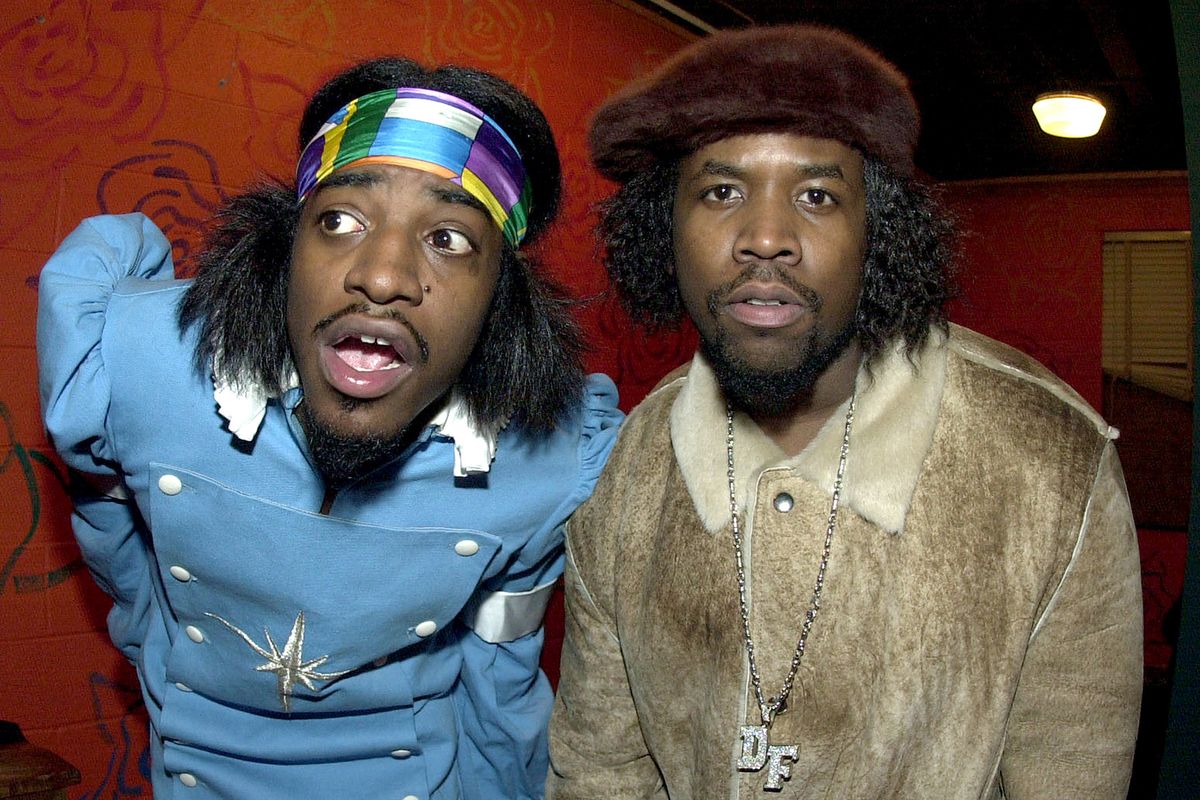

When OutKast dropped “Ms. Jackson” in the fall of 2000, the world was stunned. Nobody had ever heard a hip-hop song that sounded anything like this. But there’s never been anybody like OutKast before. The Atlanta duo, made up of Andre 3000 and Big Boi, brought their innovative hip-hop style to the pop charts with “Ms. Jackson,” from their album Stankonia. “Ms. Jackson” blew up into their first Number One hit, and it’s gone down in history as one of the group’s definitive classics. It comes in at Number 145 on Rolling Stone’s list of the 500 Greatest Songs of All Time.
Stankonia was OutKast’s fourth album, but the first one since their big commercial breakthrough with the 1998 blockbuster Aquemini, which made them superstars. Expectations were high. The first single from “Stankonia” was “B.O.B. (Bombs Over Baghdad),” a radically inventive Afro-futuristic behemoth that proved too much for radio to take. “B.O.B.” exploded out of the speakers with elements of gospel, rock, and drum-and-bass beats. For many fans, it still remains the peak of their jam-packed catalog. But it was too revolutionary to make it on the radio. “Ms. Jackson” sounded nothing like “B.O.B.,” yet the two songs had that same innovative spirit, breaking down different kinds of barriers. This time, the radio couldn’t resist. Nobody could.
“Ms. Jackson” sounded daringly confessional, with Andre 3000 sending a song out “to all the babymamas’ mamas’ mamas.” He addressed his real-life broken romance with Erykah Badu, and his strained relationship with her mother. “I’m sorry, Ms. Jackson, I am for real,” he sings to his ex’s mama. “Never meant to make your daughter cry / I apologize a trillion times.”
Andre was going for deep soul, writing the song on acoustic guitar before bringing in the beats. “Ms. Jackson” was so vulnerable and open, it made everything else on the radio sound a little half-hearted. He pledges to be there for their son as a father, but also mourns the evanscence of love, asking, “Forever? For-ever-ever? For-EVER-ever?” Big Boi comes in with a very different perspective on breaking up and moving on. The groove comes from a Seventies funk classic, “Strawberry Letter 23” by the Brothers Johnson. It sums up the independent spirit that Andre and Big Boi have always shared, whether together or alone, right up to Andre’s flute music and Big Boi’s owls.
“Ms. Jackson” became a universal smash, hitting Number One in February 2001. Everybody loved this song — even the real-life inspiration. “How did my mama feel?” Badu said on the Rap Radar podcast. “Baby, she bought herself a ‘Ms. Jackson’ license plate. She had the mug, she had the ink pen, she had the headband, everything. That’s who loved it.”
On this week’s episode of Rolling Stone’s 500 Greatest Songs, hosts Rob Sheffield and Brittany Spanos discuss “Ms. Jackson,” and how it fits into the long illustrious OutKast story. They’re joined by their brilliant Rolling Stone colleague Simon Vozick-Levinson as they break down this song, its timeless appeal and the mighty legacy of OutKast.
In 2004, Rolling Stone launched its 500 Greatest Songs of All Time list. Tabulated from a massive vote that had artists, industry figures, and critics weighing in, the list has been a source of conversation, inspiration, and controversy for two decades. It’s one of the most popular, influential, and argued-over features the magazine has ever done.
So we set out to make it even bigger, better, and fresher. In 2021, we completely overhauled our 500 Songs list, with a whole new batch of voters from all over the music map. Rolling Stone’s 500 Greatest Songs takes a closer look at the entries on our list. Made in partnership with iHeart, Rolling Stone’s 500 Greatest Songs finds Brittany and Rob discussing a new song each week, delving into its history and impact with the help of a special guest — including fellow RS colleagues, producers, and the artists themselves. It’s our celebration of the greatest songs ever made — and a breakdown of what makes them so great.
Check out the latest episode above, on iHeart, or wherever you get your podcasts, and look for new episodes every Wednesday.





Jack White Responds After Uproar Over Taylor Swift Songwriting Comment
This is why we can’t have nice things.
Jack White posted a statement on Instagram Monday evening after numerous publications took his comments in an interview with The Guardian out of context. When discussing poetry and songwriting, White mentioned fellow musician Taylor Swift‘s style of songwriting, and explored his own approach to storytelling when creating music. Unfortunately, online outlets framed his words as a critique of the Tortured Poets star, especially when it came to headlines that quickly circulated on the internet.
“Putting this up for a day and then taking down to just put this to bed,” wrote White in the since-deleted post. “I didn’t say that I think Taylor Swift’s music was ‘boring’ or whatever click bait the net is trying to scrape together. What I was trying to say in an interview I did about poetry and lyric writing, was that I don’t find it interesting at all for ME to write about MYSELF in my own lyric writing and poetry because I think that it could be repetitive for ME to always write about and It could be uninteresting for people who listen to my music to delve into, and that imaginary characters are more attractive to me as a writer.”
White went on to acknowledge the “tremendous success” of Swift and other songwriters who have their own process, while stating that just “because I say I have a way of doing things doesn’t mean that I think that EVERYONE should do it the same way.” He added, “They should do what works for them, And they do, and it is obviously appealing to many people, and I’m glad to hear that.”
When asked by The Guardian in the article published Sunday, if any of any of his songs were entirely autobiographical, White replied, “Not too much. Now it’s become very popular in the Taylor Swift way of pop singers writing about all of their publicly aired break-ups, which I don’t find interesting at all. I think it’s a little bit boring for me to write about myself.”
White further explained, “Even if I’ve had a really interesting day, I feel like I’ve already lived that, I don’t need to go through it every time I sing this song. If it’s something really painful, I’m not going to put this important, painful thing that I went through out there for some idiot on the internet to stomp all over. So I put a percentage of that into what I do and then morph it into somebody else’s character. I can’t really learn about myself until I put it into somebody else’s shoes.”
Editor’s picks
The 250 Greatest Albums of the 21st Century So Far
The 100 Best TV Episodes of All Time
The 500 Greatest Albums of All Time
100 Best Movies of the 21st Century
In his Monday statement, the Rock and Roll Hall of Fame inductee said that at times he has been “made less and less interested in doing interviews” amid the “age of this massive demand for click bait and content.” Any “scrape of anything interesting” can be used as drama and “spit out as bait,” he continued, leading White to “not want to answer questions with any sort of romance or passion or reflection as I’m too busy having to worry about accidentally triggering nonsense like this from so called ‘journalists’ and ‘editors.'”
Trending Stories
Jack White Responds After Uproar Over Taylor Swift Songwriting Comment
Watch Hilary Duff's Intimate Performance of 'Roommates' on 'Fallon'
Rihanna Shooting Suspect Held for Attempted Murder on $10.2 Million Bail
Amy Klobuchar Slams Live Nation Settlement: 'Every Sign Points to a Backroom Deal'
He ended his response to the wave of backlash following his interview by saying, “This has always been a problem as it encourages artists to give ‘safe’ answers to any question and stifles artistic vision and imagination and pushes all of us to not share anything interesting, which was one of the points I made about keeping private things private in that same interview. But yeah, content.”
ADVERTISEMENTWhite recently released Jack White: Collected Lyrics & Selected Writing Volume 1, a collection of lyrics from the artist’s solo recordings including No Name, The Raconteurs, and more, plus selected poems and writings by White, and essays by poet Adrian Matejka.