
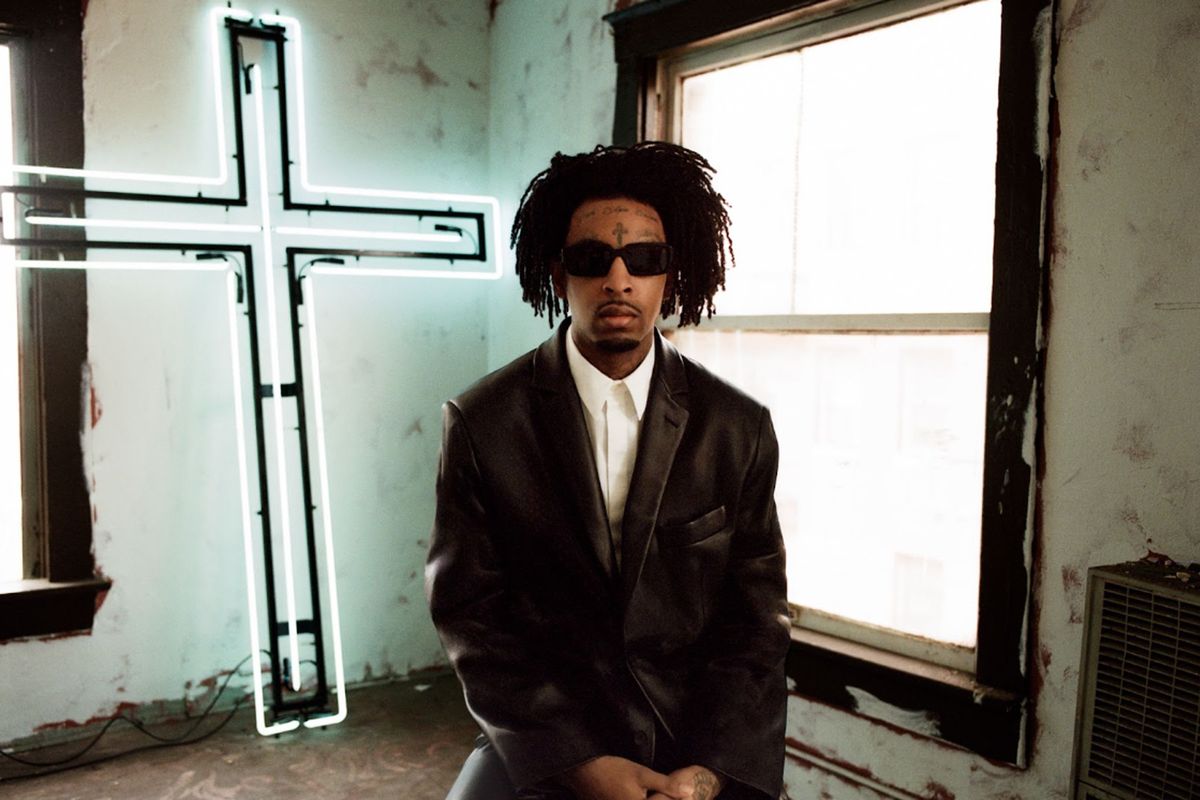

21 Savage’s third solo album, American Dream, begins with his mother, Heather Joseph, describing her family’s emigration from Britain to America during his childhood. “Every path that I walked was for my son,” she tells us. (Big Rube of Dungeon Family fame penned her introduction.) It’s a concept many others have used before, most famously by Jay-Z and his mother Gloria Carter on “December 4th” from 2003’s The Black Album.
But longtime fans worried about the Atlanta rapper veering into maudlin self-aggrandizement shouldn’t worry. “Memories in my head, God talking to me/I know Satan in my head but God walking with me,” he raps on the next track, “All of Me.” But he hastens to add, “Bulletproof my cars/Meet a homebody, fuck it, kill him in his yard.”
By now, it’s clear that there’s a stark difference between 21 Savage the wealthy musician, father of three children, and humanitarian known for his charitable works; and 21 Savage the avatar, whose deadpan boasts about murdering rivals, stunting on X bitches, and bullying snitches has thrilled listeners for nearly a decade. His assertion that these tales are informed by youthful, real-life adventures in the streets may contribute to their verisimilitude, but it doesn’t address the dissonance between his two personas, and whether his audience would accept him any other way. Jay-Z thrived in an era when rappers who hit gold were encouraged to evolve from their hustler origins and embrace less fraught themes like partying in clubs, buying expensive toys, and building successful businesses. Today, it seems artists who attempt to break character — see Gucci Mane, Killer Mike, T.I., and other rehabilitated trappers — risk losing hardcore fans turned off by anything that smacks of pop compromise.
Part of 21 Savage’s appeal is that he’s a confident performer who, for the most part, doesn’t feel it’s necessary to justify why he inhabits a role that has little relation to his current life. He’s good at playing a tough guy and he knows it. That sense of purpose fuels American Dream, even when the production flags or his choruses don’t quite hit their marks. You may be right to assume this is his Sylvester-Stallone-in-Cliffhanger phase, with 21’s most important work — the breakout moment that was 2016’s Savage Mode collab with Metro Boomin, the two-fisted bumrush of 2017’s Issa Album as well as Without Warning with Metro and Offset — largely in the rear view. Yet he’s still capable of giving you what you’ve come to expect.
American Dream is garlanded with dreamily rendered samples, a technique used to much better effect here than Her Loss, 21 Savage’s desultory and divisive 2021 collaboration with Drake. Both the “American Dream” intro and “All of Me” share connective tissue in Rose Royce’s “Wishing on a Star.” The murderous “Redrum” leans on Elza Laranjeira’s “Serenata Do Adeus.” “Should’ve Wore a Bonnet” surfs on a loop of Mary J. Blige’s “I Don’t Want to Do Anything.” Meanwhile, a reunion with Metro Boomin on three tracks peaks with “Pop Ur Shit,” a snapping session that utilizes a previously unreleased verse from imprisoned rapper Young Thug and sounds hard as nails. Most of American Dream’s cuts feature guests: Doja Cat sashays with whispery adlibs on “N.H.I.E.,” and Lil Durk shoots up “Dangerous.”
The album’s success centers on 21 Savage’s uninhibited, Lil Wayne-like punchlines. “Head so good she could eat ice cream with a straw/I’m too fertile to be goin’ in you raw,” he crows on “Sneaky.” But some of the choruses, like “Pop Ur Shit” feel underwritten, perhaps making them more effective to chant along with during his arena shows. He overuses the phrase “stand on business” on multiple tracks such as “All of Me” and “Letter to My Brudda,” the latter of which pays tribute to Thugger and seems to take aim at onetime Young Thug/YSL associate Gunna. “How you go from codefendant to a fuckin’ witness?” he asks, referring to the circumstances behind Gunna’s guilty plea in the ongoing YSL legal drama.
Incidentally, there’s one sop for all the kids hoping to follow in 21’s footsteps of hustling in the streets, earning enough money for professional studio time, then scoring a ticket out of the trap with a viral hit or two. “This for all the teenagers that wanna gun tote,” he raps on “Dark Days” as Mariah the Scientist croons the chorus. “I know it might sound lame, but just stay in school.” He’s right…it sounds a bit corny, if not necessarily as jarring as, say, Durk and J. Cole’s kid friendly “All My Life” hit last year. Wisely, 21 saves “Dark Days” for the end of American Dream, closing the album with a life-affirming if not entirely convincing moment.
One of 21 Savage’s unheralded strengths is that he knows how to create compelling albums with de rigueur elements. There’s the expected collection of bold-faced names, including Travis Scott on “Née-Nah”; a WTF surprise cameo from a major pop star like Doja Cat; and an Afrobeats collaboration, courtesy of Burna Boy, on “Just Like Me.” In a less capable artist’s hands, American Dream could come off like industry hackwork. One gets the sense that 21 remains on top of his game even if he’s not quite pushing himself.



Jack White Responds After Uproar Over Taylor Swift Songwriting Comment
This is why we can’t have nice things.
Jack White posted a statement on Instagram Monday evening after numerous publications took his comments in an interview with The Guardian out of context. When discussing poetry and songwriting, White mentioned fellow musician Taylor Swift‘s style of songwriting, and explored his own approach to storytelling when creating music. Unfortunately, online outlets framed his words as a critique of the Tortured Poets star, especially when it came to headlines that quickly circulated on the internet.
“Putting this up for a day and then taking down to just put this to bed,” wrote White in the since-deleted post. “I didn’t say that I think Taylor Swift’s music was ‘boring’ or whatever click bait the net is trying to scrape together. What I was trying to say in an interview I did about poetry and lyric writing, was that I don’t find it interesting at all for ME to write about MYSELF in my own lyric writing and poetry because I think that it could be repetitive for ME to always write about and It could be uninteresting for people who listen to my music to delve into, and that imaginary characters are more attractive to me as a writer.”
White went on to acknowledge the “tremendous success” of Swift and other songwriters who have their own process, while stating that just “because I say I have a way of doing things doesn’t mean that I think that EVERYONE should do it the same way.” He added, “They should do what works for them, And they do, and it is obviously appealing to many people, and I’m glad to hear that.”
When asked by The Guardian in the article published Sunday, if any of any of his songs were entirely autobiographical, White replied, “Not too much. Now it’s become very popular in the Taylor Swift way of pop singers writing about all of their publicly aired break-ups, which I don’t find interesting at all. I think it’s a little bit boring for me to write about myself.”
White further explained, “Even if I’ve had a really interesting day, I feel like I’ve already lived that, I don’t need to go through it every time I sing this song. If it’s something really painful, I’m not going to put this important, painful thing that I went through out there for some idiot on the internet to stomp all over. So I put a percentage of that into what I do and then morph it into somebody else’s character. I can’t really learn about myself until I put it into somebody else’s shoes.”
Editor’s picks
The 250 Greatest Albums of the 21st Century So Far
The 100 Best TV Episodes of All Time
The 500 Greatest Albums of All Time
100 Best Movies of the 21st Century
In his Monday statement, the Rock and Roll Hall of Fame inductee said that at times he has been “made less and less interested in doing interviews” amid the “age of this massive demand for click bait and content.” Any “scrape of anything interesting” can be used as drama and “spit out as bait,” he continued, leading White to “not want to answer questions with any sort of romance or passion or reflection as I’m too busy having to worry about accidentally triggering nonsense like this from so called ‘journalists’ and ‘editors.'”
Trending Stories
Jack White Responds After Uproar Over Taylor Swift Songwriting Comment
Watch Hilary Duff's Intimate Performance of 'Roommates' on 'Fallon'
Rihanna Shooting Suspect Held for Attempted Murder on $10.2 Million Bail
Amy Klobuchar Slams Live Nation Settlement: 'Every Sign Points to a Backroom Deal'
He ended his response to the wave of backlash following his interview by saying, “This has always been a problem as it encourages artists to give ‘safe’ answers to any question and stifles artistic vision and imagination and pushes all of us to not share anything interesting, which was one of the points I made about keeping private things private in that same interview. But yeah, content.”
ADVERTISEMENTWhite recently released Jack White: Collected Lyrics & Selected Writing Volume 1, a collection of lyrics from the artist’s solo recordings including No Name, The Raconteurs, and more, plus selected poems and writings by White, and essays by poet Adrian Matejka.