
Gender and desire are inextricably linked when it comes to fetish and fantasy, politics and personal attraction. When I began working as a professional dominatrix in the 2000s, I saw many clients who wanted to be “forced feminized” — i.e. transformed into sissies in lacy underwear and bubblegum-flavored lipgloss. In my daily life as a queer person, I saw so many other ways that my community was bending gender, through leather daddy contests and silicon strap-ons, through fabulous drag nightlife and genderqueer identities. For some, femininity, masculinity, and even androgyny could be a tool with which to access something they wanted more of in their sex lives. For others, gender symbols from glittery pumps to engineer boots were a form of cultural affinity, a way of affirming self expression and a sense of belonging.
In my book Why Are People Into That: A Cultural Investigation of Kink — based on my podcast of the same name which I’ve been hosting and producing independently since 2013 — I wanted to explore, alongside other fetishes like spanking and sploshing and financial domination, what author Lucie Fielding calls “gender pleasure.” The bimbo struck me as the perfect icon of twenty-first century gender expression, whose frivolity dresses up a depth of meaning. She stands for the freedom to trash oppressive gender roles and rules, to have fun and get off. That’s really what’s at the heart of the curious exploration of why people are into whatever they’re into: adventure, entertainment, intimacy, connection, and maybe even a more liberated future for people of all genders.
***
In 2017, an artist who goes by the username Sortimid posted an illustration to the website DeviantArt. The piece shows five iterative stages of a woman undergoing a particular kind of transformation as she walks left to right across the screen.
Stage One: The woman’s skin is so tan it’s orange. Her stilettos and platforms are sky-high, lacing up her long legs. She wears a bubblegum-pink minidress that looks as sprayed on as her tan. She’s heavily made up and her bottle-blond hair is voluminous. She carries a small clutch only big enough for cherry ChapStick, a smartphone for selfies, possibly some blow. She bares a giant grin and swishes her hips assertively. Her tits and ass look augmented by cosmetic surgery or obsessively toned by exercise, held in place by shapewear that plumps up her cleavage and presses her belly down. Of course, she doesn’t need Spanx or a Brazilian butt lift any more than she needs a thought in her head: she is a cartoon, the kind that inspires wolves to whistle.
Regardless of the types of people you find attractive, you will recognize her as a sex symbol. She is both rewarded and derided for being so good at this. She is, in a word, a bimbo.
Stage Two: With a cheesecake pinup whoopsie!, our bimbo bends over to find a thick untitled book in her path. Merely noticing the book has caused hairspray to seep from her head, changed her minidress to a pencil skirt and tube top, grown her purse, and slightly lowered her heels.
Stage Three: In a surprising show of sentience, the bimbo has picked up the book but still appears confused about what its purpose or function might be. She’s getting there, though, and in the meantime: her skirt has split into capri pants, her hair honeyed, her sleeves grown long, her heels kitten.
Stage Four: Our bimbo has gained the universal sign of intelligent life: she’s brunette now, baby! She’s got sneakers, her midriff is covered, her tan melted away, and she is READING! THE! BOOK!
In her fifth and final form, the bimbo’s transformation into “regular girl” is complete. She’s gone from Jenna Jameson* to Sasha Grey**; if you jerk off to her now, you are a confirmed sapiosexual***. Her pale ankles and wrists are covered, her boots sensible, her hoodie and jeans dark, and — get this! — her bag is so big that now it’s gotta be slung on her back! She’s carrying the book under her arm, but you know she’s got more books in that bag. This messy-bun brunette is heading to the library for more!
* Quintessential 1990s buxom blond porn star.
** Quintessential 2000s petite brunette porn star.
*** Joking. I’m skeptical of the term sapiosexual; the most accurate definition I’ve heard is that it’s not someone who is attracted to intelligence but someone who is attracted to people who flatter their intelligence.
As a fetish cartoonist, Sortimid specializes in bimbofication, a fetish activity in which a person of any gender is transformed into a bubbly, insatiably horny, empty-headed, smooth-brained, fun-loving, hyperfeminine creature. In the popular online art iteration of this fetish, a “normal” person is shown going through the paces of becoming a bimbo. Breasts explode out of blouses, cappuccinos become frappuccinos, white lab coats give way to cinched corsets, brows once furrowed in thought are smoothed.
What makes this particular piece distinct from Sortimid’s usual style is that it was created in response to a commission request for a portrait of de-bimbofication. After leaving the fetish art space and going viral on Tumblr and Twitter, the illustration became the subject of niche controversy. Out of context, it seemed to be a statement that reading books and caring about your appearance are mutually exclusive. Or that no booksmart woman would put energy into conspicuously courting sexual attention. Sortimid has publicly stated that that was not the intention of his exercise. But fetish logic is rarely political logic; you can’t always invert the sequence of a fetish and get a mirrored meaning.
THE DISCOURSE AROUND THE REVERSE bimbofcation illustration, which has been codified on the internet database Know Your Meme as “Bimbo Picks Up a Book,” was part of an online cultural surge reclaiming the bimbo, along with her counterpart the himbo, and even the nonbinary thembo. The himbo is Rocky Horror in gold lamé shorts and washboard abs, whose mad scientist creator promises to use the Charles Atlas method that was advertised to nerds in 1950s comic books: “I manufacture weaklings into MEN!” is a himbofcation if there ever was one. And the thembo is reimagining androgyny to be truly whatever the fuck they want. The bimbo/himbo/thembo is an icon of twenty-first-century gender-bending because they are extreme enough in their gender expression to undermine the very concept of gender roles.
Bimboism, as it’s known on Tik-Tok, is the idea that we should all be free to express our gender in attention-grabbing, overtly sexy ways, if we so choose.
Conventionally, bimbo is a derogatory and chauvinistic term used to suggest that women preoccupied with superficial beauty have nothing going on between their ears. Bimboism, then, is an epithet-reclamation project in the tradition of slut, bitch, whore, faggot, queer, and so on: a process that finds joy in being unabashedly who you are, while defanging anyone who would use those words to try and tear someone down. Your gender truth might not be pigtails and heart-shaped barrettes, but the bimbo, in her infectious expression of liking what she likes, just might inspire you to quit judging others and be very blatant about whatever it is you do like.
The wondrous thing about bimboism is that it defies the idea of innate, “natural” gender. It understands that all gender is a fantasy. All gender expression is practicing dollifcation (a fetish related to bimbofcation that converts the subject into a living plaything) on yourself; it just depends on what kind of toy you want to be or think you should be: He-Man, Rainbow Brite, My Little Pony, Care Bear. The sufix-fication implies that gender is something that you need to change yourself into, or allow someone else to change you into. The bimbo can be very helpful inspiration for playing with gender, whether it’s erotically, artistically, or as a way to affirm the fundamentals of who you really are: she’s a reminder that divisions between masculinity and femininity are made up in the first place. As evidenced by “Bimbo Picks Up a Book,” a bimbo is defined by her lack of intelligence. Her ditziness is directly correlated to her sex appeal, and her sex appeal is directly related to her hypergirliness. She’s dumb cuz she’s hot, and she’s hot cuz she’s dumb. She’s just a girl. This notion is based, of course, on a misogynistic disrespect of attractiveness. The bimbo knows that people love to look at her, that her clothes are fun. She is confident in her worth and she’s having a good time being herself. If your sexual fantasy is to wipe your mind clean of distractions so you can be a creature of pure sensation, then the bimbo is a handy archetype to embody.
Sometimes, you don’t want to be a fully integrated self during sex. You don’t always want to think about your bills or trauma or the book you’ve been reading when you’re trying to please and be pleased. Bimbofication offers a clear delineation between the moaning, cumming, uninhibited sex object you dream of being and the mild-mannered alter ego you have to be the rest of the time. You might not want to literally look and act like a dumb blond in bed, but the dumb blond can be a marvelous symbol of something many of us do want to be: someone whose simple existence is dedicated only to being admired and enjoying herself. No thoughts, just vibes. A crucial part of bimbofication is that eventually, when the party’s over, you will need to put on some sensible shoes and pick up your book again. But the bimbo is always inside you, ready to swell out of proportion whenever you need her; she’s a part of who you really were all along.
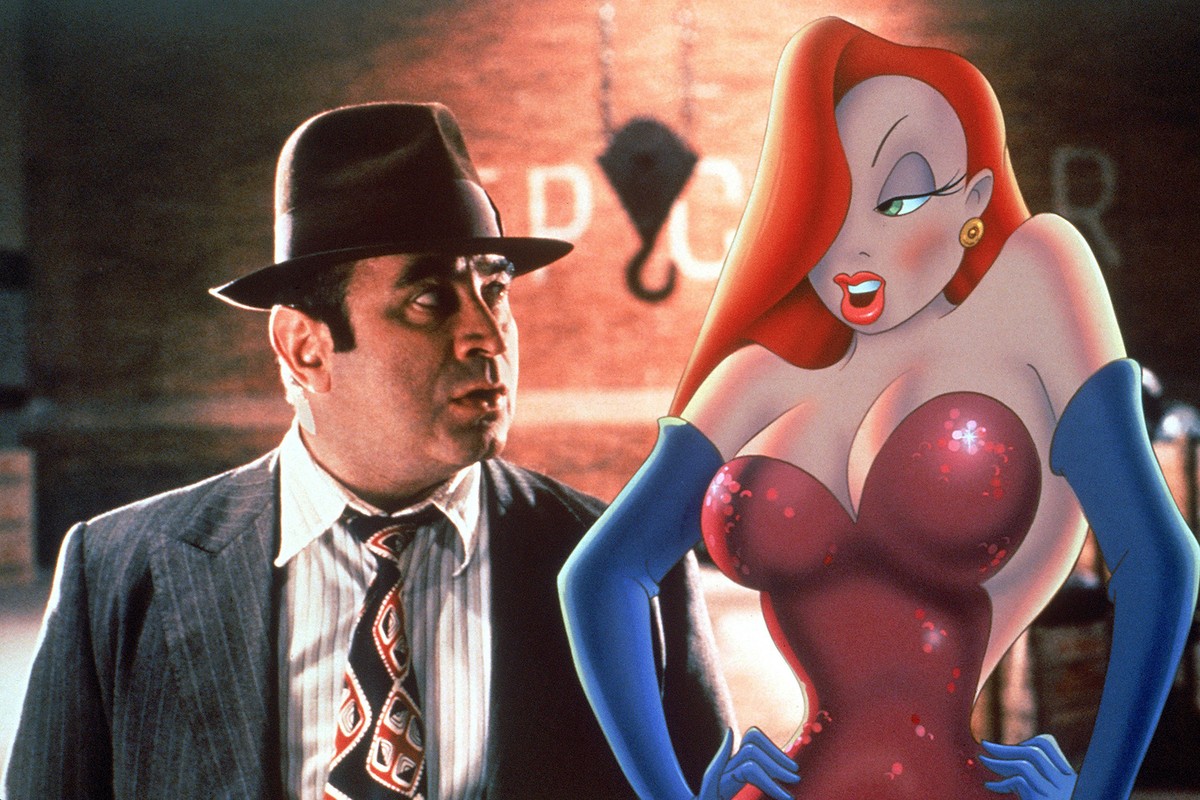
Another meme, this one from 2022 and created by writer and podcaster cosima bee concordia on her Instagram account @bimbo.theory, nicely sums up my hopes for a genderfucked future. A Tom of Finland leather daddy grabs his considerable bulge; next to him, Jessica Rabbit (human wife of Roger) clutches a microphone in a posture that can only be described as va-va-voom! The daddy’s muscles strain against his boots, jeans, motorcycle jacket, and hat. Jessica Rabbit’s sparkling red dress is slit to high heaven. Neither of their proportions are remotely realistic. Their powers of seduction are aggressive, unmistakable, irresistible.
Between them, cosima has placed the assertion: “The Age of Gender Minimalism is over. The Age of Gender Maximalism has come.”
Maximalism is the postmodern aesthetic idea of excess for excess’s sake. Instead of restraint, indulgence. Instead of polite order, raunchy chaos. No one wants to live in a world where you must look like a Gengoroh Tagame illustration or Dolly Parton in order to be worthy of sexual attention, intimacy, love, or pleasure. But exaggerated gender archetypes expose the truth that nothing about gender is innate or natural or necessary. In which case, you can choose whatever gender you want.
The Instagram caption for @bimbo.theory’s meme rifs on Judith Butler’s 1980 poststructuralist concept of gender as performative: “Gender,” cosima suggests, “is just an elaborate hot role-play we all do together.”
If gender is performative, and performance is entertainment, then gender performance can be delightful both for the entertainer and the audience. Enjoyment of your own gender performance, nature or nurture, is what therapist and author Lucie Fielding calls “gender pleasure” in her book Trans Sex. She tells me that she wanted a term more attainable and sustainable than “gender euphoria.”
“I define gender pleasure as the pleasure one can feel in/with one’s embodied experience of (a)gender, whether that’s: encountering things out in the world that feel in alignment with one’s embodied sense of (a)gender, or that are ‘(a)gender relevant’; feeling affirmed in one’s (a)gender within social, sexual, and/or intimate contexts,” Fielding says.
I see the bimbo, the himbo, and the androgynous thembo as gender expression outside of the binary. A bimbo is not a woman, nor a himbo strictly a man; they are only the glamour, only the attraction factor, only the sexuality. Transgender people need the rights that they are currently being denied, and they also need and deserve pleasure. Not every trans person prefers gender campiness; but there is a beauty in this extreme, this extraness, that could have the power to shake everyone out of our collective self-seriousness about gender, hopefully forever.
The notion of gender pleasure has been weaponized, fetishized, misunderstood, and explored by people of all identities. In a world where trans visibility has increased but anti-trans bigots still maintain political power, what does it mean for all of us — trans, intersex, cis, nonbinary, genderqueer, gender fuid, agender, and otherwise — to take erotic pleasure in our gender identity, as that identity settles and also as it continues to evolve throughout our lives? Could gender excess be the path to liberation from the constricting binary? What if the gender presentations that we have long associated with pleasing others are actually what we do to please ourselves?
Excerpted from Why Are People Into That: A Cultural Investigation of Kink by Tina Horn. Copyright © 2024. Available from Hachette Books, an imprint of Hachette Book Group, Inc.