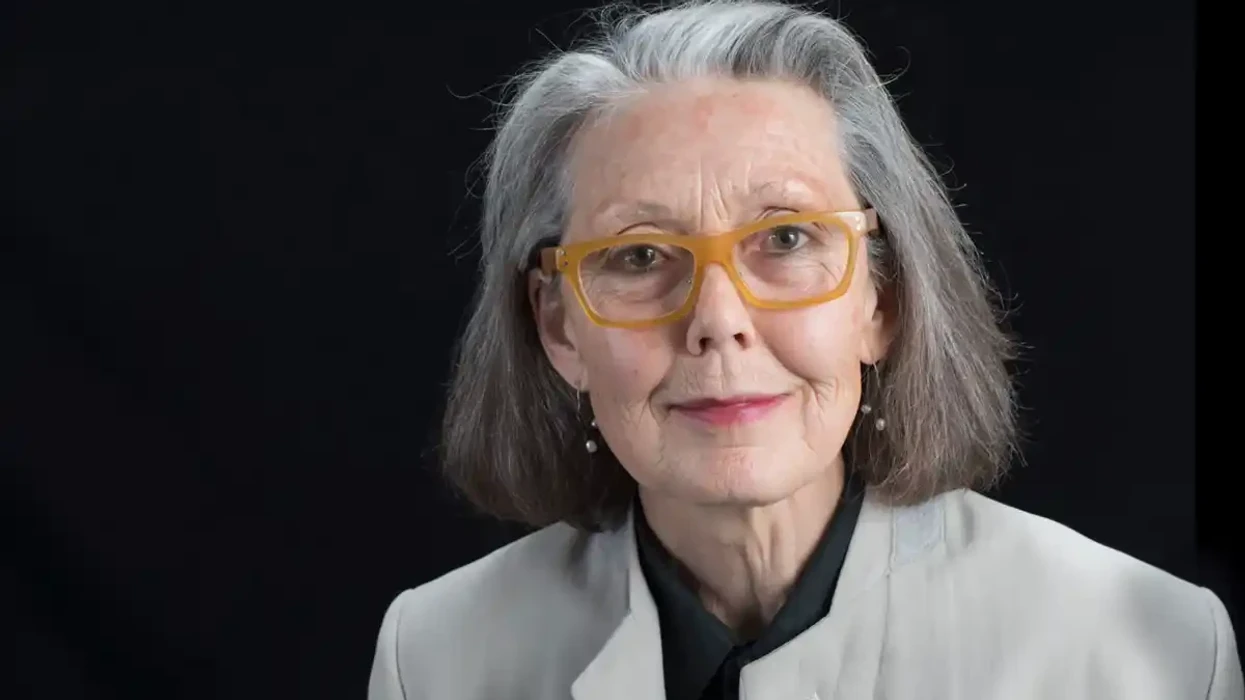

When activist and artist Cecilia Gentili died in February at the age of 52, it was instantly apparent in New York City and on global social media how much she meant to the communities that called her Mother. Queer celebrities and grassroots organizers of all kinds had personal pictures to post, depicting them embracing a grinning Cecilia on stages and at political protests. Costume designer Qween Jean spoke for many trans people of color when she posted, “Our chosen family is powerful and we now have a radical ancestor protecting us.”
Over 1,000 of Gentili’s children, peers, and admirers dressed in bright red for a memorial for Gentilli at St. Patrick’s Cathedral in Manhattan, where she was eulogized as “Santa Cecilia, Madre de la Putas” — Saint Cecilia, Mother of Whores. When Enrique Salvo, the Archdiocese of New York, called the service “sacrilegious,” Gentili’s fellow activist Ceyenne Doroshow, who organized the funeral, quickly corrected him: “Cecilia’s life was one of service,” she wrote. “We can only hope that the Catholic Church, St. Patrick Cathedral Administrators, and its members could live the example that Cecilia set forth.”
The queer community has a long history of chosen family, especially in the ballroom scene, where house mothers help fellow trans people of color navigate intense social marginalization — and indeed, Gentili was a prime example. After emigrating from Argentina to the U.S. when she was 26, Gentili spent several years as a sex worker in Miami, before moving to New York in 2003. There, she found her calling as an activist. In her autobiographical work, Gentilli spoke unflinchingly about her experiences with discrimination, violence, and poverty, and she worked tirelessly to provide access to services like hormones and mental health counseling so younger generations could have what she did not. Now, those younger generations are enacting the change they want to see — and honoring Saint Cecilia in the process.
Gentili’s grassroots organizing was crucial in transforming New York state civil rights policy on myriad issues. In 2019, she co-founded Decrim NY, a coalition that advocates for the decriminalization of the consensual sale of sex between adults. That same year, she founded Trans Equity Consulting, where many of her children work as lobbyists and campaign strategists to create affirming social programs for trans people and for those living with HIV/AIDS. In 2021, she led a successful campaign to repeal a New York State loitering law — often referred to as a “Walking While Trans” law — by arguing that it was used by police to profile and harass trans people of color. She was also central to the 2019 passing of the Gender Expression Non-Discrimination Act which more explicitly protects gender expression under the state’s Human Rights Law. More recently, she was arrested in an October 2023 demonstration in Grand Central Station organized by Jewish Voice for Peace calling for a ceasefire in Gaza.
Gentili’s magnetism as a public speaker was central to her success as an organizer, and she found time to bring those storytelling talents to a body of creative work. In 2022, she published the award-winning memoir Faltas: Letters to Everyone in My Hometown Who Isn’t My Rapist, and in 2023, she won accolades for her off-Broadway solo show Red Ink, which explored her ambivalence about her Catholic upbringing. (Another staging of Red Ink was in the works at the Public Theater just before her death; Sara Ramirez, Rio Sofía, Qween Jean, Peppermint, Ceyenne Doroshow, and Chiquitita performed the text in a memorial tribute in April instead.) She also had a small but memorable role as the nefarious Miss Orlando in FX’s Pose.
“Her brain never stopped,” says Cat Fitpatrick, who edited and published Gentili’s memoir Faltas. “Her genius for strategic thought in activism and her genius for dramatic structure in writing are weirdly the same genius, right? The way she knew how to craft a narrative in an activist campaign and the way she knew how to put together a story that would break your heart were exactly the same kind of thing.”
This combination of personal storytelling and social service may represent Gentili’s most lasting impact: the work of her many children.
Gentili contributed to a world where young trans people feel safe being themselves at work.
Gia Love’s multi-hyphenate Instagram feed shows off what it means to be a queer child of Cecilia: she promotes shimmering fashion shoots, next to energetic nightlife performance videos, next to mutual aid fundraiser links.
When Love went to Apicha Community Health Center in New York City for support in her transition, Gentili was her charismatic caseworker. Love describes the subsequent process of becoming Cecilia’s child to be organic and natural, that somehow she had the capacity to give everyone attention and make them feel special.
“She wasn’t like a PC girl — she wasn’t respectability politics,” Love says of Gentili. “She always called you a bitch [and] she always adorned you with compliments and made you feel very powerful.”
Now Love keeps Gentili’s mission alive through projects like the Celebration of Black Trans Women Cookout, an event to celebrate trans solidarity and joy through food and music.
Rio Sofia, a co-director at the non-profit arts organization Queer Art, who identifies as “one of Cecilia’s many Apicha babies,” says that the quality she is trying to integrate into her life moving forward from grief is the way that Cecilia was “greedy for liberation.”
“She was a hustler,” says Sofia. “She was so unwilling to compromise in terms of leaving any part of herself at the door when she would work with people, and she made a future of abundant care feel so irresistible. I see [her influence] in that uncompromising way of going about your business — being horny no matter what you’re doing. The way she oozed sexuality and beauty was a part of her power, was a part of how she got so much done.”
Edua Mercedes, a visual artist, first met Gentili when she invited her to an intergenerational project called Sweety’s Radio: Edición Especial, hosted at Artist Alliance Inc. Mercedes points out that Cecilia was a part of a generation of trans leaders — including Ceyenne Doroshow, founder of the grassroots organization Gays and Lesbians in a Transgender Society, and Lala Zannell, senior campaign strategist for the ACLU — who insist that direct services follow a “by-and-for approach.” From philanthropy to grant-making to coaching, these leaders have fought for a future where more paid positions are held by the people who share identities with the communities they serve. Young trans people of color seeking social services at organizations like Callen-Lorde in New York City are now more likely to get institutional support from people who look like them.
“Today I know of many trans leaders, especially black and brown trans women sex workers, who started [in outreach positions handing out condoms] and today are executive directors hiring and mentoring other trans people at their own direct service, advocacy, consulting, and entrepreneurial initiatives,” Mercedes says.
Mercedes agrees that fundraising was just another provocative cabaret stage for Cecilia. “She disarmed suit-n-ties folks,” says Mercedes. “Cecilia’s special flavor of activism included her humor, honesty, showgirlhood, gorgeous tits, and brilliantly measured lewdness in the office space, the Zoom room, the speech podium.” Gentili contributed to a world where young trans people feel safe being themselves at work.
Love adds that Cecilia could blend comedy with tragedy in her life as well as her theater work. “The life of a trans person is not easy,” Love says, referring to the violence and stigma Gentili recounted in her art. In Red Ink, “she’s talking about stuff that has traumatized her,” says Love, “but you’re laughing the entire way, right? You can cry, you will cry. But you’re laughing because you’re seeing the reality, you see the humanity.” Love says she will always strive to embody the way Cecilia was a “comedic loving force” in her own work.
In May, drag artist Chiquitita, another child of Cecilia, disrupted the 25th GLAAD awards as part of a protest planned by ACT-UP and Jewish Voices for Peace calling for a ceasefire in Palestine. Wearing a neon yellow dress and using her hands as a megaphone, she called out over and over, “GLAAD is complicit in genocide!”
“I couldn’t have done that without Cecilia,” says Chiquitita, “It just feels like her influence is always in the room. And I can always tell when she’s nearby. When I was walking to the door I could tell that she was nearby. When we got to security, I could tell she was nearby. When I got inside, I felt so secure in my decision and I felt confident in disrupting.”