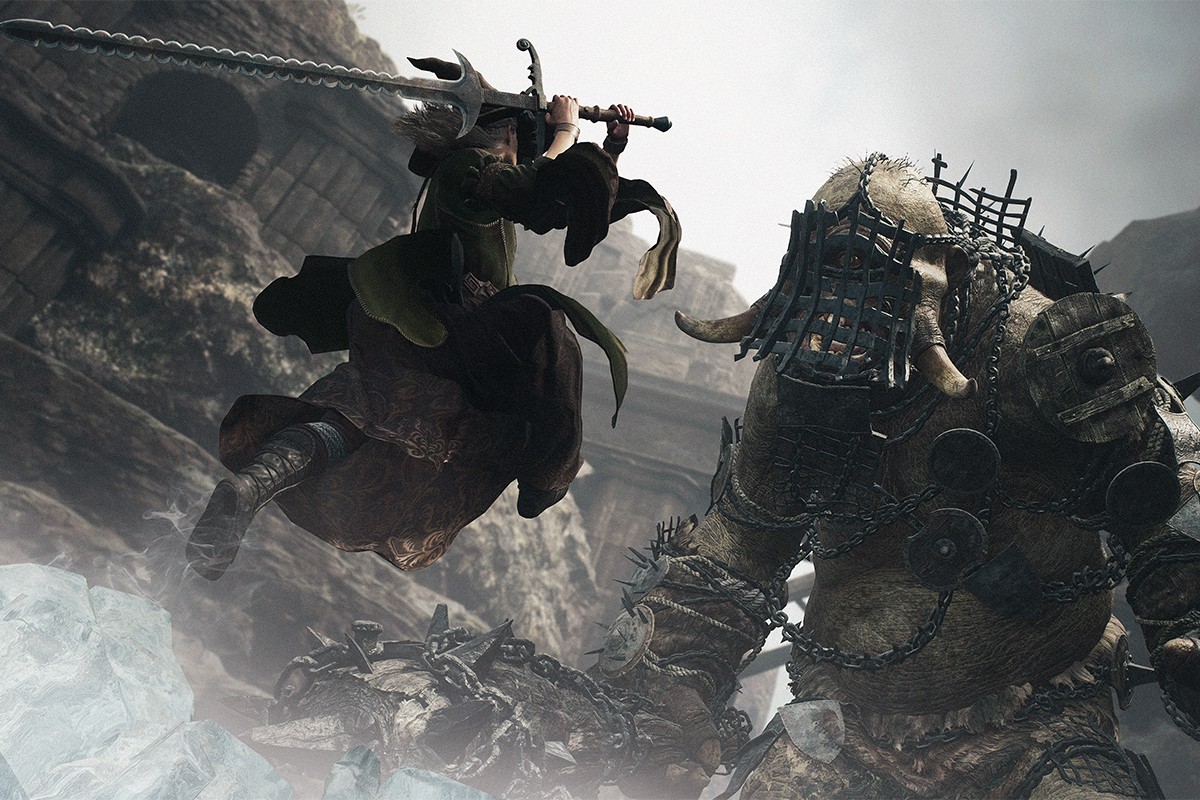

Released in 2012 for the PlayStation 3 and Xbox 360, the original Dragon’s Dogma was an action roleplaying game tailored to a very specific audience. Brutally difficult, the gameplay centered on open-world exploration with a survivalist touch, wherein players and their NPC (non-player character) companions must trek through a “persistent” world that — at the time — felt organic as shifting day-and-night cycles and changing weather conditions imbued its somewhat bland fantasy world with a sense of life. Heavy on customization options and a general “fend for yourself” attitude toward the player, it merged many of the best elements of titles like The Elder Scrolls V: Skyrim and Dark Souls just shortly after those games had seized the zeitgeist in their grip.
But despite having many interesting ideas, Dragon’s Dogma was kind of a mess. Even enhanced through its Dark Arisen re-release, it lacked the visual and mechanic polish of its ilk that would define them as massively influential all-timers. Instead, it would live on as a “gamer’s game” for fantasy fans and hardcore players to cling to as their favorite diamond in the rough while they waited years for a sequel that could truly fulfill the first game’s promise.
By that estimation, Dragon’s Dogma 2 succeeds. It’s easily the best version of Dragon’s Dogma thus far. For fans, that’s great news. For everyone else, it’s a mixed bag.
From the onset, the creators of Dragon’s Dogma 2 want to make it explicit that this is what the game was always meant to be. The plot centers on the player-controlled Arisen, a hero of destiny whose heart is stolen by a dragon, setting up a fated blood feud that frames the whole adventure. Give or take a few details, this is the exact same setup as the original game and will feel instantly familiar to anyone who played this before. The game itself also feels the same, with plodding movement and combat at your control. At first blush, you’d be hard pressed not to think it’s a flat-out remake — a feeling reinforced by the game’s own title screen that even omits the numbering as if to say, “Drop the ‘two,’ just Dragon’s Dogma. It’s cleaner.”
Once the game starts in earnest, there’s clear improvements to be seen over its predecessor. The much-adored character creator returns for players to lovingly craft their own protagonist, as well as their main Pawn (NPC sidekick), and the options are mind blowing. Standing alongside industry best character creators like Cyberpunk 2077 and Baldur’s Gate 3, the depth of the creator can be downright overwhelming, but affords dedicated players the opportunity to sculpt wildly specific features. Rightfully, Capcom had such confidence in its wow-factor as to launch the character creation mode as its own demo prior to the game’s release for players to preemptively play with its toolset to stunning effect, as the community’s most creative minds rushed to remake some of pop culture’s most iconic characters.
But beyond the creation suite, there’s a few other upgrades to enjoy. The original game was knocked for its subpar visuals, but the sequel, built on the RE Engine that gives games like Street Fighter 6 and Resident Evil 4 their sheen, fares much better. The world is highly detailed, with long draw distances and a steady frame rate that keeps motion smooth for the most part. Visually, it certainly feels like this is what Dragon’s Dogma was meant to be but, for the most part, this is where the hopes of modernization stop.
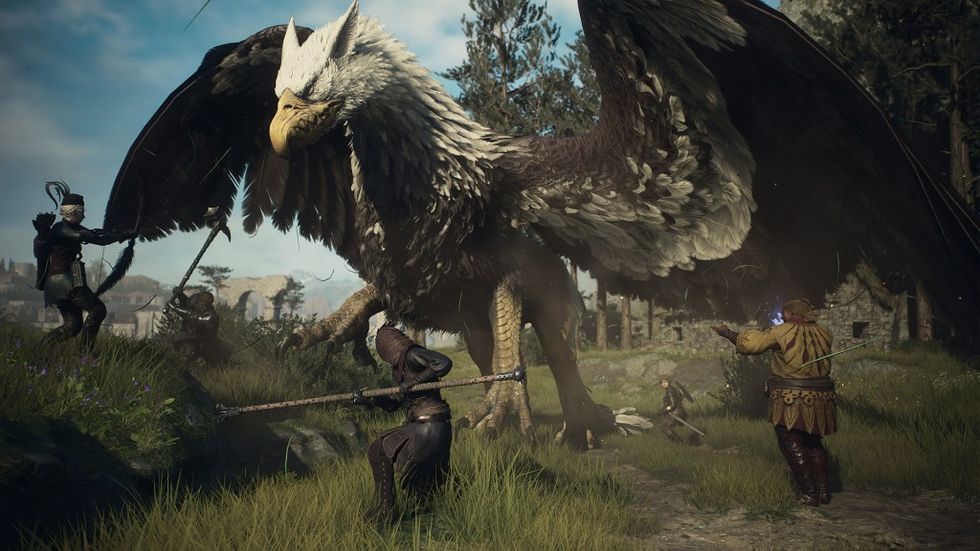
Mechanically, the game plays incredibly close to its predecessor. Players can free-roam the environment, hacking and slashing beasts and assailants using a variety of selectable roles pulled directly from familiar D&D-inspired fantasy lore including Fighter, Archer, Mage, and Thief, as well as unlockable advanced vocations like Sorcerer, Mystic Spearhand, and Trickster. Combat, as envisioned by game director Hideaki Itsuno of Devil May Cry fame, is methodical and punishing. Unlike Dark Souls or Elden Ring, players aren’t able to rely heavily on dodge-spamming as a crutch for most classes, instead forced to rely more on preparation and strategic use of their crew of Pawns to dole out measured beatdowns with a custom party (hopefully) fine-tuned for maximum synergy.
Pawns function as interdimensional servants to the Arisen, consisting of stock characters or ones built by the player community to be summoned from Riftstones or enlisted in person throughout the world. Meant as disposable party members to be milked for combat aid and quest guidance, they’re temporary companions that the player will cycle through like equipment throughout the journey. Sometimes affable, but rarely charming, the NPC pawns add little to the experience by nature. They’re practically faceless tools that don’t impact the narrative in any meaningful way, and are one of the main issues with both iterations of Dragon’s Dogma in that they lack personality. Outside of receiving (somewhat) direct commands, their sole purpose is to play to their vocation, unleashing their class-determined attacks in battle and provide overly repetitive canned dialogue to push players in the right direction in the field.
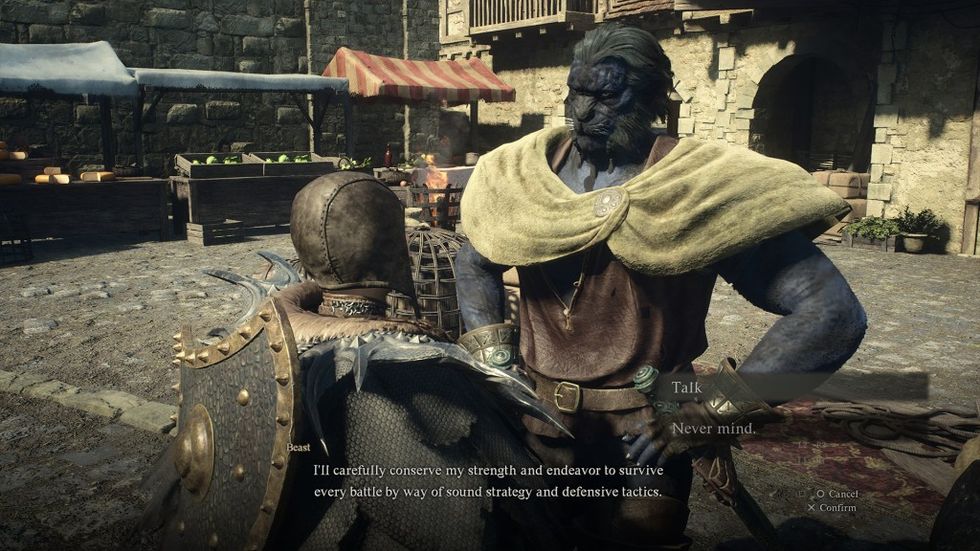
Despite understanding their function in gameplay, it’s sad to see no effort made to enliven Pawns for a modern Dragon’s Dogma sequel. Whereas games like Final Fantasy VII Rebirth and Baldur’s Gate 3 imbue party members with rich characterization that makes them feel like actual people, the Pawns of Dragon’s Dogma feel entirely inconsequential. Outside of artificially making the RPG experience less lonely by the mere existence of bodies, they add nothing to the gameplay that couldn’t be accomplished by providing players with additional skillsets. Instead, we get cannon fodder and compasses that, more frequently than not, don’t even feel like they’re effectively doing anything worthwhile. It doesn’t help that the pool of Pawns incorporates those created by other players, so expect to stumble across a dozen facsimiles of Kratos and Feyd-Rautha along the way. But if anything, it adds some ironic flair where the game’s story fails to.
The hollow-eyed Pawns are indicative of the greater issue with Dragon’s Dogma, which is that it all just feels so blasé. Towns and regions have little in the way of personality or defining geography, and every quest character and NPC feels AI-generated for maximum blandness. The game’s inspirations run the gamut from Skyrim, Dungeons & Dragons, The Lord of the Rings, and all the other obvious touchstones of the fantasy genre, but the art direction and lore never coalesce into anything substantial. It’s a game that can be played without paying any attention to the plot or character interactions without losing anything meaningful.
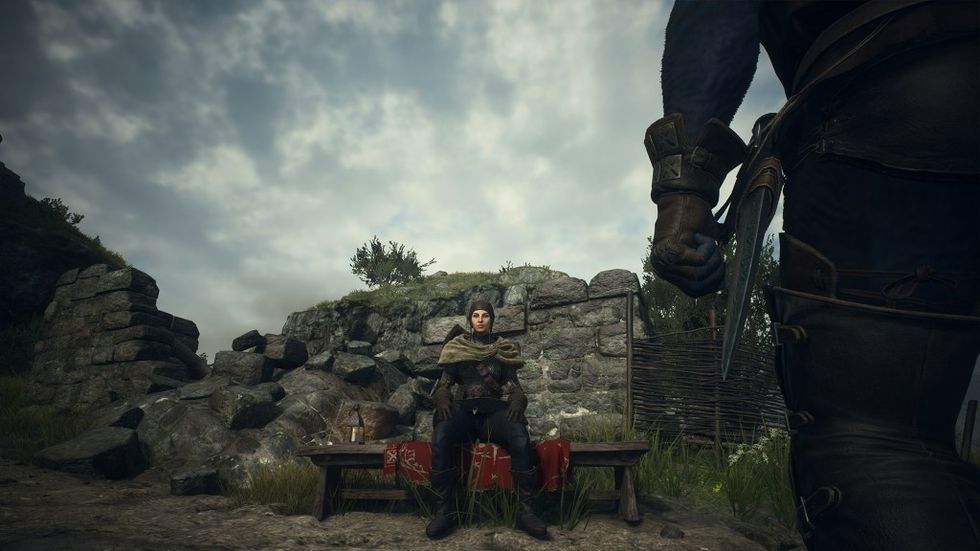
That same nonchalance runs through the game’s presentation, which still feels stuck in the PS3 era of the original. Outside of some story-specific cutscenes, character interactions pop in and out awkwardly, stuttering the frame as a random NPC you didn’t even realize you were looking for holds up the party (who can’t be bothered to look their way) to exposition dump the next objective. The overall experience amounts to stumbling into town or across an emergent scenario and being given marching orders, rinse and repeat. Sure, this is RPG 101, but most games of the last 30 years at least attempt to mask the routine with a semblance of cinematic flourish. As it stands, Dragon’s Dogma 2 makes clear that you’re just playing a video game, in the worst possible way.
And for a game so disinterested in covering the seams of its dressing, one would hope that the mechanics would be airtight. But alas, the game also plays like something from days past. Movement is clunky and persistently frustrating as climbing even small inclines can be inconsistent. Combat has its moments, primarily when NPCs properly execute their roles and the playing field’s geometry is clear, but there are too many times when Pawns will find themselves tripped up by the verticality or uneven nature of the terrain, leaving their backs turned to be slapped by an ogre’s club. There are instances where, in the heat of a surprise battle with an angry minotaur-like creature, you’ll hunker down for the beast to run itself into a wall for a precious saving moment to strike, only for it clip through the environment for a one-shot party kill, or worse, to be knocked prone for an excruciating amount of time while another emergent element like a pack of wolves appears from beyond the periphery to maul the hapless schmucks.
That word — “emergent — is one you’ll frequently see people using in reference to Dragon’s Dogma. It’s ultimately a mechanic by which the enemy and environmental AI are supposed to surprise players with unexpected turns of events. Occasionally, you’ll be taken aback by an enormous beast that’s shot out from dense woods or, more rarely, see monsters in precarious situations that are hilariously unscripted, but while the intent is to recreate the uncertainty and chaos of something like D&D, it mostly amounts to meme fodder rather than a vital extension of the gameplay or organic narrative development.
Of course, there will be people who claim that the game is intended to be difficult, and that’s valid to a degree. The popularity of Dark Souls and Nioh have brought about a decade-long infatuation with games whose central hook is player masochism, but the underlying strength of successfully challenging games is the feeling that you’re learning actual systems to get better, rather than battling against uncooperative mechanics to persevere at a game despite itself. The developers are clearly catering to fans of the “hardcore” gaming experience, where the fruit you pick rots in your pocket and bodies of water are lethal, attempting to create a world that’s intended to feel raw. But the result is undercooked, and even the open world feels constraining, frequently carved up into narrow pathways surrounded by insurmountable terrain, leaving players to bounce back and forth between menus squinting at the map to recall just where in the hell they’re supposed to be going.
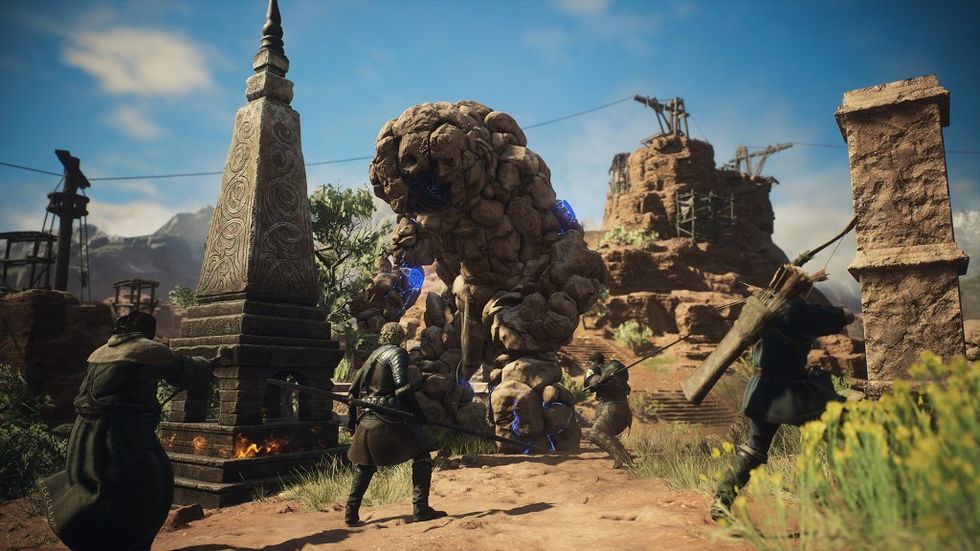
Like the original game, Dragon’s Dogma 2 feels like a collection of ideas that sound great on paper, and sometimes work in practice, but wrapped in the trappings of mediocre execution. Yes, it’s fun to climb an angry golem’s back, stabbing frantically at its weak spot to put a dent in its many health bars. No, it’s not fun to attempt a timely release to preserve stamina, only be to be awkwardly dropped like dead weight to be stomped while the NPCs circle curiously by. The risk and reward elements of combat feel more like you’re playing against Vegas casino odds than you are artfully threading the line between strategy and luck.
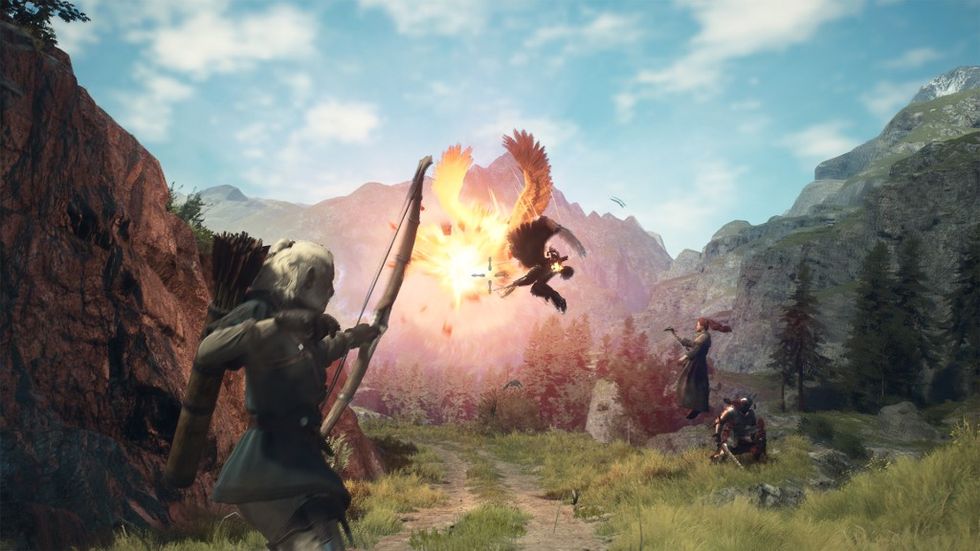
Yet despite the game’s frustrating gameplay and bland personality, over time it can grow on you. Like playing something from the 8-bit era, where a game’s limitations informed the difficulty of its design, there’s a perverse kind of enjoyment in beating your head against the wall to replay sections over and over again with ever dwindling maximum health, knowing that it just shouldn’t be this hard. And for many players, the game’s self-imposed limitations won’t be bugs, but features. If you can just learn to play Dragon’s Dogma as it is, warts and all, you’ll be cooking. But it doesn’t need to be this way.
At a point where open worlds have been perfected by the likes of Tears of the Kingdom or Elden Ring, and effective roleplay and thoughtful storytelling shines in Baldur’s Gate 3 and Cyberpunk 2077, there’s little need to invest much time in a game as vanilla as Dragon’s Dogma 2. Intentionally or not, it plays like a relic whose individual highs and headier ideas don’t amount to the sum of its parts. Time has proven that developers can make satisfying survival sims with old school RPG combat without just making the UI and moment-to-moment experience shittier. But for people who relished the ideas that felt new in 2012 and yearn for more of that thing they loved, Dragon’s Dogma 2 graciously delivers.
Dragon’s Dogma 2 launches for PlayStation 5, Xbox Series X|S, and PC on March 22.