
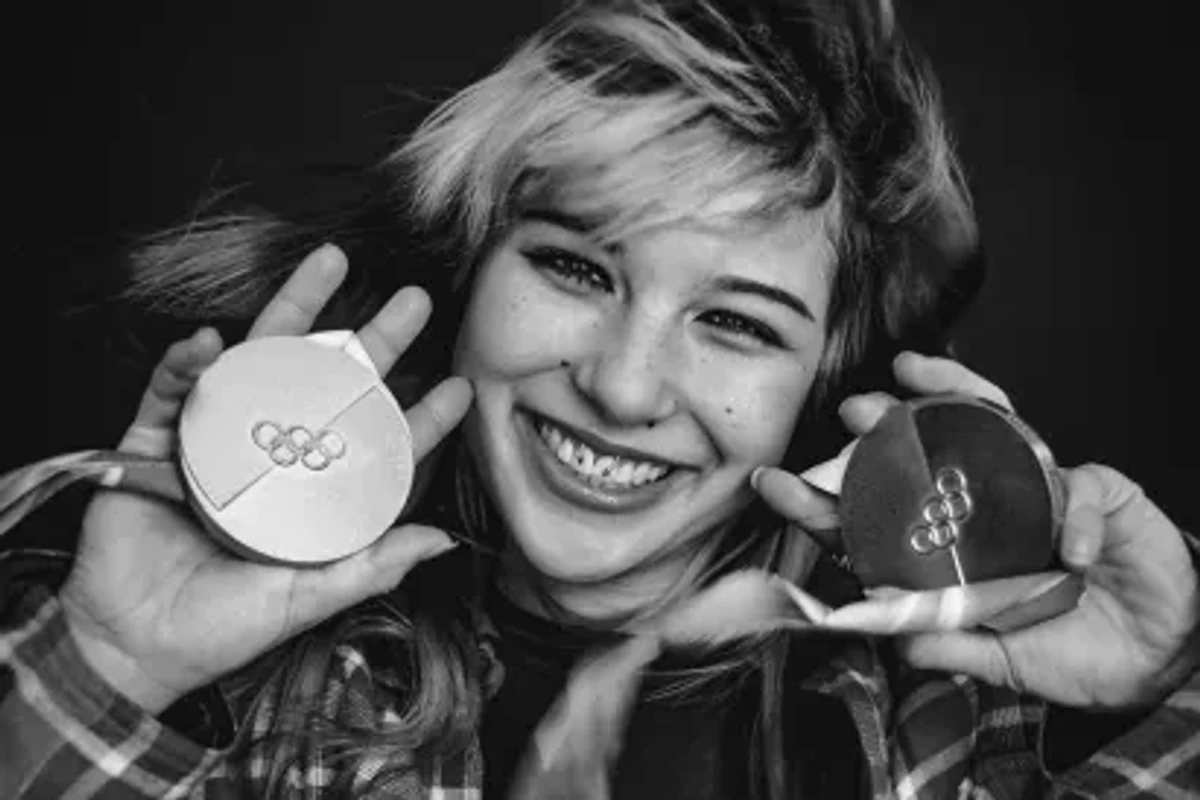

First there were the press conferences. Then there were the parties. Turns out, the first time figure skater Alysa Liu got a proper sleep after winning Olympic gold was on her flight home from Milan a few days later. “We got upgraded, because they were like, ‘We can’t put you in the back of the plane!’” she says, grinning. “So, shout-out to those Delta flight attendants.”
Since then, Liu has been getting used to a hero’s welcome, from the Oakland creamery that offered her ice cream for life to the paparazzi who followed her car after a Today show appearance. Gearing up for her Rolling Stone photo shoot at members-only club Moss New York, she’s presented with boxes of goodies: a lemon ricotta pound cake, white chocolate matcha crinkle cookies, brown butter chocolate chip cookies, and a Lucky Charms concoction devised especially for Liu (“I did a little bit of research, and I knew that she loves Lucky Charms,” the pastry chef explained. “I added extra of the marshmallows. When we found out that she would be coming in, everyone here was very, very excited”).
America loves a sweetheart, and we love a winner even more. But Liu has captivated the country with more than just her skill and her charm. At 13, she was the youngest person ever to win the women’s National Championship (only four feet seven at the time, she famously had to be helped up onto the podium). At 16, she placed sixth at the Beijing Olympics, earned bronze at the World Championships, and then abruptly quit the sport in a post on Instagram. Her return to figure skating two years later was more than just an incredible comeback (nine months after resuming training, she was named world champion); it was a testament to individuality, to the power of finding success on one’s own terms. With her halo hair, her “smiley” piercing, and her vibey performances to Lady Gaga and Laufey, Liu is no ice princess; she eats what she wants, wears what she wants, skates how she wants — and looks like she is having a ball doing it. (“That’s what I’m fucking talking about!” she shouted after her medal-clinching free skate in Milan.) “My goal was to just do amazing programs,” she says. “And the moment I finished my free skate and also the gala program, that’s when I was like, ‘Yeah, my goal is complete.’”
How did you start skating?
I was five years old, and my dad took me and my sister, Selina, to the rink, and I really liked it. I loved to fall. I loved to go as fast as I could. It gave me a roller-coaster feeling. I picked it up really fast, so [my dad] put me in group lessons, and that turned into private lessons, and then I became competitive.
When did your life start to look different from the average kid’s?
From sixth grade on I was homeschooled, and I hated it. I have ADHD, so I do not do well learning like that. I couldn’t do independent study very well, and I would procrastinate a lot on my homework. It was a really big struggle.
- YouTube youtu.be
When you were 13, you won nationals. But you’ve said you don’t have a lot of memories from that time.
Yeah. I blocked them out. Every time I see a clip of it, it’s like I’m watching a movie. I know that’s me, but it’s like I’m seeing what everyone else is seeing.
Why do you think that is?
Probably because [that time in my life] was so bad, I just didn’t want to remember it. Practice was so serious. I would cry after falling on every jump. The team I had around me was so strict. I was in fight-or-flight mode all the time. I didn’t enjoy being at the rink from 7 a.m. to 7 p.m. every day, but I skated every day because I was scared that I would lose all my jumps and lose my abilities if I took a day off. And [since] every day was the same, I can’t recall certain years or stuff like that. I missed birthdays and holidays, so that also makes the timeline a little bit sketchy for me. There’s no pinpoints.
That sounds really hard.
It was. And I was living alone, too, for a long time, from 14 to 16. I lived in the Olympic Training Center [in Colorado Springs], and I trained at the [nearby] Broadmoor facility. I was just Ubering from the OTC to the rink, back and forth, back and forth, every day. That’s it. And it was Covid, so I was there by myself.
You didn’t even see your coaches?
No, they were at their houses, and I was just skating by myself. That was my life. So, yeah, it’s not ideal.

When you trained away from home and your family, how did you choose where you were going?
I didn’t pick where I was going. They just sent me off to certain facilities where they thought, “Oh, these coaches are great. This environment will be good for you. It’ll make you a better skater.”
When you say “they,” who was making these decisions?
I have no idea.
I presume your dad was involved.
He was definitely involved in it. And I don’t know who else. Probably higher-ups in the [U.S. skating] federation.
I’ve heard you say competition is meaningless. What do you mean?
Well, my last skating career, all the programs [I did], I didn’t like. They weren’t my ideas. I never made a single decision. I was put in dresses and hair and makeup that I wasn’t comfortable in. It wasn’t me. I didn’t know who I was at that point, to be fair. But I didn’t like to perform because I was embarrassed to show my programs. Now that I have control, I want to show it. I am more confident.
You graduated high school at 15 because your coaches wanted you to have almost a full year for Olympics prep.
Yeah. And I didn’t want to let anybody down. But when Covid hit, I did not care anymore. I was really just doing it for my younger self, because I knew I wanted to go to the Olympics when I was a little kid, so I was going to hold out for her and then be done. I had my plan: “I’m just going to go to the Olympics and then quit.” And that’s what I did.

So, you walked away from the sport at 16. What did you do?
I got my driver’s license, so I was more free. I could go wherever I wanted, hang out with my friends, take my siblings out. That helped me feel like my own person. And then I went on vacation for the first time, family vacation with my best friend’s family. We were just at the beach for a week, swimming a ton. I went to school, started UCLA. I went skiing for the first time.
That ski trip led you back to skating, right? Tell me about that.
It was in 2024, January. I’d never been skiing, and I loved it so much. It’s so similar [to skating]. You’re cold, you’re gliding, you’re going fast. And the adrenaline rush I felt was unlike anything else since I had quit. I wanted to do it more often. But the mountains are far [from where I live], and the ice rink is right there. So that week, I went to the rink with my best friend and stepped on for an hour. And it was a lot of fun. Then a couple of weeks later, I went again, and I was like, “Oh, this is even more fun.” My goal was to go once a week. Then when summer hit, I was like, “I’m going to skate a couple of times a week.”
You were scratching an itch.
Yeah. I was like, “I need to find a way to kind of satisfy this urge to go fast.” But it was really traumatizing to go back to the rink. I had to go with my best friend, otherwise I would have never tried it again. It was really scary to go back.
How long did it take until you started to feel like you were skating at a preretirement level?
Definitely months. But I was already better in some ways. My artistry was better because I was more in my body. I would say after less than a year, I was back.
Well, after less than a year, you won the World Championship.
Yeah. Crazy.
Tell me about telling your coach that you wanted to return to competition.
It was Feb. 21, 2024. I called him, like, “I just want lessons. Let’s see where this takes us.”
And his response was?
He said no, and then I had to convince him! He was like, “Before, you didn’t like doing this, or this. What about now?” I’m like, “Well, I’m just not going to do that. I want to pick my own music” — I had music ideas, dress ideas that I wanted to put out into the world.
Your dad was really invested in your career before you retired. I read that he would show up at the rink with a radar gun to test the speed of your jumps.
He did.
What was his response when you decided to come back?
I have no idea. He was happy, but that didn’t matter to me. I was almost mad that he was happy. Like, “How dare you?”
What do you mean?
Well, I was just like, “You don’t deserve to be happy over this decision, because you were mad when I quit.” I thought he shouldn’t have an opinion on it, if that makes sense. I didn’t want him to care at all, because it shouldn’t affect him as much as it did the last time.
In some ways, he must have known that you were going to carve your own path because—
He raised me that way.

Exactly. Can you talk about your dad’s background? He helped coordinate demonstrations around the time of the Tiananmen Square protests in 1989. And then he literally had to flee, right?
Yeah, he got smuggled out of China and brought to America. He was a student protester in China, and he immigrated here and built his life. He left everything to start fresh. So he’s really brave, and he breaks a lot of social norms. And he raised us to be independent. We would take [public transit trains] as kids all the time. He wasn’t there a lot because he would be at work. Our family has five kids — that’s a lot of kids to take care of — so he had to work in the office all day long to provide for us financially.
You’re the oldest of those five kids, all born through anonymous egg donors and surrogates. What was it like growing up in a family with that structure?
We didn’t know about it for a long time. I figured it out because [my dad’s ex-wife] is Chinese too. I was like, “I don’t look full Chinese. Something’s up.” So I put two and two together. It hasn’t affected us at all. We’re just like, “It is what it is.”
Growing up, did you talk a lot about thinking for yourself?
Yeah, because my dad is so into politics. My whole family is — just the ideology to speak up and fight for basic human rights. Our family is pretty liberal thanks to my father. We’re proud of his story, and we’re outspoken just like he was. I mean, I was no student-protest organizer, but we go to protests, call our policymakers, write letters.
What are issues you care about?
Climate, election things, Black Lives Matter, Stop Asian Hate, ICE protests.
With these Olympics, there was some tension around the political moment we’re in. Is that something you thought about?
The fact that all of us American athletes have such unique stories and backgrounds, that is kind of what it’s all about. I was proud that I could represent who I was on the big stage on behalf of Americans who could relate to me. I think it’s all about sharing stories and having people feel for you. More empathy needs to happen, for sure.
You skated to the Donna Summer song, “MacArthur Park,” which is a park in Los Angeles where there have been ICE protests happening. Is that something that you thought about when you picked that song?
I had no idea. Someone just recommended that song to me, and I was like, “Yeah, I vibe with this.” A lot of people give me music suggestions. I have my own, but I like to add to my playlist.

How did you pick the other songs that you use in your program?
I was listening to “Promise” by Laufey since she released it, and I was like, “Wow, this is perfect for my figure-skating story. It moves me. I have to skate to it.” And then the “Stateside” remix by Pink Pantheress and Zara Larsson is one of my favorite songs. I related to a lot of Zara’s lyrics.
What’s a lyric you related to?
When she says, “All these years I’ve put in for the American dream, is it worth all the work if you can’t be here with me?” I really related to that line. I was like, “Oh, this describes the whole Olympic experience, because it’s so many people’s dream, and you put in years of work.”
Are you still majoring in psychology at UCLA?
Right now, I’m taking a break from school, but I was always into psychology. “Why do I think the way I do? How can I change my mindset and be more positive about things?” — not even “positive,” because, honestly, in life I also love sadness. I love anger. I love to feel all of that. I don’t think the pinnacle of life’s goal is happiness, actually. Maybe just more peaceful thinking.
Watching you compete for Olympic gold, you seem more relaxed than I am buying groceries. How do you get to that place of peace?
Through trial and error. Genuinely, if I didn’t hit rock bottom so many times, I could not have gone up. So that’s why I say I wouldn’t tell my younger self a thing. I want her to go through all that, because that’s the only reason why I’m here. I wouldn’t change a thing about my past.
Production credits:Video director of photography: GRAYSON KOHS. Lighting Director: LUKE NILSSON. Photographic assistance: JOEL LORA and PAIGGE WARTON. Stills Post Production: ALBERTO MORA. Film Processing & Scanning: PICTUREHOUSE + THESMALLDARKROOM. Location: MOSS NEW YORK.



 Artist Boo Patterson with her painting, “The People’s Husband,” in Liza Mandelup’s Luigi.Benjamin WhatleyADVERTISEMENT

Jack White Responds After Uproar Over Taylor Swift Songwriting Comment