

The most succinct piece of TV criticism I’ve read in the last decade was this 58-word tweet from Topher Florence:
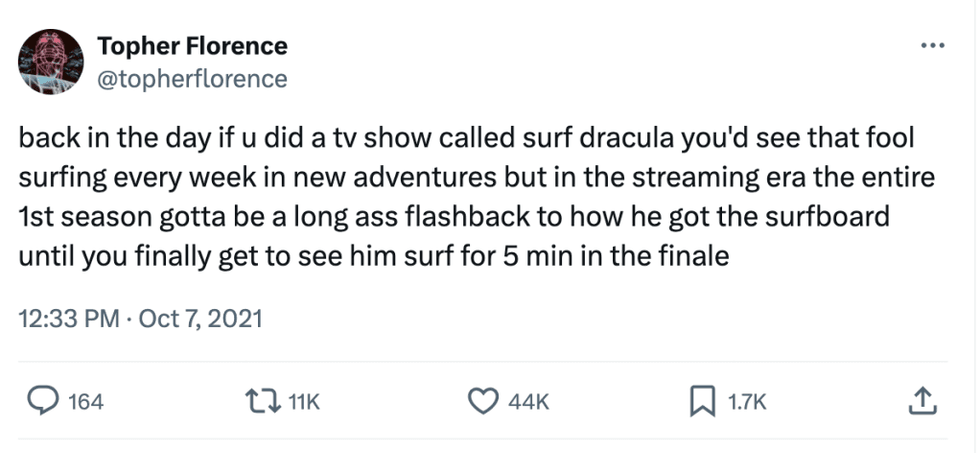
There is, sadly, no real show called Surf Dracula, but the Surf Dracula Problem is everywhere in television these days. Too many series now treat their entire first season as a premise pilot, requiring six to 10 episodes before they can get to the story their creators actually want to tell. Occasionally, audiences are willing to be patient, as we saw when House of the Dragon Season One turned its first year into a slapped-together prologue for the civil war within House Targaryen. More often than not, though, shows that take forever to get to the point don’t stick around for very long. HBO did a Perry Mason series that waited through much of its first season to allow one of the most famous fictional attorneys of all time to practice law. (Season Two, with Perry as a full-time attorney, was much better, but the audience had understandably bailed by then.) We also had a new Mosquito Coast adaptation whose first season ended with its characters nowhere near said coast, plus others like The Nevers, Preacher, and I Am Not Okay With This that dawdled for a while before revealing what what kind of show they wanted to be when they grew up.
The new Apple TV+ drama Sugar is an extreme case even by Surf Dracula standards, where it’s more like there was a show just called Surf Guy, and it took until late in the season to find out that our would-be surfer was, in fact, lord of the vampires.
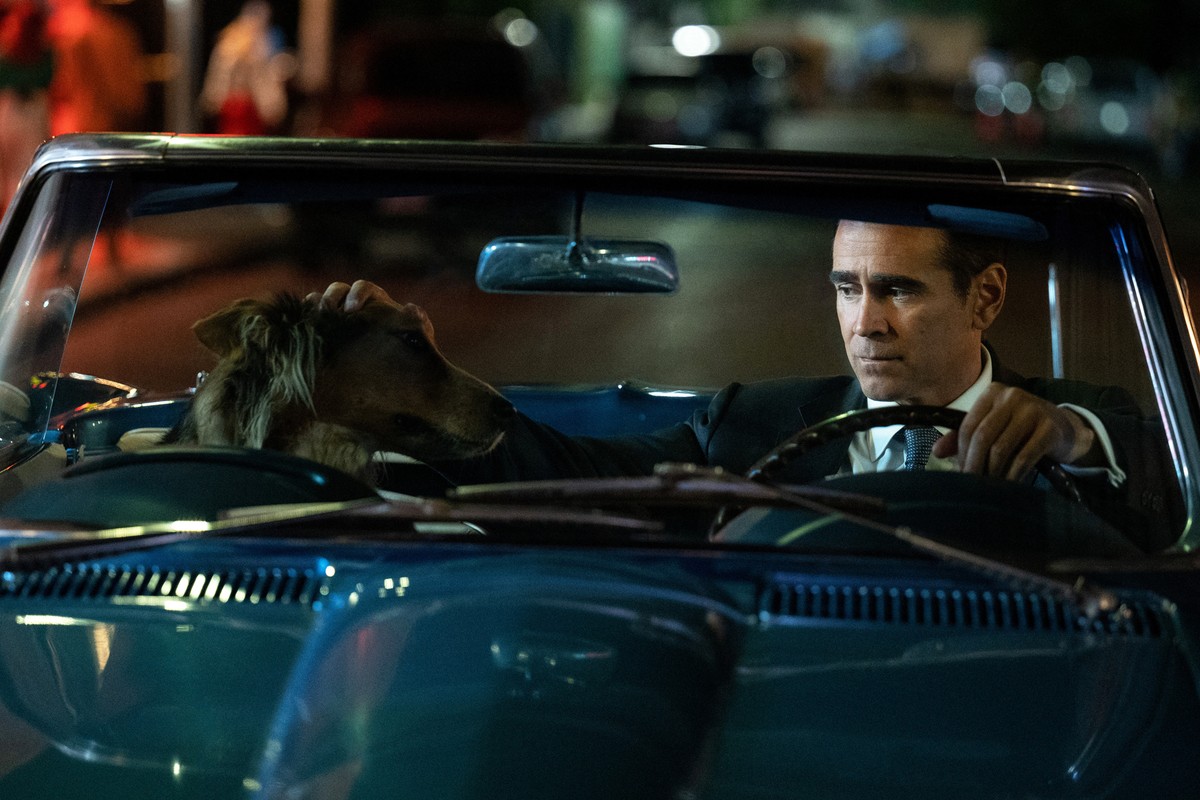
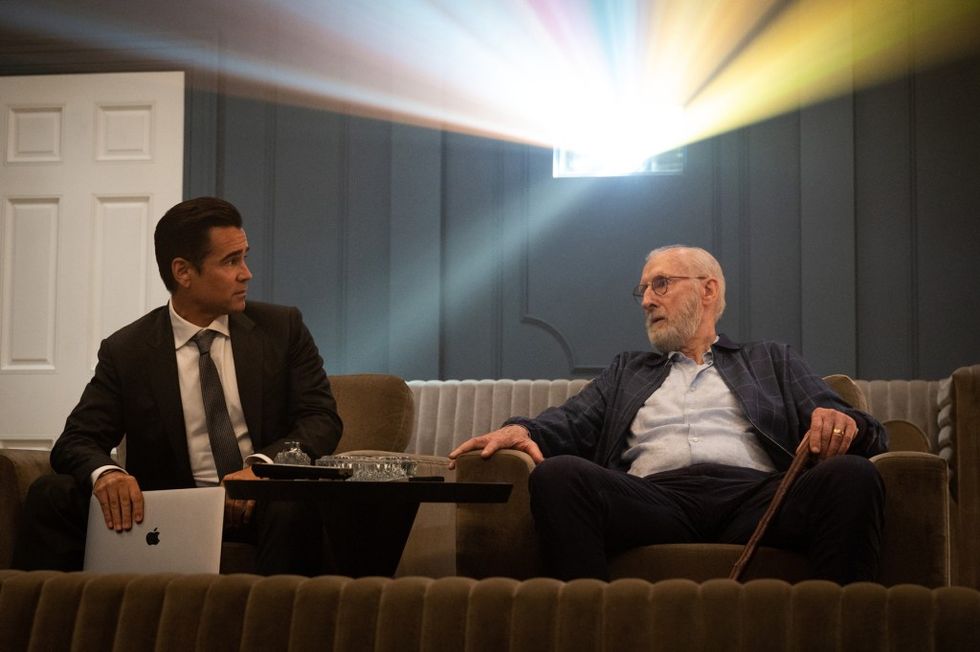
I cannot tell you what Sugar is really about. What I can tell you is that it begins as a contemporary hard-boiled detective drama, starring Colin Farrell as John Sugar, a well-dressed, highly-paid gumshoe who specializes in finding lost people and things for rich and powerful clients. He is hired by legendary movie producer Jonathan Siegel (James Cromwell) to find his missing granddaughter Olivia (Sydney Chandler), and has to figure out whether her half-brother Davy (Nate Corddry), her father Bernie (Dennis Boutsikaris), or stepmothers Melanie (Amy Ryan) and Margit (Anna Gunn) had anything to do with her disappearance.
Based on everything we can see, Sugar is a pure-hearted hero. He consistently offers bad guys a peaceful way out of their messes, confident that he’ll always win if things turn violent — and afraid of the side of himself that’s so good at hurting others. He volunteers to pay for an unhoused man’s fare to go home to stay with the sister the man is too ashamed to call without prompting, and later takes in that man’s dog. When he inadvertently gets ex-rock star Melanie too blitzed to properly answer his questions, he makes sure to get her home safely, and to ignore her drunken advances. Ruby (Kirby), who manages his business affairs, is perpetually worried that Sugar is investing too emotionally into every case.
If Sugar seems to be good to be true, then… well, no. He really is that good. But he is also not just a saintly private detective, and it’s the other part that makes Sugar a lot messier to both discuss and watch.
There are hints in the early episodes that Sugar isn’t entirely who he seems to be. As Melanie puts it in their first meeting, “There’s more to you than meets the eye. You have secrets. You keep things hidden.” But it takes until the end of the sixth episode (out of eight total for the first season) to reveal what his secrets are, and what the real story of Sugar is.
Apple has described the series, created by Mark Protosevich (The Cell, I Am Legend), as “genre-bending.” This is something of an understatement. When clarity finally arrives, it makes the missing woman plot feel like a whole lot of throat clearing before Protosevich got to the real show.
This is frustrating on several levels, not least of which is that the private eye pastiche stuff is very entertaining. Several episodes are directed by the great Brazilian filmmaker Fernando Meirelles (City of God), and he and Protosevich lean way into their influences. Sugar is a big film buff(*), particularly of the kind of Forties and Fifties noirs that the series is informed by, so his travels through modern-day Los Angeles are frequently interspersed with clips from Double Indemnity, Night of the Hunter, Kiss Me Deadly, Sweet Smell of Success, and more. It’s not a new device, though better known for being used by satires like Dead Men Don’t Wear Plaid or the early HBO sitcom Dream On. It would be easy for this to make Sugar seem like a very poor imitator of Mike Hammer and company, or for the clips to feel like they are hitting the audience over the head with the point of various sequences. But they feel deployed just right, in large part because Colin Farrell’s performance is so charismatic and lived-in, it’s not hard to imagine him starring in a version of The Big Heat if he had been born back at the same time as Glenn Ford.
(*) Amusingly, he mentions loving L.A. Confidential at one point, never remarking on the fact that he’s currently working for a man who looks exactly like the villain of that movie.
The mystery itself is fairly convoluted, but in the way the genre practically demands. And there are some odd hiccups, like Anna Gunn playing Nate Corddry’s mother despite being only nine years older than him. (Davy is a former child star, and perhaps the creative team thinks Corddry can pass for much younger, but their scenes together are awkward.) The version that Sugar mostly pretends to be for six episodes would probably do just fine without the big twist. (It helps that most of the installments hover around 35 minutes in length, keeping the story from bogging down in the way so many streaming series do.)
For that matter, the show that Sugar turns out to be is interesting, too. It just completely undercuts what came before, while also arriving much too late to feel fully-formed when Protosevich decides it’s time to turn his cards face up. It also feels like a cheat, because the series is told from Sugar’s POV, complete with voiceover narration that in no way discusses [REDACTED] until after the audience has found out about it. Everything is presented this way entirely to pull the rug out from under viewers, but without nearly enough value gained from it. If we were watching things unfold through, say, Melanie’s eyes (Ryan is terrific, as are all the supporting players), and then [REDACTED] came out, that would have real weight. Ditto a version of the story where Sugar somehow didn’t know about [REDACTED], and we learned it at the same time he did.
This is just trickeration for its own sake, and it’s counter-productive and annoying. The resolution of the mystery becomes an afterthought, while the reality of what Sugar is doesn’t get enough room to fully get up to speed. The two concepts could work together very well, with this star, this ensemble, and this much care given to the look and feel of the world. But they have to be allowed to co-exist, rather than one being held in reserve for weeks and weeks, all in favor of a one-shot burst of WTF.
When I get to the end of one of these premise-pilot-style seasons, I try to be hopeful about the intended ongoing version of the series. That optimism is sometimes rewarded (again, see Perry Mason Season Two, not that it mattered). But often, these kinds of shows don’t get second seasons because viewers rightly grow impatient. And the ones that do return tend keep on dragging their feet, as if they’ve gotten too used to moving slowly. The separate, conflicting parts of Sugar are interesting enough to once again make me a hope-watcher if it comes back. But if it doesn’t, the storytellers will have no one to blame but themselves.
Just let Dracula surf, guys. Please. People want to see the show you are trying to make, not an endless warm-up for that show.
The first two episodes of Sugar are now streaming on Apple TV+, with additional episodes releasing weekly. I’ve seen all eight episodes.





The Trump Administration’s Lies Insult the Intelligence of Every American