
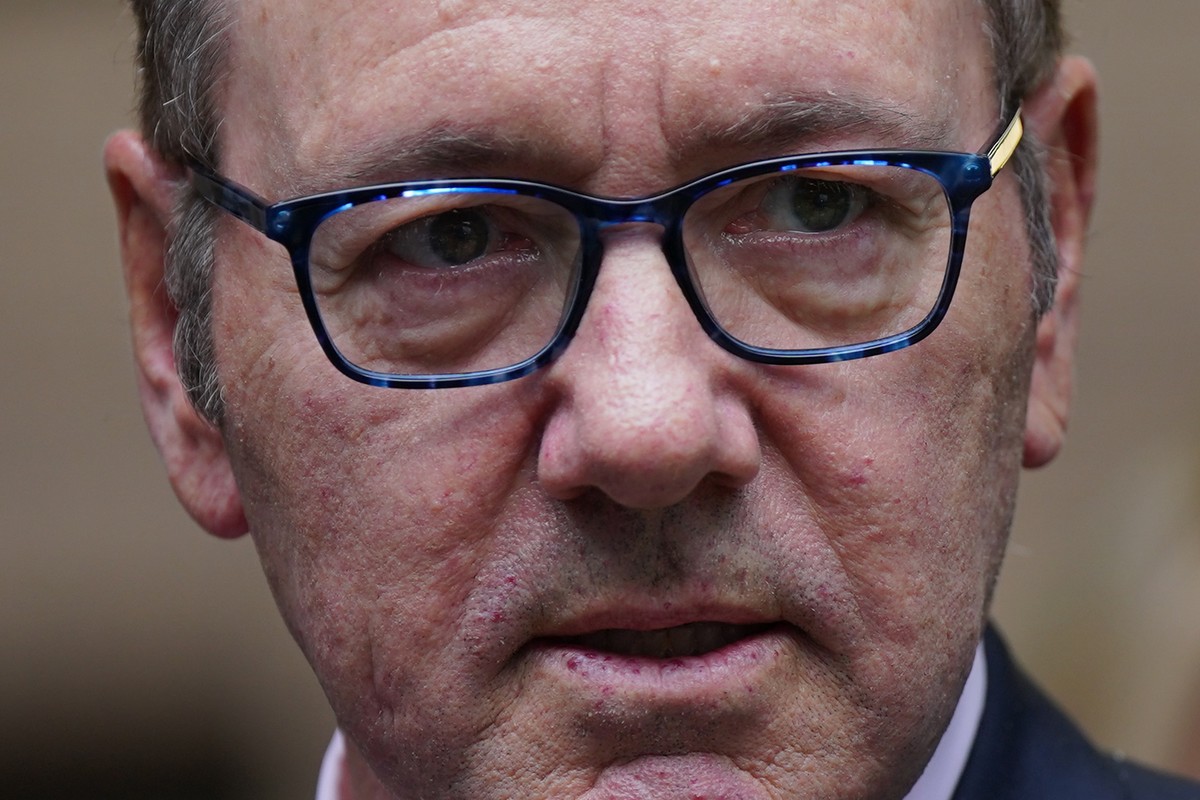

In October 2017, Hollywood became the story. The New York Times’ blockbuster investigation of Harvey Weinstein shook the entertainment industry, unleashing a torrent of stories about harassment, abusive bosses, and exploitative power dynamics. The vast majority of victims who came forward were women, but just three weeks into what is now known as the #MeToo era, actor Anthony Rapp (Rent, Star Trek: Discovery) spoke out against Kevin Spacey, accusing the Oscar winner of drunkenly molesting him when he was 14 years old. Rapp said he wanted to “shine another light on the decades of behavior that have been allowed to continue because of many people, including myself, being silent.” In the wake of his claim, some of those people were emboldened to share similar accusations about Spacey.
At the time, discussion of sexual abuse against men was rare in the public sphere. But over the years since, such stories have gradually become more prevalent in mainstream culture. Last month, the Netflix show Baby Reindeer, depicting a young man who was taken advantage of by an older, successful man in the entertainment industry, became a surprise hit. The story was written by series star Richard Gadd, based on experiences from his own life. And in the recent docuseries Quiet on Set: The Dark Side of Kids TV, actor Drake Bell opened up for the first time about his own sexual assault at the hands of Nickelodeon voice coach Brian Peck.
Now, Spacey Unmasked — a two-part documentary from British broadcaster Channel 4 — is delving into his allegedly inappropriate and exploitative behavior, covering accusations that span five decades. The documentary is a crucial entry into the conversation around male victims of sexual misconduct — and highlights how men haven’t yet developed a vocabulary to describe or process these situations. “Men are not used to discussing this, talking about this, naming it, or giving it language,” says executive producer Mike Lerner. “One of our hopes is that after this series goes out, there will be more people realizing that they should and can speak out about what’s happened to them.”
Spacey Unmasked, which airs in the UK on May 6th and 7th and will later come to the U.S. on Max (ID acquired the program), features the moving testimony of 10 men — nine of whom have never spoken publicly before — plus the commentary of journalists Adam B. Vary and Chloe Melas, who each investigated Spacey’s alleged conduct (Vary at BuzzFeed, Melas for CNN).
In 2017, when the first allegations against Spacey broke, he was in the midst of a career renaissance, racking up awards due to his critically acclaimed role as devious president Francis Underwood in Netflix’s House of Cards. For decades, the actor had been the subject of rumors surrounding his sexuality, though he had never addressed the gossip. In response to Rapp’s claims, he decided to confirm that he had had sexual relationships with men. Spacey released a statement saying he didn’t remember the incident in question, but he apologized nonetheless for “the feelings [Rapp] describes having carried with him all these years” and said the claims had encouraged him “to address other things” about his life.
But as allegations against Spacey piled up, he was fired by Netflix as well his longtime talent agency CAA, and his other projects were canned or put on hiatus. The controversy prompted Spacey to retreat for what a spokesperson called “evaluation and treatment.” When he resurfaced a little over a year later, it was in a bizarre video posted on Christmas Eve. Titled “Let Me Be Frank,” the clip featured Spacey in character as Frank Underwood, delivering questionable lines like “You trusted me, even though you knew you shouldn’t.” It became a strangely defiant holiday tradition the actor continued for several years.
In 2022, Rapp brought a $40 million civil lawsuit against Spacey in New York; Spacey was found not liable. Last year at a trial in London, Spacey was found not guilty of nine counts of sexual misconduct against four men. Now, seven years on from his #MeToo moment, Spacey has a new film out — the action-thriller Peter Five Eight. Though the documentary has been in the works since 2022, timing of its release — right at the moment when the disgraced star is attempting a comeback — does not seem coincidental. Spacey Unmasked feels designed to ask whether he should be allowed back to a position of influence.
Director and producer Katherine Haywood tells Rolling Stone that it wasn’t difficult to find men who have a history with Spacey, whether from his work as creative director at London’s Old Vic theater between 2003 and 2015, or all the way back to his career beginnings in the 1980s.
The documentary starts with Daniel — an extra who was hired on House of Cards to play a member of President Underwood’s security detail. Daniel describes how in awe he was of Spacey and the exhilarating moment of having one line in the show. But immediately after filming his first speaking scene, Daniel claims that Spacey took him aside and groped his penis on set. “It seemed like he was unstoppable,” Daniel says, adding that he thought to himself, “What power do I have?”
We also hear from Andy, who says he had an encounter with Spacey in 1981. At the time, Spacey was working as an extra in a Shakespeare production in Central Park after dropping out of Juilliard. Andy, then a theater program coordinator, claims that Spacey — who was a virtual stranger — approached him in the theater offices where he worked and suddenly forced himself on him, pressing his erection against Andy’s body despite attempts to push him off. “It was cold in a way that was almost inhuman,” Andy says. “I was really scared.” Before the alleged incident, Andy says he had been feeling on top of the world, newly out of the closet and with a new boyfriend. But that optimism quickly faded. Looking back, he asks: “If he could do that to me when he had no power, what’s he going to do with that now?”
Power is a recurring theme in Spacey Unmasked. Many of Spacey’s accusers were actors, usually at the beginning of their careers. Some were gay; others were straight, and describe how Spacey was attracted to “the challenge.” Many say Spacey promised to take them to parties with A-list actors and other entertainment bigwigs. “He was like the mayor of Hollywood,” says one man. He describes being around Spacey as a “‘sell-your-soul’ situation,” because “if you don’t pay the toll, you’re not going to have your name in lights.” Another former aspiring actor shares a story about accepting an invitation to watch Saving Private Ryan with Spacey. As the opening scene — a graphic display of the bloodshed and brutality of war — unfolded in the dark cinema room, the accuser says, Spacey was pleasuring himself in the next seat.
Each of the 10 men say that their encounters with Spacey had a profound effect on their lives, careers, and confidence. “It’s so shocking, but your first reaction is not violence. It’s ‘You did something wrong, you brought it on yourself,’” says the man who accompanied Spacey to Saving Private Ryan. “You feel shame.” Lerner notes that there are clear parallels with how some of Harvey Weinstein’s victims were characterized as having benefited from their professional proximity to him: “The idea that you’re not allowed to be ambitious and, if you are ambitious, you have to pay a price of being exploited is really interesting to discuss.”
Perhaps surprisingly, Spacey Unmasked is compassionate toward the man himself. “We’re trying to understand who he is,” Haywood says. “Where did he come from? How did that inform his behavior?” Spacey’s brother Randy appears in the documentary, describing what it was like being raised by a father who was a proud Nazi and used to host meetings in their home. Randy recalls being physically and sexually abused by their father. (He admits that he does not know whether this happened to Kevin, too.)
The documentary also addresses Spacey’s experience being hounded by whispers about his sexuality as an adult. In response, he retreated further into privacy — and the closet — seemingly to protect himself. It’s a predicament for which a lot of the men in the documentary, whether gay or straight, expressed sympathy. “They were really upset and really hurt and angry about what happened, but they also found it in themselves to have this generosity of spirit,” Haywood says. “They were able to have empathy for a man who had hurt them, and that had to be reflected.”
Ultimately, the closet became a shield for Spacey’s alleged behavior. The way he decided to come out — using the revelation about his sexuality possibly to distract from, or downplay, Anthony Rapp’s allegations against him — was a testament to that. Spacey Unmasked also points out that few alleged victims wanted to speak out against Spacey, partly because doing so would effectively be outing him.
In a lengthy post on X May 2, Spacey slammed the documentary and Channel 4, claiming he was not given adequate time to investigate the allegations himself. “I will not sit back and be attacked by a dying network’s one-sided ‘documentary’ about me in their desperate attempt for ratings,” he said, adding that every time he has defended himself in court he has been “exonerated.” (In a multimillion-dollar lawsuit brought by House of Cards production company MRC in 2021, the judge ruled Spacey’s behavior on set constituted a breach of contractual obligations for professional behavior, including anti-harassment policies. The decision was upheld on appeal.)
Still, the prevailing message of Spacey Unmasked is that behavior doesn’t have to be criminal to be exploitative and wrong — in the workplace or otherwise. “We don’t want to challenge the London trial in any way,” Haywood explains. “But we are looking at behavior here. And if it’s not criminal, then what is it? The men describe it themselves: It’s bad, it’s painful, and it’s not ethically or morally acceptable.”

 Cameron Winter, Benny Safdie and Paul Thomas Anderson, backstage at Carnegie Hall. Lewis Evans*

 Dominic Kwow / Sea to Sky Media
As Trump Dithers, Ukraine War Is Approaching a ‘Fatal Point of No Return’