Skip to content
Search

‘Einstein and the Bomb’ Hits What ‘Oppenheimer’ Left Out

‘Einstein and the Bomb’ Hits What ‘Oppenheimer’ Left Out

The awards juggernaut Oppenheimer provides a blockbuster treatment of one scientist’s profoundly mixed feelings regarding his role in the creation of the atomic bomb, and its subsequent use in destroying the Japanese cities of Hiroshima and Nagasaki. Now Netflix has dropped a much slimmer but thematically similar docudrama, Einstein and the Bomb, that packs a wallop in detailing how the man widely considered the father of atomic energy came to influence the innovations of the Manhattan Project, and how he lived to regret it.

This is a docudrama in the truest sense of the word. Director Anthony Philipson weaves dramatic scenes of Einstein (capably played by a twinkle-eyed Aidan McArdle) with documentary footage; the screenplay uses only words spoken or written by Einstein himself. The dramaturgy can get a little clunky, and the hair and makeup won’t be winning any Oscars. But that’s not really the point. In choosing to forego either a standard documentary format or a low-budget biopic approach, the filmmakers manage to make history feel more human.


The film could have also been called Einstein and the Nazis. Ample footage of Hitler’s rise and the Third Reich’s atrocities fill the screen as the first half of the film details how Einstein’s theory of relativity, combined with the fact that he was Jewish, led the Nazi regime to denounce him and his suspiciously abstract findings in the early 1930s. Einstein, in turn, got an early glimpse of, and sounded an early alarm over, the evil that Hitler was capable of committing. This is crucial context for what would follow: Einstein, by then world famous and living in Long Island, wrote to President Roosevelt in 1939, warning that Germany might be in the process of developing atomic weapons, and suggested the U.S. get busy doing the same. But he never considered the possibility that those weapons would be used to annihilate the civilians of a different country’s cities.
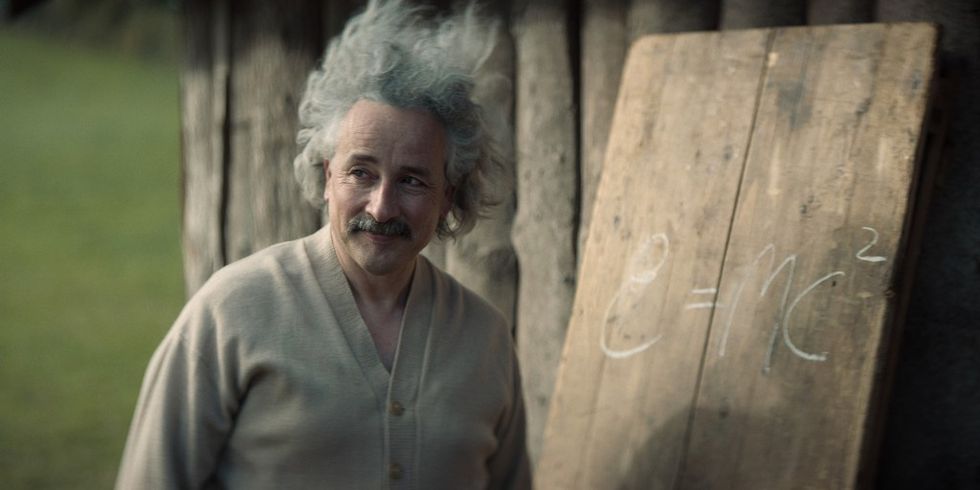
Aidan McArdle as Albert Einstein in Einstein and the Bomb.

We see McArdle’s Einstein explain his radical pacifism, a pacifism so strenuous it could, ironically, take on a warrior-like quality. We see him take refuge from Germany in a little hut on a Norfolk heath under the hospitality of Commander Oliver Locker-Lampson, a British politician and naval reserve officer played by Andrew Havill; this is also where his life is guarded by two young women with guns at the ready. All true, and all quite intriguing.

As in so many crisp documentaries, the editor is the unsung hero here. Simon Barker nimbly darts between timeframes, attaching the right documentary footage to the right dramatic scene, and keeps everything humming; Einstein and the Bomb is only 76 minutes long, and it feels even shorter. As the film sets up its historical context, detailing Einstein’s 1932 flight from Germany, his respite in England, and, finally, his voyage to the U.S., where he lived out his life, you might start to wonder if this is not a stand-alone doc but the first episode of a series. When do we get to Los Alamos? Where’s Oppenheimer? Then you remember: Einstein wasn’t at Los Alamos. He was deemed too much of a security risk. But his ideas were there, chiefly the guiding atomic principle that a small amount of mass can generate a tremendous amount of energy.

This Einstein is a fervent peacenik who saw in Nazi Germany an existential threat to peace everywhere, and to Jewish people in particular. He later felt great anguish at his role in opening up what he called the “Pandora’s box” of atomic weapons, the carnage of Hiroshima and Nagasaki, and the subsequent nuclear anxiety we experience to this day. In Oppenheimer, Einstein is portrayed by Tom Conti in passing and only as he relates to the protagonist. Here he gets to bear his soul. This is frankly the kind of thing Netflix could and should do more of. It looks inexpensive but sharp, it doesn’t reek of sensationalism, and it doesn‘t feel like a cobbled together romp through history. It has a point and a vision worthy of its subject.


More Stories

Sarah Michelle Geller Criticizes Hulu’s ‘Buffy’ Cancellation: ‘Nobody Saw This Coming’

Sarah Michelle Geller

Daniel Boczarski/Getty Images for Searchlight Pictures

Sarah Michelle Geller Criticizes Hulu’s ‘Buffy’ Cancellation: ‘Nobody Saw This Coming’

After revealing that Hulu would not be moving forward with the planned reboot of Buffy the Vampire Slayer, star Sarah Michelle Geller has spoken out about the way in which it was cancelled.

The actress got the call on Friday as she was preparing to appear at SXSW to promote her new film, Ready or Not 2: Here I Come.

Keep ReadingShow less
Oscars 2026: Best, Worst, and Most WTF Moments

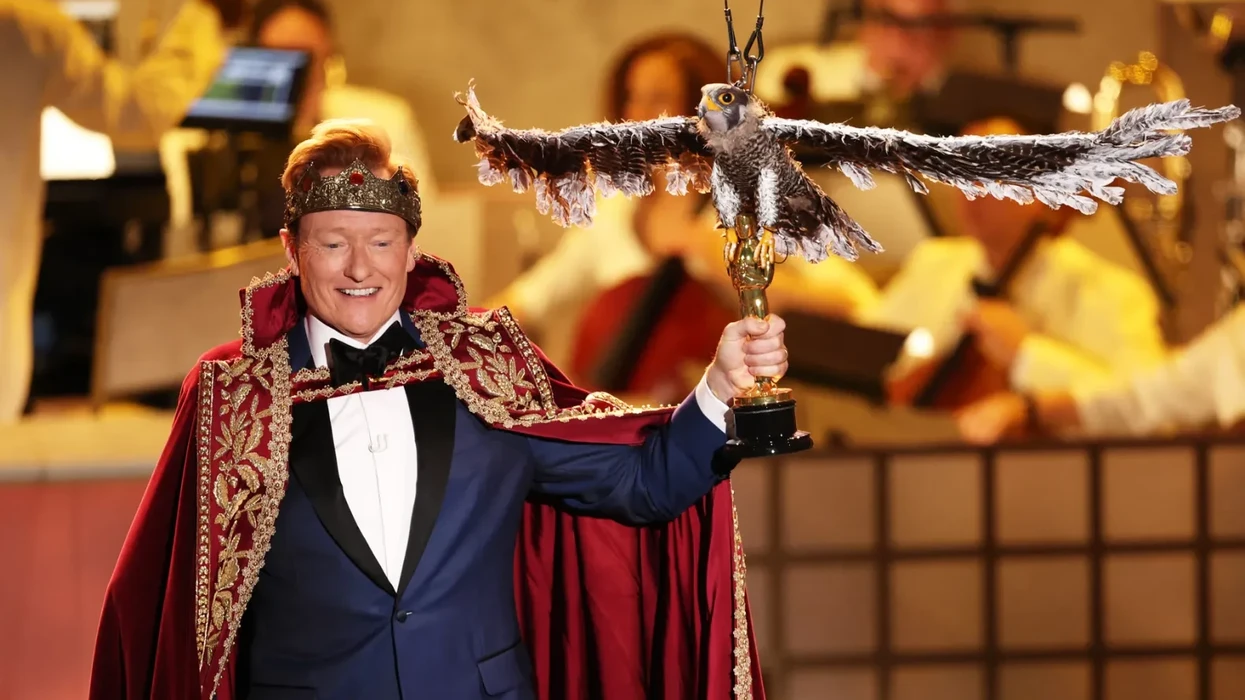
Conan O'Brien ended his monologue on a royal note.

Patrick T. Fallon/AFP/Getty Images

Oscars 2026: Best, Worst, and Most WTF Moments

To one degree or another, the Oscars are always somewhat of a slog. There’s simply no way to make a three-and-a-half-hour award show enjoyable from start to finish. But this year’s telecast was a bit more of a slog than usual thanks to scripted presenter bits that fell flat (reaching a nadir, arguably, with the evening’s final handout, which saw Ewan McGregor and Nicole Kidman singing famous songs about love?), tiresome speeches, and ongoing audio and production issues.

Still, the night wasn’t a total loss, because Conan O’Brien was once again brilliant in his second hosting tour of duty. He started the night on a high with an extended segment that poked fun at Weapons, and he kept the energy up with cheeky taped sketches — often poking fun at shortened attention spans (as in this bit with Sterling K. Brown that retooled Casablanca for those who might be watching while also starting at their phones), the scourge of AI, and the industry’s craven attempts to draw younger viewers — until the very last moment, when they inserted his smiling corpse into an incinerator, spoofing One Battle After Another. Along the way, the Academy finally honored a female cinematographer, Amy Madigan won an Oscar 40 years after her first nomination, and Timothée Chalamet had to paint a smile on his thinly mustachioed face when he lost in the lead acting category for a third time.

Keep ReadingShow less
Oscars 2026: Conan, Barbra, ‘Sinners,’ and One Awesomely Messy Night

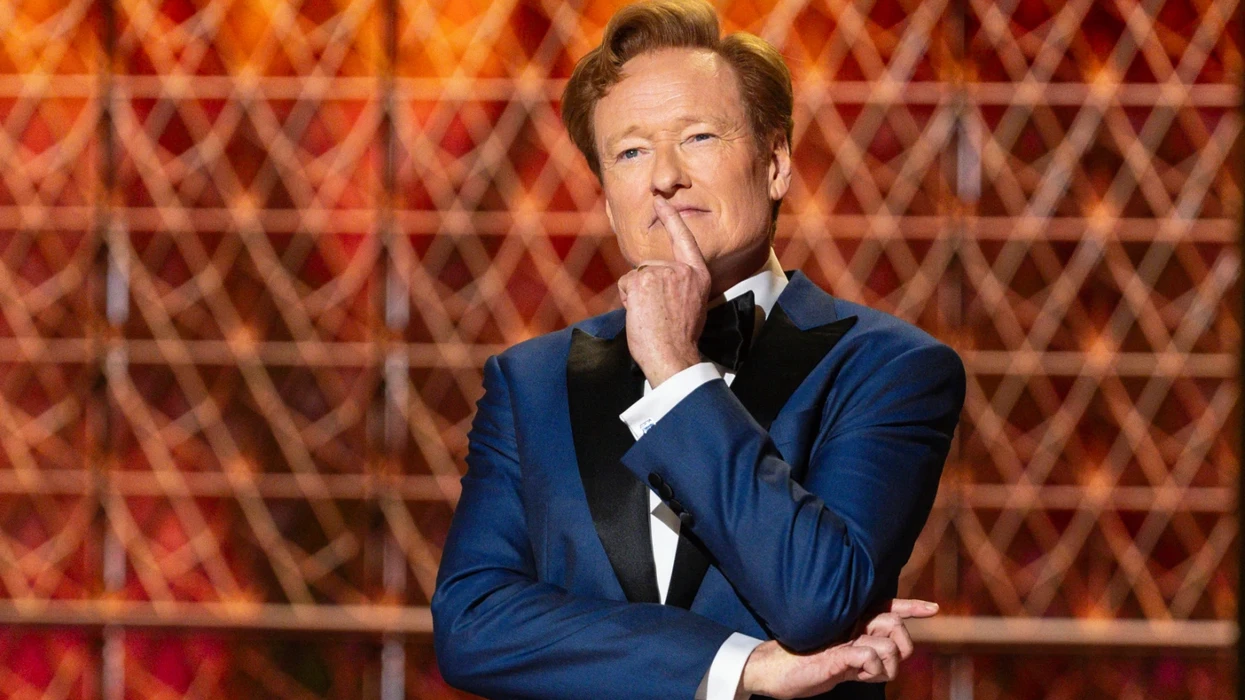
Conan O'Brien hosts the 98th Academy AwardsFrank Micelotta/Disney via Getty Images

Oscars 2026: Conan, Barbra, ‘Sinners,’ and One Awesomely Messy Night

What was that secret revolutionary password from One Battle After Another? Oh, yeah: “Time doesn’t exist, but it controls us anyway.” Fitting words for this year’s Oscars, especially when Adrian Brody was talking.

The 98th Academy Awards was the first ceremony in years where the races had actual stakes in a showdown between Sinners and One Battle After Another, two ambitious trips through American history. Both movies came away big winners, which made it a real celebration of movie culture—an Oscar Night full of highs.

And lows. LOTS of those.

Keep ReadingShow less
Kim Kardashian Denies Involvement in Sex Tape Release. Ray J’s Lawyer Calls it ‘Perjury’

Kim Kardashian Denies Involvement in Sex Tape Release. Ray J’s Lawyer Calls it ‘Perjury’

Kim Kardashian’s defamation lawsuit against Ray J took another turn this week, with Kardashian insisting she never conspired with her mother to release her infamous sex tape — and Ray J’s lawyer calling the denial “demonstrably false” and possible “perjury.”

“His claim that I had a plan with my mother and others to release a sex tape, defraud the public, and file a ‘fake’ lawsuit against the porn company that released it to ‘create buzz’ is a lie,” Kardashian wrote in a sworn declaration filed Tuesday. “My family and I are not part of a criminal enterprise; we have not conducted racketeering activity, nor have we profited from racketeering activities as the defendant claims.”

Keep ReadingShow less
Billie Eilish Eyeing Lead Role in Film Adaptation of Sylvia Plath’s ‘The Bell Jar’
Amy Sussman/Getty Images

Billie Eilish Eyeing Lead Role in Film Adaptation of Sylvia Plath’s ‘The Bell Jar’

Billie Eilish is eyeing the lead role in an upcoming adaptation of Sylvia Plath’s The Bell Jar for her feature film debut, Rolling Stone has confirmed.

Set in the In 1950s, The Bell Jar chronicles teenage student Esther Greenwood as she grapples with intense mental health struggles. The character is sent to a psychiatrist, bounces around mental institutions, and attempts to dismantle her learned understanding of traditional gender roles.

Keep ReadingShow less