
The first name you see in the opening credits of Prime Video’s new Batman: Caped Crusader cartoon isn’t Hamish Linklater, who plays Bruce Wayne, nor anyone else in the voice cast. It isn’t executive Matt Reeves, who has earned a fair share of Bat-credibility from directing Robert Pattinson in The Batman. Nor is it executive producer J.J. Abrams, who even in his fallow post-Rise of the Skywalker period remains one of the biggest names in nerd pop culture.
No, Caped Crusader wastes no time in making its intentions plain by leading off its credits with Bruce Timm, who isn’t as famous as his fellow producers, but whose name means a lot to fans of the single-best Batman screen adaptation of them all: the Nineties stalwart Batman: The Animated Series. Timm co-created that show, and oversaw a golden era of DC Comics-related cartoons that followed, including related ones about Superman, the Justice League, and even a new Batman 20 years in the future. All of them, but that first one in particular, hit the center of the Venn diagram that so many superhero stories try and fail to hit: just safe enough for kids to watch, but ambitious enough in style and theme to feel exciting to grown-ups. Even today, ask the most hardcore of Batman fans for their favorite movie featuring the character, and odds are they’ll pass over anything Christopher Nolan, Tim Burton, or Zack Snyder made in favor of the Timm co-directed Batman: Mask of the Phantasm.
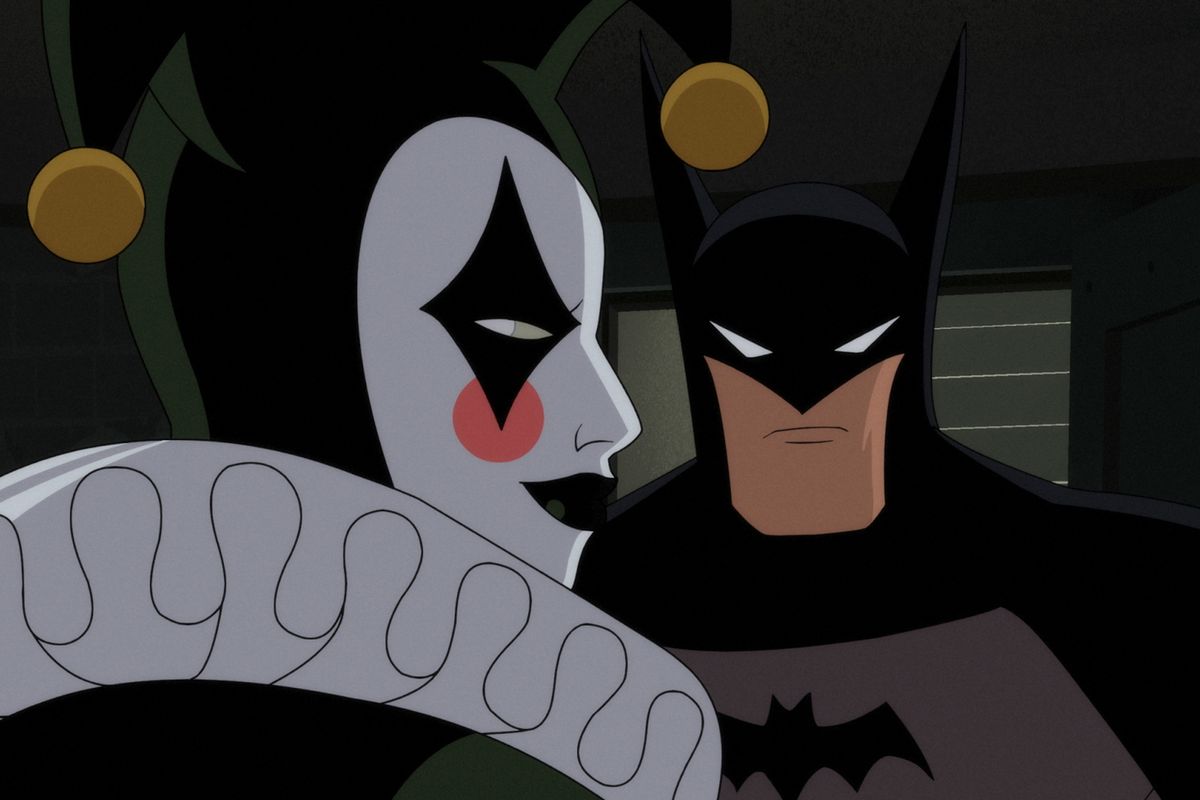
Batman: The Animated Series was meant to at once seem timeless and like a throwback to Batman’s roots as a Thirties and Forties pulp hero. Batman: Caped Crusader leans even harder into the pulp era in which Bob Kane and Bill Finger created its title character. There are a few deliberately anachronistic details like vintage TV sets, and colorblind casting of famous characters like Harley Quinn (who is Asian-American and played by Jamie Chung), Commissioner Gordon (who is Black and played by Eric Morgan Stuart) and his daughter Barbara (played by Krystal Joy Brown), in ways that pass without the comment you would expect in a less enlightened era(*). But the designs, the conflicts, and the dialogue are all straight out of the Thirties, filtered through Timm’s earlier work. Though the episodes are in color, the opening credits sequence of each is in black-and-white. In one episode, Batman and a villain get into a swordfight on a movie set designed to evoke 1938’s The Adventures of Robin Hood. Caped Crusader knows what, and when, it is about.
(*) Harley and Gotham cop Renee Montoya (Michelle Bonilla) also appear to be openly queer, as both have turned out to be in comics written (some by Caped Crusader writers like Greg Rucka and Ed Brubaker) and set many decades after this.
In leaning even further into the pulpiest aspects of the B:TAS aesthetic, Caped Crusader is a joy to look at. Over the decades, comics artists have played with Bob Kane’s original costume design — represented here with a mask featuring extra-long ears that jut out at sharp angles, and very short gloves — and tried to modernize it. But on some level, Batman feels like he fits best in the period in which he was introduced, leaping across the rooftops of Art Deco buildings and punching out gangsters wearing double-breasted suits.
Caped Crusader goes back to the beginning in more ways than one. When the first episode begins, Batman is new at the job, more a rumor than someone the general public knows about and believes in. Gordon has never seen him before. And our hero has some on-the-job learning to do. He’s not some infallible, indestructible Bat God, but a rookie vigilante prone to overconfidence. He often brushes off sensible suggestions from Alfred (Jason Watkins), and in one episode gets beaten up by a bearded lady and her friends from a circus sideshow. This unpolished take on the character suits the setting perfectly, and we get enough glimpses of him operating at full power that it still seems like a show about Batman.
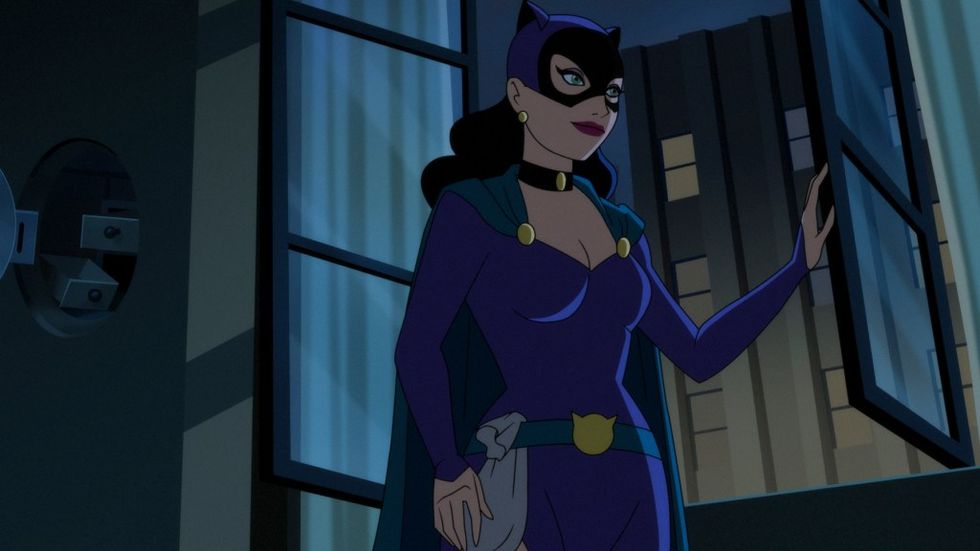
The writers also make interesting tweaks to the members of Batman’s rogues gallery who appear across the 10-episode season. Some, like the shapeshifting Clayface (Dan Donohue) or the flirtatious Catwoman (Christina Ricci), are more or less as they’ve appeared at some point in the comics. (Catwoman here is a down-on-her-luck socialite who moves in the same circles as Bruce Wayne, and wears the purple dress that was her trademark in the Forties and Fifties.) Others have been reinvented in look and/or modus operandi: the Penguin is now a woman (Minnie Driver), who performs at her floating nightclub in addition to running a criminal empire out of it, while Harley wears a more classic jester costume, and blends aspects of her day job as therapist Harleen Quinzel into her extracurricular work.
The show is loaded with Easter eggs, with nearly every significant character being named after someone in the comics, whether it’s Montoya’s fellow detectives being taken out of Rucka and Brubaker’s excellent early 2000s Gotham Central book, or newspaper photographer Eel O’Brian (Tom Kenny) having the same moniker as Plastic Man. At times, Caped Crusader can get too cute with this, like one of Harley’s associates saying “Puddin!,” which was her term of affection of Joker on B:TAS, or an episode featuring a quartet of children who are all modeled after various Robins from over the years, on a show that at the moment wouldn’t seem to have room for any kind of sidekick. (And if it did, Barbara Gordon is already there, working as a defense lawyer but frequently stepping in to protect her father from mobsters and crooked cops.) The main arc of the first season involves Bruce’s old friend, district attorney Harvey Dent, running for mayor, and in that case, the show takes advantage of the audience knowing going in that this man is the future Two-Face.
Dent is played by Diedrich Bader, who’s already voiced Batman in two other cartoons: the charmingly retro Batman: The Brave and the Bold (where Kenny also played Plastic Man), and Max’s irreverent and incredibly profane Harley Quinn. That he can fit in seamlessly in three wildly different shows is a testament to Bader’s vocal gifts. But it also speaks to the flexibility of Batman as a character that he can appear in stories with so many different tones, and so many different target audiences. And even here, all the trappings of pulp and hard-boiled fiction would make it easy for Caped Crusader to fall into self-serious parody. But despite Batman insisting to Catwoman that he isn’t fun, the show itself is.
All that having been said, Caped Crusader is a bit more exciting conceptually than it is in its actual storytelling, which is solid but unremarkable. It’s here that emphasizing Bruce Timm’s involvement is a double-edged sword, since it openly invites comparisons to a classic, of which these episodes would feel like fairly minor entries. I had a good enough time watching them, but they mostly left me wanting to revisit Batman: The Animated Series and its companion shows on a rival streaming service. Though maybe it’s all a plot to get Amazon customers to subscribe to Max through their Prime accounts?
All 10 episodes of Batman: Caped Crusader begin streaming August 1 on Amazon Prime Video. I’ve seen all 10.


 Jeremy Strong and

 Douglas, far right, with his family circa 1965 (from left): brother Joel, half-brother Peter, stepmom Anne, half-brother Eric, and dad Kirk.Hulton Archive/Getty Images
 Kirk Douglas visiting a 24-year-old Michael on the set of Hail, Hero! in 1969. Bettmann Archive/Getty Images
 Douglas with his son Cameron at the 2024 Vanity Fair Oscar Party in Beverly Hills. Kevin Mazur/VF24/WireImage
 With Glenn Close in Fatal Attraction. Paramount Pictures