
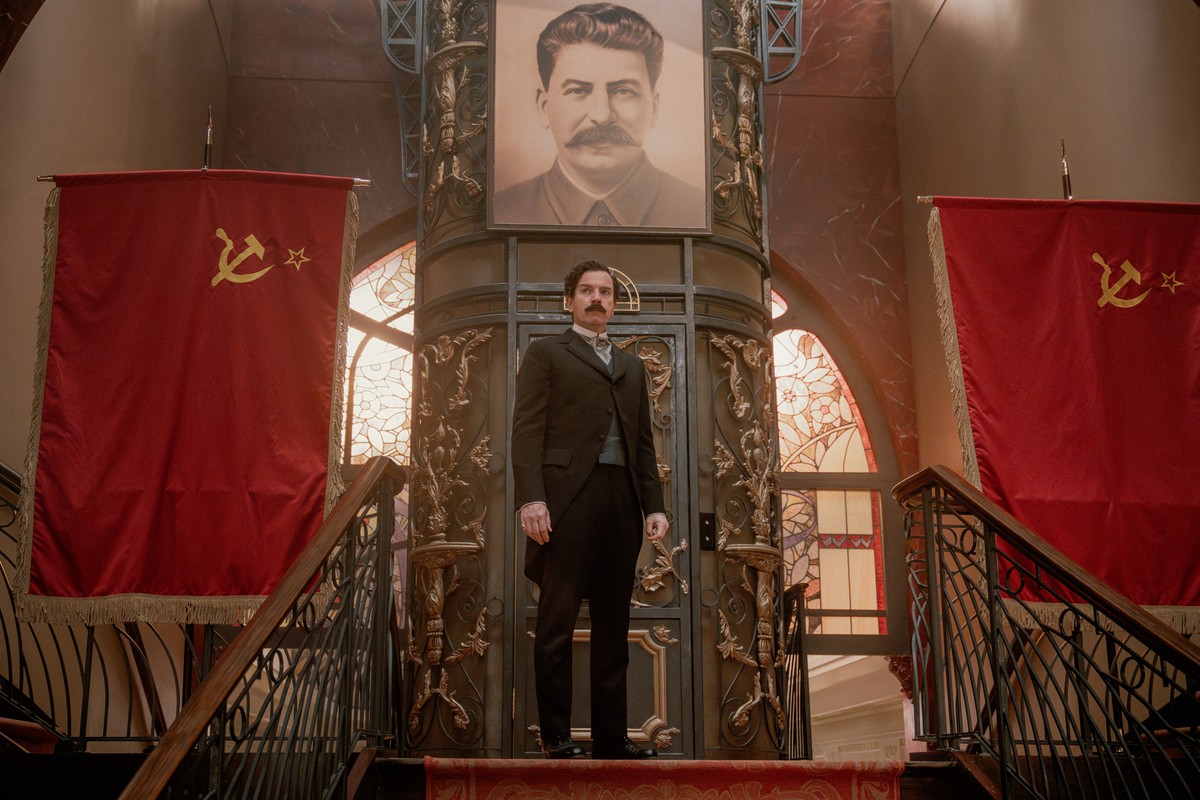

Hotels are strange, contradictory, but often wonderful places. They are permanent structures primarily designed for temporary lodging. They can offer more luxurious furniture and amenities than you get at home, yet you’ll rarely sleep as well as you do in your own bed. Dreams in hotels tend to be weirder and more vivid — there’s a reason so many of Tony Soprano’s more memorable nightmares either occurred while he was at a hotel, or depicted his unconscious self staying in one — and the setting is evocative enough to be at the center of all kinds of classic literature and film, whether the childlike wonder of the Eloise books or The Grand Budapest Hotel, the melancholy of Lost in Translation, the farce of What’s Up, Doc?, or the sheer terror of The Shining. Whether a character is in the middle of a short stay or a seemingly eternal one, a hotel makes a great starting point for all kinds of stories.
Case in point: A Gentleman in Moscow, the new Showtime adaptation of Amor Towles’ acclaimed 2016 novel. Ewan McGregor plays Count Alexander Rostov, a member of the old Russian aristocracy that has become an endangered species in the years immediately after the Revolution. It is 1921, and most of the Count’s friends and family have either fled Mother Russia or been lined up against a wall and shot. He proves a trickier case. On the one hand, Rostov is a carefree dandy who has never had to work a day in his life, but he is also credited with writing a poem that several influential Communists consider a big inspiration to their cause. As a contradictory avatar of both old Moscow and new, he’s like the old theological debate about the dead man who’s not quite good enough to pass through the gates of Heaven and not quite bad enough to be condemned to Hell. Instead, the Soviet regime sentences him to a lifetime of house arrest in his last known residence — which just happens to be the Metropol luxury hotel. Rostov has to relocate from his grand suite to tiny servant’s quarters in the attic, but he will have food and shelter for the rest of his days, so long as he never attempts to exit the building.
A four-star hotel isn’t bad as Purgatories go, especially if you’re living there while the country surrounding it is beginning decades of tumult, paranoia, and violence. Adapted by Ben Vanstone, who was the lead writer for the revival of All Creatures Great and Small, the TV Gentleman is conscious of how Rostov’s confinement is both an absurd curse and a great blessing, long before another character points out how relatively easy the Count’s life has been compared to everyone who has to live anywhere else in their motherland.
But where the series is trying to be equal parts whimsy and tragedy, it tends to be more effective at the former than the latter. The sequences about how the Count learns to navigate his unique circumstances are full of energy and wit. Rostov begins the series with an impressively waxed handlebar mustache; midway through the first episode, he’s forced to trim off its distinctive edges, but McGregor’s performance is so light and graceful in the show’s best moment, you’ll feel the curls long after you can’t see them anymore. At various points, the Count winds up playing surrogate father to two different lonely young hotel residents — first Nina (Alexa Goodall), then Sofia (Billie Gadsdon) — and it’s clear that he already sees the Metropol as an endless playground, much as they do. And it helps that the cream of Soviet society congregates there, like glamorous silent movie star Anna Urbanova (Mary Elizabeth Winstead), who’s as charmed by Alexander Rostov as everyone else(*).
(*) Real-life spouses can’t always re-create their chemistry onscreen. But McGregor and Winstead — who met playing lovers in the third season of Fargo — do not have that problem. They’re terrific together, particularly in the early episodes where Anna takes pleasure in leaving Alexander guessing about the nature of their relationship.
On the first day of his life sentence, Rostov causes a stir by appearing at his usual table in the hotel’s top restaurant for dinner. When one of the chefs wonders what the Count is doing there, head waiter Andre (Lyes Salem) suggests, “I believe he is refusing to be beaten.” That irrepressible spirit is contagious, both among the hotel staff — whose ranks the Count eventually joins, not as a punishment, but because he clearly enjoys living and working among them — and to anyone watching.
The parts of Gentleman that focus more on Russia itself are less effective. Rostov’s childhood friend Mishka(*) keeps returning to the Metropol over the years, each time providing an update on the state of the Communist experiment, and to spar with the Count over which philosophy should triumph. But even though the country keeps changing, it remains too much of an abstraction on a show whose POV character is stuck inside one building, no matter how large and architecturally impressive it may be. McGregor, Winstead, and their co-stars are also strong in the darker moments; those scenes and stories just feel less fully realized than, say, Nina and the Count discovering secret hotel passageways that only they can access through a skeleton key she procures.
(*) Like Hulu’s The Great, this show has no problem casting actors of color, like Fehinti Balogun as Mishka, to play Russians. (The two shows also have everyone speaking in a British accent — even, in this case, one or two American characters who are meant to sound different from the Russians, but whose actors can’t quite pull it off.)
Because of that slight imbalance, and because the decades-spanning story doesn’t have quite enough incident to fill eight hours, A Gentleman in Moscow turns out to be a relative rarity: the prestige drama hangout show. It can be funny at times, deeply sad at others, and occasionally even surprising. Mostly, though, it works because the Count and the makeshift family he’s forced to create within the walls of the Metropol are so appealing. For Alexander Rostov, year after year stuck inside this hotel isn’t quite what he wanted out of life. For television viewers simply looking for a likable new destination, a trip to Moscow may be just about right.
The premiere of A Gentleman in Moscow is now streaming on Paramount+ with Showtime, with additional episodes releasing weekly. I’ve seen all eight episodes.












The Trump Administration’s Lies Insult the Intelligence of Every American