
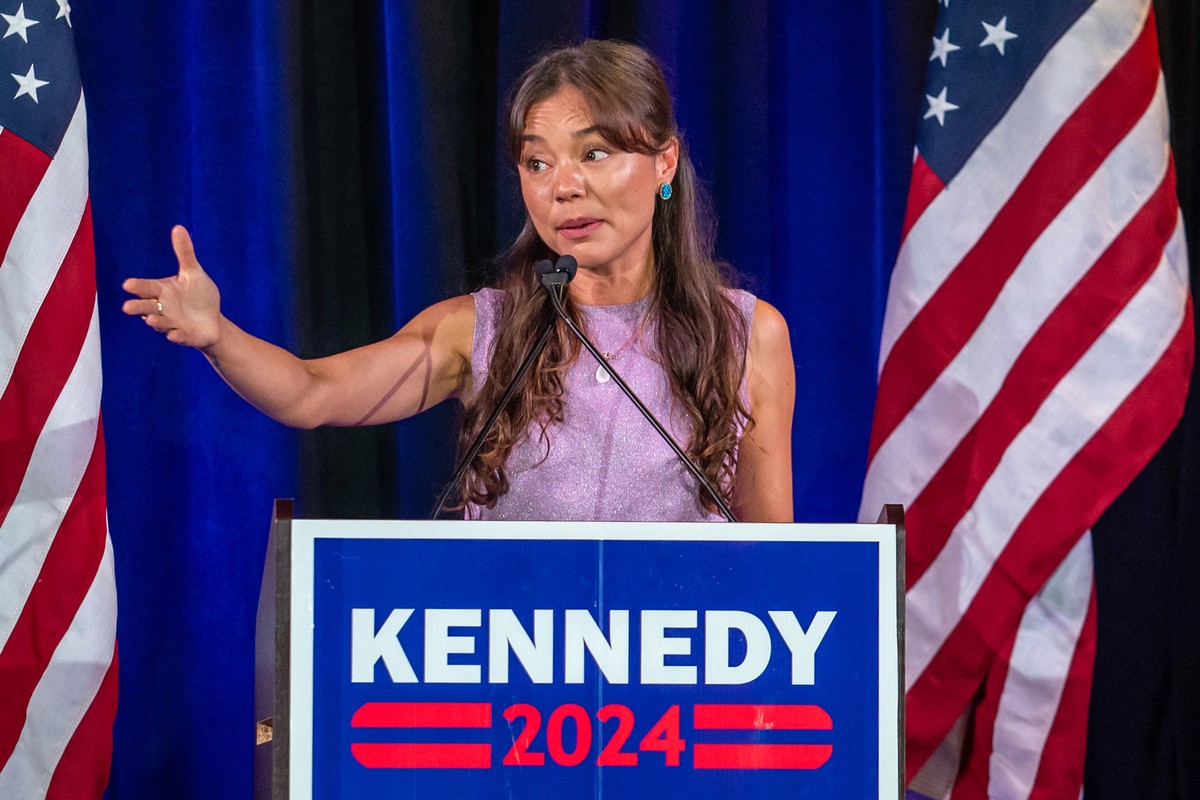

Nicole Shanahan — the running mate to independent 2024 presidential candidate Robert F. Kennedy, Jr. — is warning about a supposed luciferian influence on the national government.
Shanahan is a billionaire anti-vaxxer who, like RFK Jr., is no stranger to conspiracy theories. But Shanahan has recently embraced language common to the QAnon crowd, as well as to some Christian nationalists, to describe supernatural forces at play in our politics.
The recent dog-whistling started in late May at the Libertarian Party convention. In a written address to the gathering that Shanahan posted to X, she declared that “Bobby Kennedy can win this next election” because he “understands the deeply troubling, almost demonic forces that have overtaken our agencies, and our culture.”
A lawyer by training, Shanahan is a political neophyte, but she’s no dummy. Rhetoric about demonic possession of government plays to two crowds prone to dark superstition: adherents of the QAnon conspiracy theory and Christian nationalists. The former believe that a luciferian cabal have taken over the highest levels of government, and that this evil group of power players traffic children and harvest their blood to extend their own lives. Many Christian nationalists also believe that their movement is wrestling against demonic forces, and that their political opponents do not simply disagree with them over principle, but are in fact controlled by Satan and must be countered through “spiritual warfare.”
There is considerable overlap between the two crowds. The far-right circus known as Re-Awaken America avidly mixes QAnon adherents and the fundamentalists who encourage followers to believe that God is on their side. Both groups tend to idolize Donald Trump as a divine agent, on a heavenly mission to conquer the deep state — which helps explain why Shanahan may be seeking to substitute RFK Jr. as their savior.
As part of this persuasion effort, Shanahan on June 22 posted a list on X of things that the alleged “uniparty” hates — a list that also doubled, she wrote, as things that “most Americans love.” (The “uniparty” is populist slang to refer to Republican and Democrats who are believed to share an underlying establishment agenda despite surface level partisan disagreements.)
Most of the items on Shanahan’s top-12 list are anodyne, ranging from “democracy” and “humanity” to “real food” and “small businesses.” But one item on the list sticks out like a red flag:
“7. Questioning if the government might be satanically possessed.”
When Rolling Stone asked Shanahan and the Kennedy campaign to clarify what demonic or satanic forces she has been referring to, the campaign sent a oblique statement from Shanahan: “Corporate capture of the government has resulted in massive harm to human and ecological life,” she said. “I believe that is evil.”
Shanahan is a lawyer by training who became a billionaire by marrying and later divorcing Google cofounder Sergey Brin, whom she reportedly met at a yoga festival. Shanahan is only 38 and a political novice, but she has boosted the Kennedy campaign by donating at least $10 million to the third party effort. Kennedy tapped her as his running mate in March.
Shanahan is a raw milk enthusiast who is increasingly consuming a diet of right-wing media. She follows Tucker Carlson on X, and has in recent days retweeted a video from longtime Alex Jones wingman Owen Shroyer. Shanahan has appeared on podcasts with the chemtrail-curious Naomi Wolf and oft-canceled Dilbert creator Scott Adams. She follows two accounts of the far-right Kentucky congressman Thomas Massie on X, and has praised former congressman and GOP presidential candidate Ron Paul for “carrying [the] voice of our founding fathers.”
Shanahan is far from the only left-wing, natural-living, yoga lover whose new age spirituality and distrust of the medical establishment has led directly to a wormhole journey to the world of right-wing conspiracy theory. Rolling Stone wrote about the phenomenon during the pandemic year of 2021. “Concerns about safety have been absorbed into this other way of viewing the world,” Jack Bratich, a Rutgers professor and author of Conspiracy Panics, explained, alluding to the world of QAnon.
Shanahan, who has second billing on what is expected to be the most successful third-party presidential ticket in decades, doesn’t seem particularly averse to the conspiracy theory — if she isn’t pushing some of its core principles outright.




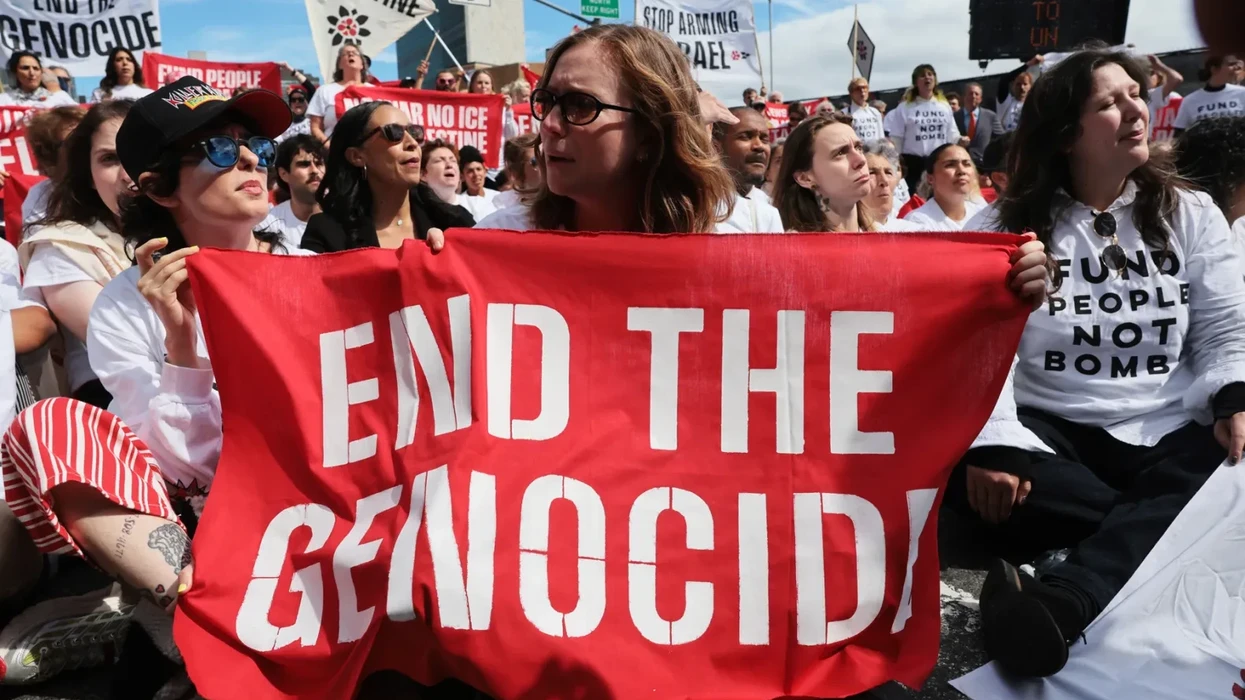
 NYPD officers detain Susan Sarandon and pro-Palestinian demonstrators near the United Nations, ahead of Benjamin Netanyahu’s address, on Sept. 24, 2026.CHARLY TRIBALLEAU/AFP/Getty Images

 A Canadian flag flies along the waterfront of Lake Ontario, on Aug. 27, 2026. Cole Burston/AFP/Getty Images
It’s Been 25 Years Since 9/11. Did the Terrorists Win?
I once had a conversation with Barack Obama about the nature of terrorism. This was during his second term, and he’d been going on for a few minutes about how Islamic terrorism wasn’t actually an existential threat to Americans, but rather a chronic and manageable risk. I was all too familiar with this argument, having conducted the interview with John Kerry in 2004, in which he said terrorism could be reduced to the level of a “nuisance” — a quote that blew up on him during the final weeks of the campaign. I found Kerry’s answer problematic then, and I had the same reaction when Obama said it. I asked him pointedly: What would have to happen for him to decide that terrorism was, in fact, existential? How about a suitcase nuke on a subway car? Then would he concede that terrorists were more than criminal gangs?
Obama didn’t hesitate. Terrorism would only reach the level of an existential threat, he told me, if Americans responded by abandoning their own values and turning on one another. There was nothing a bunch of homicidal zealots could do to destroy the most powerful country on Earth, but we could certainly destroy ourselves if we abandoned our constitutional protections in a fit of panic.
At the time, this struck me as something you might expect to hear from a constitutional-law professor, but not necessarily from the president of the United States. There was an intellectual fatalism about Obama I sometimes found disconcerting — a sense that he saw himself as a twig in the river of history, and it was up to the rest of us to change the current. I doubt he would dispute that assessment. But I thought often of that conversation a few years later, as the country careened into the Trump era. And as we pause now to reflect on the 25 years that have passed since the attacks of Sept. 11, I find myself thinking about it again.
Alternative histories are a tricky business, best left to novelists and sci-fi filmmakers. As a friend of mine in politics likes to say, mockingly, whenever such theories get floated: What if Hitler had won the Civil War? And yet, it’s hard not to see a direct line between the events of 2001 and where we are today — and to wonder how different the country might have looked had it never happened. On the eve of the devastating attacks on the World Trade Center and the Pentagon, George W. Bush’s young presidency seemed to be wobbling. Absent those attacks, he might well have been a one-term president, and he almost certainly would not have invaded Iraq. Nor would Democrats become backed into defending the entrenched war in Afghanistan as the “good war” — a way of differentiating their own response to 9/11 from Bush’s without sounding reflexively pacifist.
Without the economic shock of 2001, it’s unlikely that desperate policymakers would have looked the other way while lenders, underwritten by the government, turned the housing market into a casino, leading to the second massive blow of the decade: the market collapse of 2008. All of these things, in quick succession, destroyed what remained of the public’s faith in its governing establishment, leading directly to Obama’s stunning takeover of the Democratic Party and, later, to the election of Donald Trump.
The Trump I met in the late 1990s, while he was flirting with an independent run for president, held himself out as a centrist reformer, in the mold of Ross Perot. By 2015, when he started running as a Republican, Trump had fully embraced a reactionary, white-nationalist movement — a response to Obama, yes, but also to Bush, whose instinct in the months after 9/11 had been to speak out forcefully in defense of Muslim Americans, and whose support for liberalized immigration infuriated much of his party’s base. Trump’s core appeal then, as it is now, was rooted firmly in the nativist, anti-globalist backlash that emerged in 2001. (According to Pew Research, roughly 42 percent of Americans believe Muslims are having a negative impact on the country.) The animating idea of Trump’s second term is that white, English-speaking Americans are the only authentic Americans. It shouldn’t be controversial to say that he will twist or shred any page of the Constitution to enact this vision, since he really makes no effort to conceal it.
Nor is America’s hard turn away from pluralism and liberal democracy happening in a vacuum — far from it. In the past decade, similarly reactionary, anti-immigrant movements have rocked Britain and taken over Italy, and they now seem poised to wrest power in France and Germany. Maybe some of this would have happened without 9/11; the hollowing-out forces of globalization and automation were already fueling plenty of economic fury here and in Europe by the turn of the century, and the revolution in social media wasn’t far off. But there’s little doubt that the “War on Terror,” which became the first real foreign policy framework since the end of the Cold War, focused all of that anxiety toward an identifiable enemy, fracturing societies that had been held together by a 50-year consensus around personal liberties. If Obama were being honest, he’d probably say he told me so, and he’d be right.
IN THE MONTHS after 9/11 and before the invasion of Iraq, it was hard to get much perspective, and genuine patriotism mixed — as it always does — with a series of mindless gestures and clichés. Flag pins became mandatory even for reporters, peace songs were effectively banned, Republicans brought “freedom fries” and “freedom toast” into the lexicon to protest French misgivings about war. It became rote for politicians to say that the terrorists hated our way of life and we would never let them win. (To this day, when my dog snarls at some terrified Shiba Inu for no reason, I ask her why she hates freedom.)
Twenty-five years on, though, with the benefit of distance and experience, we can ask some questions we couldn’t ask then. And one of them is what the violent extremists who sent those suicide planes into our buildings really hoped to achieve. Did Osama bin Laden think he could win a holy war with America? Did we ultimately frustrate his script for the downfall of the West, or did we simply play our part?
Terrorism is, by its nature, asymmetrical. Whether it’s the Viet Minh under the French, or the IRA in Britain, or Al Qaeda, there’s an inherent understanding that the terrorist can’t win a conventional war against an obviously superior military force. What the terrorist seeks is destabilization of the status quo. His desperate act is an igniter in search of fuses; the goal is to set off a chain reaction inside the fortress that can’t be controlled, to disrupt order with chaos and see what shakes out. The terrorist knows this will likely cause his own people suffering in the short run, but that’s part of the point. He believes the occupier to be a soulless monster, and by reducing it to its basest instincts, he hopes to bare its nature to the world.
We’re seeing this play out, in real time, in Israel. The leaders of Hamas, their military options exhausted and their political goals slipping away, could not have been under any illusion that they would drive out the Israeli occupiers by savagely killing and mutilating more than a thousand innocent people. They must have hoped that Israel would react with blind fury and cruelty, resorting to the instinct for all-out annihilation that its leaders had long managed to suppress. Nearly three years later, Israel has tumbled from legitimatized power to international pariah, its politics riven by disunity, its moral authority in shambles. Do we think Hamas really cares that more than 70,000 of its own people have died in the carnage? Its repugnant leaders almost certainly consider that a cost worth paying in the broader context of history. What they have achieved, in political terms, has exceeded their most feverish dreams.
The Israelis should have looked across the Atlantic and learned something from our own experience. America on Sept. 10, 2001, was an unchallenged superpower at peace — vexed by social and economic divisions, yes, but still stable enough to survive a disputed election with its political consensus intact. A quarter century later, we find ourselves fighting a third unsuccessful war in the Middle East, our society more divided and our politics more poisoned than any time since the 1800s, a foundation of laws imperiled after 250 years of durability, immigrants hunted down like animals by masked agents, violence and extremism on the rise from both right and left, truth and intellectualism in retreat. This is not solely the fallout from Sept. 11, 2001, but it is the result of a series of events that, were you able to hit a rewind button and live it all again in reverse, would lead you directly back to that day. If bin Laden meant for his attack to be the first in a series of similarly epic crimes, then he was soundly defeated — no small achievement for American soldiers and spies. But if his goal was to destabilize America and bring out the worst of our nature, then he may have pulled off the most successful terrorist attack in history.
Over and over we told ourselves, in that agonizing moment, that the terrorists would never win. A quarter century later, it’s getting hard to argue they didn’t.