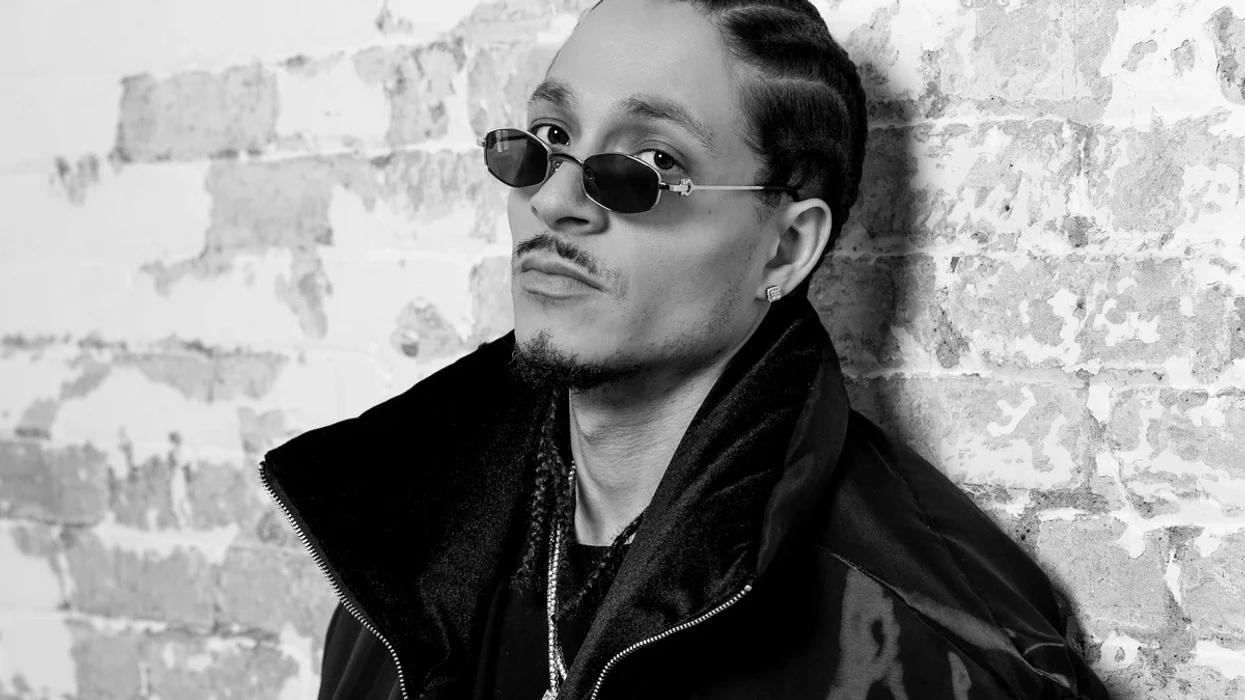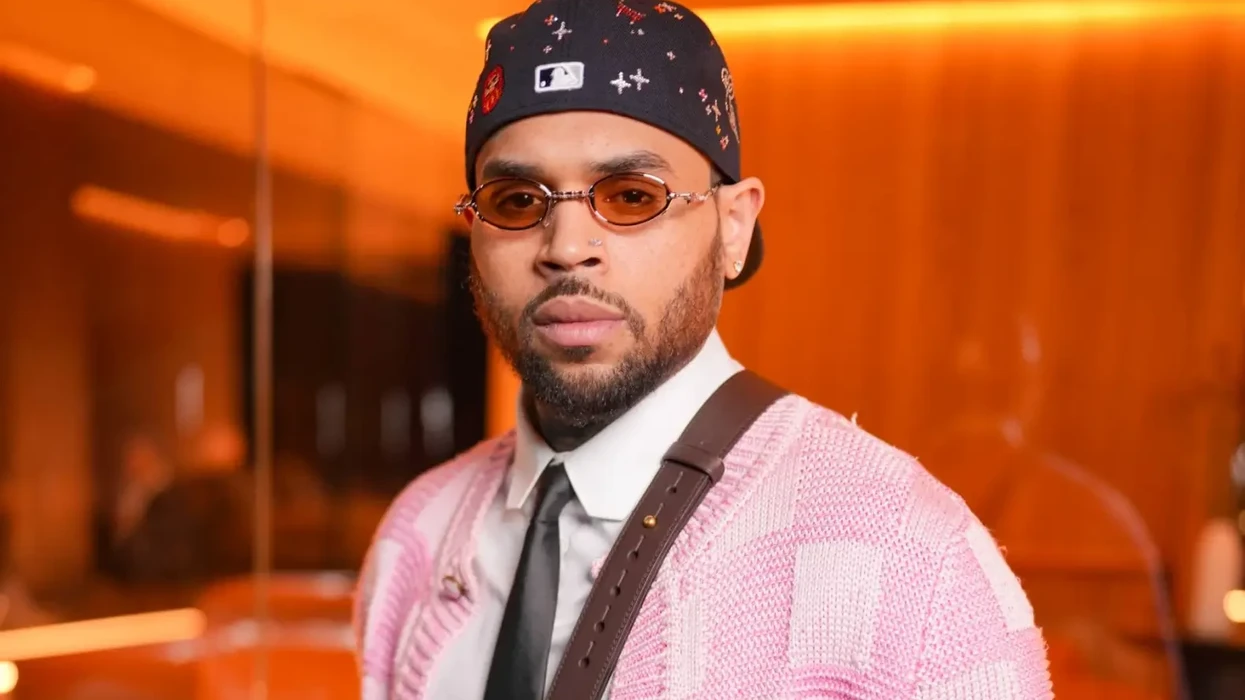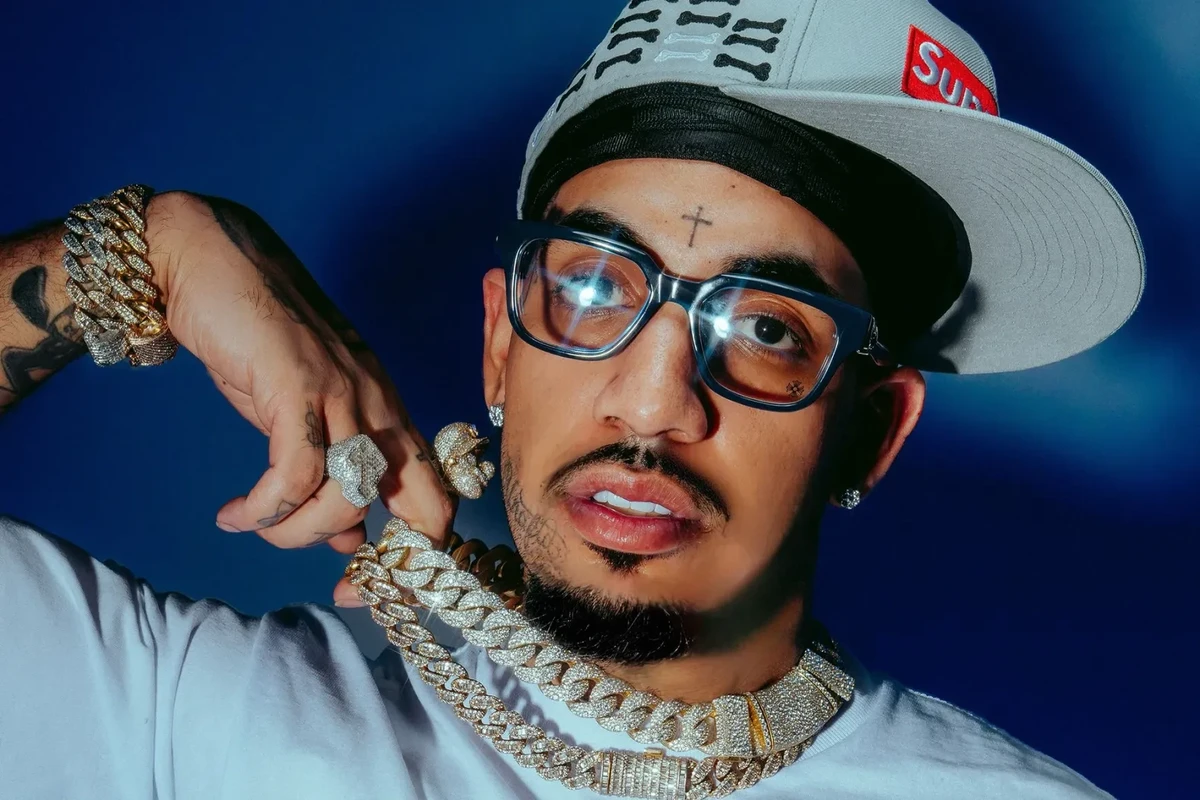

When Fenix Flexin and Tyga worked together in a studio this summer, Tyga realized they had independently landed on a similar Eighties sound. By then, Fenix, the Los Angeles rapper and Shoreline Mafia member, had released a song called “Rubberz” with producer Purps on the Beat. It sounded like a record transmitted straight from a time machine, with Fenix singing in a fake British accent over New Wave synths. As you probably know by now, it became a hit: “Rubberz” peaked at Number 58 on the Billboard Hot 100.
Tyga, meanwhile, was deep into $TARFACE, a 10-song album of glossy Eighties pop credited to Tyga and his new alter ego, also named $TARFACE. He and Fenix recorded “Lavish,” an unreleased collaboration that found them playing with the same bright keyboards and processed vocals. Tyga says they arrived at the sound separately.
“But when he came to the studio, I was already deep into working on my Eighties-sounding music,” Tyga recently told VIBE. “I had already played him some stuff. So, when I saw what he was doing, I was like, ‘Oh, this is fire! We should do this record together because I see you on a similar wave.’”
Then both “Rubberz” and $TARFACE got pulled into the AI debate. Tyga confirmed that he used AI as a production tool, citing the Eighties-style synths and a guitar solo as examples of what the technology supplied, while maintaining that he wrote the songs and performed all the vocals. Fenix initially said there was “no AI” on “Rubberz.” After Treblo’s own classifier returned a “very likely Treblo” result, he acknowledged some AI use but claimed it “had nothing to do with the recording process” and that he did not know about the app until he got to the mixing stage.
The AI fight soon crowded out the music — it’s heavily cited in Pitchfork’s review of Tyga’s album, which features the site’s lowest rating in 19 years. All the while, though, another trend has been brewing, as rappers across the country reach back into hip-hop’s own dance-floor history.
Kendrick Lamar’s Number One hit “Squabble Up” is built around Debbie Deb’s Pretty Tony-produced freestyle classic “When I Hear Music.” Drake’s 2025 hit “Nokia” runs on a bright keyboard riff and the bounce of Atlanta bass. Tyler, the Creator followed 2024’s Chromakopia with Don’t Tap the Glass, a compact dance album steeped in electro, synth-funk, and Miami bass. This year, Drake returned to the dance floor on Maid of Honour. Chicago rapper BabyChiefDoit’s electro-sounding “Ghetto Love Story” and its rise to Number 44 on the Hot 100 speaks to the same renewed appetite for rap records made for dancing. Its hook puts the idea simply: “I just wanna dance.”
While “Eighties revival” is convenient shorthand, it’s not the entire picture. Mainstream pop has spent years mining this and similar eras, most visibly in the neon synth-pop of the Weeknd and the disco revival around Dua Lipa. But the rappers reaching backward now are often pulling from a different archive.
“Everybody in pop these days wants a piece of Eighties synth-pop, but these artists are doing it in a specifically hip-hop way,” says Rolling Stone contributing editor Rob Sheffield. “They’re going back to crucial moments on the timeline of the music’s evolutionary history. They’re also giving it up to specific Eighties regional rap scenes, so it’s geographical as well as time travel.”
Music journalist, DJ, and producer Vivian Host similarly objects to the easy genre label. “I think freestyle, electro and bass music should not be lumped into Eighties synth pop,” she says. The overlap comes partly from the gear used at the time, including drum machines like the Roland TR-808, and a new generation of synthesizers that came to define the era across genres. Even so, the songs were built differently and worked on different dance floors. “I would say electro, freestyle, Miami bass and Eighties synth-pop spoke to different cultural/regional communities,” Host adds.
“Squabble Up” depends on exactly that kind of regional specificity. Host notes that “When I Hear Music” came out of Miami and became a fixture on Los Angeles radio stations, including KDAY and Power 106. She hears the sample as an homage to a local favorite that had long circulated within Los Angeles rap culture. Fat Joe, Anitta and DJ Khaled made a similar move on 2024’s “Paradise,” which samples Stevie B’s “Spring Love,” a freestyle staple in New York and Miami. The reference points on “Rubberz,” meanwhile, are closer to the polished, synth-heavy Eighties pop and rock of Tears for Fears, Hall & Oates, and Phil Collins.
“‘Squabble Up’ sounds so radical because Kendrick’s out to make the ultimate 2020s L.A. record, but he’s doing it with the ultimate 1980s Miami beat,” Sheffield says. “It’s total freestyle with that Debbie Deb/Pretty Tony dance beat, with the 808s in attack mode. It’s even more audacious since in terms of Eighties regional sounds, L.A. and Miami had such different agendas.”
Oliver Wang, a sociology professor at Cal State Long Beach who also writes about music and works as a DJ, notes that this trend isn’t necessarily new. “The Eighties, musically speaking, never went out of fashion, certainly not in hip-hop,” says Wang. “The Eighties ushered in this incredible diversity of distinct musical flavors, from late-era disco to freestyle dance music, synth-driven modern rock to drum machine hip-hop beats.” Artists born well after the decade still grew up with those sounds. “Today’s artists would hardly be the first to think, ‘Maybe I can make something new by reworking something old,’” Wang continues. “That’s the history of hip-hop from its very beginning.”
In the early days of hip-hop, rap existed on the dancefloor alongside other genres. Egyptian Lover, the pioneering Los Angeles DJ and producer whose 808-driven records helped define West Coast electro, remembers the categories coming later. “Electro was hip-hop,” he says. “‘Planet Rock’ had everyone in hip-hop trying to make a dance track.” Of the scene that followed, he adds, “It was a big scene in hip-hop. Later they called it electro.”
As rap’s existential moment continues, with commentators noting the ongoing lack of chart-topping rap hits, as well as the kinds of rap and pop crossovers seen in the 2000s, it would appear there’s an instinct towards these otherwise overlooked connections. Early in the genre’s history, long before the advent of streaming and more passive modes of engaging with music, there was still an emphasis on sounds that got people moving.
To Sheffield, it’s a sign of generations recognizing one another. “It sounds like utopian community-building, making connections between different rap eras and scenes and cultures,” he says. “For these artists, I don’t think it really has anything to do with any kind of Eighties nostalgia. It sounds really different from the Dua/Weeknd synth-pop approach. I hear it as hip-hop celebrating its own unique legacy.”