
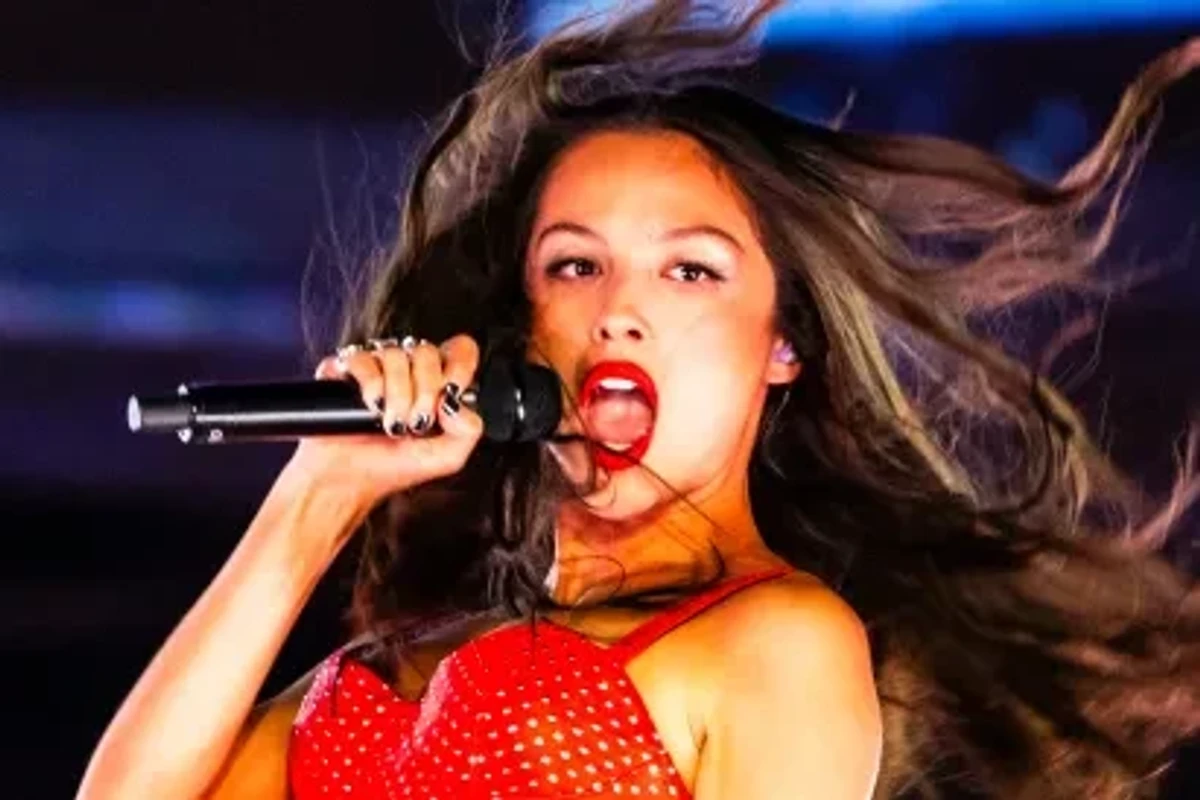

Olivia Rodrigo will never settle for being just another main pop girl. She demands to be your perfect all-American rock star. O-Rod has claimed her crown as the truest, realest, most shameless rock & roller of our moment. “There’s something so special about rock music made by women,” she said in December, in her conversation with Bikini Kill’s Kathleen Hanna for the Rock & Roll Hall of Fame podcast. “There’s a different emotional quality to it. The pain and rage and vulnerability that a woman can express through a rock song is an entirely different category. Growing up, I was so inspired by that.”
This former Disney princess has always reveled in her rock moves, ever since her first tour in 2022, when she was covering Veruca Salt and Avril Lavigne. Early on, she joined No Doubt and Sheryl Crow onstage. But she takes special pride in celebrating the Nineties feminist-punk explosion — and claiming her place in it. This is the girl who told Rolling Stone her mom used to wake her up every morning by playing the 1990s grunge queens Babes in Toyland. (“Vomit Heart” walked so “Drivers License” could run?)
Last year was Rodrigo’s festival era, rampaging around the world with her lethal all-female band. She cranked up her fiercest arena-slaying bravado, belting “All-American Bitch” as the bloodthirsty rock & roll animal she was always meant to be. She dropped to her knees to worship the guitar heroes in her band, Daisy Spencer and Arianna Powell. She sang duets with her idols, from Weezer to David Byrne. Best of all, she shared the stage with the Cure’s Robert Smith at Glastonbury, calling him “the greatest songwriter to come out of England.”
But she’s always given it up to her rock inspirations. In June, when she made her surprise appearance at the Primavera Festival in Barcelona, she shocked the crowd by bringing out Robert Smith himself, who joined her to debut their then-unreleased duet “What’s Wrong With Me.” She sang her Number One hit “Drop Dead,” with the line “You know all the words to ‘Just Like Heaven,’ and I know why he wrote them” — then she sang a duet with the man who wrote them.
Rodrigo obviously wasn’t kidding when she kept saying how her new tunes were inspired by goth bands like the Cure and Joy Division. You can hear that all over her blockbuster album You Seem Pretty Sad for a Girl So in Love. She digs deep into Eighties and Nineties rock sounds: the synth buzz of “Maggots for Brains,” the electro-punk aggro of “My Way,” the post-punk guitar jangle of “U + Me = <3.” “The Cure” might be her greatest song yet, simmering in the 1990s mode of Smashing Pumpkins and Liz Phair. This summer, she joined the Pumpkins at Lollapalooza, singing the Mellon Collie banger “Thirty Three and a Third,” shortly before she was seen rocking out at a My Chemical Romance show.
She has made a bold statement with her Daisy Chain Fields festival, a wildly ambitious celebration of women in music, reaching back to legends like Stevie Nicks from the 1970s; Garbage, Bikini Kill, and the Breeders from the 1990s; and Karen O from the 2000s. The slate reached from Doechii to Katseye to Mitski, not to mention her old doughnut-shop friend Chappell Roan. It’s fitting that she sang a triumphant duet with Sarah McLachlan, since she’s upholding the spirit of the pioneering Lilith Fair.
She keeps showing off her wide-ranging sense of rock history, with her producer-collaborator Dan Nigro, who came out of the Long Island emo scene with his band As Tall As Lions. (She’s said he suggested her joke on the album about her “yacht-rock music taste.”) Rodrigo’s unfiltered rockness is an achievement to celebrate. May she stay this unrelentlessly upset forever.
This story is part of our Reasons to Love Rock series, with all the sounds, trends, scenes, and artists that have us excited about rock music in 2026.






Elliott Smith in 2003.
Why Is Everyone So Mad at Supreme’s Elliott Smith Collaboration?
Earlier this week, Supreme announced an Elliott Smith capsule collection, including a selection of jackets and T-shirts featuring artwork from across the late musician’s career, from his self-titled 1995 album to his seminal 1997 album Either/Or to 1998’s XO and 2000’s Figure 8.
The internet seems to be in a huff over this, relying on a view of Supreme and streetwear frozen in 2008 that was, even then, embarrassingly myopic. The line of thinking goes that Supreme, the brand that was founded in New York in 1994 by designer James Jebbia and that has been a staple in skate and streetwear culture ever since, is an inauthentic purveyor of the ethos represented by Smith and his music. One might cite the brand’s roughly $500 million investment from the Carlyle Group in 2017 or its association with high fashion as disqualifying characteristics. More than anything, there seems to be a sense that taking shots at a nearly 40-year-old streetwear institution is a way to prove one’s unsullied dedication to a sense of anti-consumerism. The anger is misplaced.
In a culture awash in goofy collaborations and corporate cash grabs, Supreme might be one of the few brands still operating from an actual set of beliefs. Its Elliott Smith capsule (which was made with permission from Smith’s estate) is in a long line of collaborations that Supreme has done with musicians. Its first artist collaborator was Rammellzee, the experimental rapper and visual artist whose relationship with the brand dates to 1994, the year Supreme opened. By 2005, Raekwon was posing with a Tickle Me Elmo for the first of Supreme’s commissioned portrait T-shirts. Across its music collaborations, portrait tees, and tributes, the list includes everyone from Michael Jackson to the Velvet Underground, Nirvana, Butthole Surfers, My Bloody Valentine, Daniel Johnston, Aphex Twin, and SALEM.
There have been collections with record labels like Stax, Wackies, Rap-A-Lot, Ruff Ryders, Jah Life, and Duck Down, the last of which put Black Moon and Smif-N-Wessun’s album artwork on clothes. There are shirts and shoes with Peter Saville’s artwork for Joy Division and New Order. The Smith collaboration is so patently in the wheelhouse of what the brand has done for decades that bringing it up now as some sort of “gotcha!” feels more like a product of social media’s tilt towards rage-bait than any defense of an artist.
Elliott Smith, who died in 2003 at 34, has long been a part of skate culture. He was friends with Mike Mills, the skateboarder and filmmaker who designed graphics for Stereo and one of Supreme’s early logos. Mills worked on unused cover art for Figure 8 and later enlisted Smith to record music for his film Thumbsucker. And Smith’s music has been celebrated in the world of skateboarding for many years now. Mark Baines skated to “Happiness” in Blueprint’s Waiting for the World in 2000. Nate Broussard used “A Distorted Reality Is Now a Necessity to Be Free” in Static III in 2007. Dylan Rieder skated to “Coast to Coast” in Alien Workshop’s Mind Field in 2009, and Mark Suciu used “Junk Bond Trader” in Cross Continental in 2012.
Arguing that he would have hated the collaboration, aside from being infantilizing, completely ignores the actual culture around Elliott Smith when he was alive, instead opting for some abstract representation of a person who actually existed in the real world — a particularly Gen Z problem, to be frank.
With these collaborations, estates and relevant parties are always compensated. And that actually matters in an era where an artist can remain a staple for young people for generations, long after they’ve died, while reaping diminishing returns thanks to the paltry payouts from streamers. Meaning, short of throwing him onstage as a hologram or doling out money-grabbing box sets, a tasteful collection with a brand with a real connection to his work is actually one of the better options that exists.
People who want to be mad at Supreme want to separate themselves from some sort of mainstream idea of cool. They want to believe that they have an authenticity that Supreme doesn’t. Sorry to say, the reverse is more likely true. Just last week, Business of Fashion published a report on the brand’s cultural durability. “Supreme isn’t cool anymore” is, in fact, a very uncool thing to say in 2026. And beyond that, the people inside the company are coming from an ethos that has remained steadfast in actually supporting youth culture.
To sit on the outside now and pretend that you’re such an authentic Elliott Smith fan that you’re upset by this is simply to expose how out of touch you are.