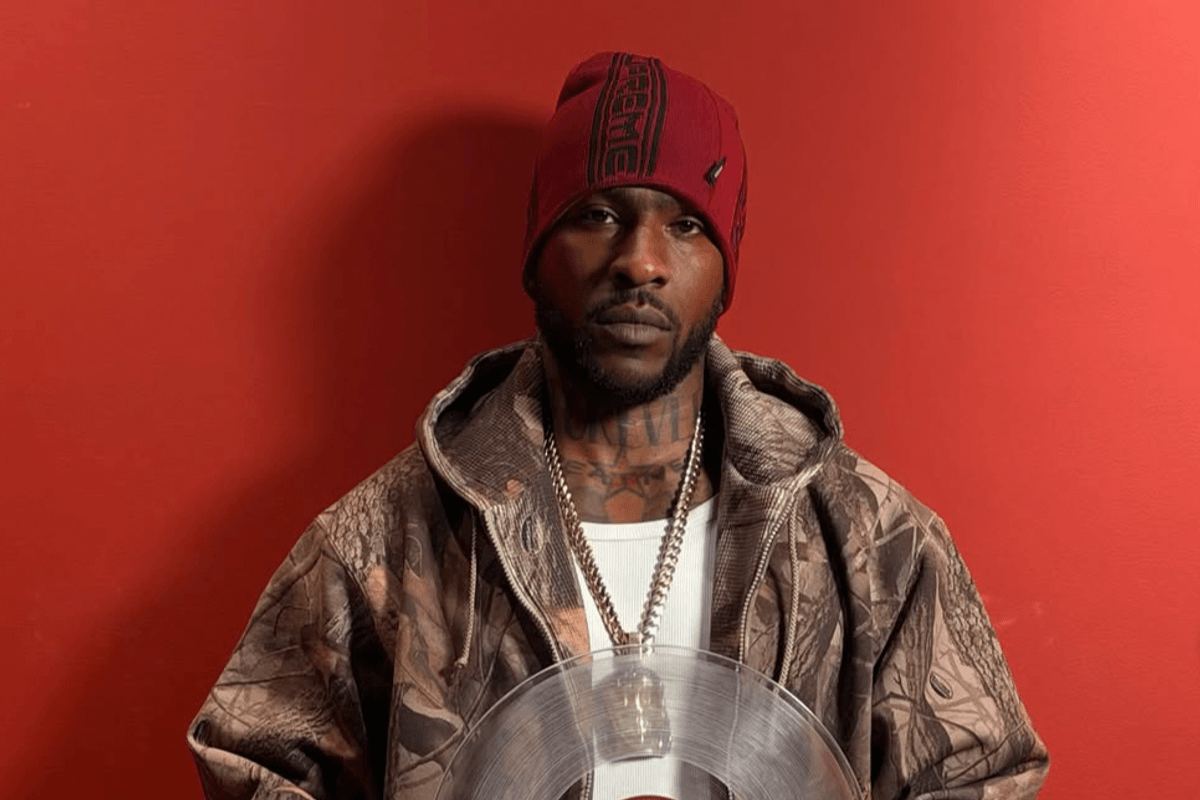

On “Outside,” Skepta is signing records at airport arrivals when he gets to the matter of his standing in grime. He’s been calling himself the king for 20 years, he says, and nobody has cared to challenge him for the title. Novelist follows with an observation about the limited authority of a man who crowns himself. The joke is in the running order, whatever either rapper intended. It’s also a measure of Skepta’s confidence on The Fork and Knife, his first solo album since 2019’s Ignorance Is Bliss. He knows how much a guest can do for a song, especially when they complicate the verse he’s just delivered. At its best, this is an album on which a boast can turn into a conversation before Skepta has had time to admire it.
The title comes from a family story. Skepta’s maternal grandfather, who worked in hospitality in Nigeria, hoped his family would one day be prosperous enough to sit down to a meal with a fork and knife. “Secrets of Patriarchy” has a dry sense of what that prosperity can look like in practice. Skepta gets home from the studio at five in the morning, sleeps for two hours and gets up for the school run. The refrain recites the instructions he grew up hearing about earning money, starting a family and being a man. There’s more wit in the verse, where he has to make good on several of those instructions before breakfast.
The record is less nimble when it tries to make money explain everything. “Turnt that pain to currency” is a neat line that loses something each time “Currency” sends it around again. “Magic,” with Finessekid, has a better sense of how people behave around money. The same people who disappear when you’re broke can resent you enough to explain away your success when you’re rich. Project Pat has more fun with the subject than anyone. On the Memphis-leaning “Cold Shower,” he remembers robbing people, thanks God for his mercy and gets back to counting money without giving any indication that he considers these separate subjects. It’s one of the funniest verses on the album.
“Pandora’s Box” and “Revenge” are the strongest stretch of solo writing. In the first, Skepta notices how quickly a friend who treats people badly can recover his manners when someone has drugs, then brings his own weed use into the story. The admission matters because he’s spent enough of the verse sounding like the sensible one. On “Revenge,” he dates his loss of direction to 2008, remembers Wiley giving him the “Rolex” beat and supplies the answer he wishes he’d given. That imagined reply is more revealing than any broad apology for chasing pop hits. He remembers wanting the opportunity badly enough to make a decision he still has occasion to reconsider. With no chorus, he can follow that thought for nearly four minutes, and the older “Gas Me Up (Diligent)” feels a little too assured when it turns up two tracks later.
There’s a welcome lightness to the love songs. Asake gets the hook on “Aloe Vera,” and his compliment about somebody’s skin has a simplicity Skepta’s Steph Curry and Einstein punchlines could use. On the zouk-inflected “Chippie,” Skepta introduces himself to Aya Nakamura in French and gives the flirtation somewhere to go by leaving her plenty to say back. “Melody” is more intimate for a smaller reason. A woman interrupts his deliberations about whether he’s in love to ask when he’ll make time for her and whether he’s eaten. He’s been thinking about the nature of his feelings. She’s been thinking about the last time they saw each other.
“Broken Hearts” is the album’s best song because it lets that difference develop over several turns. Skepta buys a woman a Rolex after she asks for attention, and Central Cee gives an equally persuasive account of why a man might consider what he can spend a measure of how far he’s come. Jorja Smith sings about a man who says he’ll call and then goes silent. When she brings up the watches, she makes Skepta’s choice of gift sound like an unusually literal evasion. He produced the song himself, and letting her close it is the smartest decision he makes on the track. Another verse from him would only make her point for her.
The album’s most ambitious single makes room for an argument of a different order. On “Innocent Smile,” Chase & Status supply the breakbeats and Suggs of Madness sings the hook, while Skepta traces his parents’ journey from Nigeria to Tottenham and goes after British politicians who scapegoat immigrants. “Ain’t no love for an immigrant child,” he raps, and the line takes on extra force if you remember the reconstructed playground encounter that opens the album, where another child asks what kind of name Adenuga is. The collaboration works because the song has the scale of a club single and a grievance specific enough to survive that scale. Skepta knows exactly whom he’s talking about.
“Belly” is the strongest argument for the album’s length. Skepta, Mayhem NODB, Kruz Leone, Kibo, Jme, Frisco, Queenie and Bossman Birdie get nearly nine minutes without a chorus. Deep into the cypher, Queenie mentions that Skepta would bet on her, then warns you what she charges for a line. It’s a lovely piece of etiquette from an MC who can acknowledge the invitation and make sure you understand the terms of the next one. The digital edition closes with “Victory Lap,” the Fred again.. and PlaqueBoyMax collaboration that samples Doechii’s verse from “Swamp Bitches,” her track with Rico Nasty. It’s a good party record, but “Belly” is the one I’d go back to first. Skepta spends “Outside” wondering who’ll come for his title, then spends the longest track on the album giving seven people a fair shot.
The Fork and Knife