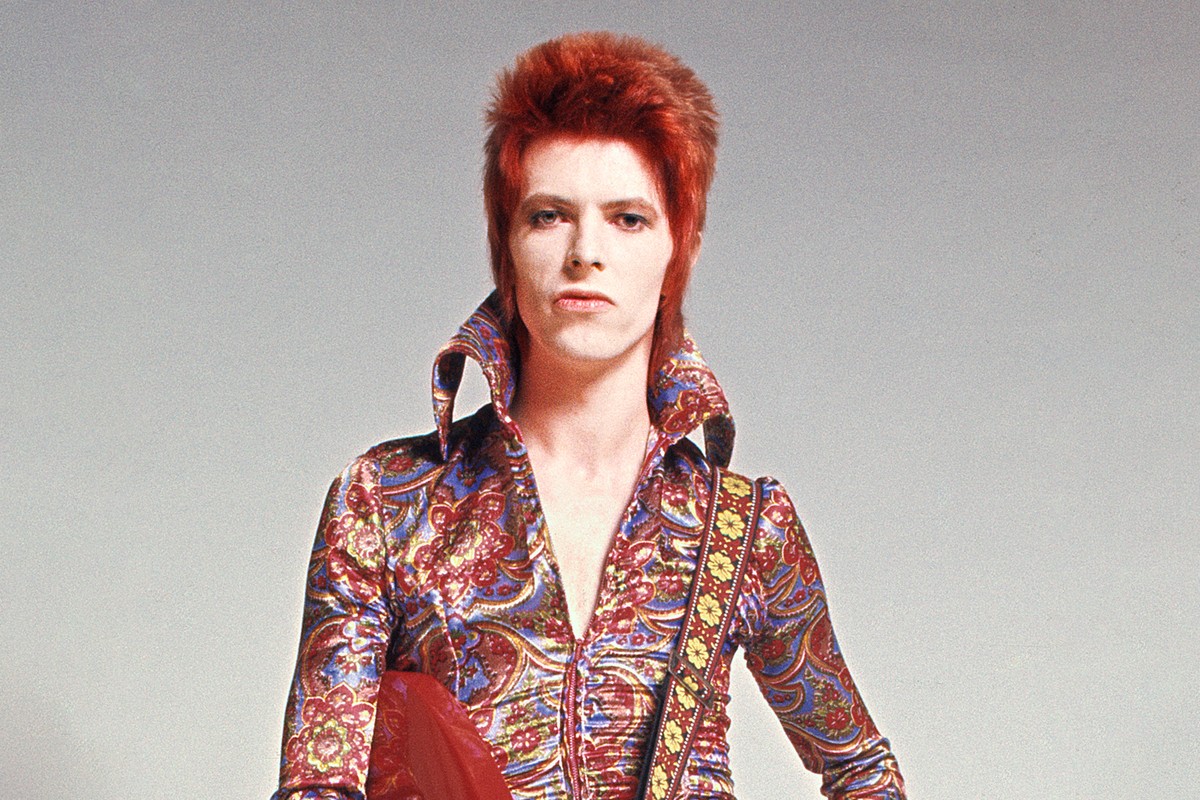

The genius of David Bowie didn’t lie so much in how he reinvented his personae but in how he concealed their formations from the world. During the space of about a presidential term, Bowie went from Marc Bolan’s personal mime to a coffeehouse space oddity before settling on Ziggy Stardust, the androgynous alien hero of his classic 1972 album, sent from Mars to liberate the people of Earth from their hangups. The changes arrived at an alarming speed, and he’d cycle through two or three more characters before the Seventies ended. The box set Rock ‘n’ Roll Star! tugs back the curtain specifically on the genesis of Ziggy Stardust with previously unreleased demo recordings, outtakes, and facsimiles of Bowie’s notebooks and handwritten lyrics and most of it is illuminating.
The collection’s five CDs and Bluray trace Bowie’s stumbles into stardom. It begins with “So Long 60s,” an unremarkable demo he cut, plodding away at an acoustic guitar in a hotel room in early 1971. The lyrics are embarrassingly dull (“Keep your mouth shut, listen to the world outside/Keep your hair long, and open up your eyes real wide”) but the vocal melody is unmistakably “Moonage Daydream,” one of the Ziggy Stardust album’s best songs with truly great lyrics. Similarly, an acoustic demo of “Hang On to Yourself” lacks the raging punk pep of Mark Ronson’s guitar playing on the album, but it still bears the melodic tension that made it great. The demo for “Soul Love” contains his spoken notes about adding horns and strings to the song, and one take of “Starman” has a country feel. It’s also interesting to hear how a zygotic demo of the song “Ziggy Stardust” finds Bowie playing the tune’s grungy riff on an acoustic guitar, again hinting at future greatness.
Most revelatory are the revisions of “Stars” (later “Star”), a song that initially began with Bowie dreaming grandly about all the good he could do if only he were a rock star. On the demo, he pounds optimistic quarter notes out of a piano as he sings the type of words only Narcissus could whisper into the water: “If someone had the sense to hear me/If someone had the time to see/I could tell them who they are, like the rock & roll stars.” And then he levels up: “Someone has to build the buildings, and someone has to pull them down, but I could make it all worthwhile as a rock & roll star.” He still sounded delusional about the power of rock stars on the album version of “Star,” but at least he updated the verses to reference the Troubles in Ireland and a politician who helped socialize medicine in the U.K. (And in hindsight, maybe Bowie did become something as a savior for outcasts and misfits.)
Another notable lyrical revision documented in the facsimile notebook that comes in the box set are the lyrics to “Ziggy Stardust.” In an early draft, Bowie described Ziggy as a Nietzschean “superman” — an extension of his flirtations with supremacist ideology — but eventually he either woke up or took some good advice and revised it to “Ziggy became the special man.” The cover of the notebook also features Bowie’s doodle of a flag with a lightning-bolt S on it that looks suspiciously like the Schutzstaffel insignia. (Within a few years, he was praising Hitler before eventually coming to his senses.)
Nothing in the collection shows the mechanics of how Bowie fought these dark impulses, and all Angela Bowie, who probably knew him best at the time, wrote about his flirtations in her Backstage Passes tell-all was that “his real interest lay first in causing a stir.” That explains somewhat why the lyrics to “Sweet Head,” on Disc Five, contain racial epithets and homophobic slurs but also why one of the drafts of the lyrics to “Velvet Goldmine” in the notebook are gayer than the ones he recorded. In these instances, the box set poses more questions than it answers.
Mostly, though, the collection chronicles Bowie’s vision of the Ziggy Stardust album from a cracked concept album about what he called “the archetype messiah rock star,” into an androgynous beacon for inclusivity. Discs Two and Three document Bowie’s many radio recordings, and a lot of it came out previously on the Bowie at the Beeb collection, but in the context of the transformation into Ziggy, it’s interesting to hear how Hunky Dory’s “Queen Bitch” blends perfectly into a cover of the Velvet Underground’s “Waiting for the Man” and then into Ziggy’s “Lady Stardust.” If you look closely enough, metaphorically speaking, you can see the throughline. A previously unreleased rendition of Jacques Brel’s “My Death” (featured in the Ziggy Stardust movie) recorded live in Boston is especially moving.
The best parts of the set, though, are the final disc’s outtakes. You can hear his excitement in tracking “Hang On to Yourself” with the band, which include alternate lyrics about a woman being the Virgil for the Spiders From Mars. Also notable are the intimate rendition of “Lady Stardust,” which contains Bowie’s surprisingly reserved and intimate guide vocal that feels like he’s singing just to you rather than in full Ziggy character, and a harder hitting rendition of his castaway “Looking for a Friend,” which he originally gave to a bland band with the unfortunate name the Arnold Corns. The moving, introspective “Shadow Man,” should have made the Ziggy Stardust cut due to its lush 12-string backdrop and Bowie’s soulful performance, while the Buddy Hollyish drug oddity “It’s Gonna Rain Again” is just good fun.
The Hunky Dory box set Divine Symmetry, which came out a few years ago, had better curiosities, since there were more outtakes, but Rock ‘n’ Roll Star! gives a sharper look at how Bowie made love to his ego and created something bigger than himself.